A rolling mill hydraulic system can run for years without a single alarm and still be fourteen days away from a seal failure that nobody saw coming. Pressure gauges only tell you what the system is doing right now, not what it is quietly becoming. Steel plants that rely on manual oil sampling and periodic pressure checks are effectively flying blind between inspection rounds, and hydraulic failures rarely announce themselves with a warning shot. iFactory's predictive monitoring platform closes that gap by watching pressure, oil condition, filter status, and valve behavior continuously, turning a slow trend into an early alert instead of a surprise breakdown call, and you can book a demo to see it running against your own AGC and caster hydraulics.
Hydraulic Failures Rarely Happen Suddenly. They Build for Weeks Before Anyone Notices.
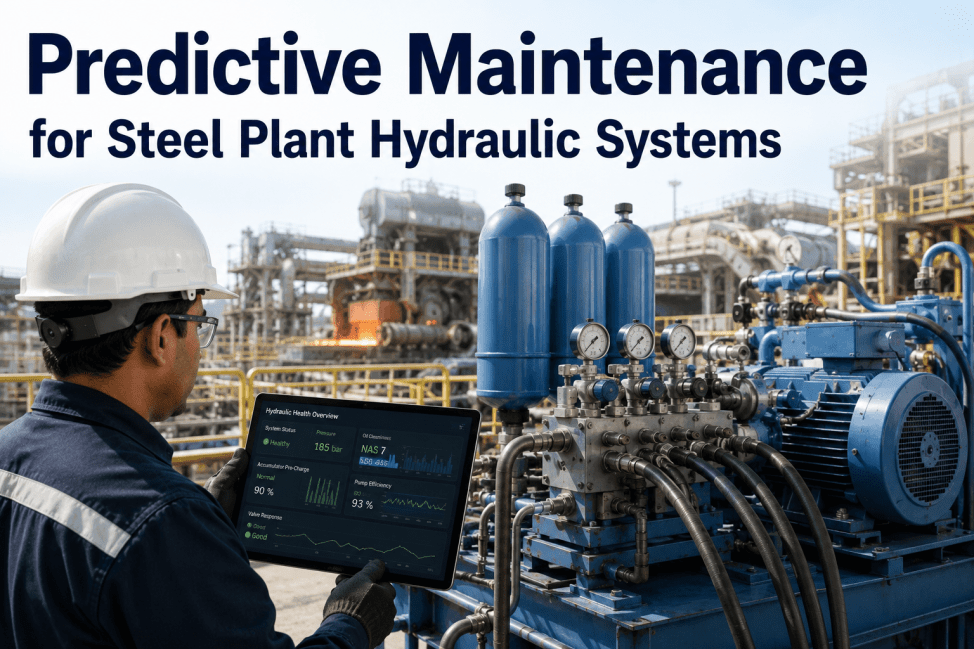
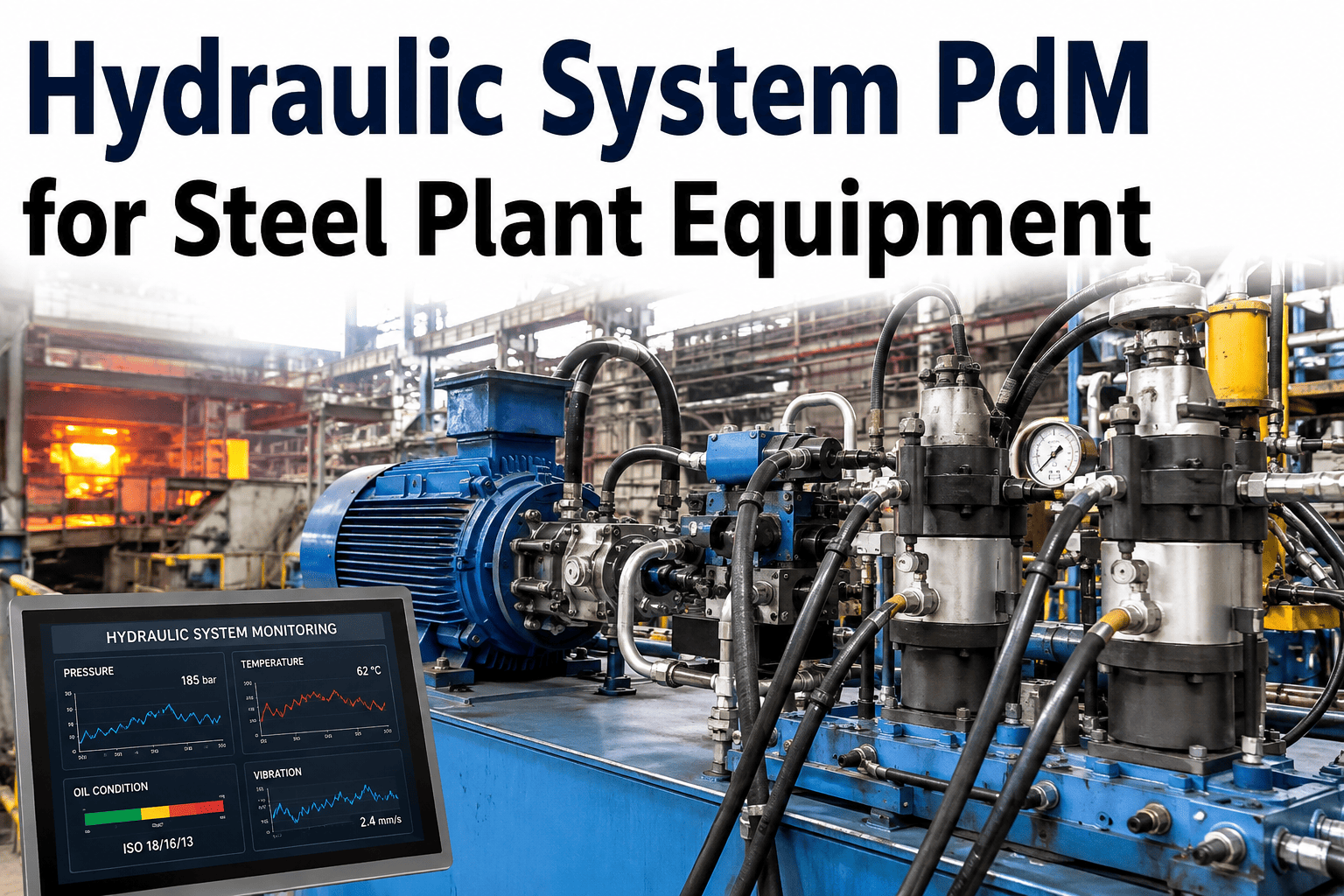
iFactory tracks pressure trends, oil condition, filter loading, and valve response across every hydraulic circuit in your steel plant, turning slow degradation into an early alert your maintenance team can act on before a rolling mill, caster, or crane goes down.
One Hydraulic Fault Can Take Down an Entire Finishing Line
Hydraulic systems power the automatic gauge control on rolling mills, the mold oscillation on continuous casters, and the clamping and lifting functions on cranes and ladle handling equipment. When a servo valve sticks or a pump cavitates, the consequence is rarely a graceful shutdown. It is an unplanned stoppage that halts an entire line until technicians locate the fault, drain the circuit, and replace the failed component under time pressure. Contamination is the leading cause behind most of these failures. Water ingress, particle buildup, and additive depletion erode servo valve performance long before a pressure gauge shows anything unusual, which is exactly why plants that rely on periodic sampling alone tend to discover problems only after secondary damage has already occurred in a bearing or motor downstream.
What makes hydraulic failures particularly disruptive compared to other mechanical faults is how tightly they are woven into the rest of the production line's control logic. A rolling mill's gauge control loop is constantly adjusting roll gap in response to real-time thickness feedback, and any loss of hydraulic response accuracy shows up immediately as gauge deviation in the steel itself, not just as a maintenance event. Casters depend on precise mold oscillation to prevent the shell from sticking to the mold wall, so hydraulic drift there carries a breakout risk that goes well beyond simple downtime. These are not circuits where a plant can afford to wait for an obvious symptom before acting, which is exactly the case for continuous, trend-based monitoring rather than periodic spot checks.
Four Signals That Reveal Hydraulic Health Long Before a Failure
A single pressure reading tells you almost nothing on its own. The value of hydraulic monitoring comes from watching how each signal trends over days and weeks, and from correlating multiple signals so a real degradation pattern is not confused with a normal load swing. A pressure dip during a heavy pass on a rolling mill is completely normal; the same size dip appearing consistently across light and heavy passes over a two-week period is a very different story, and distinguishing between the two is exactly the kind of pattern recognition that manual spot-checks cannot reliably perform.
Pressure Trending
Continuous logging of system and circuit pressure identifies slow decay patterns that indicate seal wear, internal leakage, or pump degradation well before a visible drop in performance.
Oil Condition Analysis
Particle count, water content, and viscosity tracking flag contamination trends early, giving maintenance a window to schedule a fluid change before additive depletion accelerates wear.
Filter Status Tracking
Differential pressure across filters is monitored continuously so replacement happens on actual loading conditions instead of a fixed calendar interval that either wastes filters or runs them too long.
Valve Performance Monitoring
Response time and positional accuracy on servo and proportional valves are tracked continuously, catching the early signs of wear that precede gauge control drift on rolling mills.
Why Manual Sampling Alone Leaves a Dangerous Blind Spot
Most steel plants still rely on a maintenance technician pulling an oil sample once a month or once a quarter, running it through a lab, and waiting days for the results to come back. That cadence made sense when hydraulic monitoring meant sending a jar of oil offsite, but it leaves weeks of blind spot between samples, and contamination trends can move fast once a seal starts to degrade or a filter starts loading unevenly. A pump that tests clean in March can be pulling contaminated fluid by the second week of April, and nobody finds out until either the next scheduled sample or the pump fails outright. Pressure gauges mounted on the panel face the same limitation: they show today's number, not the seven-day trend that reveals a slow decline. By the time a gauge reading looks obviously wrong, the underlying wear has usually been progressing for weeks, and the plant has lost the option of a calm, planned repair in favor of an emergency response during a production shift. Continuous monitoring removes the guesswork by keeping every circuit under constant observation rather than checking in on a fixed schedule that has no relationship to how fast a particular failure mode is actually developing.
The financial impact compounds quickly once a hydraulic fault reaches the point of visible failure. A stuck servo valve on an AGC circuit does not just cost the hours of downtime required to diagnose and replace it; it also produces off-gauge steel in the run-up to the stoppage that may need to be scrapped or reworked, and it often triggers secondary damage to bearings or seals downstream that were starved of clean, pressurized fluid during the failure event. Reliability teams that have modeled this out consistently find that the true cost of a reactive hydraulic failure runs several times higher than the cost of the planned repair that early detection would have allowed, which is the core economic argument for shifting hydraulic maintenance from a calendar-based or purely manual approach to continuous, condition-based monitoring.
Stop Discovering Hydraulic Problems After the Secondary Damage
iFactory correlates pressure, oil, filter, and valve data across every circuit so your team gets an early warning instead of an emergency call.
Hydraulic Circuits Across the Plant, Ranked by Consequence of Failure
Not every hydraulic circuit in a steel plant carries the same risk. Automatic gauge control on a hot strip mill has essentially zero redundancy and stops the entire finishing line the moment it fails, while a general lifting circuit on an overhead crane usually has a backup unit or a slower recovery path. iFactory lets plants prioritize monitoring coverage by actual production consequence rather than treating every circuit identically, which matters enormously when a reliability budget has to be allocated across dozens of hydraulic units with very different failure profiles.
This kind of criticality ranking also shapes how quickly an alert needs to reach a human. A deviation on the AGC circuit should reach a supervisor within minutes, since the production consequence starts accumulating the moment gauge accuracy drifts, while a similar deviation on a secondary lifting circuit can reasonably wait for the next shift handover. Building this differentiation into the alerting logic, rather than treating every notification with the same urgency, is what keeps a monitoring program useful over the long run instead of becoming background noise that technicians eventually learn to ignore.
| Circuit | Failure Consequence | Typical Root Cause | Monitoring Priority |
|---|---|---|---|
| Rolling mill AGC | Full line stop, gauge deviation scrap | Servo valve wear, contamination | Critical |
| Caster mold oscillation | Strand breakout risk | Cylinder seal degradation | Critical |
| EAF electrode hydraulics | Furnace tap delay | Pump cavitation, pressure decay | High |
| Crane lift and clamp | Material handling delay | Hose wear, valve sticking | Medium |
From Raw Sensor Data to a Work Order Your Team Can Act On
iFactory does not just collect readings. It turns a stream of pressure, temperature, and particle data into a prioritized, explainable alert that tells a technician what is degrading, how fast, and what to check first, rather than leaving them to interpret a raw trend chart under time pressure during a shift. Every alert is traceable back to the underlying data, so a reliability engineer can audit why a particular recommendation was made and build trust in the system over successive maintenance cycles.
Baseline Established
The platform learns each circuit's normal pressure, temperature, and response profile across varying load conditions so alerts reflect genuine deviation, not routine operational swings.
Deviation Detected
When a signal drifts outside its established pattern, the system correlates it against related signals to rule out sensor noise or a one-off load spike before raising anything.
Alert Prioritized
Confirmed deviations are ranked by circuit criticality and estimated time to failure, so the maintenance queue always surfaces the highest-consequence issue first.
Work Order Issued
An actionable work order is generated with the likely cause and recommended check, ready for a planned maintenance window instead of an emergency breakdown response.
What Steel Plants Report After Deploying Hydraulic Predictive Monitoring
These figures reflect outcomes reported by plants that moved from periodic manual sampling to continuous hydraulic condition monitoring across mill, caster, and furnace circuits. The pattern across every deployment is consistent even when the exact numbers vary by mill configuration: catching contamination and pressure decay early converts what would have been an emergency stoppage into a planned repair scheduled around production, which is where the majority of the cost savings actually come from rather than from the monitoring technology itself.
Questions Reliability Teams Ask About Hydraulic Predictive Monitoring
What sensors do we need to add to our existing hydraulic circuits?
Most plants start with pressure transducers at key points in the circuit, temperature sensors near the reservoir and pump, and a periodic or inline particle counter for oil condition, layered onto whatever PLC data already exists rather than replacing it. iFactory is built to ingest existing control system tags alongside new sensor data, so the retrofit is additive rather than disruptive to the circuit. Book a demo to scope the sensor list for your specific mill or caster hydraulics.
How early can the platform actually warn us before a failure occurs?
Advance warning depends on the failure mode, but pressure decay from seal wear and contamination trends from filter loading typically surface eight to fourteen days before a functional failure would occur, giving maintenance a real planning window instead of an emergency response. Sudden mechanical failures such as a hose rupture are harder to predict precisely but are still often preceded by measurable pressure instability. Contact our support team for typical lead-time data by circuit type.
Will this replace our existing oil sampling program?
Most plants keep laboratory oil analysis in place for detailed additive and wear-metal breakdown, while using continuous monitoring as the layer that catches trend changes between lab sampling intervals, which are often monthly or quarterly. The two approaches complement each other rather than compete, since continuous data tells you when to pull an off-cycle sample. Book a demo to see how the two data sources work together on the dashboard.
How does the system avoid flooding technicians with false alerts?
Alerts are generated only after a signal deviates from its own established baseline and is corroborated by at least one related signal, which filters out routine load swings and sensor noise that would otherwise trigger a raw threshold alarm. Every alert also carries the underlying trend data so a technician can see the reasoning rather than reacting to a black-box notification. Contact our support team to review sample alert logic for your circuits.
Can this cover hydraulic systems on older mills without modern PLCs?
Yes, retrofitting standalone pressure and temperature sensors onto legacy hydraulic circuits is a common starting point, and the platform does not require a full control system upgrade to begin collecting useful trend data. Many plants start with the highest-consequence circuits, such as AGC or caster mold hydraulics, and expand coverage once the initial results are validated. Book a demo to discuss a phased rollout across your mill.
A Phased Rollout That Starts With Your Highest-Risk Circuits
Plants rarely need to instrument every hydraulic circuit on day one to see meaningful results, and trying to do so usually slows a project down rather than speeding it up. The most effective rollouts start with a short list of circuits where a failure would stop the most production, typically the AGC system on the primary rolling stand and the mold oscillation hydraulics on the continuous caster, since these carry the highest consequence and the clearest business case for early investment. Sensors are added at the pressure, temperature, and filtration points that already exist on most modern hydraulic power units, and where a circuit lacks instrumentation, low-cost transducers are retrofitted without requiring a shutdown of the unit itself. Within the first few weeks, the platform begins building a baseline of normal behavior for each monitored circuit across the full range of operating loads the mill actually sees, which is what allows later alerts to reflect genuine deviation rather than routine variation.
Once the initial circuits are validated against real maintenance outcomes, most plants expand coverage to secondary hydraulic systems such as crane lifting circuits, ladle turret drives, and coiler hydraulics, following the same criticality-first logic. This phased approach means the reliability team sees value from the very first circuits monitored rather than waiting for a plant-wide rollout to finish before any benefit materializes, and it gives the maintenance organization time to build confidence in the alerts and adjust response procedures before scaling further. Throughout the rollout, iFactory's team works alongside your reliability engineers to tune alert thresholds to your specific equipment and operating conditions, since a generic threshold set for a different mill configuration rarely performs as well as one calibrated against your own historical failure data.
Your Next Hydraulic Failure Is Probably Already Trending on a Signal Nobody Is Watching
iFactory turns pressure, oil, filter, and valve data into an early warning your team can act on before the line stops. Book a demo and see it running against your own hydraulic circuits.