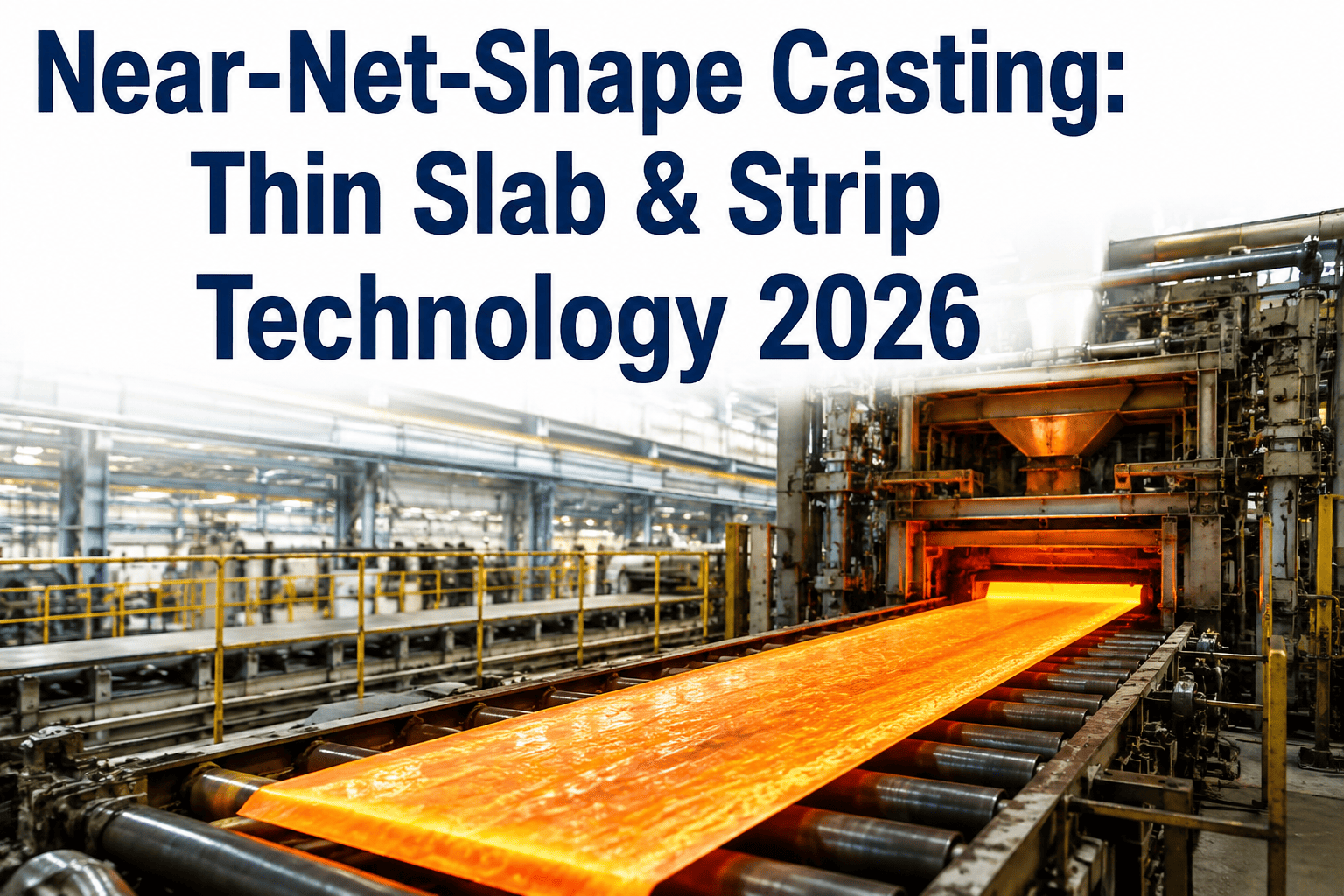
Every ton of steel that goes through a conventional slab caster and then a full reheat-and-rough-rolling sequence before it ever reaches finishing is carrying an energy cost that near-net-shape casting was invented specifically to remove. The idea is simple to state and genuinely hard to execute at scale, cast the steel closer to its final product dimension in the first place, so the downstream rolling process has far less reduction work to do and the reheating furnace has far less mass and thickness to bring back up to temperature. Thin slab casting proved the concept decades ago and strip casting is pushing the same idea even further today. Deciding whether either technology fits your product mix and capital plan starts with a clear look at the tradeoffs, and the fastest way to explore that against your own operation is to book a demo with our team.
CASTING TECHNOLOGY · ENERGY EFFICIENCY · CAPITAL PLANNING
The Steel Industry Has Been Quietly Removing Rolling Steps for Thirty Years
Thin slab casting, strip casting, and beam blank casting all share the same underlying goal, casting steel closer to its final shape so less energy and capital gets spent turning a thick slab into a thin product. iFactory helps plants model where each technology fits their specific product mix and cost structure.
WHY NEAR-NET-SHAPE MATTERS
The Simple Economics Behind a Complicated Technology
A conventional slab caster produces slabs roughly 200 to 250 millimeters thick, which then require extensive rough rolling to bring down to the one to two millimeter range needed for many flat products. Every pass through that rough rolling sequence consumes energy, wears down rolls, and adds cycle time, none of which adds value to the final product beyond simply reducing thickness.
Near-net-shape casting technologies attack this directly by casting the steel thinner in the first place, sometimes as thin as 50 to 90 millimeters for thin slab casting, and in the case of strip casting, close enough to final gauge that the traditional hot strip mill's rough rolling stands become almost entirely unnecessary. The capital and operating cost savings from removing that equipment and that energy consumption are the entire reason these technologies have steadily gained ground since their commercial introduction.
THE TIMELINE
Three Decades of Casting Getting Closer to the Final Product
1989
Thin Slab Casting Goes Commercial
The first compact strip production lines demonstrated that a thinner slab combined with an inline tunnel furnace could replace the traditional slab reheat and full rough mill sequence entirely.
1990s-2000s
Beam Blank Casting Matures
Casting near-net cross sections for structural beam products reduced the extensive rolling required to shape a rectangular slab into a finished structural profile.
2000s-Present
Strip Casting Pushes Further
Twin-roll strip casting technology aims to cast steel directly at close to final strip gauge, removing nearly all of the rough and finish rolling steps required by thicker casting methods.
THREE TECHNOLOGIES COMPARED
Thin Slab, Strip, and Beam Blank Casting Side by Side
| Technology |
Typical Product Fit |
Primary Advantage |
Key Consideration |
| Thin Slab Casting |
Flat hot-rolled and cold-rolled coil products |
Removes most rough rolling, proven at commercial scale for decades |
Requires an inline reheat or equalizing furnace integrated to the caster |
| Strip Casting |
Thin gauge flat products, particularly certain grades |
Casts nearest to final gauge, largest potential energy savings |
Narrower proven grade range and higher process control demands |
| Beam Blank Casting |
Structural sections such as beams and columns |
Reduces rolling passes needed to shape a structural profile |
Cross-section design must match the intended finished beam profile closely |
Model Where Near-Net-Shape Casting Fits Your Product Mix
iFactory helps casting and rolling teams evaluate the energy, capital, and product-fit tradeoffs of thin slab, strip, and beam blank casting against your actual production data.
WHERE THE SAVINGS ACTUALLY COME FROM
Energy and Capital Savings Are Not the Same Line Item
It is easy to lump near-net-shape casting savings into one broad category, but the energy savings and the capital savings come from genuinely different parts of the process, and evaluating a technology fairly means separating the two rather than treating them as a single combined number.
Energy Savings
A thinner cast section requires less reheating energy to bring back to rolling temperature, and fewer rolling passes means less energy spent on deformation work overall, both compounding across every ton produced.
Capital Savings
Removing rough rolling stands, and in some designs entire sections of the mill, reduces the equipment footprint and the capital investment required for a new line or a major rebuild.
EVALUATING FIT
A Practical Way to Evaluate Whether Near-Net-Shape Casting Fits Your Plant
Not every product mix or plant configuration benefits equally from these technologies, and the decision deserves a structured evaluation rather than a blanket assumption based on industry trend alone.
1
Map Your Current Product Mix Against Grade Compatibility
Confirm which of your current grades and gauges are proven compatible with thin slab or strip casting before evaluating further.
2
Quantify Current Energy Spend in Reheating and Rough Rolling
Establish a clear baseline of what those specific process steps cost today, since that figure defines the realistic ceiling on potential savings.
3
Compare Capital Cost Against the Equipment Footprint Removed
Weigh the investment required for a new near-net-shape line against the rolling equipment and floor space it would allow you to retire or avoid building.
4
Pilot on a Single Product Line Before Full Commitment
Where possible, validate the technology against your specific grades on a limited scale before committing capital to a full production line conversion.
FREQUENTLY ASKED QUESTIONS
Questions Steel Producers Ask About Near-Net-Shape Casting
Is strip casting a replacement for thin slab casting, or a different application entirely?
Strip casting pushes the same underlying idea further rather than replacing thin slab casting outright, and the two currently serve overlapping but not identical parts of the flat product market. Strip casting's proven grade range remains narrower today, which is why many producers evaluate it as a complement to existing thin slab capacity rather than a wholesale substitute.
Book a demo to review which technology fits your specific grade portfolio.
How much of the traditional hot strip mill can actually be removed with thin slab casting?
Thin slab casting lines typically eliminate the majority of rough rolling stands by pairing the caster with an inline tunnel or equalizing furnace, though the finishing mill stands that produce the final gauge and surface quality generally remain in the process. The exact footprint reduction depends heavily on the specific line design and target product range.
Contact support to review a specific line configuration.
What grades are currently best suited to beam blank casting?
Beam blank casting works best where the finished structural profile, such as an H-beam or wide-flange section, can be reasonably approximated by the cast cross section without requiring excessive shape rolling afterward. Producers focused on structural steel products tend to see the clearest capital and energy benefit from this specific approach.
Book a demo to discuss beam blank fit for your structural product line.
Does adopting near-net-shape casting require replacing an entire existing line?
Not necessarily. Some producers integrate near-net-shape casting technology as part of a planned rebuild or a new line addition rather than replacing an entire existing conventional caster and mill outright, allowing the transition to align with a broader capital investment cycle already planned for other reasons.
Contact support to plan a phased transition approach.
How should a plant validate expected energy savings before committing capital?
Establishing a precise baseline of current reheating and rough rolling energy consumption, broken down by product and gauge, gives a realistic comparison point against published or vendor-provided savings figures for a near-net-shape alternative. Modeling against actual plant data produces a far more reliable projection than relying on industry-average figures alone.
Book a demo to build an energy baseline model for your plant.
Find Out Where Near-Net-Shape Casting Fits Your Capital Plan
iFactory helps steel producers model the energy, capital, and product-fit case for thin slab, strip, or beam blank casting against real production data.