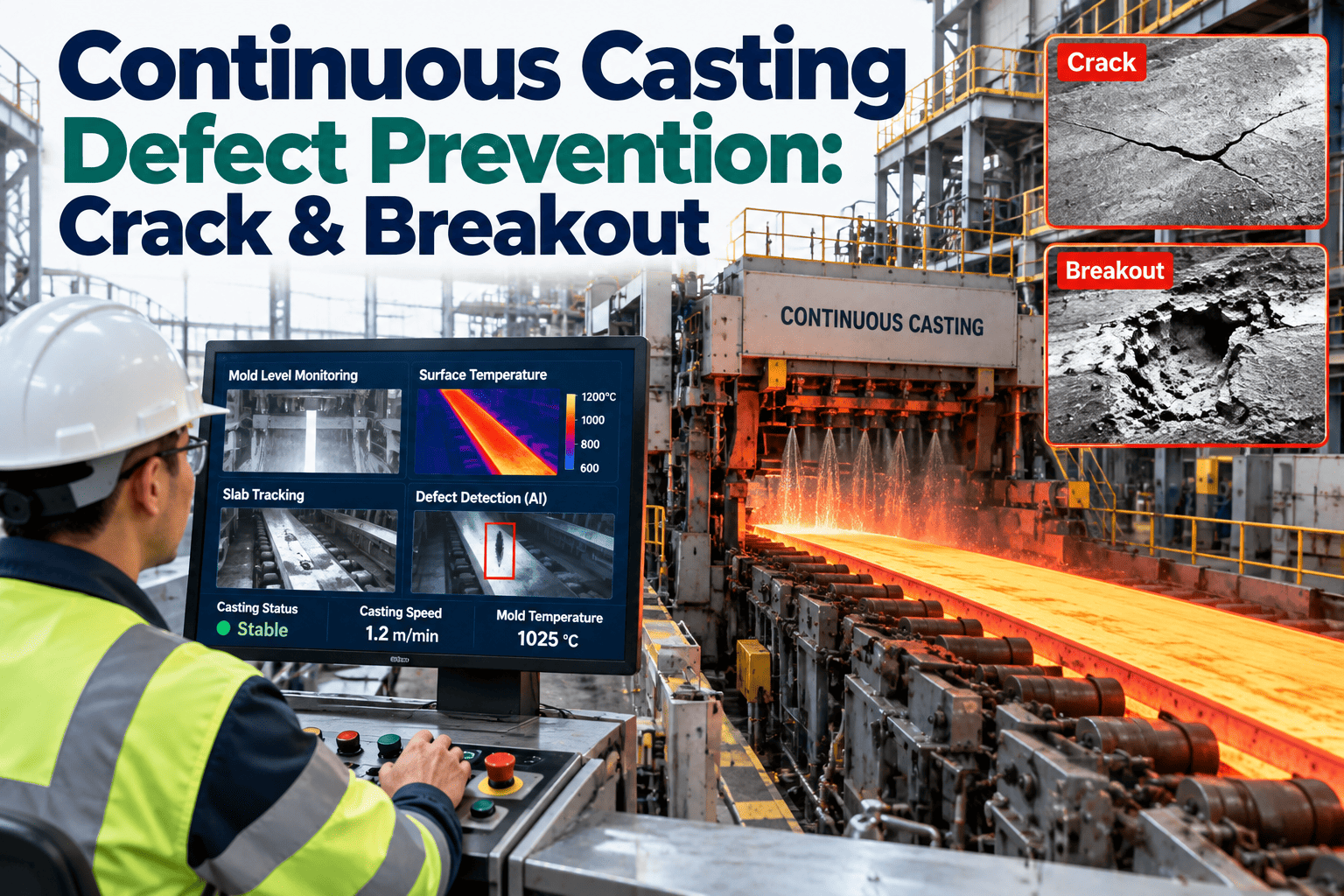
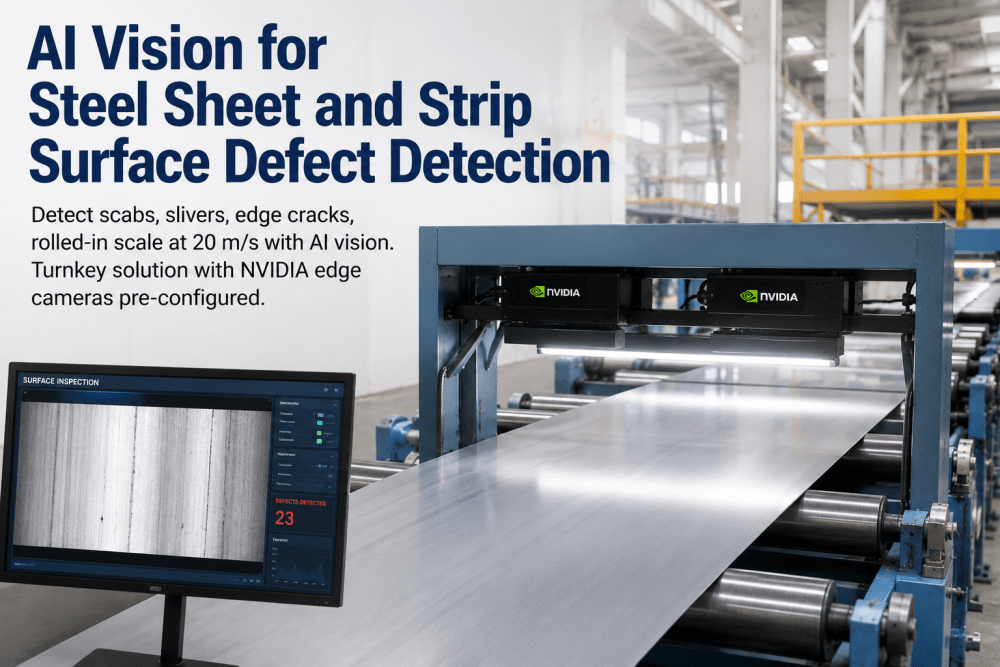
A slab that leaves the caster with a hidden longitudinal crack, a transverse crack near the corner, or a faint star pattern from uneven cooling can travel through hot rolling, cold rolling and coating before the defect finally surfaces as a customer complaint. By then the cost has multiplied many times over. Slab surface defect detection AI reads continuous casting images and thermal data at the point of cast, classifies the crack type, and flags the slab before it moves downstream, and you can walk through how this fits your caster with our team.
Continuous casting, slab quality
Catch Longitudinal, Transverse and Star Cracks Before the Slab Leaves the Caster
iFactory AI watches every slab surface as it exits continuous casting, classifies crack type and severity, and routes flagged slabs before they reach hot rolling.
Three crack types this page covers
LongitudinalTransverseStar
Why it is missed
Manual Slab Inspection Cannot Keep Pace With the Caster
A continuous caster produces slabs on a fixed rhythm, and a human inspector walking the runout table has seconds per slab to judge a surface that is still radiating heat, often under uneven lighting.
Hot, moving surface
Glare and distortion hide fine cracks
Seconds per slab
No time for a close, careful look
Fatigue across a shift
Attention drops over long runs
Defect reaches rolling
Cost grows with every process step
Vision AI watches continuously, at full line speed, without the fatigue curve a human shift develops.
Crack types
Three Surface Cracks That Start at the Caster
Each crack type has a different root cause, so detection needs to classify, not just flag a surface anomaly.
Longitudinal crack
Runs along the casting direction, often linked to mold friction or uneven shell growth.
Transverse crack
Runs across the slab, often near corners, linked to bending and straightening stress.
Star crack
Radiating pattern from a point, linked to localized cooling irregularity or inclusions.
Detection pipeline
Four Steps From Camera to Routing Decision
1
Capture
High-speed cameras image the slab surface as it exits the caster.
2
Classify
The model labels crack type, length and position on the slab face.
3
Score severity
Depth estimate and location decide whether the slab needs conditioning.
4
Route
The slab is tagged for scarfing, grinding, downgrade or release.
A crack that is correctly classified early can often be conditioned on the spot, instead of being discovered after hot rolling has already stretched it.
See Your Own Caster Images Classified
Share sample slab images or a short clip from your runout table and see how the model handles your crack types and lighting.
Root cause table
Matching Crack Type to Likely Cause
| Crack type | Common cause | Typical response |
|---|
| Longitudinal | Mold friction, uneven shell | Adjust mold powder or taper |
| Transverse | Bending and straightening stress | Review unbending temperature window |
| Star crack | Localized cooling or inclusion | Check spray pattern and steel cleanliness |
| Corner crack | Corner cooling imbalance | Review mold corner design |
Downstream cost
The Cost of a Missed Crack Grows at Every Step
A crack caught at the caster costs a conditioning pass. The same crack found after rolling costs a coil, and found at the customer costs a claim.
After cold rolling or coating
This illustrative scale shows relative cost growth, not a fixed cost figure for any plant.
Occurrence by stage
Where Cracks Tend to Appear Across a Cast
Crack rates are rarely uniform across a sequence. Start-up and ladle-change slabs often carry more risk.
Start of sequenceHigh
Steady castingLow
Ladle changeElevated
End of sequenceModerate
Tracking crack rate by sequence position helps focus process review where it matters, and to connect detection data to your sequence scheduling, ask our team about sequence-level reporting.
Maturity path
From Spot Checks to Full Surface Coverage
Level 1: Manual spot checksInspectors sample a fraction of slabs
Level 2: Camera captureEvery slab imaged, reviewed later
Level 3: Live classificationCrack type and severity scored in real time
Level 4: Closed loopRouting and process alerts tied to defect trends
Expert review
Caster surface defects are a process signal before they are a quality problem. Treat each flagged slab as a clue about mold condition, spray pattern or sequence position, not only as a piece to reroute.
Watch for
Crack rates that cluster at specific sequence positions or strand numbers.
Do next
Pilot classification on one or two strands and compare against existing conditioning decisions.
— iFactory steel specialists
Frequently asked questions
What Steel Mills Ask About Slab Surface Defect AI
Can the model tell crack types apart automatically?
Yes, the model is trained on labeled examples of longitudinal, transverse and star cracks so it returns a crack type and a rough severity rather than a single generic flag. This makes routing decisions faster and more consistent across shifts.
See how classification works.
Does this work with existing caster cameras?
In many cases existing cameras can be used if they give a clear enough view of the slab surface, though some casters benefit from an added camera position. A short review of your current setup is the fastest way to know.
Ask about your camera setup.
How fast does a flagged slab get routed?
Classification happens within seconds of the image being captured, fast enough to tag the slab before it leaves the runout table or scarfing station. The routing decision reaches the operator screen immediately.
Discuss your routing workflow.
Can this reduce false alarms from surface scale or water marks?
Training the model on your own slab images, including normal scale and water patterns, is what separates a true crack from surface texture that looks similar at a glance. This is part of why a sample review matters before rollout.
Send sample images for review.
Does this replace the conditioning team?
No, it gives the conditioning team a faster, more consistent flag so their time goes to slabs that actually need attention rather than a wide manual sweep. The decision to scarf, grind or release still sits with your team.
Talk through your conditioning workflow.
From caster exit to routing decision
Stop Letting Slab Cracks Travel Downstream
Book a session with iFactory AI to review your caster layout and see how slab-level crack classification fits your current conditioning and rolling workflow.