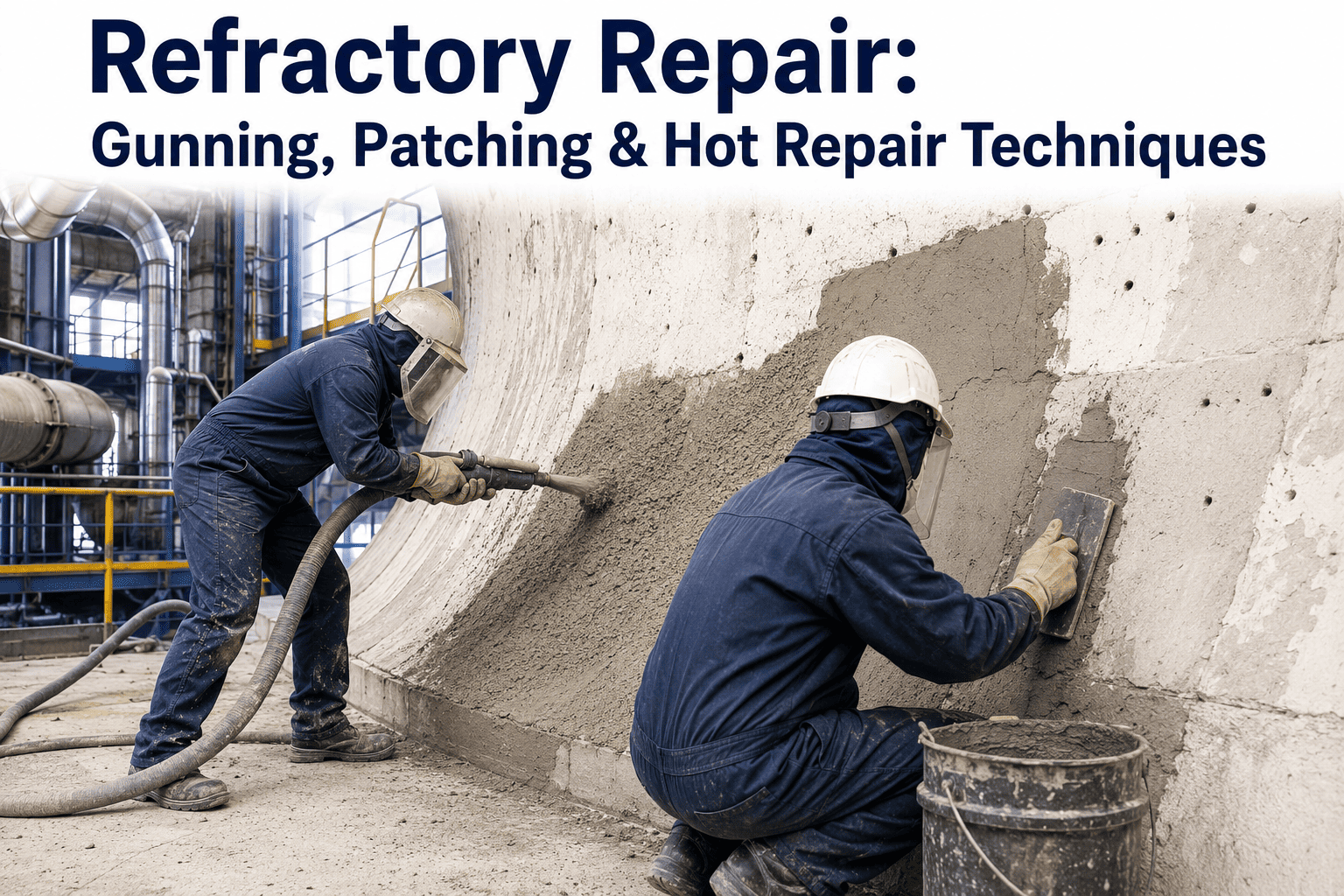
A refractory lining rarely needs full replacement the moment wear shows up in one spot. Most of the time, a well-timed repair, whether that is gunning a worn slag line, patching a localized hot spot, or running a hot repair between heats, buys back weeks of campaign life for a fraction of the cost of pulling the vessel out of service entirely. The problem most plants run into is not whether to repair, but which technique fits the specific damage pattern, and how to apply it without the repair itself becoming the next point of failure. Getting that judgment right consistently is what iFactory's refractory tracking platform is designed to support.
Refractory Failure · Repair Techniques
Refractory Repair: Choosing Between Gunning, Patching, and Hot Repair
Not every wear pattern calls for the same fix. Gunning, patching, and hot repair each solve a different kind of damage, and picking the wrong one wastes material, wastes downtime, or worse, patches over a problem that needed a full section replaced.
Three Tools, Three Jobs
What Each Repair Technique Is Actually Good For
Gunning
Sprayed refractory material applied pneumatically over a broad worn area, best suited to shallow, distributed wear across the slag line or wall where a full patch would be overkill but the surface still needs material added back evenly.
Patching
A manually or mechanically applied repair material used on localized, deeper damage such as a groove, a corner erosion point, or a specific hot spot that gunning alone would not fill with enough density.
Hot Repair
Repair performed on a still-hot vessel between heats, minimizing thermal cycling stress on the existing lining and cutting downtime, but requiring materials and technique suited to bonding onto a hot surface safely.
A Consistent Sequence
How a Repair Decision Actually Gets Made
1
Inspect and Measure Wear
2
Classify Damage Pattern
3
Select Matching Technique
4
Apply and Cure Correctly
5
Verify Before Return to Service
Side by Side
Gunning vs. Patching vs. Hot Repair
| Factor | Gunning | Patching | Hot Repair |
|---|---|---|---|
| Best for | Broad, shallow wear | Localized, deep damage | Any pattern needing minimal downtime |
| Vessel condition | Cold or warm | Cold or warm | Hot, between heats |
| Typical downtime | Moderate | Moderate to low | Very low |
| Material demand | High volume, sprayable grade | Dense, high-bond grade | Fast-setting, thermal-shock tolerant |
Match the Fix to the Damage
Review Your Repair History Against Actual Wear Patterns
Bring your recent repair logs and wear inspection records and we will show you where the technique used didn't match the damage pattern it was meant to fix.
What Determines Repair Quality
The Variables That Actually Decide If a Repair Holds
Surface Preparation
A repair applied over loose, contaminated, or improperly cleaned surface almost never bonds well, regardless of how good the repair material itself is.
Material and Substrate Compatibility
Repair material with a thermal expansion mismatch against the base refractory tends to spall off within a handful of thermal cycles.
Curing and Heat-Up Discipline
Rushing the heat-up schedule after a patch or hot repair drives off moisture too fast and cracks the new material before it has properly set.
Applicator Skill and Consistency
Application thickness and technique vary noticeably between operators, and that variability shows up directly in how long the repair actually lasts.
What Trips Teams Up
Common Mistakes in Refractory Repair Decisions
Gunning Over Deep, Localized Damage
Using a broad-coverage technique on a deep groove that actually needed a dense patch, leaving a thin, weak layer over the real problem.
Skipping Surface Prep to Save Time
Applying repair material directly over loose or contaminated substrate under time pressure, which shortens the repair's life dramatically.
Rushing the Heat-Up After Repair
Returning a vessel to full temperature too quickly after a patch, cracking the new material before it has cured properly.
Not Logging Repair History by Location
Failing to track where repairs were made and how long each one lasted, so recurring failure points never get identified and addressed at the root.
A Composite Scenario
A Ladle Slag Line, Two Repair Approaches
Before
A ladle slag line showing localized deep erosion at the impact point was gunned as a standard practice, since gunning was the default repair method for that vessel. The thin gunned layer wore through again within three heats, and the crew repeated the same fix twice more before someone flagged the pattern.
After
Once wear location data showed the damage was consistently deep and localized rather than broad, the team switched to a dense patching material at that specific point. The patch held for the remainder of the campaign, and repeat repairs at that location dropped to zero.
Before the Next Repair
Readiness Checklist for Repair Technique Selection
Measure and map the wear pattern before deciding on a technique, not from memory of past repairs
Confirm surface preparation steps are followed fully, even under production time pressure
Match repair material thermal properties to the base refractory being repaired
Log the repair location, technique, and material so recurring failure points can be tracked over time
Common Questions
Refractory Repair Techniques — FAQ
How do I know if damage needs gunning or patching?
Gunning generally suits broad, shallow wear spread across a larger surface, while patching is better matched to localized, deeper damage like a groove or corner erosion point that needs denser material concentrated in one spot. Measuring wear depth and area before choosing avoids applying a technique that doesn't match the actual damage. Our team can help review specific wear patterns.
Is hot repair always better because it saves downtime?
Hot repair does reduce downtime and thermal cycling stress, but it needs fast-setting, thermal-shock tolerant materials and trained application under hot conditions. If those requirements aren't met, a rushed hot repair can fail faster than a properly cured cold repair, so the technique needs to match both the damage and the team's actual capability to execute it safely.
How long should a repair be expected to last?
It varies widely by technique, material, and location, but a well-executed repair should generally get a vessel through to its next planned inspection or campaign milestone without requiring another repair at the same spot. Repeated short-lived repairs at one location usually signal the wrong technique was chosen, not bad luck.
Does repair history actually help prevent future failures?
Yes, tracking where repairs happen and how long each one holds up reveals recurring failure points that a one-off inspection would miss, letting teams address the underlying cause instead of repeating the same patch indefinitely. Book a demo to see how repair history is tracked by location inside the platform.
Can a bad repair make future wear worse?
Yes, a poorly bonded or mismatched repair can create a new weak point that fails faster than the surrounding original lining, sometimes creating a worse problem than the original wear it was meant to fix. Proper surface prep and material matching are what prevent this outcome.
Match the Right Fix to Every Repair
Track Repair Technique, Location, and Outcome on One Platform
iFactory logs every refractory repair against wear data by location, so you can see which technique actually holds up and stop repeating fixes that don't.