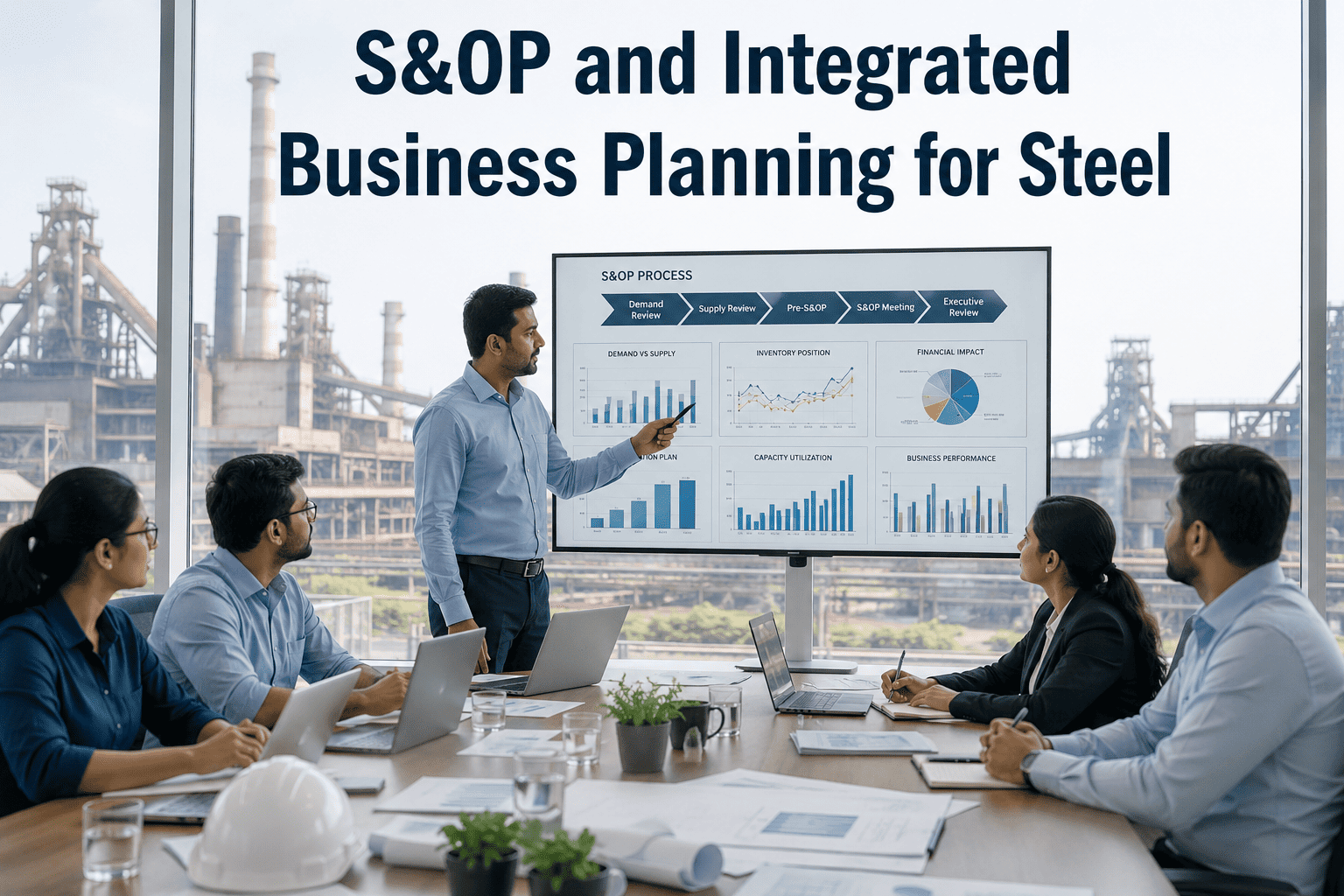
The S&OP cycle in most integrated steel groups still runs on the rhythm it did fifteen years ago — demand review week one, supply review week two, pre-S&OP week three, executive S&OP week four. By the time the executive plan is signed, demand signals are a month stale, capacity has shifted, and half the scenarios planners wanted to run were dropped because the spreadsheet build took three days. Steel is a business of long lead times and expensive campaign switches — a slow S&OP cycle costs real margin every month. Book a demo to see a compressed steel S&OP cycle end to end.
S&OP LEAD · STEEL · INTEGRATED BUSINESS PLANNING
Your Steel S&OP Cycle Runs on a Four-Week Calendar — AI Compresses It, Sharpens the Forecast, and Runs the Scenarios You Never Had Time For
AI does not replace the demand, supply, pre-S&OP, and executive reviews anchoring a steel IBP process. It compresses the analytical prep between them from days to hours, adds forecast accuracy and scenario range, and puts a real consensus number in front of the executive review.
30-40%
Forecast Accuracy Uplift Reported With AI-Native Planning
3-12 Mo
Steel Demand Visibility AI Models Extend Ahead
18-36 Mo
Tactical S&OP Planning Horizon in Steel
THE PLANNING REALITY
Why the Steel S&OP Cycle Still Runs at Four-Week Cadence in 2026
A steel group's S&OP cycle looks orderly on the calendar — demand review week one, supply review week two, pre-S&OP week three, executive S&OP week four — but under the surface it runs on a spreadsheet exercise that starts three days before every meeting. Demand planners pull order book data from SAP SD, sales pipeline from CRM, and market intelligence from trade press. Supply planners pull production capacity from PP, maintenance windows from PM, and campaign constraints from the mill schedulers.
By the time numbers reach pre-S&OP, the demand plan has drifted and the supply plan is out of date. Scenarios executives actually need — what happens if auto orders drop 15% next quarter, what if a competitor's blast furnace comes back online, what if the anti-dumping tariff extends — never get modelled because there is no time. The consensus plan that goes to the board is really the plan the fastest spreadsheet could build.
THE COMPRESSED CYCLE
What a Steel S&OP Cycle Looks Like Before and After AI-Assisted Planning
The meetings do not disappear — demand, supply, pre-S&OP, and executive reviews stay. The analytical prep consuming each week collapses from days into hours, and the time freed up goes into scenario range and consensus quality.
BEFORE — Manual Cycle, 4 Weeks
Week 1Demand Review · 3 days spreadsheet prep · 1 day meeting
Week 2Supply Review · 3 days capacity model · 1 day meeting
Week 3Pre-S&OP · Reconcile numbers · 2 scenarios if lucky
Week 4Executive S&OP · Plan already stale on arrival
AFTER — AI-Assisted Cycle, 1-2 Weeks
Days 1-2Demand Review · AI forecast baseline + planner overrides
Days 3-4Supply Review · Auto capacity model · Campaign fit tested
Days 5-6Pre-S&OP · 8-12 scenarios auto-generated · Full trade-off view
Day 7Executive S&OP · Fresh numbers · Consensus plan committed
THE FIVE STAGES WHERE AI ADDS VALUE
Where AI Actually Plugs Into a Steel Integrated Business Planning Process
AI does not sit at one point in the S&OP cycle — it sits at five, each with a different job. Which model class supports which stage separates a working IBP-plus-AI deployment from a science project.
01
Product Portfolio & Grade Review
AI reads the last 24 months of order patterns by grade, thickness, width, and customer segment — surfacing which SKUs are gaining share and which have dropped below profitability. Planners walk into portfolio review with the ranked list.
02
Demand Review — Forecast Baseline
AI generates a statistical baseline per grade family, informed by construction indices, auto build rates, infrastructure spend, and steel imports. The planner reviews and overrides where market intelligence justifies it — not builds from scratch.
03
Supply Review — Capacity & Campaign Fit
AI tests the demand plan against blast furnace campaign, BOF/EAF capacity, caster sequence constraints, and hot mill throughput. Bottlenecks surface as a ranked list with the specific asset and week they hit — not as a hunch at the review.
04
Pre-S&OP — Scenario Generation
This is where AI earns most of its value. Eight to twelve what-if scenarios are auto-generated — auto demand shock, tariff extension, competitor restart, iron ore spike, currency shift — each with a probability and margin impact. Planners no longer choose between running one scenario and running none.
05
Executive S&OP — Consensus Support
AI does not attend the executive review — it prepares for it. A consensus recommendation with confidence bands, top three scenarios, and specific trade-offs lands in front of executives so the meeting is spent on the decision, not on reconciling versions of the numbers.
Every Week Your S&OP Cycle Loses to Spreadsheet Prep Is a Week Running on Yesterday's Numbers
Compressing analytical prep from days to hours unlocks scenario range, consensus quality, and a plan the executive review commits to. Book a session to walk through compression on your specific S&OP calendar.
SCENARIOS PLANNERS NEVER HAD TIME TO RUN
The What-If Scenarios a Steel S&OP Lead Should Be Looking at Every Cycle
Every steel S&OP lead has scenarios they wish the pre-S&OP meeting could walk through — the ones that change how the group commits capacity. In a manual cycle, at most two get modelled. In an AI-assisted cycle, the matrix is on the table. The four categories below appear in almost every steel group's planning discussion.
DEMAND SHOCKS
Auto, Construction, Infrastructure Swings
What happens to grade mix and margin if auto build rates drop 15% next quarter, or an infrastructure package pulls forward $200B of demand for HRC and rebar? AI runs both scenarios in the same afternoon and shows campaign-schedule impact per mill.
SUPPLY DISRUPTIONS
Blast Furnace Restart, Outage Extension
What happens if a competitor's blast furnace comes back online in your region, or your planned reline runs three weeks over? Scenarios test volume, price, and customer allocation trade-offs before the pre-S&OP conversation starts.
RAW MATERIAL & ENERGY
Iron Ore, Coking Coal, Power Cost Moves
Margin impact if iron ore moves $20/t, coking coal moves $50/t, or industrial power tariffs jump 10%? The pre-S&OP deck shows pass-through options and the customer segments where price adjustments are viable.
POLICY & TRADE
Tariffs, Anti-Dumping, Import Quotas
What happens if the anti-dumping determination extends another six months, or a new import quota reshapes regional flows? AI runs the volume and share scenario against the group's export exposure and domestic order book.
FORECAST ACCURACY BREAKDOWN
The Forecast Biases AI Helps a Steel S&OP Lead See Before They Ship a Bad Plan
Forecast accuracy is not a single number — it is the sum of five biases steel demand planners fight every cycle. The table below is how a well-instrumented planning platform decomposes the accuracy conversation so the S&OP lead can act on it.
| Bias Type |
What It Looks Like |
Typical Impact |
| Optimism Bias |
Sales forecast consistently higher than actual |
Excess inventory, downgrade risk |
| Anchoring Bias |
Forecast pinned to last quarter's number |
Missed demand shifts, wrong campaigns |
| Product-Mix Bias |
Aggregate right, grade mix wrong |
Yield loss, wrong-grade inventory |
| Seasonality Bias |
Missed construction or auto seasonal peaks |
Late campaigns, expediting cost |
| Recency Bias |
Last month over-weighted in the plan |
Whiplash on capacity commitments |
ROLLOUT APPROACH
How a Steel Group Sequences an AI-Assisted S&OP Rollout Without Disrupting the Cycle
The right rollout does not throw out the S&OP calendar and replace it with a new tool. It runs AI-assisted planning in parallel to the existing cycle for one quarter, compares outputs, and only then promotes it to primary.
Q1
Baseline & Data Wiring
Order book, production history, campaign schedule, and market indices are wired into the planning platform. Historical forecast accuracy is measured to establish the baseline.
Q2
Shadow Cycle
AI-assisted cycle runs alongside the manual cycle. Same inputs, same meetings, two outputs compared side by side. The S&OP lead sees where AI helped and where it needed override.
Q3
Primary Rollout
AI-assisted cycle becomes primary. Manual cycle retires. Scenario range doubles, cycle time compresses, and the executive review sees a consensus number instead of a compromise.
Q4
Extension to IBP
Financial planning, capital planning, and long-range strategic scenarios join the same platform — the S&OP process matures into a full Integrated Business Planning cadence.
FREQUENTLY ASKED QUESTIONS
What S&OP Leads Ask Before Adding AI to a Steel Planning Cycle
Does AI-assisted S&OP replace the demand, supply, and executive review meetings we already run?
No. The meetings that anchor a steel IBP process — demand review, supply review, pre-S&OP alignment, and executive S&OP — stay in place with the same participants and governance. What changes is the analytical prep each meeting rests on. Instead of three days of spreadsheet build, planners walk in with an AI baseline, an override log, and a scenario matrix. The meeting becomes a decision forum rather than a numbers-reconciliation forum.
Book a walkthrough to see how a compressed cycle sits inside your current calendar.
How much forecast accuracy uplift can a steel group realistically expect from AI in the first year?
Published benchmarks for AI-native planning platforms cite 30–40% accuracy improvement over statistical baselines across manufacturing, though the realized number for a specific steel group depends on grade mix, customer concentration, and how much market intelligence planners currently overlay. Most steel S&OP leads see the biggest gain not from aggregate accuracy but from grade-mix accuracy — getting the split between HRC, CRC, coated, and specialty grades right, which drives yield and downgrade risk.
Contact planning support for a benchmark specific to your grade portfolio.
Do we need to replace SAP IBP or Blue Yonder to run AI-assisted planning, or does it layer on top?
You do not need to replace what you run. AI-assisted planning is layered on top of the ERP or IBP suite that owns your master data and financial plan — SAP IBP, Blue Yonder, o9, or Kinaxis. The AI layer reads order book, capacity, and campaign data through the existing platform's read paths and writes recommendations into a supervised queue that planners promote back into the primary system. No master-data governance is bypassed.
Book a session to review integration with your planning platform.
Can we run a shadow cycle for a quarter before committing to change our primary S&OP process?
Yes — this is the recommended approach for every steel S&OP rollout. The AI-assisted cycle runs alongside the manual cycle for a full quarter, consuming the same inputs and producing outputs the S&OP lead can compare directly against the manual process. Executive trust is built on that side-by-side comparison, and the shadow quarter is where planners identify where AI adds most and where their own judgment still overrides it.
Talk to planning support to structure a shadow quarter for your group.
How does AI-assisted planning handle the campaign nature of steel production, where short lead-time changes are not possible?
Campaign constraints are a first-class input to the supply model, not a bolt-on. Blast furnace campaign schedule, caster sequence rules, hot mill roll change windows, and coating line changeover times all feed the scenario engine. When a demand shock scenario runs, the AI does not pretend the mill can pivot overnight — it shows the earliest week each grade can realistically be produced given the current campaign, and flags the switching cost of forcing an earlier change.
Book a session to see campaign-aware scenarios against your schedule.
RUN A SHARPER CYCLE NEXT MONTH
Give Your Executive S&OP Meeting a Consensus Plan Instead of the Fastest Spreadsheet Someone Could Build
AI-assisted S&OP compresses the cycle, sharpens forecast accuracy, and surfaces scenarios your planners never had time to model. Book a session to map a compressed cycle onto your steel group's calendar.