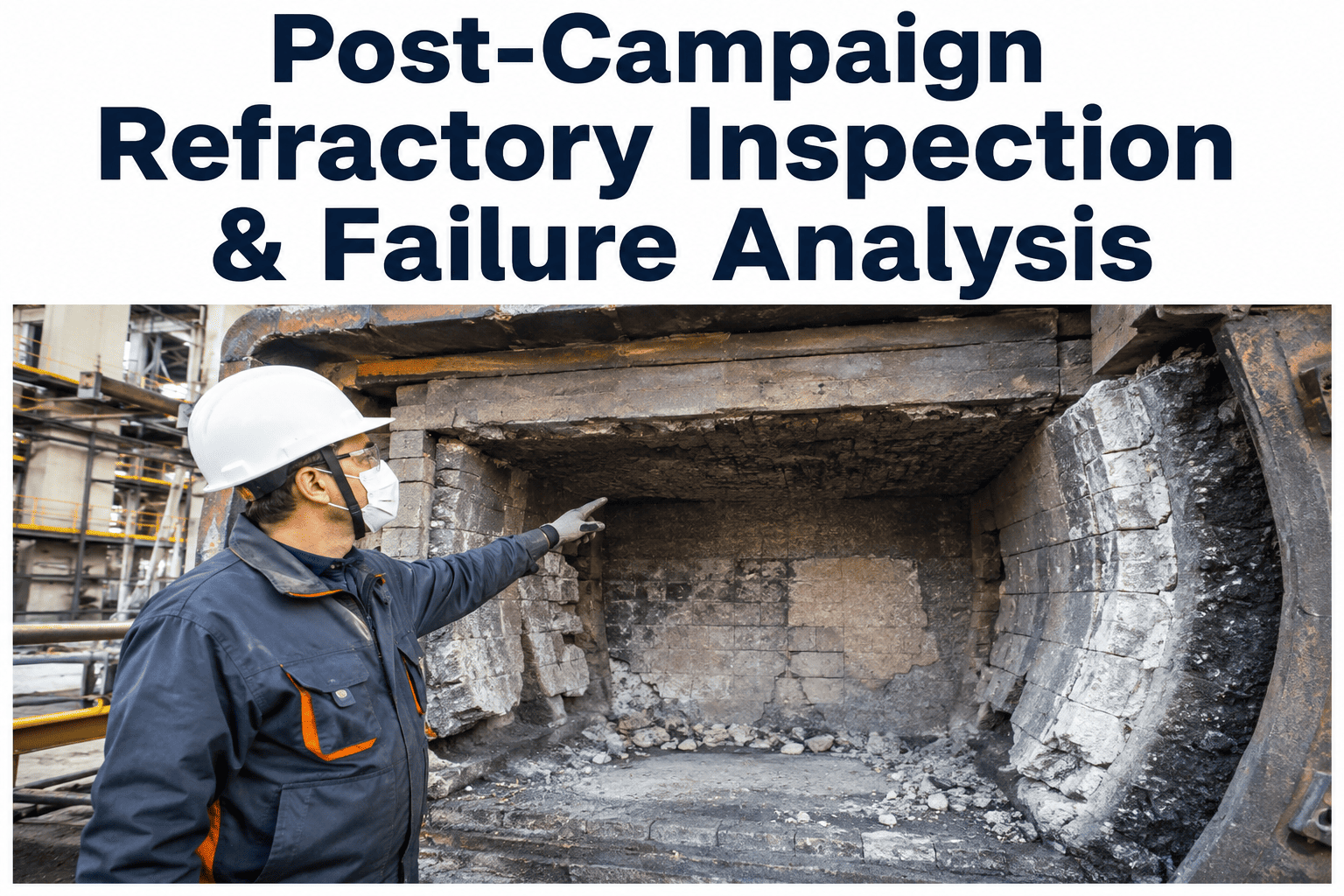
A refractory lining rarely fails the way people picture it. There is no single dramatic event — no crack that appears overnight. What actually happens is slower and far more chemical: molten slag sits against a brick or castable surface for hours at a time, and depending on how basic or acidic that slag is relative to the refractory's own mineralogy, it slowly dissolves grain boundaries, penetrates pores, and converts the hot face into a soft, low-melting layer that erodes away under flow. Two plants running the same furnace design and the same nominal refractory grade can see campaign lives that differ by 30-40% purely because one is managing slag chemistry and the other is not. That is the gap iFactory's refractory monitoring platform is built to close.
Refractory Failure · Corrosion Analysis
Slag-Refractory Interaction: Understanding Corrosion Resistance Before It Costs You a Campaign
Slag attack is the single largest driver of refractory wear in steelmaking vessels, yet most plants still select and monitor refractory purely on thickness loss, without tracking the chemistry that is actually causing it. iFactory correlates slag composition data with wear rate to show exactly which chemical mechanism is shortening your campaign.
3 Mechanisms
Chemical dissolution, penetration, and spalling drive most slag-related refractory loss
Basicity-Driven
Slag basicity relative to refractory composition determines attack rate more than temperature alone
Compounding
Penetrated slag layers accelerate thermal spalling on the very next thermal cycle
How the Damage Actually Happens
Three Ways Slag Attacks a Refractory Lining
Mechanism 1
Chemical Dissolution
Basic slags dissolve silica-bonded or acidic refractory phases directly, converting the hot face into a low-melting glassy layer that gets washed away by slag movement, thinning the lining from the surface inward with every heat.
Mechanism 2
Slag Penetration
Liquid slag wicks into open pores and grain boundaries ahead of the visible wear front, reacting with the refractory matrix beneath the surface and creating a weakened, chemically altered zone that looks intact until it spalls off in one piece.
Mechanism 3
Thermal Spalling of Reacted Layers
Once slag has penetrated and reacted with the refractory, that altered layer has a different thermal expansion behavior than the base material. The next heat-up or cool-down cycle cracks along that boundary and drops large sections at once.
Mechanism 4
Redox-Driven Oxidation
Carbon-bonded refractories lose their bonding phase when slag chemistry shifts oxidizing, opening up the structure to faster penetration by exactly the mechanism described above, so oxidation and slag attack tend to accelerate each other.
Matching Material to Chemistry
Slag Basicity vs. Refractory Compatibility
| Slag Type | Typical Basicity (CaO/SiO2) | Aggressive Toward | Better-Matched Refractory |
|---|
| Highly Basic (BOF, EAF) | 3.0 - 4.5 | Silica-bonded, acidic castables | Magnesia-carbon, magnesia-chrome |
| Moderately Basic (Ladle) | 1.8 - 3.0 | Low-purity magnesia, alumina-spinel at low grade | High-purity magnesia-spinel, dolomite |
| Neutral to Slightly Acidic | 0.9 - 1.8 | Basic bricks in wrong service | Alumina-silicate, fireclay grades |
| Acidic (some non-ferrous, glass) | 0.3 - 0.9 | Basic refractories, magnesia grades | Silica, high-alumina castables |
Basicity is a starting point, not the full picture. FeO content, MgO saturation, and slag temperature all shift how aggressively a given basicity actually behaves against a specific lining, which is why chemistry needs to be tracked heat-by-heat rather than assumed from a design spec.
See Your Own Wear Data Differently
Correlate Your Slag Reports Against Actual Wear Readings
Bring a few months of slag lab reports and refractory thickness logs and we will show you where chemistry is quietly driving your campaign length down.
Beyond Basicity
Other Variables That Change Corrosion Rate
FeO and MnO Content
Even a basic slag becomes far more corrosive when FeO or MnO content rises, since these oxides lower the slag's melting point and increase its ability to dissolve magnesia grains.
Slag Viscosity and Flow
Low-viscosity slag penetrates pores faster and washes dissolved material away more efficiently, so two slags of identical basicity can produce very different wear rates depending on fluidity.
Contact Time and Turbulence
Areas with longer slag dwell time or higher turbulence, such as the slag line and impact pad, wear faster than quieter zones exposed to identical slag chemistry.
MgO Saturation of the Slag
Slag that is already saturated with MgO has far less capacity to dissolve additional magnesia from the lining, which is why MgO addition is a standard slag-conditioning practice in basic-lined vessels.
A Composite Scenario
A Ladle Slag Line, Two Ways
Before
A ladle refractory team tracked only thickness loss per heat and treated a run of accelerated wear as a bad batch of brick. Slag lab reports existed but sat in a separate system nobody cross-referenced against wear logs, so the actual cause, a drift toward higher FeO from a change in deoxidation practice, went unnoticed for six weeks.
After
With slag chemistry and thickness data brought into one view, the FeO drift showed up clearly against the wear curve within days. The team adjusted deoxidation practice and added a targeted MgO conditioner, and slag-line wear rate returned to its prior baseline within a handful of heats.
What Teams Get Wrong
Common Mistakes in Managing Slag-Refractory Interaction
Selecting Refractory on Cost Alone
Choosing a lower-grade lining without checking it against actual slag basicity and FeO trends for that specific vessel and process route.
Treating Slag Data and Wear Data Separately
Keeping lab chemistry reports and refractory thickness logs in different systems that nobody actually cross-references heat by heat.
Assuming Basicity Alone Predicts Attack
Ignoring FeO, viscosity, and dwell time, all of which can make two slags of identical basicity behave completely differently against the same lining.
Reacting Only After Thickness Drops
Waiting for a measured thickness loss to investigate, instead of watching slag chemistry trends that typically move well before wear accelerates.
Before Your Next Campaign
Readiness Checklist for Slag-Aware Refractory Management
Pull slag lab reports and refractory thickness logs for the last three campaigns into one timeline
Identify which zones of the vessel show wear rates that don't match their nominal refractory grade
Check whether FeO, MnO, or basicity has drifted in the periods preceding accelerated wear
Confirm someone owns the link between slag conditioning practice and refractory performance data
Common Questions
Slag-Refractory Interaction — FAQ
Is basicity the best single predictor of slag corrosion?
Basicity is a useful starting indicator but not a complete predictor on its own. FeO and MnO content, slag viscosity, temperature, and contact time all shift how aggressively a slag of a given basicity actually behaves against a specific refractory. Tracking basicity alongside these secondary variables gives a far more reliable read on expected wear than basicity alone.
Our team can help set up that combined view.
How quickly does a slag chemistry drift show up in wear rate?
It depends on the mechanism involved, but chemical dissolution and penetration effects often start showing measurable acceleration within a handful of heats once a drift, such as rising FeO, becomes sustained. Waiting for a full campaign's thickness data to confirm a problem usually means the damage is already done, which is why continuous chemistry tracking pays off.
Can refractory selection alone solve a slag attack problem?
Upgrading refractory grade can extend campaign life, but if the underlying slag chemistry keeps drifting unchecked, even a better-matched lining will eventually see accelerated wear. The most durable fix usually combines a compatible refractory choice with active slag conditioning and ongoing chemistry monitoring rather than a one-time material swap.
What data does a slag-refractory correlation actually need?
At minimum, heat-by-heat slag lab chemistry, refractory thickness or wear measurements by zone, and enough metadata to line the two up by heat number or timestamp.
Book a demo to see how this correlation is built and visualized inside the platform.
Does this apply outside of steelmaking vessels?
The same three mechanisms, dissolution, penetration, and spalling, apply anywhere molten slag or glass contacts a refractory lining, including non-ferrous smelting and glass furnaces, though the specific chemistry and better-matched materials differ by industry and process.
Stop Guessing at Slag Attack
Correlate Slag Chemistry With Refractory Wear on One Platform
iFactory brings slag lab data and refractory thickness readings into a single timeline, so you catch a corrosive chemistry drift before it shortens your next campaign.