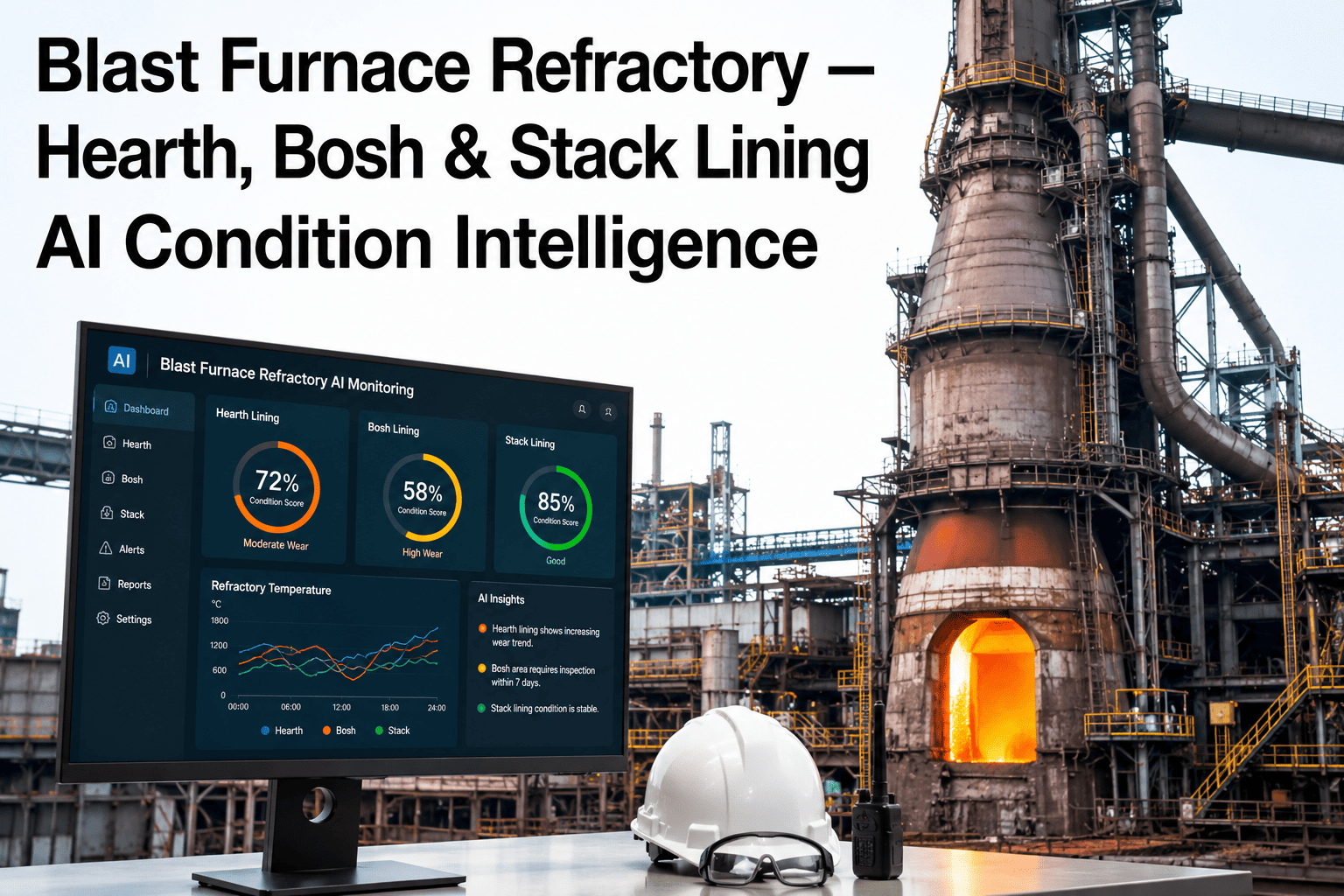
A blast furnace campaign can run fifteen to twenty years between relines, and the single biggest financial decision an ironmaking operation makes is when to schedule that reline before an unplanned lining failure forces an emergency shutdown. Stack, bosh, and hearth lining wear each progress at different rates and carry different consequences if ignored, and a hearth breakout in particular is one of the most catastrophic and expensive failures in all of steelmaking. Campaign life management is fundamentally a monitoring discipline — thermocouple trends, heat flux readings, and erosion modeling turned into an ongoing picture of remaining safe life, not a single end-of-campaign inspection. iFactory helps ironmaking teams build that ongoing picture, with the monitoring workflow detailed at iFactory support.
Blast Furnace · Campaign Life Management
Blast Furnace Campaign Life Management: Tracking Stack, Bosh, and Hearth Lining Wear
Continuous lining condition tracking across the stack, bosh, and hearth to extend safe campaign life and give reline planning real lead time instead of a reactive scramble.
15-20 yrs
Typical modern BF campaign length between full relines
Hearth
Zone where undetected wear carries the highest catastrophic risk
Months
Lead time a well-monitored campaign can give planners before end-of-life
Lining Zones & Wear Behavior
Stack, Bosh, and Hearth Don't Wear the Same Way — or Fail the Same Way
Gradual refractory erosion from descending burden abrasion and thermal cycling, generally the slowest-wearing of the three major zones under normal operation.
Consequence of neglect: localized shell hot spots, gas leakage at damaged joints
Exposed to high thermal load and chemical attack from the cohesive zone, often the fastest-wearing region and a common driver of mid-campaign cooling stave replacement.
Consequence of neglect: stave burn-through, localized shell cooling water leaks
Carbon and ceramic lining erosion from hot metal and slag flow, accelerated by elephant-foot wear patterns near the taphole that are notoriously difficult to inspect visually.
Consequence of neglect: shell breakout, the most catastrophic failure mode in ironmaking
Monitoring Signals
What Actually Tells You How Much Lining Is Left
Embedded Thermocouple Trends
Rising temperature at a fixed thermocouple depth over time indicates the remaining refractory thickness above it is thinning, the primary long-term wear indicator.
Shell Heat Flux Measurement
Localized heat flux increases at the shell surface point to thin or lost refractory at that specific location, especially valuable for hearth elephant-foot detection.
Erosion Modeling Against Campaign Tonnage
Cumulative hot metal tonnage correlated against thermocouple trends builds a predictive erosion curve rather than relying on temperature snapshots alone.
Cooling Water Flow and Return Temperature
Abnormal cooling water return temperature at a specific stave or cooling element often signals localized lining thinning before a thermocouple confirms it.
The Difference Between a Planned Reline and an Emergency One Is Usually Measured in Months of Lead Time.
iFactory tracks thermocouple trends, heat flux, and cumulative campaign tonnage into a single remaining-life view for the stack, bosh, and hearth.
Reline Decision Framework
Turning Wear Data Into a Reline Timing Decision
Signal State
Interpretation
Recommended Action
Stable thermocouple trend
Wear progressing within expected campaign curve
Continue normal operation and monitoring cadence
Gradual localized rise
Accelerated wear at a specific zone or elevation
Increase monitoring frequency, begin reline scope planning
Sharp localized spike
Potential rapid lining loss or hot spot forming
Immediate inspection, consider cooling intervention or load reduction
Sustained hearth elevation
Elephant-foot pattern likely developing near taphole
Prioritize reline scheduling, evaluate campaign extension limits
Field Example
Extending a Campaign by Eighteen Months Through Better Hearth Monitoring
A steel producer approaching the seventeen-year mark on a blast furnace campaign was facing a reline decision based largely on cumulative tonnage and periodic manual thermocouple spot checks, with no consolidated view of how wear was trending across the hearth relative to the stack and bosh. Budget pressure made an early reline undesirable, but the team also had no confident basis for extending the campaign safely.
With iFactory correlating hearth thermocouple trends, shell heat flux readings, and cooling water return temperatures into a single tracked remaining-life view, the team confirmed that hearth wear was progressing well within a safe margin despite the stack showing more advanced erosion. The reline was rescheduled around the stack's actual condition rather than a blanket campaign-age assumption, extending safe operation by roughly eighteen months before the eventual planned reline.
18 months
Campaign life extended beyond the original age-based estimate
3 zones
Stack, bosh, and hearth tracked independently rather than as one estimate
0
Unplanned wear-related incidents during the extended period
Frequently Asked Questions
What Ironmaking Teams Ask About Campaign Life Monitoring
How is hearth elephant-foot wear detected before it becomes dangerous?
Elephant-foot erosion forms as a localized bulge in the hearth carbon lining near the taphole level, and it is notoriously difficult to inspect visually since it forms below the hot metal pool. The most reliable detection method combines embedded thermocouple arrays at multiple hearth elevations with shell heat flux measurement, watching for a localized temperature rise pattern at a specific elevation and azimuth that indicates thinning refractory at that exact point rather than uniform wear across the hearth.
Can a campaign be safely extended once thermocouple trends show accelerated wear?
In many cases yes, provided the acceleration is understood, localized, and actively managed — sometimes through targeted cooling intervention, load or blast rate adjustment, or increased monitoring frequency at the affected zone. The key is distinguishing a gradual, tracked trend from a sudden spike; the former can often be managed toward a planned reline window, while the latter typically demands immediate inspection and a more conservative response.
How many embedded thermocouples does a furnace actually need for reliable wear tracking?
Coverage requirements vary by furnace size and zone, but reliable hearth monitoring generally needs multiple elevations and multiple azimuthal positions to catch localized elephant-foot patterns rather than relying on a handful of single-point sensors that can miss wear occurring between measurement points. Stack and bosh zones typically need fewer points given more uniform wear behavior, though bosh staves benefit from cooling water flow monitoring in addition to embedded thermocouples.
What's the relationship between cumulative hot metal tonnage and reline timing?
Tonnage is a useful baseline indicator since refractory wear correlates broadly with total throughput, but it is not a substitute for direct condition monitoring because the same tonnage can produce very different wear outcomes depending on burden abrasiveness, operating temperature discipline, and cooling system performance across the campaign. Plants that rely on tonnage alone tend to either reline too conservatively early or, more dangerously, too late if wear has accelerated faster than the tonnage curve assumed.
How does iFactory build a remaining-life view without new sensor installation?
iFactory connects to existing embedded thermocouple, heat flux, and cooling water instrumentation already installed on most modern furnaces, correlating the trends against cumulative tonnage and historical wear patterns into a single remaining-life dashboard by zone. Where a furnace has sparse instrumentation in a critical area like the hearth, we can also advise on targeted sensor additions as part of the reline planning process. To review your furnace's current instrumentation coverage,
book a demo.
Turn Campaign-End Guesswork Into a Tracked, Defensible Timeline.
Stack, bosh, and hearth wear tracked independently, correlated with tonnage and thermal data, built to give reline planning real lead time.