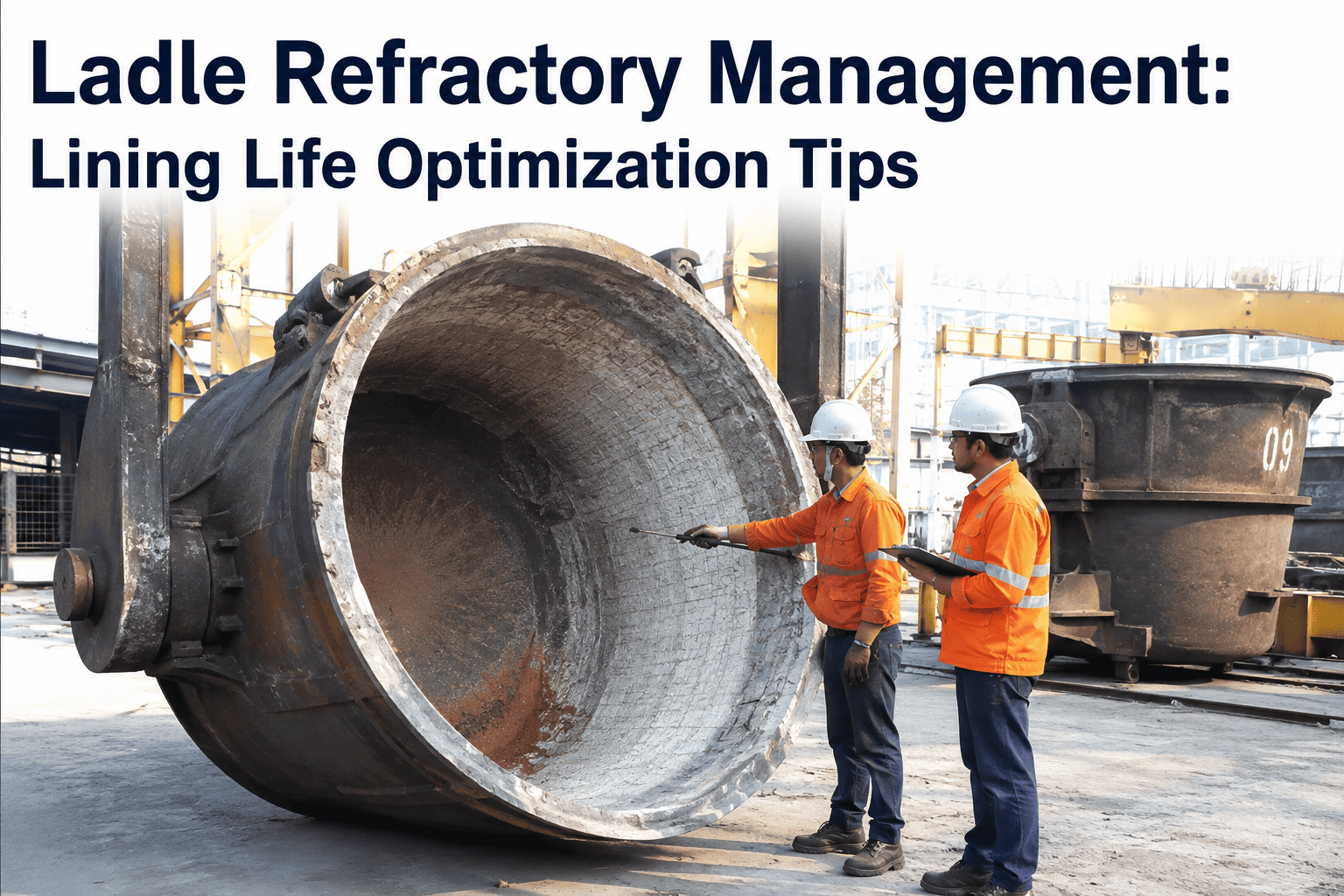
A ladle lining that gets preheated inconsistently, tracked only by tap count instead of actual condition, and relined on a fixed calendar schedule regardless of remaining life is a ladle program leaving campaign life on the table in three different ways at once. Ladle refractory management done well treats preheating, thermal management, slag control, and campaign tracking as one connected system rather than four separate habits, because each one directly affects how much life the others can deliver. Plants ready to connect that system can Book a Demo to see campaign tracking built around actual lining condition instead of a fixed schedule.
LADLE REFRACTORY · LINING LIFE · CAMPAIGN TRACKING
Ladle Refractory Management: Lining Life Optimization Tips
A practical guide to extending ladle refractory campaign life through disciplined preheating, thermal management, slag control, and wear rate tracking — built around actual lining condition, not a fixed relining calendar.
The Ladle Lining Lifecycle: Four Stages, Four Different Risks
A ladle refractory campaign moves through distinct stages, and the risk profile at each stage is different enough that treating the whole campaign with one uniform management approach misses opportunities specific to each phase. New lining preheating sets the thermal foundation the entire campaign builds on; early campaign is when initial wear rate reveals whether the lining and operating conditions are well matched; mid-campaign is where steady-state wear tracking against baseline matters most; and end-of-campaign is where the decision to reline versus push further becomes a genuine risk calculation rather than a default.
STAGE 1
New Lining Preheat
Controlled, gradual heat-up removes moisture and establishes thermal equilibrium before the first heat. Rushed preheating is one of the most common causes of early-campaign thermal shock damage.
STAGE 2
Early Campaign
Initial wear rate over the first several heats reveals whether the lining grade and thermal practice are matched to actual operating conditions, before deviations compound into bigger problems.
STAGE 3
Mid-Campaign Steady State
Wear should track a predictable, roughly linear rate against baseline. Deviation from that expected rate is the earliest signal that something in operating practice or slag chemistry has shifted.
STAGE 4
End-of-Campaign Decision
The decision to reline or continue becomes a genuine risk calculation weighing remaining measured thickness against safety margin, not a default calendar trigger applied regardless of actual condition.
LADLE MANAGEMENT · LINING LIFE · CAMPAIGN TRACKING
Manage Each Campaign Stage on Its Own Risk Profile
iFactory tracks ladle lining condition through every campaign stage — from preheat discipline through end-of-campaign relining decisions — against real wear data instead of a fixed calendar.
Preheating Discipline: Why the First 24 Hours Set the Whole Campaign
Preheat practice is consistently underweighted relative to how much campaign life it actually determines. A new or relined ladle carries residual moisture and has not yet reached thermal equilibrium across the lining thickness; heating too quickly generates steam pressure within the refractory structure and thermal gradient stress across the lining, both of which can initiate microcracking before the ladle has processed a single heat of metal. That early damage does not necessarily show up as an immediate failure — it shows up as a campaign that wears faster than an identical lining that was preheated correctly, often without anyone connecting the shortened campaign back to a preheat decision made weeks earlier.
A disciplined preheat schedule follows a controlled ramp rate appropriate to the lining thickness and material, holds at intermediate temperature stages long enough for moisture to fully escape, and confirms thermal equilibrium before the ladle receives its first heat. The time investment in doing this correctly is measured in hours; the campaign life cost of skipping it is measured in heats lost across the entire subsequent campaign, which is a poor trade by almost any measure once both sides are actually compared.
Slag Control: The Chemistry Lever Operators Actually Control
Slag basicity, volume, and contact time at the slag line are among the few chemical attack variables operators have meaningful influence over heat to heat, unlike refractory grade which is fixed for the campaign. Slag chemistry drifting outside the range the installed grade was selected to resist accelerates chemical wear at the slag line specifically, which is why slag-line wear so often outpaces wear elsewhere in the ladle even when the rest of the lining is performing to expectation.
Basicity Control
Keeping slag basicity within the range the installed grade was selected to resist limits chemical attack at the slag line specifically.
Slag Volume Management
Excess slag volume increases contact time and surface area of chemical attack; carryover control from upstream processes directly reduces this exposure.
Slag-Line Monitoring
Tracking slag-line wear separately from bottom and wall wear catches the zone most sensitive to chemistry drift before it becomes the limiting factor for the whole campaign.
Campaign Tracking: Wear Rate vs. Tap Count
Many ladle programs still trigger relining primarily on tap count — a fixed number of heats after which the ladle is scheduled for reline regardless of measured condition. Tap count is a reasonable proxy when operating conditions are consistent, but it becomes an increasingly poor predictor as product mix, slag chemistry, and thermal practice vary heat to heat, which is exactly the normal condition on most plants. Two ladles reaching the same tap count can carry meaningfully different actual remaining lining thickness depending on what those heats actually put the lining through.
| Tracking Basis | Tap Count Only | Measured Wear Rate |
| Accounts for chemistry variation |
No |
Yes |
| Accounts for thermal practice variation |
No |
Yes |
| Relining trigger basis |
Fixed schedule |
Actual remaining thickness |
| Risk of premature relining |
Higher |
Lower |
| Risk of unplanned breakout |
Higher under mix variation |
Lower, condition-based |
Frequently Asked Questions: Ladle Refractory Management
How much campaign life is typically lost to improper preheating?
The exact figure varies by lining material and preheat deviation severity, but rushed or inconsistent preheating is consistently identified as a leading contributor to early-campaign wear acceleration across ladle refractory studies. The damage from a rushed preheat does not always cause an immediate visible failure — it more often manifests as a campaign that reaches relining meaningfully sooner than an identical lining preheated on a controlled schedule, making the connection easy to miss without dedicated tracking. Plants wanting to quantify this for their own ladles can
Book a Demo to see preheat-to-campaign-life correlation in their own data.
Should relining be scheduled by tap count or by measured wear?
Measured wear rate is the more accurate basis whenever operating conditions vary meaningfully heat to heat, which describes most real production environments. Tap count works reasonably well only when product mix, slag chemistry, and thermal practice stay tightly consistent across the campaign — a condition few plants actually maintain. A hybrid approach, using tap count as a planning estimate and measured wear as the actual trigger, captures the benefit of both without requiring a complete process overhaul.
Why does slag-line wear often outpace wear elsewhere in the ladle?
The slag line experiences the most concentrated chemical attack in the vessel, since it sits at the direct interface with slag chemistry that can drift outside the installed grade's designed resistance range. Combined with the thermal cycling that a slag line experiences at the metal-slag-atmosphere boundary, this zone frequently becomes the limiting factor for overall campaign life even when the bottom and wall linings still have substantial remaining thickness.
How does product mix affect ladle lining wear rate?
Different steel grades produce different slag chemistries and require different processing temperatures and hold times, all of which affect the chemical and thermal stress the lining experiences. A ladle running a consistent product mix will show a more predictable, steady wear rate than one alternating between grades with significantly different slag chemistry, which is exactly why tap-count-only tracking becomes less reliable as product mix diversity increases.
What is the safest way to decide between pushing a campaign further or relining now?
The decision should weigh measured remaining lining thickness against a defined safety margin specific to the vessel and operating conditions, not against how many heats have historically been achieved on similar campaigns. Pushing based on historical averages when actual measured wear is already tracking faster than baseline is a common path to unplanned breakout risk. Contact
iFactory Support for guidance on setting condition-based relining thresholds specific to your ladle fleet.
LADLE REFRACTORY · CAMPAIGN LIFE · CONDITION-BASED RELINING
Extend Ladle Campaign Life Without Guessing at Relining Timing
iFactory tracks preheat discipline, slag chemistry, and measured wear rate against baseline for every ladle in your fleet — turning relining decisions into a data-backed calculation instead of a calendar guess.