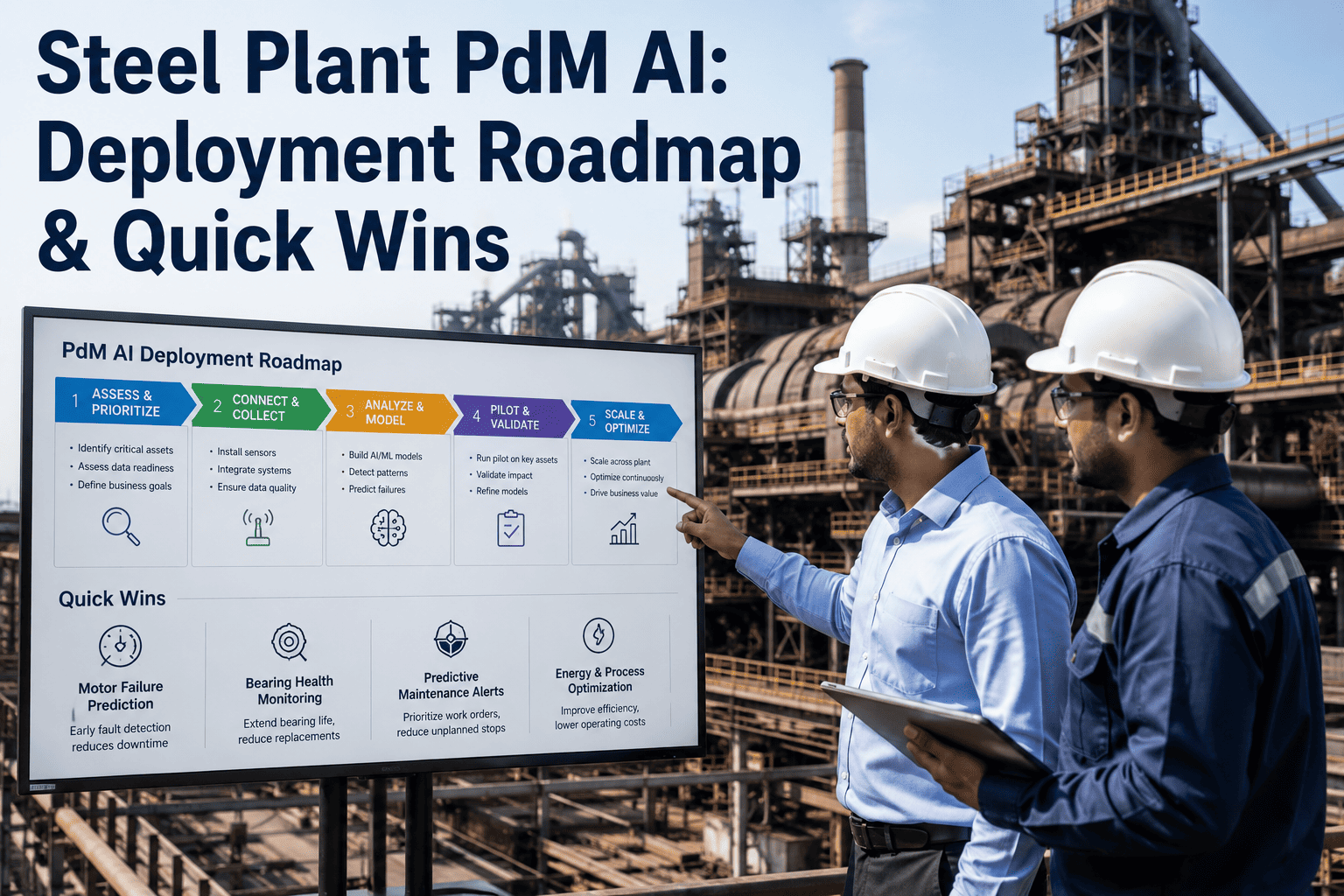
Most steel plants don't fail at predictive maintenance because the technology doesn't work — they fail because they try to deploy prescriptive, multi-sensor AI across the whole plant on day one, before a single vibration baseline has even been validated. The plants getting real return from AI maintenance investment almost never started there. They started with one sensor type on a handful of assets, proved the model caught something a human would have missed, and only then expanded — first in sensor variety, then in analytical sophistication, then finally in scope. iFactory builds deployments around that same maturity progression, not a big-bang rollout that outruns what the data can actually support.
The Roadmap That Actually Works Skips Straight to Nothing — It Climbs a Ladder
Deploying AI predictive maintenance across a steel plant isn't a single project — it's three distinct maturity stages, each one earning the trust and the data foundation the next stage depends on.
Why Skipping Stages Is the Single Most Common Deployment Failure
The temptation to deploy multi-sensor, prescriptive AI across the whole plant immediately is understandable — it's the version of the technology that promises the biggest number in a vendor pitch. It's also the version most likely to fail in practice, because prescriptive recommendations are only as good as the models underneath them, and those models are only as good as the sensor data and validated baselines feeding them. Skipping the earlier stages means building the most sophisticated layer on the least tested foundation.
This pattern shows up repeatedly across steel plant AI deployments that stall or get quietly shelved after an expensive first year. The technology itself usually isn't the problem — the sequencing is. A plant that commits to full-scope, full-sophistication deployment before anyone has confirmed the underlying data actually predicts real failures is making a bet on the model's accuracy before that accuracy has been demonstrated on their own equipment, in their own operating conditions, against their own failure history.
Unvalidated Baselines
A prescriptive model trained on data nobody has confirmed actually correlates with real failures produces confident-sounding recommendations built on nothing.
Alert Fatigue From Day One
A full-scope deployment with untuned thresholds generates enough false positives in the first weeks that maintenance teams stop trusting the system before it's had a chance to prove itself.
No Internal Champion
Without an early, visible win on a small scope, there's no internal success story to build organizational trust for the harder cultural shift a plant-wide rollout demands.
Stage One: Vibration Monitoring on the Assets That Actually Justify It
Vibration monitoring is the right starting point for nearly every steel plant, not because it's the simplest technology available, but because rotating equipment failure modes — bearing wear, misalignment, imbalance — are the best understood failure category in industrial reliability, with decades of documented signature patterns to validate against.
This maturity of the underlying science matters more than it might seem. Bearing fault frequencies, gear mesh signatures, and imbalance patterns have been studied and documented extensively enough that a vibration model doesn't need years of plant-specific failure data to start producing useful, checkable predictions — it can lean on decades of established industry signature libraries while it accumulates the plant's own history in parallel. That head start is exactly why Stage One is the fastest realistic path to a confirmed catch.
Top 10-20 Critical Assets
Ranking assets by failure consequence — production impact, safety risk, repair cost — rather than instrumenting everything at once keeps the initial scope small enough to validate properly.
Audit Before You Buy
Most steel plants are already collecting a meaningful share of the vibration and process data needed but never analyzing it in a predictive context — auditing what exists is faster and cheaper than assuming new sensors are required everywhere.
Weeks, Not Days
Establishing what normal actually looks like for each specific asset, across a range of operating conditions, is what separates a genuine baseline from a guess dressed up as one.
The goal of Stage One isn't comprehensive plant coverage — it's a small number of confirmed catches, where the vibration model flagged a developing fault that a subsequent inspection actually verified. That confirmed catch is the evidence base every later stage builds on.
Stage Two: Multi-Sensor Fusion — Adding Signal Types the Vibration Data Alone Can't See
Vibration data is powerful for mechanical failure modes but blind to a meaningful share of the failure categories that actually take steel plant equipment down — thermal degradation, electrical faults, hydraulic pressure loss. Stage Two expands the sensor mix on the same proven asset base rather than expanding to new assets, layering additional signal types onto equipment the plant already trusts the monitoring program on.
Keeping the asset base constant while expanding the sensor mix is a deliberate choice, not an efficiency shortcut. Introducing new failure signals on equipment where the team already trusts the baseline vibration monitoring isolates the variable being tested — is the added sensor type actually improving detection — rather than confounding it with the separate question of whether a brand-new asset's baseline is even valid yet. Expanding scope and expanding sophistication at the same time makes it much harder to tell which change is responsible for any given result.
| Sensor Type | Failure Mode Captured | What It Adds to Vibration Alone |
|---|---|---|
| Thermal / Infrared | Bearing friction, electrical hot spots, insulation breakdown | Catches degradation vibration alone won't flag until much later |
| Motor Current Signature | Winding faults, rotor bar issues, load anomalies | Non-intrusive electrical health check without new wiring |
| Acoustic Emission | Early-stage cracking, lubrication failure | Detects high-frequency events vibration sampling can miss |
| Hydraulic Pressure | Seal wear, pump cavitation, system leaks | Essential for mill hydraulics that vibration monitoring alone doesn't cover well |
The analytical shift at this stage matters as much as the added sensors. A model correlating signals across sensor types can distinguish failure modes that look similar on any single signal but diverge clearly once multiple data sources are fused — reducing false positives and sharpening the specificity of what the system is actually telling a maintenance team.
Stage Three: Prescriptive AI — From "Something's Wrong" to "Do This, By This Date"
The first two stages answer the question of whether something is degrading. Stage Three answers a harder and more valuable question: given everything the model knows about this specific asset's failure trajectory, what should a maintenance team actually do, and when. This is where remaining-useful-life estimation, automated work order generation, and spare parts integration turn a prediction into an executed action.
The organizational shift required at this stage is often larger than the technical one. Stage One and Stage Two ask a maintenance team to trust an alert enough to go check something. Stage Three asks them to trust a system enough to let it generate a work order and trigger a parts order automatically, with less direct human judgment in the loop at the moment of action. That's a meaningfully bigger ask, and it's exactly why the trust built through two prior stages of confirmed, verified predictions is the prerequisite that makes Stage Three viable rather than reckless.
Remaining Useful Life Estimation
Fused sensor data feeds a model trained on the plant's own accumulating failure history, producing a specific predicted failure window rather than a generic health score.
Automated Work Order Generation
The predicted failure window feeds directly into the CMMS, generating a scheduled work order automatically rather than requiring someone to translate a report into action manually.
Spare Parts Integration
Procurement timing ties directly to the predicted failure window, so the right part is on hand for the scheduled repair rather than ordered reactively once a failure is already confirmed.
Prescriptive AI is genuinely valuable, but only once the two stages beneath it have earned enough trust and generated enough validated data that a maintenance team is willing to act on what the model recommends — which is precisely why this stage sits last, not first.
Prescriptive Recommendations Are Only as Good as What's Underneath Them
iFactory builds toward prescriptive maintenance on a validated foundation of proven vibration monitoring and fused multi-sensor data, not as a first move.
Quick Wins Within Each Stage: What to Target First
Within each maturity stage, some assets and use cases deliver a visible result faster than others, and targeting those first builds the organizational momentum that carries a program through the slower, less glamorous work of scaling.
Assets With a Documented Failure History
An asset that has failed before, with maintenance records describing what happened, gives a model something concrete to validate against far sooner than an asset with no failure history at all.
Equipment With Existing Instrumentation
Assets already wired with some sensing, even if the data isn't currently analyzed, reach a working model faster than assets requiring new sensor installation from scratch.
Assets Requiring New Sensor Installation
Equipment with no existing monitoring still belongs in the program, but realistically sits later in the sequence once the initial proof points from better-instrumented assets are already secured.
A Composite Scenario: The Plant That Waited to Prove Stage One Before Buying Stage Three
A composite integrated steel producer had been pitched a full prescriptive maintenance platform covering the entire plant, with a price tag reflecting comprehensive multi-sensor coverage and automated work order integration from day one. Rather than committing to the full scope, the plant's reliability team scoped an initial deployment to twelve rolling mill drive bearings with documented prior failure history and existing vibration probes already installed but not being analyzed predictively.
Within the first several weeks of the pilot, the vibration model flagged early-stage gear mesh wear on one drive, a fault confirmed by inspection during the next scheduled maintenance window rather than discovered as an unplanned failure. That single confirmed catch became the internal case study the reliability team used to secure budget for Stage Two sensor expansion across the same asset base, and Stage Three prescriptive capability was added only once eighteen months of validated multi-sensor data existed to train the remaining-useful-life models against.
Assumptions That Derail a Maturity-Staged Rollout
Buying the most advanced platform capability upfront saves time compared to phasing the rollout.
Prescriptive capability deployed before vibration baselines and multi-sensor correlation are validated produces recommendations nobody trusts enough to act on, which wastes the investment regardless of how advanced the underlying technology is.
Every critical asset needs new sensors installed before a predictive maintenance program can start.
A meaningful share of the data most plants need is already being collected through existing historians and instrumentation but simply isn't being analyzed in a predictive context yet.
Stage progression should be time-based — move to the next stage after a set number of months regardless of results.
Progression should be evidence-based — a confirmed catch and a validated baseline are the actual gate to the next stage, not a calendar date that may arrive before the foundation is ready.
A Readiness Checklist Before Advancing to the Next Stage
Stage One has at least one confirmed catch verified by physical inspection
A model flag that was never checked against reality isn't evidence the system works — confirmation closes that loop.
Baseline data spans enough operating conditions to be genuinely representative
A baseline captured only during one production mode may not hold once the asset runs under different load or speed conditions.
Maintenance teams are acting on alerts, not just receiving them
A system generating alerts that get ignored hasn't earned the trust needed to support a more advanced, higher-stakes stage.
The CMMS integration path for the next stage has been scoped in advance
Confirming how automated work orders will flow into existing systems before Stage Three begins avoids a late-stage integration scramble.
Frequently Asked Questions
How long should a plant expect to spend in Stage One before moving to multi-sensor fusion?
Most plants need several months to establish reliable baselines and secure at least one confirmed catch, though the exact timeline depends heavily on how much existing sensor data is available and how quickly a genuine failure signature appears in the monitored asset population. Visit support to scope a realistic Stage One timeline for a specific asset base.
Can a plant skip vibration monitoring and start directly with multi-sensor fusion?
Technically yes, but doing so forgoes the fastest, best-understood validation path available — vibration-based rotating equipment failure modes have the most mature detection science behind them, making Stage One the quickest route to a confirmed, trustworthy result.
What data volume is actually needed before a prescriptive model becomes reliable?
Assets with documented failure history typically need several months to a year of high-frequency multi-sensor data to train a reliable remaining-useful-life model, while assets without failure history may take longer since the model has less to validate against. Book a demo to review data requirements for a specific asset population.
Does every asset in the plant need to reach Stage Three eventually?
No — many lower-criticality assets deliver sufficient value from Stage One or Stage Two monitoring alone, and reserving full prescriptive capability for the highest-consequence equipment keeps the program's complexity proportional to where the return actually justifies it.
How does existing CMMS or historian data factor into the early stages of this roadmap?
An audit of existing PLC historians, DCS systems, and prior sensor installations often reveals a meaningful share of usable data already being collected, which shortens the path to a working Stage One baseline considerably compared to starting from a fully greenfield instrumentation plan. Contact support to review what your existing systems can already support.
Climb the Ladder Instead of Skipping to the Top
iFactory sequences your predictive maintenance deployment through vibration monitoring, multi-sensor fusion, and prescriptive AI — each stage validated before the next begins.

.png)

-for-steel-manufacturing.png)