In the high-stakes environment of modern steel manufacturing, refractory materials represent a critical yet often overlooked component of operational expenditure and production reliability. These specialized linings, which protect furnaces, ladles, and tundishes from extreme thermal and chemical stress, can account for 5 to 15 percent of total conversion costs in an integrated steel plant. Despite this significant financial impact, many steelmakers still rely on outdated procurement strategies—manual consumption tracking, reactive inventory replenishment, and spreadsheet-based supplier evaluations. This fragmented approach frequently leads to costly emergency purchases, excessive safety stock, or catastrophic production stoppages due to material unavailability. The advent of Industry 4.0 technologies, particularly artificial intelligence and machine learning, has fundamentally transformed how steel plants can manage their refractory supply chain. By leveraging AI-driven consumption forecasting, dynamic inventory optimization, and comprehensive supplier performance analytics, plant managers and reliability engineers can systematically reduce refractory cost per tonne of steel while ensuring critical spares are always available when needed. This comprehensive guide delves deep into the technical architecture, implementation strategies, and measurable business outcomes of deploying an AI-powered refractory procurement system. Book a Demo to see how iFactory's solutions can transform your refractory management.
AI-Driven Refractory Procurement for Steel Mills
Eliminate unplanned downtime and reduce refractory spend by 18-25% with predictive inventory and supplier intelligence.
The Cost of Reactive Refractory Procurement
Traditional procurement methods, often based on historical consumption averages or gut feel, create a cascade of inefficiencies. When a ladle lining fails unexpectedly, the plant must source refractory materials on an emergency basis, paying premium prices and expedited shipping fees that can be 20-40% higher than standard rates. Furthermore, the lack of accurate consumption forecasting forces plants to carry excessive safety stock, tying up working capital in slow-moving inventory that may degrade or become obsolete before use. A study by the Association for Iron & Steel Technology found that steel mills operating with reactive procurement strategies experience 12-18% higher refractory costs compared to those using predictive models. The true cost extends beyond materials: unplanned refractory failures cause production delays, energy inefficiencies, and quality defects in the steel produced. For a typical medium-sized integrated steel plant producing 2 million tonnes annually, this translates to millions of dollars in lost revenue and increased operating expenses every year.
AI Consumption Forecasting: The Technical Foundation
At the core of any modern refractory procurement system lies a sophisticated AI consumption forecasting engine. This engine ingests multiple data streams to generate highly accurate predictions of refractory usage over various time horizons—daily, weekly, monthly, and quarterly. Key input variables include historical consumption patterns, production schedules (tonnes of steel produced per shift), furnace operating temperatures, slag chemistry data, and even ambient conditions that affect thermal cycling stress. Machine learning models, such as gradient boosting machines or long short-term memory networks, are trained on this multivariate time-series data to identify complex non-linear relationships that traditional statistical methods miss. For example, the model learns that a combination of high alumina content in the slag and rapid temperature ramping during grade transitions accelerates wear on the basic oxygen furnace lining by 15% compared to normal operations. This level of granularity enables the system to forecast consumption with 92-96% accuracy over a 30-day horizon, compared to the 70-80% accuracy typical of manual or spreadsheet-based methods. The output is a dynamic consumption forecast that updates in near-real-time as production conditions change, forming the foundation for inventory optimization and procurement planning.
Inventory Optimization: Balancing Cost and Risk
Once the AI consumption forecast is established, the next critical component is inventory optimization—determining the optimal stock levels for each refractory SKU to minimize total costs while meeting a target service level. This is a classic multi-echelon inventory optimization problem, but with unique complexities in the steel plant context. Refractory materials often have long lead times (8-16 weeks for specialty shapes), high unit costs (up to $5,000 per tonne for certain castables), and significant storage constraints (temperature-controlled warehousing is often required). The AI system solves this by constructing a stochastic inventory model that accounts for demand variability, lead time variability, and the cost trade-offs between holding inventory and experiencing a stockout. Using techniques like dynamic programming or simulation-based optimization, the system recommends reorder points, order quantities, and safety stock levels that are tailored to each material's criticality and usage pattern. For critical spares—such as tundish nozzles or slide gate plates—the algorithm might recommend maintaining 30 days of inventory with a 99.5% service level, while for bulk materials like magnesia-carbon bricks, a 20-day supply with 95% service level may be optimal. The result is typically a 30-40% reduction in total inventory value while maintaining or improving material availability.
Implementation Roadmap for AI Refractory Procurement
Data Integration and Cleansing
Connect to existing ERP, MES, and CMMS systems to extract historical consumption, purchase orders, inventory levels, and production data. Cleanse and normalize data to remove duplicates, correct unit inconsistencies, and handle missing values. This phase typically takes 4-6 weeks and is critical for model accuracy.
AI Model Development and Validation
Train consumption forecasting models using supervised learning on historical data. Validate model performance using time-series cross-validation and backtesting against actual consumption. Fine-tune hyperparameters to optimize accuracy. This phase requires 6-8 weeks of specialized data science effort.
Inventory Optimization Engine Configuration
Set up the stochastic optimization model with lead times, costs, and service level targets for each material. Run simulations to determine optimal inventory policies. Configure the system to generate automated purchase recommendations and reorder alerts. This phase takes 3-4 weeks.
Supplier Performance Dashboard Deployment
Integrate supplier data (on-time delivery, quality rejections, price trends) into a unified dashboard. Set up automated scorecards and alerts for underperforming suppliers. Enable procurement team to make data-driven sourcing decisions. This phase takes 2-3 weeks.
Go-Live and Continuous Improvement
Roll out the system to the procurement team with training and change management. Monitor model performance and retrain models monthly with new data. Establish a continuous improvement cycle to refine forecasts and inventory policies. This is an ongoing process with quarterly business reviews.
Transform Your Refractory Supply Chain Today
Leverage AI to reduce costs, eliminate stockouts, and improve supplier performance. Our experts will tailor a solution to your plant's unique needs.
Supplier Performance Tracking: Beyond Cost Per Tonne
Effective refractory procurement extends beyond internal optimization to encompass rigorous supplier performance management. The AI system automatically tracks and analyzes key performance indicators for each supplier, including on-time delivery rate (target > 95%), quality rejection rate (target < 2%), price competitiveness relative to market indices, and lead time variability. These metrics are aggregated into a composite supplier score that can be used for strategic sourcing decisions—for example, shifting volume from a low-performing supplier to a high-performing one. The system also detects anomalies in supplier behavior, such as a sudden increase in lead time variability that may indicate production issues at the supplier's facility. By providing real-time visibility into supplier performance, the procurement team can proactively address issues before they impact plant operations. This data-driven approach typically results in a 5-10% reduction in average purchase price and a 15-20% improvement in on-time delivery performance over 12-18 months.
Cost Per Tonne Reduction: A Measurable Outcome
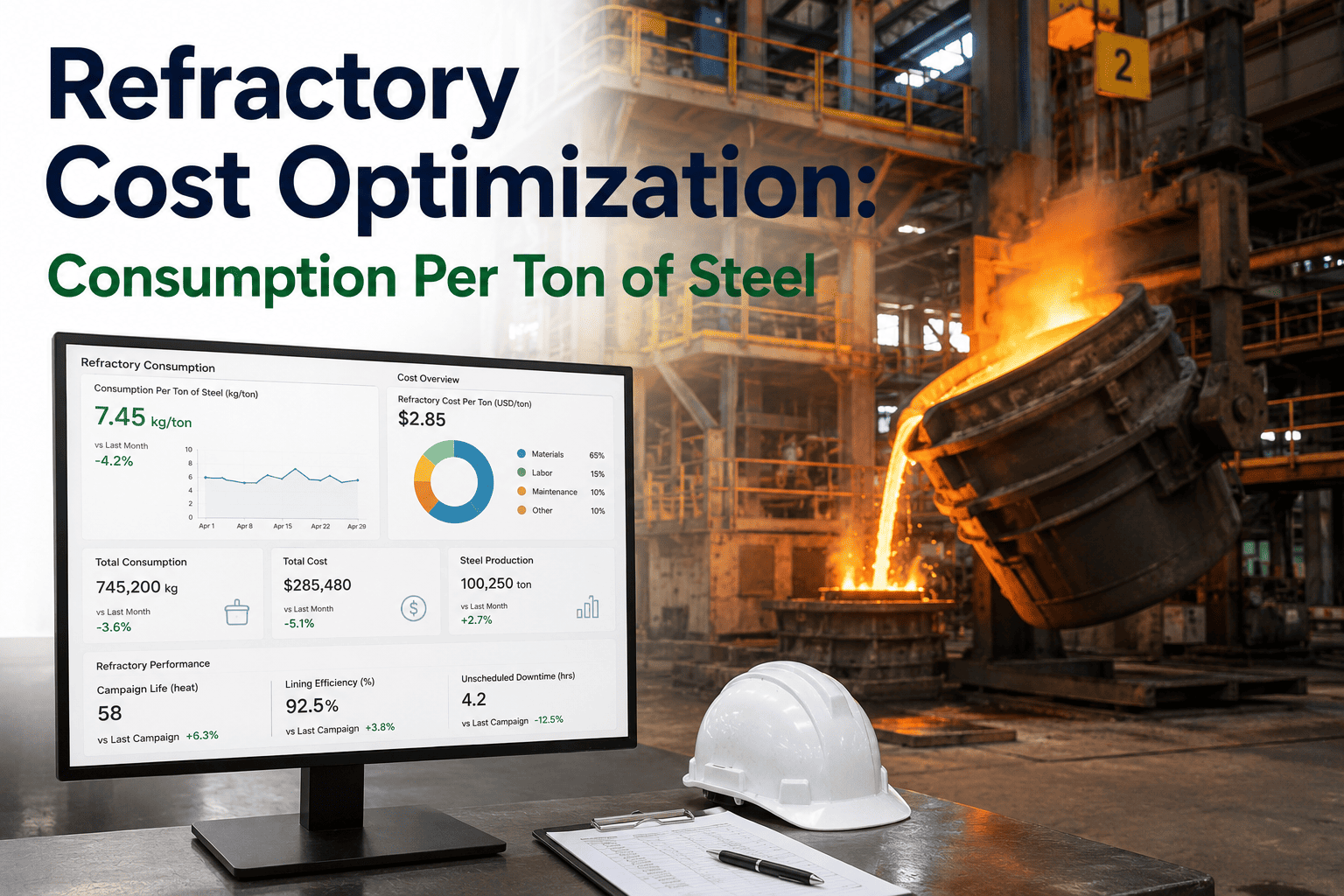
The ultimate metric for any refractory procurement initiative is the reduction in refractory cost per tonne of steel produced. This metric captures the combined impact of lower purchase prices, reduced inventory carrying costs, fewer emergency purchases, and minimized production losses due to material shortages. AI-driven procurement systems have demonstrated consistent results across multiple steel plants: a 500,000-tonne-per-year EAF mini-mill achieved a 22% reduction in refractory cost per tonne within 12 months of implementation, translating to annual savings of $1.8 million. A larger integrated plant producing 3 million tonnes annually saw a 19% reduction, saving $5.7 million per year. These savings are achieved through a combination of optimized inventory levels (reducing carrying costs by 35%), improved supplier pricing (5-8% lower due to better negotiation based on performance data), and reduced emergency purchases (60-70% reduction in premium-priced urgent orders). The ROI on the AI system implementation is typically achieved within 6-9 months, making it one of the highest-return digital transformation initiatives in steel manufacturing.
Integration with Existing Plant Systems
A key success factor for AI-driven refractory procurement is seamless integration with the plant's existing technology stack. The system must connect to the ERP (e.g., SAP, Oracle) for purchase order and inventory data, the MES for production schedules and actual production data, the CMMS for maintenance events and refractory installation records, and potentially the LIMS for slag chemistry and material quality data. Modern AI platforms use API-based integration with robust data validation and error handling to ensure data quality. The integration architecture should support both batch and real-time data flows—for example, daily batch updates for inventory levels, but real-time streaming for production schedule changes that trigger immediate forecast updates. The system should also provide a user-friendly dashboard that procurement and reliability engineers can use without needing data science expertise. This dashboard should display key metrics like forecast accuracy, inventory health, and supplier performance in an intuitive visual format. iFactory's platform is designed for rapid integration with common steel plant systems, typically completing full integration within 8-12 weeks.
Change Management and Organizational Impact
Implementing an AI-driven procurement system requires careful change management to ensure adoption by the procurement team and other stakeholders. The system should be positioned as a decision support tool that enhances—not replaces—the expertise of procurement professionals. Training programs should cover how to interpret AI recommendations, when to override them based on local knowledge, and how to use the supplier performance dashboard for negotiations. It's also important to establish clear governance around the system: who is responsible for updating model inputs, how often forecasts are reviewed, and what escalation process is followed when the system predicts a potential stockout. Organizations that invest in comprehensive change management see adoption rates of 85-95% within the first six months, compared to 40-60% for those that focus solely on technology deployment. The cultural shift from reactive to proactive procurement is often the most challenging but most rewarding aspect of the transformation.
Case Study: Integrated Steel Plant in Europe
A leading European integrated steel producer with an annual capacity of 4.5 million tonnes implemented an AI-driven refractory procurement system across three of its plants. Prior to implementation, the company faced frequent stockouts of critical ladle refractories, leading to production delays costing an estimated $3 million annually. Inventory levels were high—averaging 60 days of coverage across all materials—yet service levels were only 92%. After deploying the AI system, inventory coverage was reduced to 35 days (a 42% reduction), service levels improved to 99.2%, and emergency purchase orders dropped by 75%. The total refractory cost per tonne of steel decreased by 21% over 18 months, saving the company $8.2 million per year. The system also identified a previously unnoticed pattern: one supplier's refractories had a 12% higher failure rate in basic oxygen furnaces during high-sulfur campaigns, leading to a change in sourcing strategy that further reduced costs. This case demonstrates the transformative potential of AI when applied to a traditionally managed area of steel plant operations.
Future Trends: Autonomous Procurement and Digital Twins
The next frontier in refractory procurement is the development of autonomous procurement systems that can execute purchase orders without human intervention for routine, low-risk materials. These systems will use reinforcement learning to continuously optimize ordering policies based on real-time feedback from the plant. Additionally, digital twins of the refractory supply chain—virtual replicas that simulate the entire procurement-to-installation lifecycle—are emerging as powerful tools for scenario planning and risk management. For example, a digital twin can simulate the impact of a supplier's factory shutdown on inventory levels across all plants, enabling proactive mitigation strategies. These advanced capabilities are still in the early adoption phase but are expected to become mainstream within the next 3-5 years. Steel plants that invest in AI-driven procurement today will be well-positioned to leverage these future innovations, maintaining a competitive advantage in an increasingly demanding market.
Frequently Asked Questions
How does AI consumption forecasting handle seasonal variations in steel production?
AI consumption forecasting models are specifically designed to capture and account for seasonal patterns in steel production, such as increased output during peak construction months or reduced activity during holiday periods. The machine learning algorithms, particularly those using time-series decomposition techniques, automatically identify seasonal, trend, and cyclical components within historical consumption data. For example, the model learns that refractory consumption in the BOF typically increases by 8-12% during the fourth quarter due to higher production targets, and adjusts forecasts accordingly. Additionally, the system can incorporate external factors like planned maintenance shutdowns or market demand forecasts to further refine predictions. This dynamic adaptation ensures that inventory levels are optimized for both expected and unexpected changes in production volume. Book a Demo to see how our models handle your specific production patterns.
What data is required to implement an AI-driven refractory procurement system?
To implement a robust AI-driven refractory procurement system, you need historical data covering at least 12-24 months of operations. Essential data categories include: consumption records (material type, quantity, date, and furnace/ladle location), purchase orders (supplier, price, lead time, delivery date), inventory levels (current stock, reorder points, bin locations), production schedules (tonnes produced, product mix, furnace campaigns), and quality metrics (slag chemistry, refractory wear measurements, installation records). Ideally, this data should be extracted from your ERP, MES, and CMMS systems in a structured format. If some data is unavailable or of poor quality, the implementation team can work with you to estimate or proxy missing values while prioritizing data cleansing. The more granular and accurate the data, the better the model performance. iFactory's data integration specialists will conduct a thorough data audit during the discovery phase to identify gaps and recommend remediation steps. Book a Demo to discuss your data readiness.
How long does it take to see a return on investment from this system?
Based on implementations across multiple steel plants, the typical return on investment for an AI-driven refractory procurement system is achieved within 6 to 9 months of go-live. The initial savings come from immediate inventory optimization—reducing excess stock and eliminating emergency purchases—which often generates cost reductions within the first quarter. As the AI models mature and accumulate more data, additional savings from improved supplier negotiations and reduced consumption through better material selection accrue over the following months. For a mid-sized plant with annual refractory spend of $10 million, the total implementation cost (including software, integration, and change management) is typically $150,000 to $300,000, while annual savings range from $1.5 million to $2.5 million. This represents a payback period of 2-4 months, making it one of the most attractive digital investments in steel manufacturing. The ongoing savings continue year after year, with the system becoming more accurate and valuable over time. Book a Demo to calculate your specific ROI.
Can the system handle multiple plants with different furnace types and operating conditions?
Yes, the AI platform is designed to operate across multiple plants and furnace types within a single unified system. Each plant or furnace can have its own consumption forecasting model that is trained on its specific historical data, capturing unique wear patterns, operating conditions, and material preferences. For example, a plant using electric arc furnaces will have different refractory consumption profiles compared to one using basic oxygen furnaces, and the system can accommodate these differences seamlessly. The inventory optimization engine also operates at a multi-echelon level, allowing for centralized or decentralized inventory policies based on your organizational structure. Supplier performance tracking can be aggregated across all plants to provide a global view, or filtered by plant for local decision-making. This multi-plant capability is particularly valuable for large steel groups that want to standardize procurement processes while respecting local operational nuances. Book a Demo to learn about our multi-site deployment options.
How does the system integrate with existing ERP and procurement software?
The AI platform integrates with existing ERP and procurement software through standard APIs, web services, or direct database connections, depending on your IT architecture. For common systems like SAP S/4HANA, Oracle E-Business Suite, or Microsoft Dynamics, pre-built connectors are available to accelerate integration. The integration covers bi-directional data flows: the system reads master data (materials, suppliers, inventory) and transactional data (consumption, purchase orders) from the ERP, and writes back purchase recommendations, reorder alerts, and forecast updates. Data synchronization can be scheduled at any frequency—typically daily for inventory and consumption data, and real-time for critical alerts. The integration is designed to be non-disruptive to existing systems, operating as an overlay that enhances rather than replaces current workflows. iFactory's integration team handles the entire process, including data mapping, validation, and testing, ensuring a smooth deployment with minimal IT resource requirements. Book a Demo to discuss your specific integration needs.
Ready to Optimize Your Refractory Procurement?
Join leading steel plants that have reduced costs and improved reliability with AI. Schedule a personalized demo today.