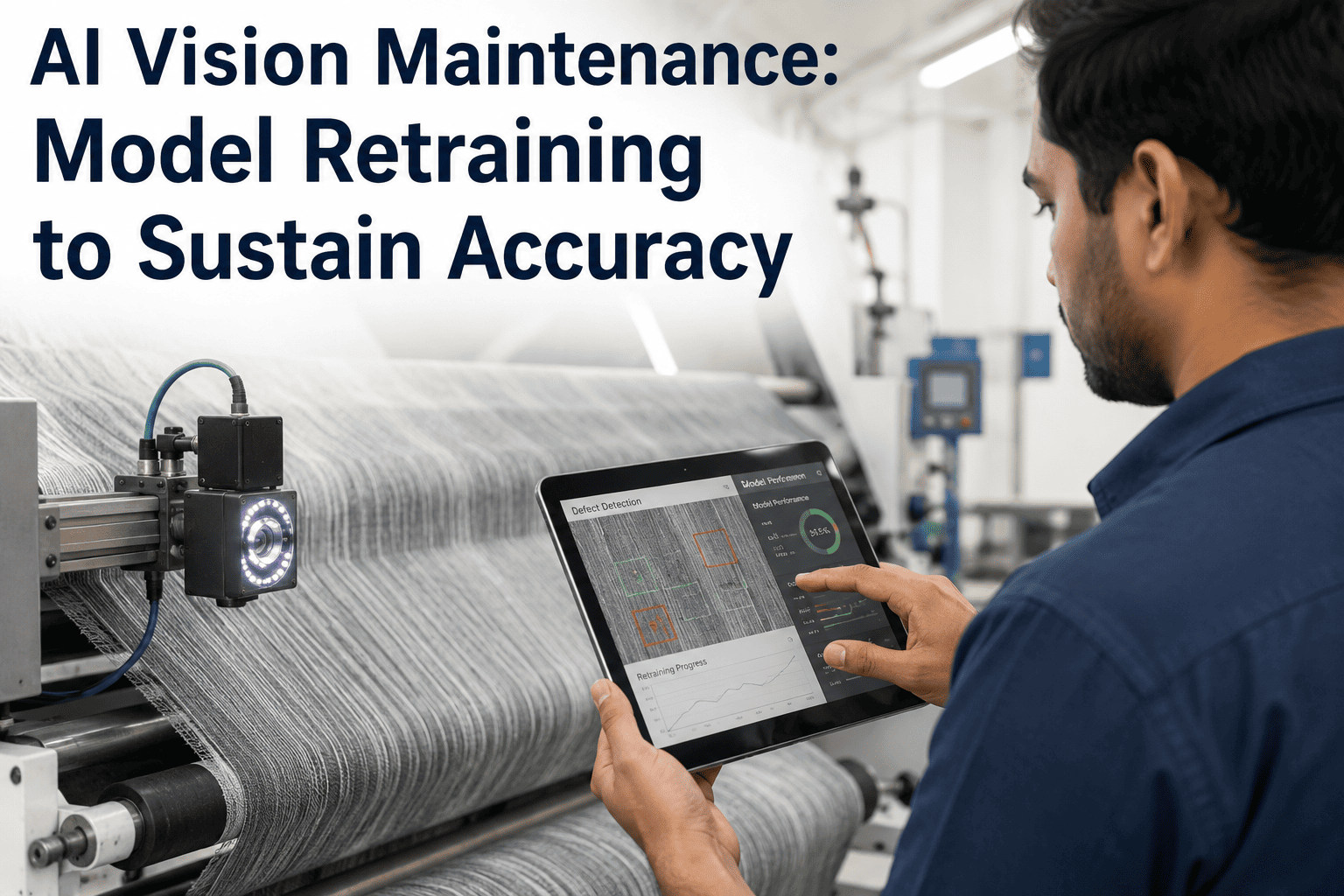
A defect detection model that scored 98% accuracy at go-live does not stay at 98% forever, even if nobody touches it. Fiber lots shift, dye batches vary, a camera lens accumulates a thin film of lint, ambient lighting changes with the seasons, and every one of those ordinary production realities nudges the model's inputs further from what it was trained on. This is model drift, and unlike a hardware failure it produces no error message, no alarm, no obvious signal — the model keeps running and keeps returning confident answers that are gradually less correct. iFactory builds drift detection and retraining directly into every AI vision deployment, so accuracy is a maintained property of the system, not a one-time achievement from the day it launched. To see drift monitoring running against your own production data, book a demo.
The Model That Launches at 98% Accuracy Is Not the Same Model a Year Later
iFactory pairs every deployed vision model with continuous drift monitoring, a tiered response protocol, and a scheduled retraining cadence, so accuracy degradation gets caught and corrected long before it shows up as a customer complaint.
Drift Produces No Error Message, Which Is Exactly the Problem
Most production software failures announce themselves. A service crashes, a query times out, a log fills with exceptions. Model drift does none of that. The model keeps accepting frames, keeps running inference, and keeps returning a confidence score on every single one, all while its actual correctness quietly erodes underneath a completely normal-looking system.
All three causes produce the same downstream symptom: a model whose predictions grow steadily less trustworthy, with no built-in mechanism to tell anyone that is happening unless one is deliberately added. Sensor drift deserves particular attention because it is the easiest of the three to mistake for a model problem when the actual fix is mechanical — a fouled lens or a degraded illumination source produces exactly the same symptom as genuine data drift, and diagnosing the wrong cause wastes a retraining cycle on a problem a camera cleaning would have solved in minutes.
How Drift Actually Gets Measured Before It Becomes a Visible Problem
Catching drift early requires comparing what the model is seeing right now against what it was trained on, using statistical methods that can flag a meaningful shift long before accuracy has degraded enough for a person to notice by eye.
| Detection Method | What It Measures | Best For |
|---|---|---|
| Population Stability Index | How far the current input distribution has shifted from the training baseline | Ongoing automated monitoring with a single interpretable score |
| Kolmogorov-Smirnov Test | Statistical distance between two continuous distributions | Detecting shifts in continuous features like brightness or texture density |
| Confidence Score Tracking | Trends in the model's own prediction confidence over time | A lightweight early signal that requires no separate statistical test |
| Sampled Ground-Truth Audit | Actual accuracy against a manually verified sample of recent predictions | Confirming whether a statistical drift signal has translated into real accuracy loss |
No single method tells the whole story on its own. Statistical drift tests can flag a shift in the input data that turns out not to affect accuracy at all, which is why the most reliable monitoring setups combine a drift signal with an actual accuracy check rather than alerting on distributional change alone. A reference dataset chosen carelessly compounds this problem further — the baseline used for comparison should be the exact sample the model was originally trained on, not a convenient recent snapshot, since comparing against the wrong reference can either mask a genuine shift or manufacture a false one.
See drift detection running against your own model's history
iFactory reviews your deployed model's prediction confidence trends and flags where drift may already be developing, before it shows up as a missed defect.
Not Every Drift Signal Deserves the Same Level of Reaction
Retraining a production model is not free — it costs engineering time, requires validation before deployment, and carries its own small risk of introducing a regression. Treating every drift alert as an emergency retraining trigger wastes that effort on shifts too small to matter, while treating every alert as background noise misses the ones that do. A tiered response protocol is what resolves this properly.
This tiered structure is what lets a plant running dozens of deployed models avoid drowning its engineering team in false alarms, while still guaranteeing that a genuine accuracy collapse gets an immediate, prioritized response rather than waiting in a queue behind minor noise. The tier a given alert lands in should be decided by a combination of drift magnitude and confirmed accuracy impact together, not drift magnitude alone, since a large statistical shift that has not actually degraded accuracy does not warrant the same urgency as a smaller shift that has.
Turning Operator Corrections Into the Next Training Dataset
The single richest source of retraining data a plant has is not a new labeled dataset purchased from outside, it is the corrections operators already make every day when they override a model prediction they know is wrong. Capturing that feedback systematically is what keeps the model improving on exactly the failure modes it actually has, rather than a generic benchmark's failure modes.
That last curation step matters more than it might seem. An operator override is a valuable signal, but it is not automatically correct — building a retraining pipeline that accepts every override without review risks quietly teaching the model an operator's mistake instead of a genuine correction, which is exactly how label noise compounds over successive retraining cycles.
What a Sensible Retraining Cadence Actually Looks Like
Beyond the tiered drift response, most mature deployments also run retraining on a baseline schedule independent of any specific alert, simply because gradual minor drift accumulates even when no single check crosses an alert threshold.
Every retrained model version is validated against a held-out benchmark before it replaces the live model, and the prior version is retained for rollback, so a retraining cycle that underperforms expectations can be reversed immediately rather than compounding a new problem on top of the drift it was meant to fix.
What Drift Tends to Look Like Before Monitoring Catches It Formally
Even without a formal drift monitoring system in place, a few operational patterns tend to show up as early informal signals that something has shifted. Recognizing these is useful even at plants still in the process of building out proper instrumentation.
None of these three signals alone proves drift has occurred, but any one of them appearing consistently over several weeks is a reasonable trigger to pull a sampled accuracy audit ahead of the next scheduled check, rather than waiting for the regular cadence to catch up.
How iFactory Builds Maintenance Into the Model From Day One
Drift monitoring and retraining are not offered as an optional add-on purchased later, they are part of how every iFactory AI vision deployment is built from the initial rollout, on the understanding that a model without a maintenance plan is a model with a shrinking shelf life.
What Textile Teams Ask About Keeping AI Vision Accuracy Sustained
Keep Your Vision Model as Accurate a Year From Now as It Was at Go-Live
iFactory builds drift detection, a tiered response protocol, and a scheduled retraining cadence into every AI vision deployment, so accuracy degradation gets caught and corrected before it ever reaches your customers.