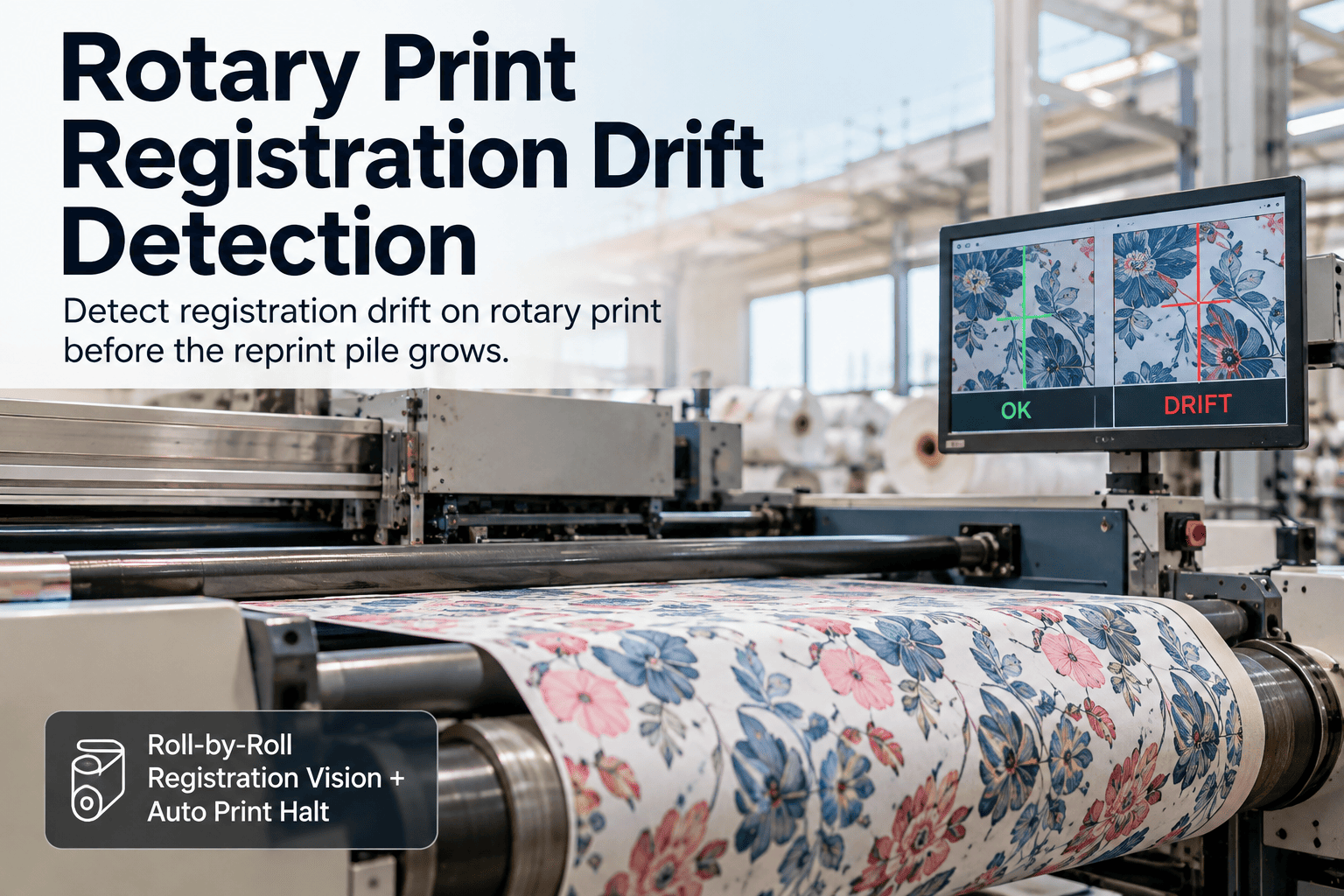
A rotary print machine runs 8, 12, or 24 screens laying successive colours onto fabric in tight registration. When one screen drifts even 0.5 mm off, the pattern doubles or leaves a halo — and drift compounds roll after roll until someone at the exit table notices. By then the reprint pile is measured in hundreds of metres. Registration drift is a solved problem in theory (registration marks, motor sync) and unsolved in practice, because eyes only catch it once waste is visible. Vision AI reads registration marks every repeat, quantifies per-screen offset in millimetres, and halts the print before drift crosses the reprint threshold.
iFactory / Rotary print registration drift
Halt the Print on Registration Drift Before the Reprint Pile Grows
Roll-by-roll registration vision reading every repeat across 8-24 screen rotary print heads (SPGPrints, Zimmer Austria, Reggiani, MS Printing) — per-screen offset in millimetres, threshold-driven print halt, drift trend attributed to specific screen and print head for maintenance action.
Every repeat
registration read
Auto-halt
before reprint threshold
The Problem in Rotary Print Registration
A typical rotary print floor runs 8 to 24 screens per pattern with each screen driven off a synchronised servo motor system. Screens are precision-engineered and drives are controlled — but drift still happens. A worn bearing on one screen introduces microns of slip per revolution that compound over minutes. A slight tension variance in the fabric transport shifts registration for one colour but not another. An operator setting up a pattern in a rush left one screen 0.3 mm off nominal, invisible on the first repeat but obvious after 40. The exit table inspector catches drift when the pattern doubles — but by then hundreds of metres are reprint or a heavy penalty against the buyer contract.
Where Registration Drift Actually Bleeds
Rotary print registration failure modes are consistent across screen printers. Each is a specific mechanical, operator, or setup cause that vision AI can localise to a single screen.
Bearing wear drift
A worn screen-cylinder bearing introduces microns of slip per revolution. Drift compounds over 30-60 minutes. Exit inspector flags waste of 200-400 m — every hour of delay is another shift's rework.
Fabric tension shift
Tension variance on the printing blanket shifts registration for the screens on one side more than the other. Difficult to trace by eye because drift is asymmetric across the width.
Setup off-nominal
Operator setting up a repeat set one screen 0.3 mm off. First repeat looks fine; drift becomes visible only after fabric length compounds it. Root cause invisible at exit inspection.
Screen wear over life
Nickel electroformed screen elongates fractionally over its life cycle. New pattern with old screen shows drift the operator did not expect. Fleet-level screen life tracking not connected to print planning.
What Good Looks Like in Print Registration
A working print registration vision system holds four disciplines together — every-repeat mark reading, per-screen offset quantification, threshold-driven halt, and drift attribution for maintenance.
Every-Repeat Read
Vision cameras positioned to read registration marks or feature points on the printed fabric at every repeat. Not sample; every repeat, so drift is caught within one cycle rather than at inspection.
Every repeat, not sample
Per-Screen Offset
Offset per screen quantified in millimetres X/Y, with historical trend per screen. Operator sees which screen is drifting and by how much — not just that something is wrong.
Named screen, mm offset
Halt Before Reprint
Threshold-driven print halt before drift crosses the reprint criterion. Configurable per pattern and per buyer tolerance. Halt is proactive — before waste, not after.
Proactive halt
Drift Attribution
Recurring drift pattern per screen linked to bearing, motor, or tension cause. CMMS work order raised for the specific machine and screen position for planned intervention.
Attribution to CMMS
How iFactory AI Fits
iFactory AI overlays your rotary print machine (SPGPrints Kapok/Teak/Palm/Pegasus, Zimmer Austria Rotascreen, Reggiani, MS Printing), MES, and CMMS — reading registration frame-by-frame from mounted vision cameras, quantifying per-screen drift, and driving the halt-vs-continue decision on evidence.
Registration Vision
Vision Layer
Vision cameras above the printing blanket reading registration marks or intrinsic pattern features every repeat. Per-screen X/Y offset computed and displayed live on the operator HMI.
Halt Controller
Vision + Machine
Configurable halt thresholds per pattern and buyer. Threshold breach halts print machine before drift crosses reprint criterion. Operator confirms restart after mechanical correction.
Drift Trends
Vision + Analytics
Per-screen drift trend over shifts, days, weeks. Recurring patterns per screen surface bearing or motor drift before it becomes daily halt. Baseline for scheduled intervention.
CMMS Bridge
Vision + CMMS
Chronic drift per screen raises CMMS work order (IBM Maximo, SAP PM, eMaint) with specific machine, screen position, and drift history attached. Maintenance targets root cause.
Ask your rotary printing head how last week's reprint metres broke down by cause. If registration drift is on the list — or if the answer is "we don't track it that way" — vision AI at the print head is where those metres get recovered. Book a print registration review.
10-Week Registration Vision Pilot on One Machine
One rotary print machine, ten weeks. The pilot mounts registration vision, activates per-screen offset display, tests halt thresholds, and closes the first month of drift trend against maintenance data.
Weeks 1–2
Camera Mount + Cal
Vision cameras mounted above the printing blanket. Calibration against reference registration marks. Baseline current-state drift over a range of patterns.
Weeks 3–5
Per-Screen Live
Per-screen offset display live on operator HMI. Operators trained on offset interpretation. Historical trends per screen accumulate.
Weeks 6–8
Halt Thresholds
Halt thresholds configured per pattern and buyer tolerance. First threshold-driven halts. Operator response protocol tested. False-halt rate below acceptable threshold.
Weeks 9–10
CMMS Attribution
Chronic drift patterns per screen surfaced. CMMS work orders raised for specific bearings or drives. Reprint metres attributed to registration drift measured against baseline.
Who Owns the KPI
Print registration crosses printing, quality, maintenance, and finance. Each function owns a specific KPI or drift stays hidden in the reprint pile.
Rotary Printing Head
Reprint metres from registration drift
Owns the floor outcome — the specific reprint metres attributed to registration drift. Rising trend signals mechanical or setup discipline gaps.
QA Lead
Drift-related buyer penalties
Owns the customer-facing outcome — buyer penalties or rejections tied to registration defects. Zero is the target; each is a specific mechanical or process gap.
Print Maintenance
MTBF on print head bearings and drives
Owns the reliability outcome — mean time between failure on bearings and servo drives that cause drift. Vision-attributed patterns drive planned intervention.
Print Planning
Screen life tracked to pattern history
Owns the planning discipline — screen life tracked against print history so aged screens don't run demanding new patterns without pre-verification.
FAQ
Does this work on all rotary print machines or only the newer ones?
Vision is mounted externally to the machine — above the printing blanket downstream of the print heads — so it works with SPGPrints Kapok, Teak, Palm, Pegasus, and RD-series machines regardless of vintage, Zimmer Austria Rotascreen with open- or closed-bearing systems, Reggiani, MS Printing, and legacy machines from Buser and Stork. The vision layer reads registration marks or intrinsic pattern features and doesn't require modification to the machine's own registration system. Where the machine has native registration control, the vision adds the closed-loop halt discipline the native system rarely triggers proactively; where it doesn't, the vision provides the discipline the machine lacked.
What about digital textile printing — does this apply to inkjet as well as rotary screen?
Digital inkjet printing (Kornit, EFI Reggiani BOLT, Durst, Mimaki) has different registration dynamics — no physical screens to align, but printhead colour registration and substrate distortion still create drift. The vision approach adapts: reading printed pattern features against the digital reference file to quantify per-colour offset and substrate distortion. Where the digital machine has native colour management, the vision provides the closed-loop verification and halt discipline. Where the shop runs both rotary screen and digital, the same vision infrastructure and analytics apply — same halt discipline, same buyer-tolerance thresholds, same trending.
Book a demo to see the digital-print application.
How does this handle high-repeat patterns where a small drift per repeat looks like camouflage?
Small per-repeat drift on high-repeat patterns is exactly where human eyes fail and vision AI wins. The vision reads absolute offset per repeat against the pattern's reference, not relative to the last repeat — so a slow linear drift over 100 repeats surfaces as a slope on the trend chart before it reaches the reprint threshold. On camouflage or noise-heavy patterns where the eye's tolerance is high but the buyer's inspection tolerance is not, the vision catches drift the operator would never see. On low-repeat patterns with obvious detail, the vision catches drift faster than the operator's periodic checks. Either way, the discipline is objective rather than dependent on operator vigilance.
Stop discovering registration drift at the exit table.
Read Per-Screen Registration on One Machine — Live
Bring one rotary print machine's last week of reprint metres by cause, its current registration-check protocol, and one pattern with buyer tolerance spec. We'll walk through what vision at the print head would have caught, and demonstrate the halt-vs-continue discipline.


.jpg)