A defect that originates in a supplier's raw fabric, gets missed during factory inspection, and finally surfaces as a customer complaint travels through three completely disconnected systems along the way — a supplier quality spreadsheet, a factory inspection log, and a customer service ticket nobody on the production floor ever sees. By the time anyone connects those three dots, if they ever do, dozens of additional units have likely shipped with the same underlying issue. Closing that loop is the entire premise behind a connected quality ecosystem, and it's the specific architecture iFactory builds for textile manufacturers.
CONNECTED QUALITY
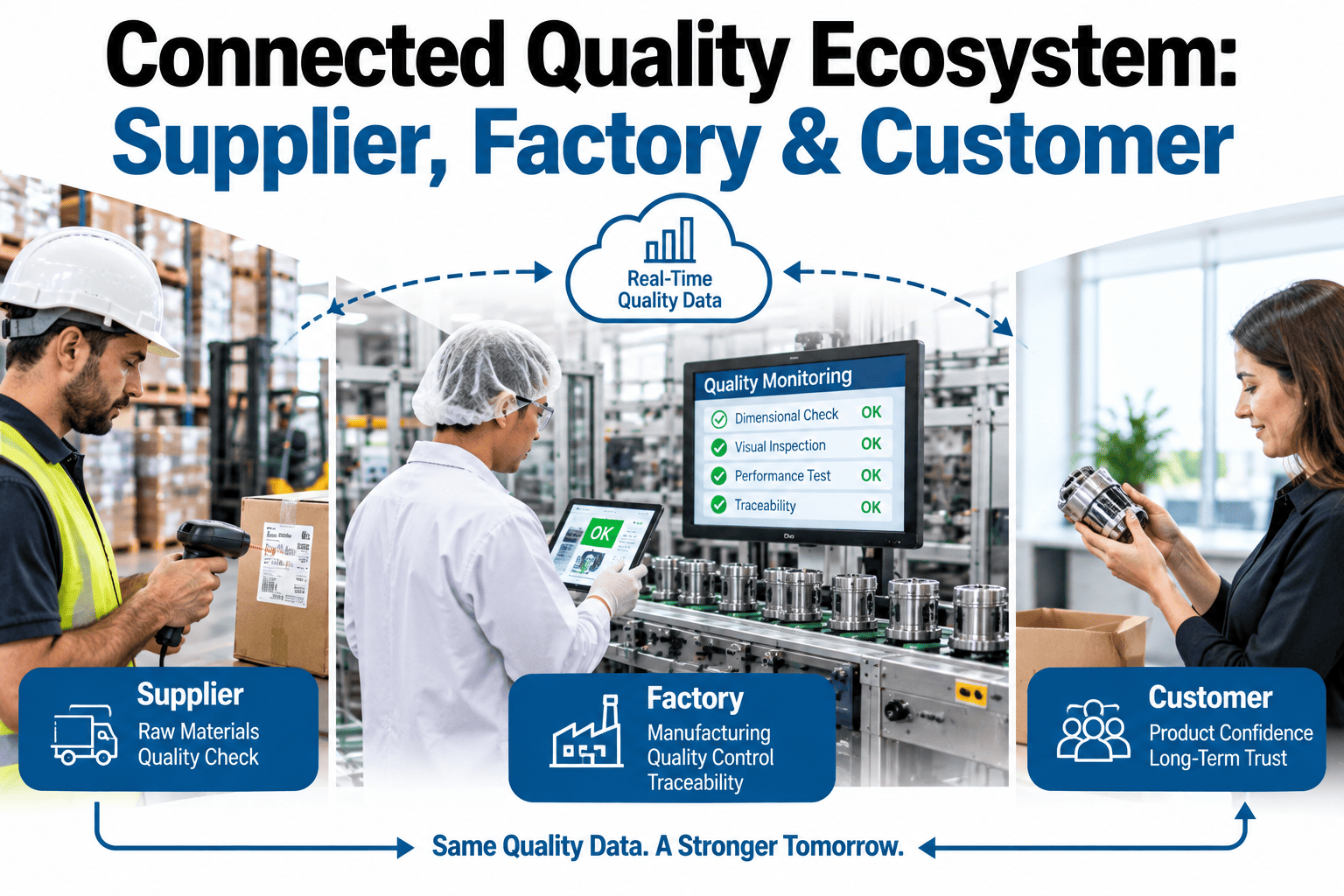
Connected Quality Ecosystem: Supplier, Factory & Customer
End-to-end quality data flow linking supplier quality, factory production, and customer feedback into one closed loop — so a defect pattern gets caught at its source, not three steps downstream.
Supplier
→
Factory
→
Customer
feedback loops back to source
Why Quality Data Stops Traveling Between These Three Points
Each stage of the supply chain has its own reason for tracking quality data the way it does — a supplier quality team manages incoming material inspection records, a factory floor team logs in-process defects against production runs, and a customer service or returns team catalogs complaints as they arrive. None of these teams was ever organizationally incentivized to make sure their data reached the other two, which is exactly why the connection breaks down by default rather than by any specific decision.
What Flows Through Each Connection Point
A genuinely connected ecosystem isn't a single database holding everything — it's a defined data flow between three distinct systems, each still owned by the team closest to that stage of the process.
SUPPLIER → FACTORY
Incoming Material Quality Data
Raw material inspection results, supplier defect rates, and lot-level quality records flow into factory production planning before goods enter the line.
FACTORY → CUSTOMER
In-Process & Final Inspection Data
Production defect records and final quality checks travel with the product, so shipped batch quality is traceable if a customer issue arises later.
CUSTOMER → SUPPLIER
Feedback Loop Closure
Customer complaints and returns are traced back through factory batch records to the specific supplier lot, closing the loop at its true source.
Disconnected vs Connected — What Actually Changes
The practical difference between a disconnected quality process and a genuinely connected ecosystem shows up most clearly in how long it takes to trace a defect pattern back to its origin, and how many additional units ship before that tracing happens.
| Scenario | Disconnected Process | Connected Ecosystem |
|---|
| Time to trace a customer complaint to its source | Days to weeks, often manual investigation | Minutes to hours via linked batch records |
| Units shipped before a pattern is caught | Potentially an entire production run or more | Limited to the batch already in transit when flagged |
| Supplier accountability for recurring defects | Difficult to prove without consolidated data | Clear, data-backed pattern across multiple incidents |
| Factory response to incoming material issues | Often discovered only after production defects appear | Flagged before affected material enters the line |
Connect Your Supplier, Factory, and Customer Quality Data
iFactory links incoming material inspection, factory production quality, and customer feedback into one traceable system, so a defect pattern is caught at its source.
Building the Connection Without Disrupting Existing Teams
Connecting these three stages doesn't require centralizing every team's workflow into a single new system. The steps below reflect how most textile manufacturers build the connection while letting each team continue working in a way that fits their day-to-day process.
1
Standardize Batch and Lot Identifiers
A consistent identifier that follows material from supplier receipt through production and into finished goods is the foundation every connection depends on.
2
Link Systems, Not Just Reports
Live data connections between supplier, factory, and customer systems replace periodic manual report exchanges that quickly go stale.
3
Build Traceability Views for Each Team
Each team gets a view relevant to their own role — a factory manager doesn't need the full customer complaint database, just the traceable link back to it when needed.
A VP of Quality on Tracing a Recurring Defect to Its Actual Source
"
We had a recurring fabric pilling complaint from one specific customer account that had been going on intermittently for close to a year, and every time it came up, our response was essentially to apologize and offer a replacement, because we genuinely had no efficient way to trace which production batch, let alone which supplier lot, was actually behind each specific complaint. Once we connected our supplier lot records through to our factory batch tracking and then through to customer complaint records, the pattern became obvious almost immediately — every single complaint traced back to material from one specific supplier, delivered during a fairly narrow window. That supplier had apparently changed a treatment process on their end without notifying us, and it was affecting pilling resistance in a way that wasn't caught during our standard incoming inspection because we weren't testing for that specific property at receipt. We would never have found that connection manually, because the complaints were spread out enough over time that nobody connecting individual customer service tickets would have seen the pattern the data made obvious in minutes.
— VP of Quality, Textile Manufacturing Company · Connected Supplier, Factory, and Customer Data Across 3 Facilities
Frequently Asked Questions
Do our suppliers need to adopt new software for a connected quality ecosystem to work?
Not necessarily full software adoption — many connected quality systems are designed to accept data from suppliers through relatively simple mechanisms like structured spreadsheet uploads or a lightweight portal, rather than requiring every supplier to adopt a new complex platform. The key requirement is consistency in how lot identifiers and quality data are formatted and submitted, which can often be achieved with a defined data submission standard rather than mandating a specific software tool on the supplier's end.
How far back does batch traceability typically need to go to be useful?
This depends on your product's typical time from production to customer use and complaint, but many textile manufacturers find that traceability covering twelve to twenty-four months back is sufficient for the large majority of quality investigations, since most defect patterns surface within that window. Products with longer shelf life or use cycles before an issue might reasonably surface may warrant a longer retention window, which is worth determining specifically for your own product categories rather than applying a generic standard.
How do we get customer service teams to actually feed complaint data back into the quality system?
This connection tends to work best when it requires minimal extra effort from the customer service team — capturing the product batch or lot identifier as a standard field during complaint intake, rather than asking them to manually cross-reference and report quality patterns themselves. Once that identifier is captured consistently, the tracing back to supplier and factory records can happen automatically within the connected system, without putting additional analytical burden on a team whose primary job is customer service, not quality investigation.
What's the difference between a connected quality ecosystem and a standard quality management system?
A standard quality management system typically focuses on documentation, procedures, and audit readiness within a single facility or organization, while a connected quality ecosystem specifically addresses the data flow across organizational boundaries — supplier, factory, and customer — that a QMS alone often doesn't touch. The two are complementary rather than competing: a solid QMS provides the internal process discipline, while the connected ecosystem ensures quality data actually travels across the full chain rather than staying siloed within each individual organization's own systems.
Can iFactory help connect our existing supplier, factory, and customer quality data?
Yes — iFactory works with textile manufacturers to establish standardized batch identifiers and build live data connections between existing supplier, factory, and customer systems, without requiring a full replacement of tools each team already relies on. To discuss connecting your specific quality data sources,
book a demo with our team.
Close the Loop Between Supplier, Factory, and Customer
A defect pattern hiding across three disconnected systems can ship for months before anyone notices. iFactory connects supplier, factory, and customer quality data into one traceable loop so patterns surface at their source.