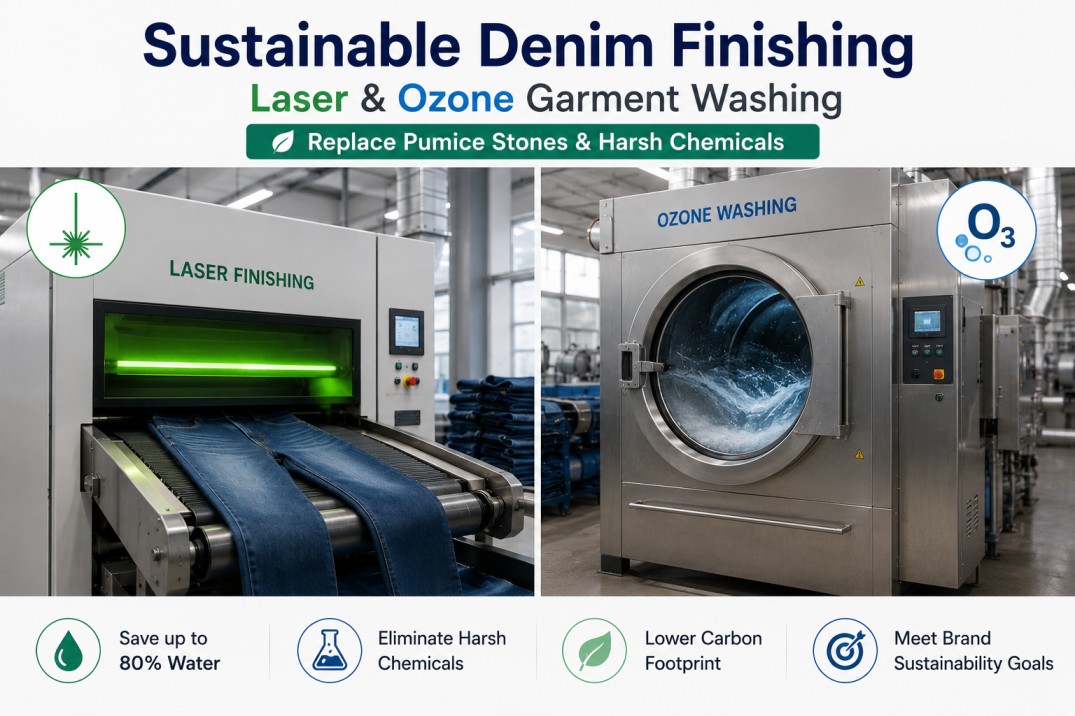
The global denim industry produces over 6 billion garments annually, and every pair of jeans has traditionally consumed 70 liters of water, 1 kilowatt-hour of energy, and 150 grams of chemicals during its finishing process. With regulatory pressure mounting across the US and EU — including the EU Textile Strategy's Digital Product Passport requirements and California's pending extended producer responsibility rules — brands and manufacturers can no longer treat garment washing as an operational afterthought. Laser engraving and ozone oxidation have emerged as the two most scalable alternatives to pumice stone washing and potassium permanganate spraying, and the data justifies the transition across every measurable dimension.
Ready to Retrofit Your Finishing Line for 2026 Compliance?
iFactory integrates laser and ozone equipment monitoring, production throughput analytics, and sustainability reporting into a single manufacturing operations platform.
Comparing the Three Dominant Garment Finishing Approaches
Each approach carries distinct trade-offs across water usage, chemical dependency, worker safety, throughput, and quality consistency. The table below maps the operational data for traditional pumice washing, laser engraving, and ozone oxidation side by side.
| Parameter | Traditional Pumice Wash | Laser Engraving | Ozone Oxidation |
|---|---|---|---|
| Water per garment | 70 L | 0 L (dry process) | Up to 80% reduction |
| Energy impact | Baseline | -62% | -45% |
| Chemical usage | 150 g per garment | -85% | Near zero |
| Production throughput | 10-30 units/hr per worker | 100-200 units/hr per machine | Comparable to traditional |
| Fabric strength retention | Baseline | +50% vs traditional | Comparable |
| Pattern consistency | Variable (manual) | Digital, identical repeat | Uniform across batch |
| Worker health risk | Silicosis, chemical exposure | Eliminated | Eliminated |
| Setup cost per line | Low (existing infrastructure) | Moderate to high | Moderate |
| Regulatory alignment | Increasingly non-compliant | Fully aligned | Fully aligned |
The Three-Stage Digital Finishing Workflow
Modern sustainable finishing replaces mechanical abrasion and chemical bleaching with a controlled digital workflow. The sequence below represents the production architecture deployed by leading denim manufacturers operating at scale.
Pattern Design & Laser Mapping
Design files are uploaded directly to the laser control system. Whiskers, abrasions, grinding, and ripping patterns are mapped digitally with sub-millimeter precision. No physical samples, no manual stencils, no chemical spray masks.
Ozone Chamber Bleaching
Garments enter the ozone chamber where controlled oxidation breaks down indigo molecules on exposed fibers. The result replicates sun-bleached vintage effects without hypochlorite or permanganate. Ozone reverts to oxygen after treatment — zero toxic effluent.
Automated Production Analytics
Every cycle — laser exposure time, ozone concentration, energy consumed, water used — is captured into the operations platform. Real-time dashboards surface throughput, quality yield, and per-garment sustainability metrics for compliance reporting.
Standardize Your Finishing Operations Across Every Line
iFactory connects laser engravers, ozone generators, wash tunnels, and dryers into one production view. Monitor cycle times, chemical substitution progress, and water reduction targets from a single dashboard.
What the Industry Data Actually Shows
Beyond anecdotal case studies, aggregate production data from facilities that have transitioned to laser-ozone hybrid finishing reveals quantifiable improvements in five essential categories that directly affect both compliance posture and margin structure.
Compliance Deadlines That Make the Business Case
Sustainability regulations are accelerating faster than most finishing operations are prepared for. The following milestones create a hard deadline for transitioning away from traditional chemical-intensive garment washing.
EU Separate Textile Waste Collection
Mandatory separate collection of textile waste across all EU member states begins. Manufacturers must track and report finishing waste streams including pumice sludge and chemical effluent.
US State-Level EPR Proposals
California, New York, and Washington advance textile extended producer responsibility bills. Brands must demonstrate verifiable water and chemical reduction across finishing supply chains.
EU Digital Product Passport
Textile products sold in the EU must include a Digital Product Passport containing verified sustainability data for every manufacturing step, including finishing chemical and water usage.
Zero Discharge of Hazardous Chemicals
ZDHC program milestones require elimination of all priority hazardous chemicals from textile finishing by 2028, directly affecting potassium permanganate and chlorine-based bleaching.
Frequently Asked Questions
Can laser and ozone fully replace traditional washing?
For most commercial denim finishes — whiskers, grinding, abrasions, vintage bleaching, and overall fading — yes. Laser handles pattern-based distressing with zero water, and ozone achieves the bleaching effect without chlorine or permanganate. Certain specialized finishes still benefit from enzymatic treatment, but the hybrid laser-ozone approach covers 90% of production SKUs in the average finishing facility.
What is the payback period for laser and ozone equipment?
Facility operators report payback periods between 14 and 24 months depending on production volume. The savings come from eliminating chemical procurement, reducing water and energy costs, cutting effluent treatment expenses, and tripling throughput per labor hour. Higher-volume facilities naturally see faster returns.
How does iFactory support laser and ozone production monitoring?
iFactory connects directly to laser engraving systems and ozone generators via industrial IoT protocols. The platform captures per-garment cycle data, energy consumption, water usage, and chemical substitution progress in real time. Production dashboards track throughput, quality yield, and sustainability metrics. The data feeds directly into Digital Product Passport preparation and regulatory compliance reporting, eliminating manual data collection across finishing lines.
Do laser and ozone work on all fabric compositions?
Laser finishing performs optimally on fabrics with at least 98% cotton content. The laser ablates the indigo-dyed surface fibers, so the substrate must be cellulosic. Ozone reacts with indigo molecules specifically and works on any indigo-dyed fabric regardless of blend. Stretch denim with elastane requires adjusted ozone parameters to avoid degrading synthetic fibers, which experienced operators calibrate per batch.
What infrastructure changes are needed to adopt these technologies?
Laser systems require adequate electrical capacity, exhaust ventilation for vaporized indigo particulates, and compressed air lines. Ozone generators need water supply for the corona discharge cooling system and ventilation to maintain safe ozone concentration levels. Most existing wash-house facilities can accommodate both with moderate electrical and plumbing upgrades. The digital monitoring layer — iFactory — runs on standard industrial network infrastructure already present in most facilities.
Finishing Operations That Meet 2028 Compliance Standards Today
Stop retrofitting compliance after the regulations land. iFactory gives you the production visibility, equipment integration, and sustainability reporting infrastructure to prove your finishing line meets every emerging standard — from EU Digital Product Passport to California EPR.