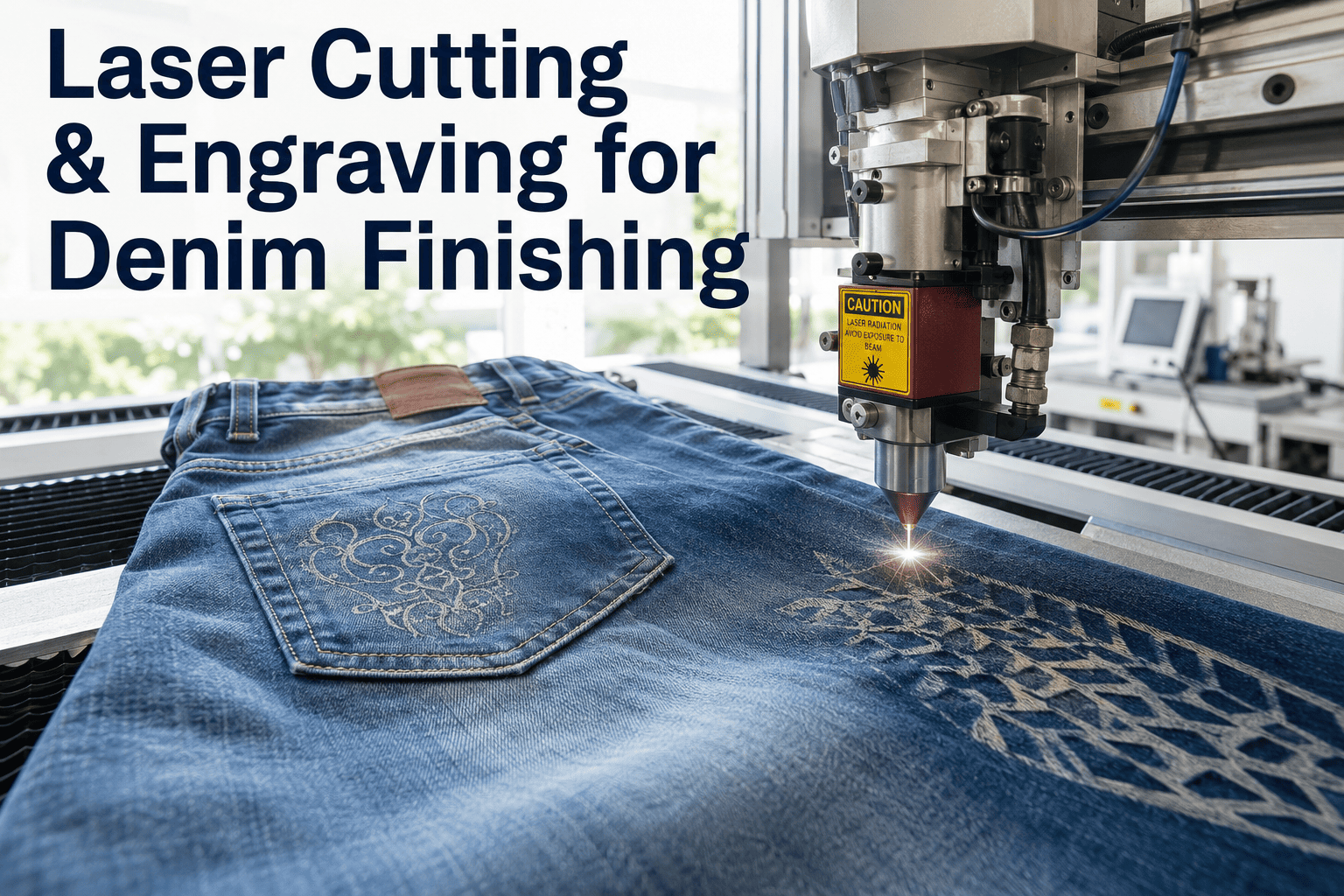
Denim finishing used to mean sandblasting booths full of silica dust, enzyme wash tanks that never produced quite the same fade twice, and a manual whisker pattern that depended entirely on which operator was on shift that day. Laser fading and engraving replaced the guesswork with a programmable beam that burns away indigo dye at a controlled depth, reproducing the exact same fade, whisker, or logo pattern on every single garment in a run. The catch is that laser output drifts with lens wear and ambient temperature, so a setting dialed in Monday morning can be subtly off by Thursday afternoon unless something is actively watching it. Teams evaluating AI-monitored laser parameter control can Book a Demo to see drift correction running against a live denim laser line.
Every Fade Pattern, Repeated Exactly, Garment After Garment.
iFactory monitors laser power, speed, and frequency in real time, correcting drift before it changes the fade pattern mid-run.
The Problem With Sandblasting and Enzyme Wash Fading
Manual sandblasting exposes operators to silica dust fine enough to cause respiratory illness, which is why the practice has been restricted or banned in a growing number of markets. Enzyme washing avoids the dust hazard but introduces a different problem: the fade result depends on bath temperature, enzyme concentration, and dwell time, all of which vary slightly between batches even with a written recipe.
Laser engraving removes both problems by replacing physical abrasion with a programmable beam that vaporizes indigo dye at whatever depth the pattern file specifies, with no dust and no wet chemistry involved. The pattern itself becomes a reusable digital file rather than a stencil or a wash recipe, which is what makes exact repeat runs possible across a full production order instead of a best-effort match.
The Laser Settings That Actually Control the Fade
Four settings determine how deep and how visible a laser fade pattern turns out, and each one interacts with the others rather than working in isolation.
Power (Watts)
Controls how much dye is removed per pass. Too high burns through the weave; too low leaves the fade barely visible.
Speed (mm/s)
Determines dwell time per point on the fabric. Slower speed deepens the fade but raises the risk of scorching.
Frequency (kHz)
Sets pulse overlap, which shapes how smooth or textured the fade edge appears on the finished garment.
Focal Distance
Even small shifts change the beam's spot size, which is one of the most common sources of unnoticed drift.
Why the Same Program File Doesn't Always Give the Same Fade
A laser program file specifies power, speed, and frequency precisely, but the beam that actually reaches the fabric depends on more than the program alone. Lens contamination from denim dust gradually reduces effective power delivered to the fabric, ambient temperature shifts change the laser tube's output slightly across a shift, and fabric tension variation changes the effective focal distance across a garment's surface.
Continuous Power Verification
Output power is checked against the program's target continuously rather than at shift start only, catching lens-wear drift as it happens.
Vision-Based Pattern Check
Camera inspection compares the actual fade result against the reference pattern on a sampling basis through the run.
Automatic Compensation
Detected drift triggers a small power or speed correction so subsequent garments return to the target fade depth.
Laser Fading vs. Traditional Finishing Methods
| Factor | Sandblasting | Enzyme Wash | Laser Fading |
|---|---|---|---|
| Repeatability | Low, operator-dependent | Moderate, batch-dependent | High, program-defined |
| Health hazard | Silica dust exposure | Chemical handling | None, dry dry process |
| Water use | None | High | None |
| Pattern change time | New stencil required | New recipe trial | File swap only |
Results After AI-Monitored Laser Control
Reduction in garments rejected for fade depth or pattern mismatch after drift correction is deployed.
Compared with enzyme wash finishing for an equivalent visual fade effect on the same garment volume.
Typical time to switch a laser line from one pattern file to another between production orders.
Adding Drift Monitoring to an Existing Laser Line
Monitoring is added alongside the existing laser hardware rather than requiring a replacement machine. A camera and power sensor are fitted to the line, a reference pattern library is built from current best-run garments, and the system runs in observation mode for the first few production runs before compensation is switched on. Most lines move from installation to active drift correction within three to five weeks.
Laser Denim Finishing — Common Questions
Does laser fading work on all denim weights and blends?
Laser fading works across most cotton and cotton-blend denim weights, though heavier weights and stretch blends with elastane typically need their own calibrated parameter set rather than reusing a lighter fabric's settings. A parameter library built per fabric type is what keeps results consistent across a mixed product line.
How is lens contamination actually detected before it affects output?
A continuous power check compares the beam's measured output against the program's target rather than waiting for a visible pattern defect to appear. A gradual drop in delivered power relative to target is the earliest signal of lens contamination, well before it changes the fade result enough to be visible on a finished garment.
Can the same system flag a pattern file error before a full run is lasered?
Yes, the vision check compares the first few garments in a run against the reference pattern before the full batch proceeds, catching a wrong file or an incorrect scaling setting early rather than after hundreds of garments have already been processed. Teams can review setup details with iFactory Support.
Does adding monitoring slow down the laser line's throughput?
No, the power check and pattern sampling run alongside normal production without adding a separate inspection step, since the camera and sensor observe the process as garments move through rather than pausing the line for a manual check.
What's needed to get a pilot running on one laser line?
A pilot typically needs one laser machine, its current pattern files, and four to six weeks of production time to build a reference library and validate drift correction against a real run. Teams ready to scope a pilot can Book a Demo to review a comparable denim line's setup.
See Drift Correction Running on a Live Denim Line.
Talk to iFactory about monitoring laser power, pattern accuracy, and fade consistency across your finishing floor.





.jpg)