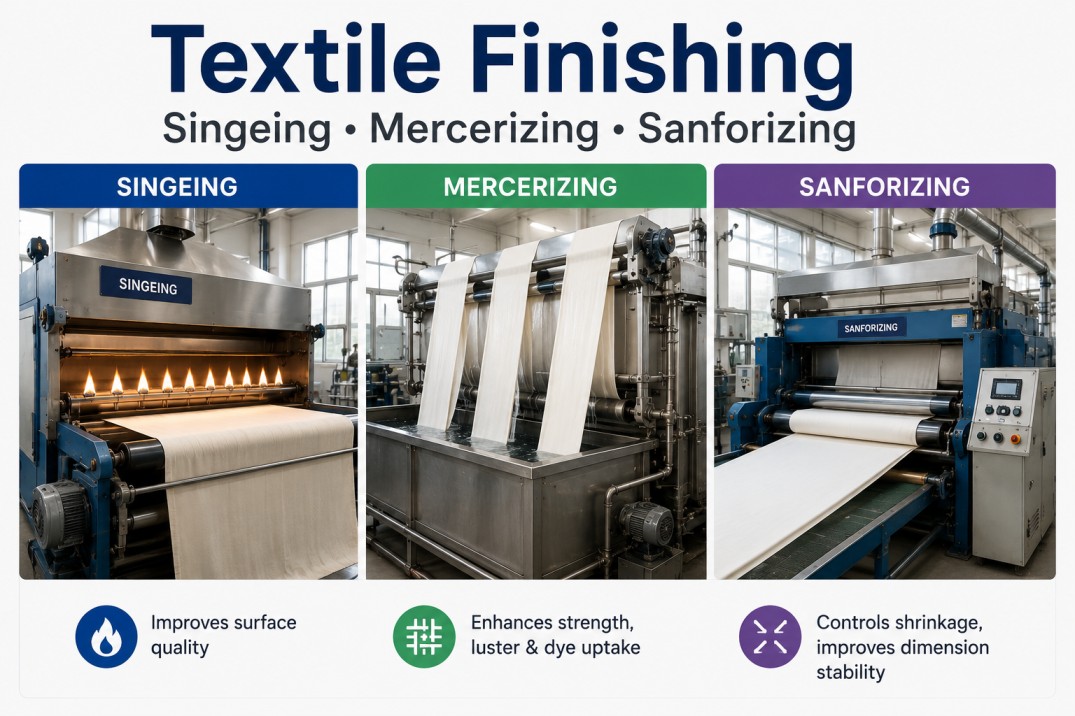
Textile finishing operations determine the final quality, appearance, and performance of every fabric that leaves a mill. Singeing removes protruding fibers for a clean surface, mercerizing increases dye uptake and luster, and sanforizing controls shrinkage to within 1 to 3 percent — but each process requires precise control of machine parameters, chemical concentrations, and contact times. A deviation of 2 seconds in singeing flame contact or 5 grams per liter in mercerizing caustic concentration can shift the finished fabric properties outside specification, resulting in rejected rolls, customer claims, and re-processing that consumes both time and margin. Most finishing departments rely on operator experience and periodic lab testing to manage these parameters, leaving them blind to drift between tests. iFactory Textile Finishing Intelligence Platform monitors every critical parameter across singeing, mercerizing, sanforizing, calendering, and stentering operations — detecting drift in real time, alerting operators before fabric goes off-spec, and correlating finishing parameters with final fabric quality data to continuously optimize the process window for every fabric style.
Stop Guessing — Know Every Finishing Parameter in Real Time
iFactory Finishing Intelligence connects to your existing machines — singeing frames, mercerizing ranges, sanforizing units, stenters, and calenders — to deliver real-time visibility into every process parameter that affects fabric quality. The platform detects drift in flame temperature, caustic concentration, overfeed percentage, and frame tension before the fabric reaches the inspection table. Facilities using the system report 45 percent reduction in finishing seconds and 30 percent fewer customer claims related to dimensional stability and appearance defects. Book a 30-minute demonstration to see your finishing line data live on the platform.
Three Critical Finishing Operations That Define Fabric Quality
Each finishing operation serves a distinct purpose in transforming grey fabric into finished goods that meet customer specifications. The machine settings and process conditions at each stage directly affect the final fabric properties, and drift in any single parameter can degrade quality across multiple dimensions.
The Complete Finishing Line: From Grey Fabric to Finished Roll
A typical textile finishing line processes fabric through four sequential stages, each with its own set of machine parameters, chemical formulations, and quality control points. The entire line must be monitored and balanced to produce consistent finished fabric quality.
Preparation
Singeing removes surface fibers, desizing removes warp size, and scouring removes natural impurities. Chemical concentrations, temperatures, and contact times at this stage determine the foundation for all subsequent finishing quality.
Chemical Finish
Mercerizing and bleaching apply chemical treatments that alter fiber structure and appearance. Caustic concentration, stabilizer dosage, and dwell time must be maintained within tight windows to achieve consistent luster and whiteness.
Mechanical Finish
Sanforizing, calendering, and compacting apply mechanical treatments that set fabric dimensions, surface texture, and hand feel. Overfeed, tension, temperature, and pressure must be coordinated to achieve target shrinkage and appearance.
Inspection & Shipment
Finished fabric is inspected for appearance, dimensional stability, hand feel, and width. Inspection data feeds back to process monitoring, enabling real-time adjustment of upstream parameters when quality drift is detected.
Catch Finishing Drift Before It Becomes Seconds
iFactory Finishing Intelligence monitors every critical parameter across your entire finishing line — singeing flame temperature and fabric speed, mercerizing caustic concentration and dwell time, sanforizing overfeed and moisture, stenter frame width and temperature profile. The platform alerts operators the moment any parameter drifts outside the acceptable window, typically 5 to 15 minutes before the fabric reaches the inspection table. This early warning gives operators time to adjust the process before off-spec fabric accumulates. Facilities using real-time finishing line monitoring report 45 percent reduction in seconds and 30 percent fewer customer claims related to shrinkage, luster variation, and appearance defects.
QC Points Across the Finishing Line
Each finishing stage has specific quality parameters that must be verified at defined checkpoints. Real-time monitoring combined with periodic lab testing creates a complete quality control system that catches deviations at the source rather than at final inspection.
- Surface appearance rating against standard (visual or FP grade)
- Fabric weight loss within target range (2–8% depending on fiber)
- Flame temperature logged per batch with trend monitoring
- Burner distance and fabric speed recorded for traceability
- Caustic concentration verified at impregnation and recovery sections
- Barium activity number measured per lot (target 100–115)
- Fabric width after mercerizing vs. target width specification
- Dye uptake ratio tested on swatch before lot release
- Residual shrinkage tested per roll (warp and weft direction)
- Overfeed percentage logged and correlated to shrinkage results
- Fabric width and straightness measured at exit
- Moisture content verified for dimensional stability compliance
- Visual inspection per 4-point system or automated vision grading
- Shrinkage test results within customer specification (1–3% typical)
- Hand feel and drape verified against approved reference standard
- Roll width, length, and packaging compliance confirmed
What Intelligent Finishing Line Monitoring Delivers
Textile mills that deploy real-time monitoring across their finishing lines report consistent improvements in quality, efficiency, and customer satisfaction. The metrics below represent averages across iFactory deployments in woven and knit finishing facilities.
Frequently Asked Questions
How does real-time monitoring detect singeing quality drift?
The platform continuously monitors flame temperature at each burner, fabric speed, burner-to-fabric distance, and singeing intensity profile across the fabric width. These parameters are compared against the recipe specification for the current fabric style. When any parameter deviates beyond the configured tolerance, the system generates an alert with the specific deviation, direction, and recommended correction. For example, if flame temperature drops by 30 degrees while fabric speed remains constant, the system alerts the operator to check gas pressure or burner nozzle condition — typically 8 to 12 minutes before the affected fabric reaches the inspection point. The platform also correlates singeing parameters with downstream inspection results to continuously refine the optimal process window for each fabric style.
What sensors are needed to monitor caustic concentration in mercerizing?
Caustic concentration in mercerizing is monitored using inline conductivity sensors and density meters installed at the impregnation trough and recovery section. Conductivity sensors provide real-time concentration readings with accuracy of ±2 g/L, sufficient for detecting drift before it affects fabric quality. The platform also monitors caustic temperature, which affects swelling efficiency, and fabric dwell time calculated from speed and immersion length. For facilities that require higher accuracy, the platform supports integration with automatic titration systems that take periodic samples and provide lab-grade concentration measurements. Concentration readings are logged per lot and correlated with barium activity test results from the lab, creating a complete mercerizing quality record for each production batch.
How does the platform link sanforizing overfeed to final shrinkage results?
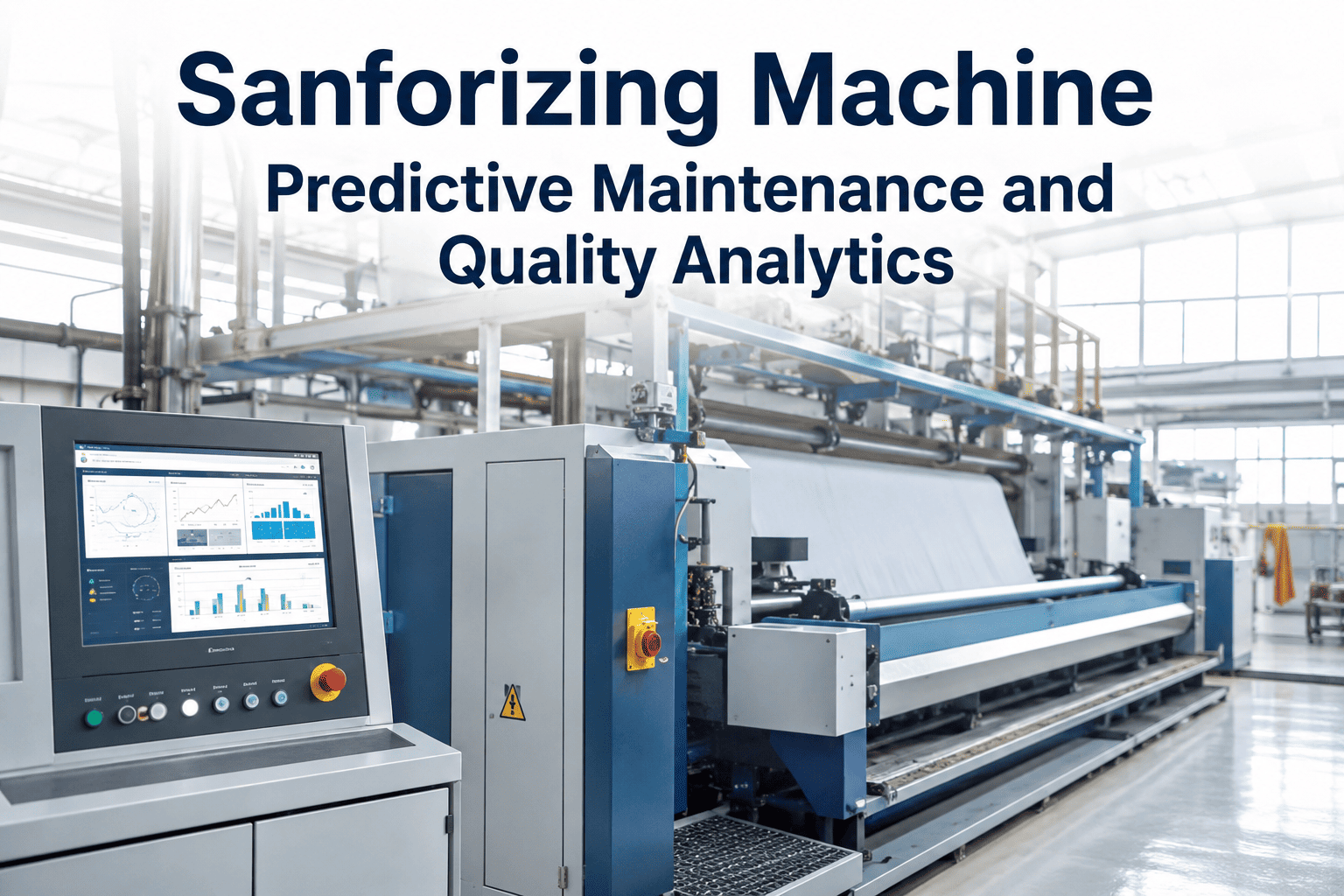
The platform records the overfeed percentage set on the sanforizing unit for every roll produced, along with Palmer cylinder temperature, fabric moisture content at entry and exit, and compressive force. When the QC lab reports the residual shrinkage test result for that roll, the system automatically pairs it with the recorded machine parameters. Over time, the platform builds a correlation model that predicts the expected shrinkage outcome for any combination of overfeed, moisture, temperature, and fabric construction. If a parameter combination would produce shrinkage outside the customer specification, the system alerts the operator before the roll is run, preventing off-spec fabric. This predictive capability reduces dependence on end-of-line shrinkage testing and enables first-time-right sanforizing for every fabric style.
Can the platform detect stenter frame width deviation and temperature profile issues?
Yes, the platform connects to stenter frame sensors that monitor rail width at entry and exit, temperature profile across each zone (typically 4 to 8 zones), exhaust humidity, and fabric overfeed. Width deviation of more than 2 mm from target triggers an immediate alert, as does a temperature spread exceeding 5 degrees across zones at the same setpoint. The platform tracks temperature profile trends over time to detect burner or heating element degradation before it affects fabric quality. Exhaust humidity monitoring prevents condensate drip defects by maintaining the correct moisture balance in each zone. Combined with fabric temperature measurement at the stenter exit, these parameters give operators complete visibility into the drying and heat-setting process that determines fabric width, hand feel, and dimensional stability.
What is the typical ROI for finishing line monitoring?
The return on investment for finishing line monitoring comes from three primary sources: reduction in finishing seconds that would otherwise be sold at a discount or reprocessed, reduction in customer claims and chargebacks for shrinkage and appearance defects, and reduction in chemical and energy waste from out-of-spec process conditions. For a typical finishing plant processing 15 million meters per year, a 45 percent reduction in seconds from a baseline of 4 percent represents 270,000 meters of fabric that moves from discounted to first-quality pricing. Combined with claim reduction and chemical savings, the typical payback period is 6 to 12 months. Facilities with multiple finishing lines or high-value fabric segments achieve even shorter payback due to the higher absolute value of quality improvement.
See Your Finishing Line Data Live on the Platform
Schedule a 30-minute demonstration to see iFactory Finishing Intelligence monitoring your actual machine parameters in real time. The demo uses a data set matched to your finishing line configuration — singeing frame, mercerizing range, sanforizing unit, stenter, and calender — showing live parameter dashboards, drift alerts, and quality correlation reports from the first screen share. No commitment, no pressure — just a clear view of how real-time finishing line monitoring reduces seconds, prevents customer claims, and gives your team the visibility they need to produce consistent quality every shift. Facilities that move forward after the demo typically go live with their own data within 6 weeks.