Polyester holds a crease because of what happens to its polymer chains above a specific temperature threshold, not because of anything applied to the surface of the fibre. Heat setting works by relaxing those chains into a new configuration and then locking them there through controlled cooling, and getting the temperature window wrong in either direction costs the mill dimensional stability, dye uniformity, or both. See how iFactory tracks stenter zone temperature, dwell time, and cooling rate against fabric outcomes with a Book a Demo.
Dimensional Stability Is Decided In A 15 To 50 Second Window
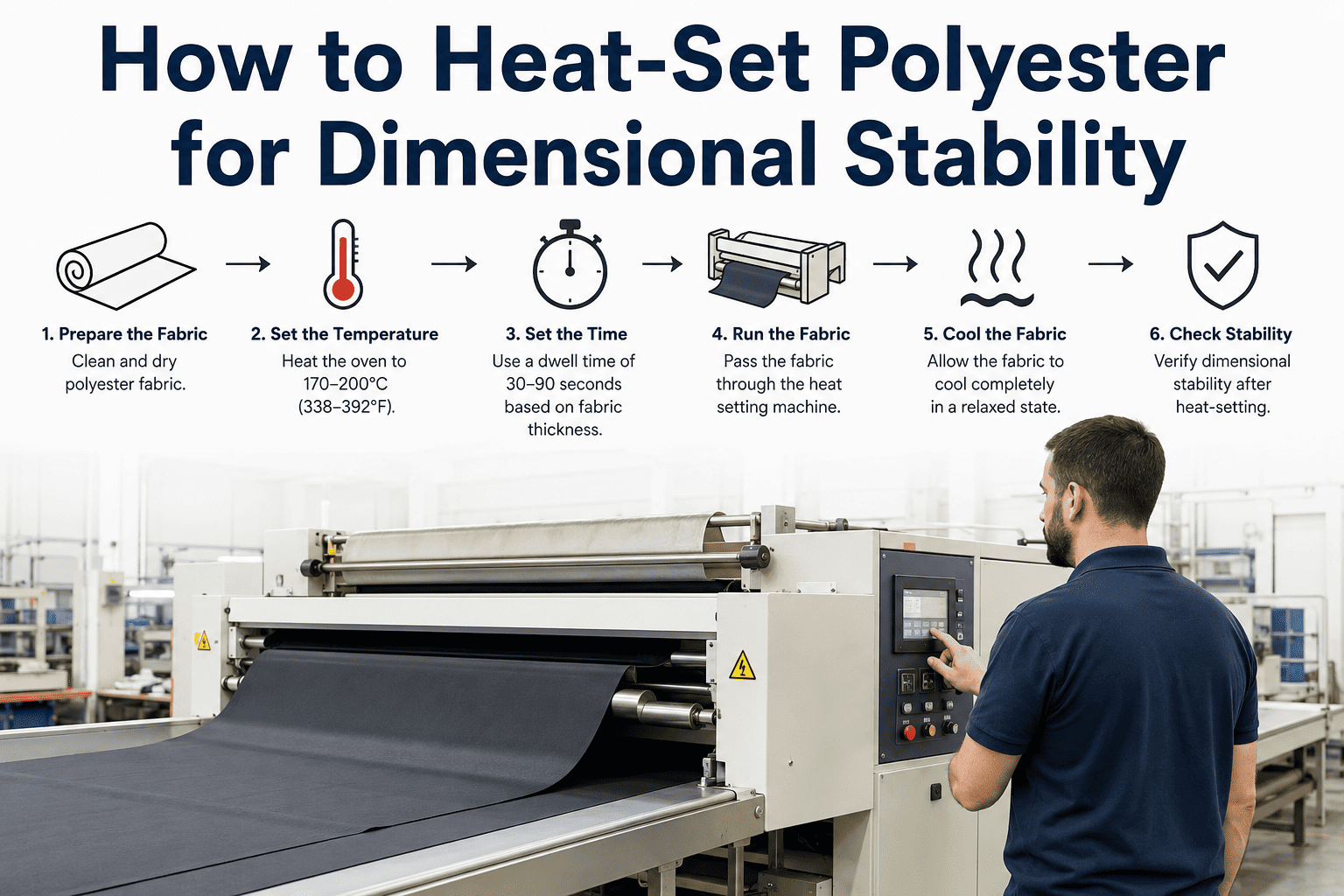
Heat setting takes polyester above its glass transition temperature so polymer chains can relax into a stress-free configuration, then locks that shape in place through controlled cooling. Standard polyester heat setting typically runs between 170°C and 210°C for 15 to 50 seconds, and drifting outside that window in either direction shows up later, not immediately.
What Happens In Each Zone Of The Stenter Frame
A stenter frame typically runs 80 to 100 feet long, and the fabric passes through distinct temperature zones on its way through, with each zone playing a specific role in the setting process rather than simply applying uniform heat throughout.
Entry & Weighing
Fabric enters the stenter and is weighed to establish a baseline before temperature exposure begins, giving a reference point for shrinkage and weight change later in the process.
Heating Above Tg
Temperature rises above the polyester glass transition point, allowing polymer chains to relax and molecules to vibrate freely enough to rearrange into a lower-stress configuration.
Setting Dwell
Fabric holds at peak setting temperature for the required dwell time, typically 15 to 50 seconds depending on fabric weight and construction, allowing the new configuration to stabilize.
Controlled Cooling
Fabric temperature is brought back below the glass transition point using cool air before leaving the frame, locking the relaxed polymer configuration permanently in place.
A Few Degrees Of Zone Drift Won't Show Up Until The Dye Bath
iFactory logs zone-by-zone stenter temperature and dwell time against every roll so setting quality is verified before, not after, dyeing.
Setting Temperature Varies By Fibre, Not By Habit
Thermoplastic fibres each have their own glass transition and melting characteristics, and applying a polyester setting recipe to a nylon or blended fabric by habit rather than by fibre type is one of the more common causes of inconsistent results on mixed-fibre production floors.
| Fibre | Min Temp | Max Temp | Typical Time |
|---|---|---|---|
| Polyester | 170°C | 210°C | 15–50 sec |
| Polyamide 6.6 | 170°C | 210°C | 15–40 sec |
| Polyamide 6 | 160°C | 180°C | 15–40 sec |
| Triacetate | 160°C | 180°C | 15–40 sec |
Fabric weight and construction also affect required dwell time, since heat needs enough time to penetrate a heavier fabric evenly, not just reach the surface temperature target.
Setting Sequence Changes What The Process Is Actually Protecting
Heat setting can be performed before or after dyeing, and the choice is not interchangeable. Setting before wet processing is generally recommended to avoid creases and folds forming during subsequent treatment, while setting after dyeing carries the added risk of sublimating disperse dyes if the dye class and setting temperature are not carefully matched, which can shift or fade the finished colour.
Setting Before Or After Dyeing Both Work. Getting It Backwards Doesn't.
iFactory ties setting sequence and dye class data together so sublimation risk is flagged before the batch runs, not after inspection.
Where Heat Setting Most Often Goes Wrong
Heat setting defects rarely show up as an obvious visible flaw at the stenter exit, which is exactly why the same mistakes tend to repeat across multiple production runs before someone traces a downstream complaint back to the setting stage.
Uneven Zone Heating
Temperature variance across the width of the stenter causes uneven dye uptake later, since fabric set at different effective temperatures absorbs dye differently even from the same bath.
Insufficient Cooling Before Exit
Fabric leaving the stenter still above its glass transition temperature can distort or lose the set configuration before it fully stabilizes, undoing part of the setting work.
Gas-Fired Yellowing
Direct gas heating without proper indirect-air arrangement can introduce combustion byproducts that cause fibre yellowing, particularly on lighter shades.
Wrong Dye Class After Setting
Applying a disperse dye without accounting for the fabric's post-set thermal history risks partial sublimation during any later heat exposure, including finishing or pressing.
What Mills Typically See After Adding Zone-Level Stenter Monitoring
Mills that move from a single stenter setpoint reading to zone-by-zone temperature and dwell time tracking tend to catch dimensional stability and dye uniformity issues before the fabric leaves heat setting rather than after dyeing.
Frequently Asked Questions
Q: Why does unlevel dyeing sometimes trace back to heat setting rather than the dye bath itself?
Heat setting changes the physical structure of the polyester fibre, and uneven heating across the width or length of the stenter produces fabric with inconsistent internal stress and crystallinity, which in turn absorbs dye differently even when the dye bath itself is perfectly uniform. This means a shade variation complaint that looks like a dyeing problem on the surface can actually originate several process steps earlier, at the stenter, which is why tracing root cause requires zone-level setting data rather than just dye bath records. Reach out through Support Contact if unlevel dyeing keeps recurring despite consistent dye bath conditions.
Q: Is it better to heat set polyester before or after dyeing?
Setting before dyeing is generally the recommended sequence, since it stabilizes the fabric and prevents creases from forming during the wet processing that follows. Setting after dyeing is sometimes used for specific finishing goals but carries a real risk of sublimating disperse dyes if the dye class was not selected with post-dye heat exposure in mind, which can shift the finished shade in ways that are difficult to correct afterward. A Book a Demo session can walk through how sequence and dye class data help avoid this specific failure mode.
Q: What causes polyester fabric to yellow during heat setting even at a correct temperature?
Yellowing is most commonly linked to direct gas-fired heating systems without proper indirect-air arrangement, since combustion byproducts can interact with the fabric surface during the high-temperature setting process. An indirect-air heating stenter, which separates the combustion process from the air stream contacting the fabric, is specifically recommended to avoid this issue, and mills seeing recurring yellowing on light shades should check heating system configuration before assuming the problem is temperature-related.
Q: How is the degree of heat setting actually measured or verified?
One established method is iodine absorption testing, since properly heat-set polyester absorbs measurably less iodine than unheated material, giving a quantifiable way to assess whether the setting process achieved its intended molecular reconfiguration rather than relying purely on visual inspection or a temperature log. This kind of verification is particularly useful when troubleshooting a suspected under-set batch that looks acceptable on the surface but performs poorly on later dimensional stability testing.
Q: Can heat-set polyester still shrink or distort after leaving the stenter?
Yes, further thermal shrinkage or expansion can occur if the fabric is exposed to additional thermal processes after initial heat setting, particularly if a subsequent process pushes the fabric temperature back above its glass transition point without the same controlled cooling. This is why garment-stage pressing, laminating, or other heat-involving finishing steps need to account for the fabric's original setting temperature rather than being treated as thermally neutral operations.
Get Dimensional Stability Right The First Time Through The Stenter
iFactory connects zone temperature, dwell time, and setting sequence data to catch drift before it reaches the dye range.