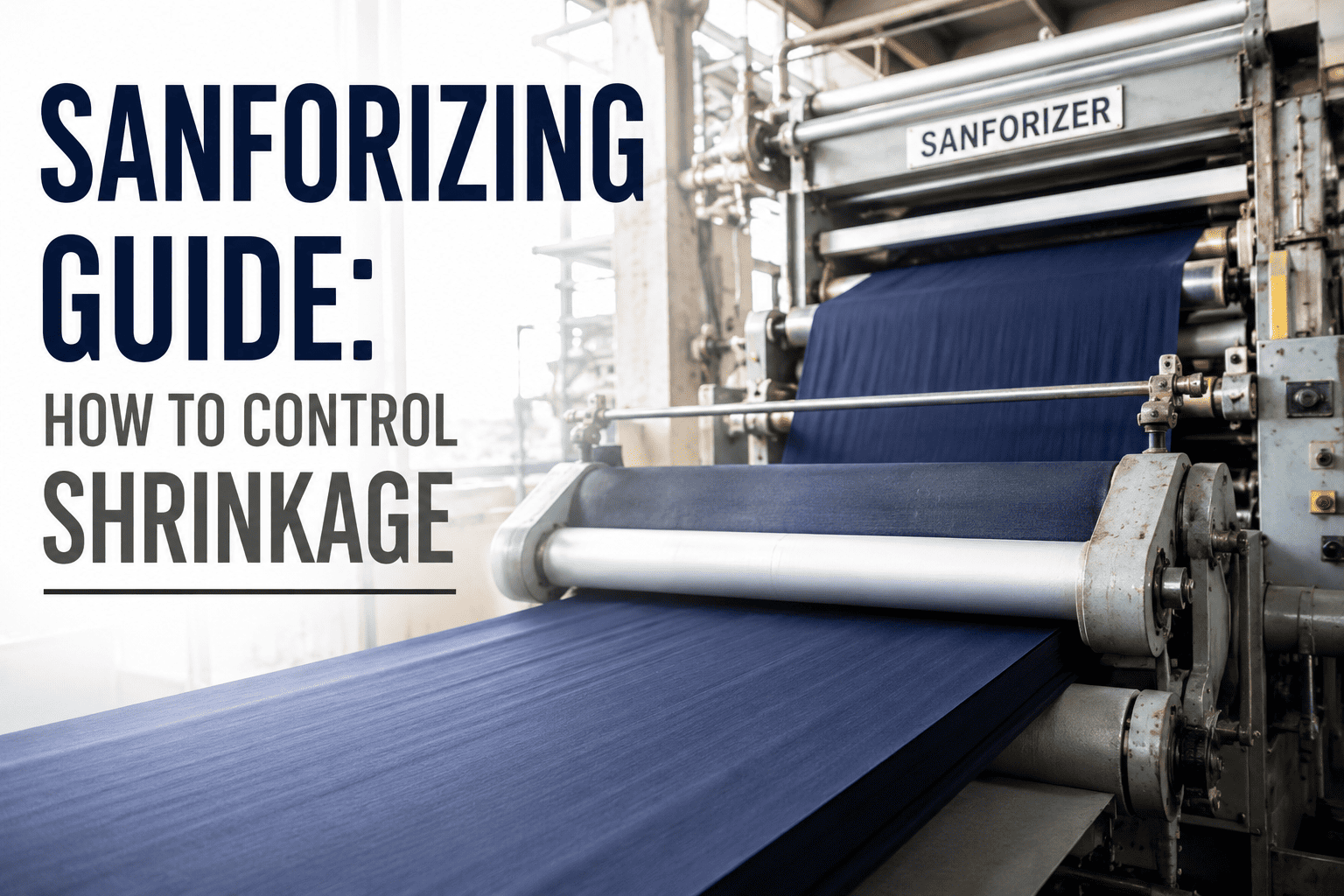
A pair of jeans that shrinks two sizes after the first wash is not a fabric defect in the traditional sense — it is a sanforizing process that never fully removed the latent shrinkage built into the fabric during weaving and finishing. Compressive shrinkage is the last mechanical step standing between a roll of fabric and a garment that holds its dimensions through the wash cycles a buyer's technical specification promises. For fabric mills and garment-grade finishers, the sanforizing range is deceptively simple in concept — a rubber blanket compresses fabric before it can relax on its own — but the machine parameters that determine whether AATCC 135 wash-shrinkage targets are actually met are easy to get subtly wrong, as outlined further in iFactory's support documentation.
01 / What Sanforizing Actually Removes From Fabric
Woven fabric leaves the loom carrying residual tension from warp yarns held under stress throughout weaving, and further tension is added during dyeing, drying, and stentering. That stored tension is latent shrinkage — it does not disappear until the fabric is either washed by the end consumer or mechanically pre-shrunk on a sanforizing range. The sanforizing process forces the fabric to give up this stored length before it reaches the garment stage, compressing the fabric between a thick rubber blanket and a heated cylinder so that the yarns are physically pushed closer together in a controlled, repeatable way, rather than being left to shrink unpredictably in a consumer's washing machine.
02 / The Compressive Shrinkage Process, Step by Step
A sanforizing range moves fabric through a defined sequence of moisture conditioning, mechanical compression, and heat setting. Each stage has a narrow operating window, and skipping or rushing any one of them is the most common reason a fabric passes an in-house shrinkage check but fails a buyer's independent lab test.
03 / Machine Parameters That Determine Pass or Fail on AATCC 135
Sanforizing operators typically control four variables, and each one has a direct, measurable effect on final residual shrinkage. Getting one parameter right while leaving another loose is a common reason fabric tests inconsistently across a production run.
| Parameter | Function | Typical Range | Effect If Out of Range |
|---|---|---|---|
| Blanket Compression | Degree of yarn compaction achieved per pass | 3-8% compression depending on fabric weight | Under-compression leaves latent shrinkage; over-compression distorts weave structure |
| Fabric Moisture | Yarn mobility under compression pressure | 8-12% moisture content entering the blanket | Dry fabric resists compaction; over-wet fabric slips and tracks unevenly |
| Cylinder Temperature | Sets and locks the compacted yarn state | 100-130°C depending on fiber content | Low heat allows compaction to partially relax after winding |
| Line Tension | Prevents stretch-back during cooling and winding | Fabric-specific, set to minimum stable tension | Excess tension re-introduces the shrinkage the process just removed |
04 / Why Fabric Passes In-House but Fails at the Buyer's Lab
One of the more frustrating patterns mills encounter is a fabric that clears an in-house shrinkage check comfortably, only to fail when retested by a buyer's independent laboratory weeks later. This is rarely a testing dispute — it usually reflects a real difference between the fabric state at the moment it left the sanforizing range and its state after transport, storage, and handling.
05 / Fiber Content Changes the Compression Math
A compression and temperature profile calibrated for 100% cotton will not transfer cleanly to a cotton-polyester blend, and treating fiber content as a minor variable is a common source of inconsistent shrinkage performance across a mill's fabric portfolio. Cotton fibers absorb moisture readily and respond well to the eight to twelve percent conditioning window, but as polyester content rises, the fabric's moisture regain drops and its response to mechanical compression changes meaningfully. Blends above roughly 35% polyester typically need lower cylinder temperatures to avoid glazing the synthetic fiber surface, combined with slightly higher compression to compensate for the reduced compaction response. Stretch fabrics containing elastane introduce a further variable, since the elastane's own recovery behavior interacts with the compression set in ways that pure cotton fabric does not exhibit. Mills running a mixed fiber portfolio through a single sanforizing range get the most consistent results by maintaining a documented parameter profile per fiber blend rather than adjusting settings from memory at each changeover, and by validating each profile against actual wash-test results rather than assuming a textbook starting point will hold across every supplier's yarn.
06 / Building a Monitored Sanforizing Line
Closing the gap between in-house and buyer test results comes down to measuring the same parameters continuously rather than spot-checking them at shift start. iFactory's monitoring layer connects directly to existing sanforizing range instrumentation to track compression, moisture, and temperature against wash-test outcomes over time.
07 / Conclusion — Consistent Shrinkage Control Is a Data Problem, Not Just a Machine Problem
Sanforizing machines are mechanically capable of holding fabric well under a one percent residual shrinkage target — the gap between capability and consistent buyer-lab performance is almost always a visibility gap in moisture, compression, and tension data across shifts and lots. Book a demo to see how continuous monitoring closes that gap on your sanforizing range.
Frequently Asked Questions — Sanforizing and Compressive Shrinkage
Most garment-grade woven cotton and cotton-blend fabrics are specified to a residual shrinkage target of under one percent in both warp and weft direction after three home wash cycles under AATCC 135 test conditions, though the exact figure depends on the buyer's technical specification and the garment category. Denim and heavier bottomweight fabrics sometimes carry slightly looser tolerances given the garment washing and finishing they undergo after cutting. A properly calibrated sanforizing range operating within its compression, moisture, and temperature windows can consistently hold fabric within these targets, which is why deviation usually points to a specific parameter drifting rather than a fundamental process limitation.
Yes — pushing blanket compression beyond the fabric's construction limits does not simply produce extra shrinkage margin, it distorts the weave structure itself. Over-compression can crush yarn crimp unevenly, create a harsh or boardy handfeel, and in extreme cases cause visible surface distortion or crepe-like puckering across the fabric width. This is why compression settings are fabric-specific rather than a single machine default, and why mills running multiple fabric constructions through the same range need documented compression profiles for each construction rather than relying on operator memory between changeovers.
Yarn compaction under the rubber blanket depends on the yarns being able to move and rearrange under pressure, and dry fibers are significantly stiffer and more resistant to that movement than properly conditioned fibers. Fabric entering the blanket too dry will show reduced compression efficiency even at correct pressure settings, effectively leaving latent shrinkage in the fabric despite the machine appearing to run normally. Fabric that is too wet, on the other hand, can slip within the blanket nip, producing uneven compaction and tracking issues. Maintaining moisture within the eight to twelve percent range is one of the highest-leverage controls on a sanforizing line, and it is also one of the easiest to lose track of without continuous sensing, as discussed further in iFactory's support documentation.
Rubber blanket life varies significantly with production volume and fabric type, but most mills recondition or replace blankets somewhere between six and eighteen months of continuous operation, with compression efficiency measurements guiding the exact timing rather than a fixed calendar schedule. Blankets degrade unevenly across their width, so a blanket that still measures acceptable average compression can still be producing edge-to-center shrinkage variation that only shows up in wash testing of edge-cut samples. Tracking compression consistency across the full fabric width over time is the most reliable way to catch blanket degradation before it produces inconsistent buyer-lab results.
Yes, and doing so is one of the most effective ways to close the gap between in-house and buyer-lab shrinkage results. By logging the exact compression, moisture, temperature, and tension settings in effect for each fabric lot and linking that record to the corresponding wash-test outcome once it comes back from the lab, mills can identify which specific parameter combinations reliably produce passing results for each fabric construction. Over time this builds a data-backed operating profile per construction rather than relying on general industry guidelines. Book a demo to see how this correlation is set up on an existing sanforizing range.