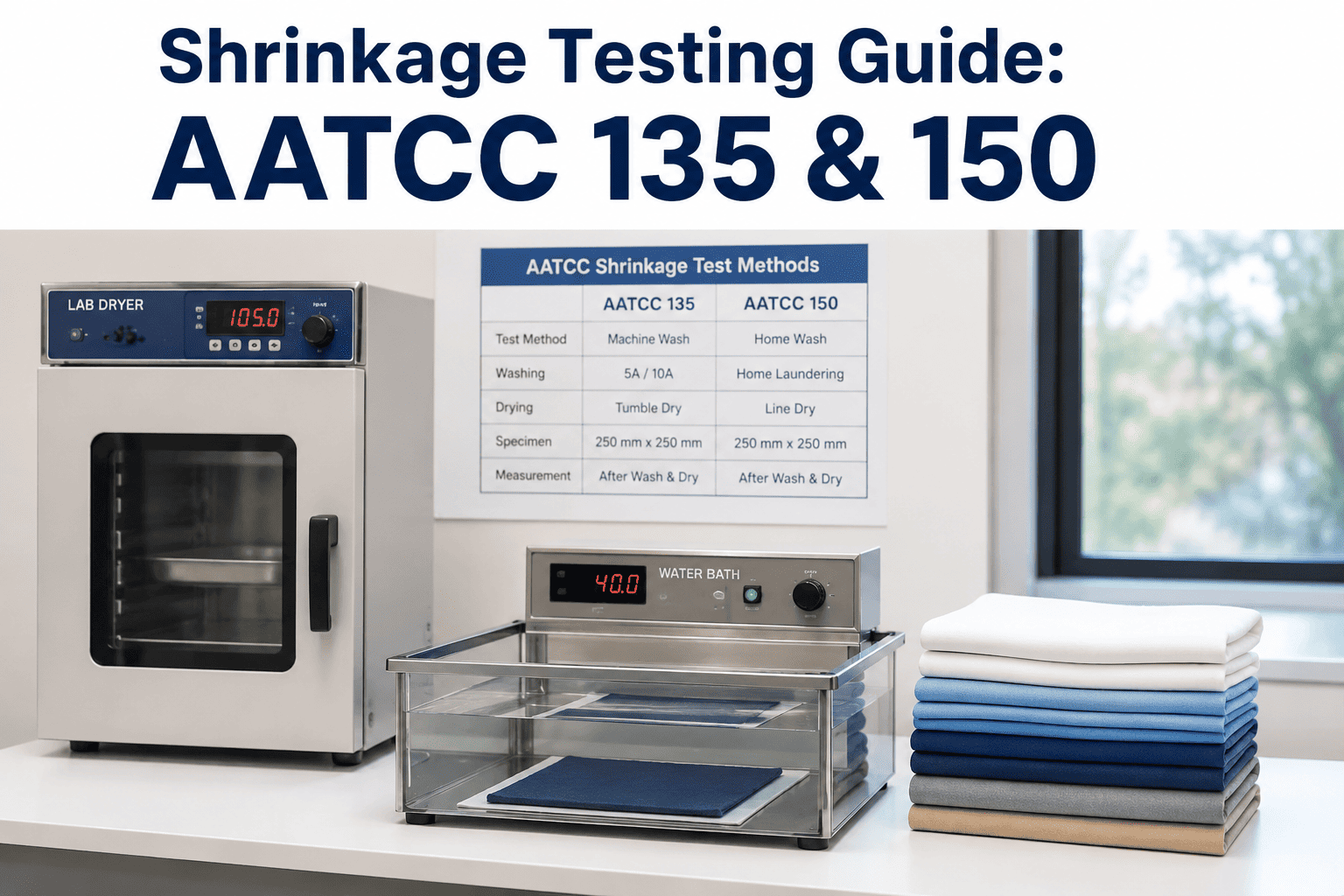
A garment that fits perfectly on the sales floor and comes back two sizes smaller after the first wash is not a defect anyone can see on the cutting table — it shows up weeks later as a return rate spike, a chargeback, or a retailer refusing the next shipment. AATCC 135 and AATCC 150 are the two laundering standards mills and quality labs run to catch that failure before it reaches a customer: AATCC 135 measures dimensional change on fabric swatches after simulated home laundering, while AATCC 150 runs the same laundering stress on finished, constructed garments and measures the points buyers actually care about, like chest width and sleeve length. They answer two different questions — fabric behavior and finished-garment behavior — and a quality program that only runs one of them is carrying a blind spot. Teams building or auditing a shrinkage testing program can book a 30-minute demo to see how iFactory logs AATCC 135/150 results against supplier and fabric lot data automatically.
Dimensional Stability & Shrinkage Testing — AATCC 135 and AATCC 150
How fabric-level shrinkage testing differs from garment-level shrinkage testing, the washing and drying conditions each standard uses, how to calculate percent dimensional change, and what tolerance a result actually needs to pass.
Tests loose fabric swatches, before cutting or sewing. Answers: does this fabric itself shrink or grow beyond spec when laundered the way a customer would launder it at home.
Tests the finished, sewn garment. Answers: does the actual product — with its seams, interlinings, and trims — hold its shape and size after repeated home laundering.
Why Dimensional Stability Testing Exists
Every woven or knitted fabric carries residual internal stress from spinning, weaving or knitting, dyeing, and finishing — the yarns are stretched, held under tension on a stenter frame, and set in a configuration that is not their natural relaxed state. The first few times that fabric gets wet, heated, and agitated, those yarns pull back toward their relaxed geometry, and the fabric measurably changes size. Dimensional stability testing exists to quantify exactly how much that change will be, under conditions that mimic how a real customer washes and dries the finished product, before a mill ships a production lot or a brand puts a product on shelf. Skipping this step does not make the shrinkage go away — it just moves the discovery of it from the lab to the customer's washing machine, which is a far more expensive place to find out.
AATCC 135 — Fabric-Level Test Procedure
Cut and mark specimens
A minimum of three fabric specimens are cut, typically around 38 cm square, well clear of the fabric selvedge and any fold marks. Benchmark points are stamped or stitched onto each specimen in a measurement grid, commonly spaced roughly 25 cm apart in both the length (warp or wale) and width (weft or course) direction.
Precondition and take the baseline measurement
Specimens are conditioned in a standard temperature and humidity environment before any measurement is taken, since fabric absorbs moisture from ambient air and that alone can shift a reading. The original benchmark-to-benchmark distances are recorded before laundering begins.
Launder under a specified washing condition
Specimens are washed in a home-style washing machine under one of several standardized condition combinations, which vary water temperature, agitation cycle, and load size to represent normal, permanent-press, or delicate home laundering. The number of wash cycles run — commonly one, three, or five — depends on whether the test is checking initial shrinkage or shrinkage trend across repeated washing.
Dry under a specified drying condition
Drying method is specified separately from washing — tumble dry, line dry, drip dry, or flat dry are the common options, each identified by a letter code, and each produces a materially different shrinkage result on the same fabric because heat exposure time differs so much between methods.
Recondition and remeasure
After drying, specimens are conditioned again under the same standard environment used for the baseline reading, then the same benchmark distances are remeasured. The difference between the original and final measurement, expressed as a percentage, is the dimensional change result.
AATCC 150 — Garment-Level Test Procedure
AATCC 150 applies to whole, finished garments rather than fabric swatches — shirts, trousers, dresses, and similar constructed products — and is run after the garment has already been cut, sewn, and finished with all its trims and interlinings in place.
Instead of a benchmark grid, the lab marks specific construction points defined by garment type — for a shirt that typically means chest width, body length, sleeve length, and neck width, each marked with removable ink or fine tape at a repeatable landmark like a seam line.
Garments are laundered using the same family of washing and drying condition codes used in AATCC 135, but they are typically run through repeated cycles so a lab can see both the first-wash shrinkage and the cumulative shrinkage trend across a garment's realistic wash life, and are often laundered together with similar garments to approximate a normal load size.
Seams, interlinings, elastic, and stitching tension all constrain how much a panel of fabric is physically able to shrink once it is sewn into a garment, so a fabric that shrinks 4 percent as a loose swatch can shrink a different amount — sometimes less, sometimes unevenly across the garment causing puckering — once it is constructed.
Washing and Drying Conditions Compared
| Condition Focus | Typical Use Case | Effect on Result |
|---|---|---|
| Cold water, delicate cycle | Delicate knits, wool blends, items with a gentle-wash care label | Lowest shrinkage stress; used to validate a gentle care label claim |
| Warm water, normal cycle | Everyday cotton and cotton-blend wovens and knits | Middle-of-range shrinkage; the most commonly requested condition for basics |
| Hot water, normal cycle | Heavy-duty items, workwear, some denim programs | Highest agitation and heat stress; surfaces worst-case shrinkage behavior |
| Tumble dry | Standard consumer drying habit for most casual wear | Fastest, highest-heat exposure; usually produces the largest shrinkage reading |
| Line dry / drip dry | Delicate fabrics, garments with a line-dry care instruction | Lowest heat exposure; typically produces the smallest shrinkage reading on the same fabric |
Calculating Percent Dimensional Change
A positive result means the fabric or garment measurement got smaller — the standard convention records this as shrinkage. A negative result means the measurement got larger, which is recorded as growth and shows up most often in ribbed or stretch knit constructions. The calculation is run separately for the length and width direction, since a fabric rarely shrinks the same amount both ways, and a lab report should always list both figures rather than a single blended number.
Types of Shrinkage a Lab Report Will Reference
Relaxation Shrinkage
The yarns release the tension applied during weaving, knitting, and finishing and return toward their natural, relaxed state. This happens almost entirely on the first wash, which is why a single-wash AATCC 135 or 150 result is often the most business-critical number on the report.
Progressive Shrinkage
Additional dimensional change that continues to accumulate across repeated wash cycles rather than stopping after the first wash. Some cotton and viscose-rich fabrics show a meaningful progressive component, which is exactly why multi-cycle testing exists rather than relying on a single wash result alone.
Felting Shrinkage
Specific to wool and other animal fibers, where individual fiber scales interlock and mat together under the combination of moisture, heat, and agitation. Felting shrinkage is largely irreversible and can be severe, which is why wool care labels so often specify hand wash or dry clean only rather than a standard machine cycle.
Acceptable Shrinkage Tolerance by Product Type
| Product Category | Typical Accepted Range | Common Failure Point |
|---|---|---|
| Woven cotton shirting | Around 3 percent or less | Under-relaxed fabric before cutting |
| Cotton knit t-shirts | Roughly 5 to 8 percent, length direction | Insufficient compacting or over-fed stenter finishing |
| Denim (unwashed to garment-wash) | Around 3 percent post garment-wash | Skipped or inconsistent pre-shrink treatment |
| Performance and activewear knits | Around 3 percent or less, both directions | Fiber blend mismatch between base yarn and stretch yarn |
| Wool and wool-blend outerwear | Around 3 to 5 percent, with felting risk flagged separately | Machine wash tested against a hand-wash-only construction |
Tolerances are set by the buyer's technical specification for a given program and can be tighter or looser than the ranges above depending on end use, so the figures here are a starting reference point rather than a universal pass line.
Common Causes of a Failed Shrinkage Test
Fabric sent to cutting before it has been properly relaxed or compacted, leaving stored tension that releases on the first wash the customer runs.
Overfeed settings on the stenter frame set too low during finishing, which stretches the fabric width-wise beyond what the yarn structure can hold once washed.
Drying temperature used in production testing set lower than the heat a typical consumer dryer actually reaches, understating the real shrinkage a customer will see.
Blended fabrics built from fibers or yarns with mismatched natural shrinkage rates, which does not just shrink the garment — it can pucker or distort the seam line unevenly.
Yarn count or twist variation between lots feeding into the same fabric roll, producing inconsistent shrinkage results across specimens cut from the same delivery.
Frequently Asked Questions
What is the simplest way to explain the difference between AATCC 135 and AATCC 150?
AATCC 135 tests a loose piece of fabric before it becomes a product, while AATCC 150 tests the finished, sewn garment after construction. A mill or supplier typically runs AATCC 135 to approve a fabric before cutting begins, and a brand or quality team runs AATCC 150 on finished units to confirm the actual product performs the way the approved fabric predicted. Running only one of the two leaves a real gap, since seams and trims can change how a fabric behaves once constructed. Contact iFactory Support for help setting up both checkpoints in a single quality plan.
How many wash cycles should a shrinkage test actually run?
A single wash cycle is the standard checkpoint for approving a fabric or garment against a buyer's dimensional change specification, and it captures most relaxation shrinkage on its own. Multi-cycle testing, commonly three or five washes, is added when a fabric has a history of progressive shrinkage or when a program needs to demonstrate stability across the garment's realistic wash life rather than just the first wash. Running only one wash on a fabric known for progressive shrinkage risks passing a lot that fails after a customer's third or fourth laundering.
What shrinkage percentage counts as a pass for my product?
There is no single universal number — tolerance depends on the buyer's technical specification, the product category, and end use, though woven cotton programs commonly target around 3 percent or less while knit programs often allow a wider range up to roughly 5 to 8 percent in the length direction. The table above gives typical starting ranges by category, but the specification document for a given program is always the final authority. Book a demo to see how tolerance limits can be set per product line and flagged automatically when a lab result comes in outside range.
Can an AATCC 135 fabric result reliably predict the AATCC 150 garment result?
It is a strong indicator but not a guarantee, because seams, interlinings, elastic, and stitching tension all physically constrain how a panel of fabric is able to shrink once it is sewn into a garment. A fabric that measures well within tolerance as a loose swatch can still produce an out-of-spec or unevenly puckered garment if the construction adds stress the swatch test never saw. That gap is exactly why both tests exist as separate checkpoints rather than one being treated as a substitute for the other.
What should happen operationally when a fabric lot fails a shrinkage test?
A failed result should trigger a documented corrective action tied back to the specific fabric lot and supplier — re-testing under an adjusted finishing process, rejecting the lot, or renegotiating tolerance with the buyer before cutting begins, rather than a verbal note that gets lost between the lab and the cutting floor. The cost of catching a shrinkage failure before cutting is a fraction of the cost of catching it after garments are sewn, packed, and shipped. Contact iFactory Support to see how failed results can auto-route to a supplier corrective action workflow.
Shrinkage failures caught after shipping cost far more than the test itself.
iFactory logs every AATCC 135 and AATCC 150 result against the supplier, fabric lot, and product line it belongs to, so a failed shrinkage test routes straight to a corrective action instead of surfacing three weeks later as a customer return. A 30-minute demo builds a live view against your own quality testing data.