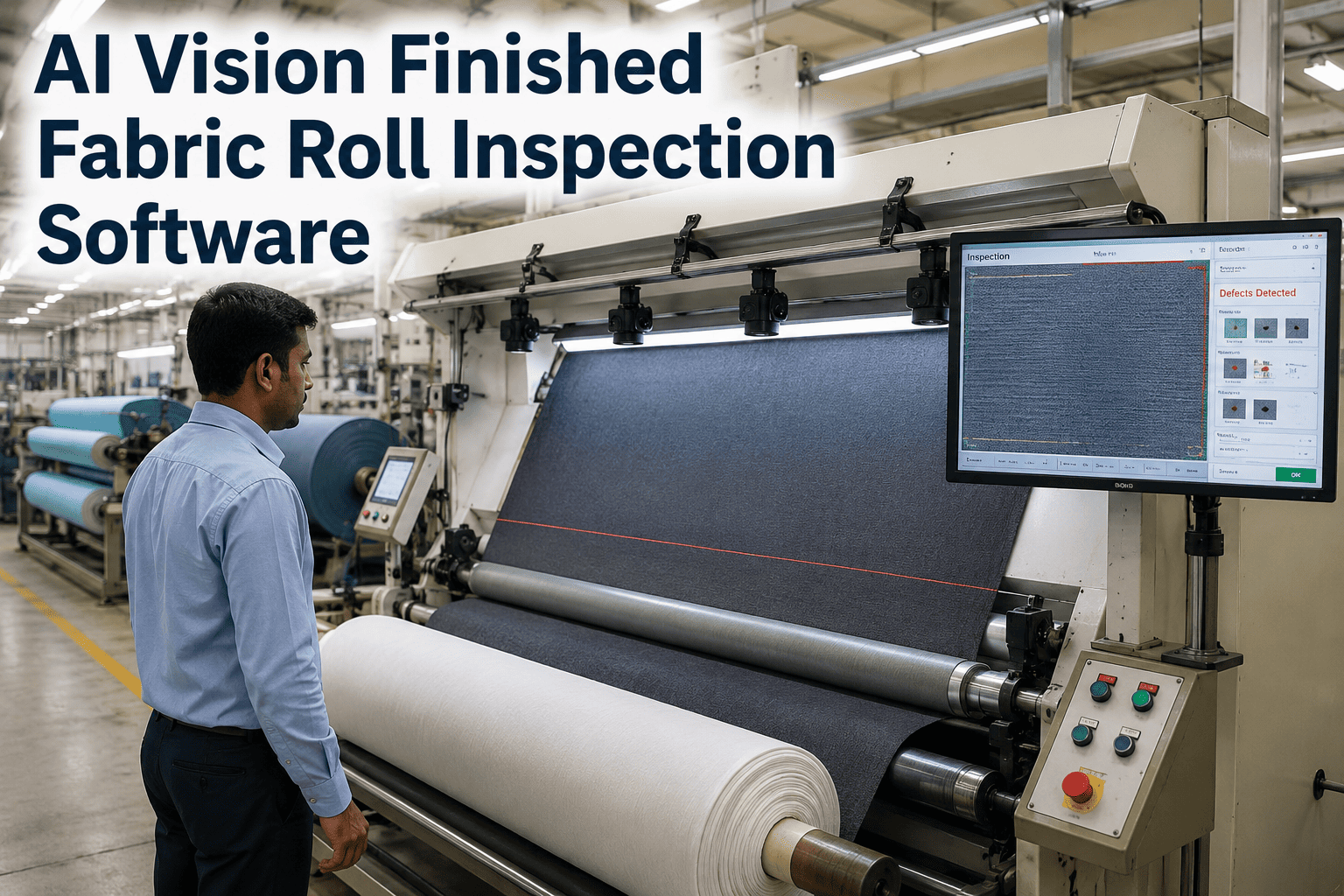
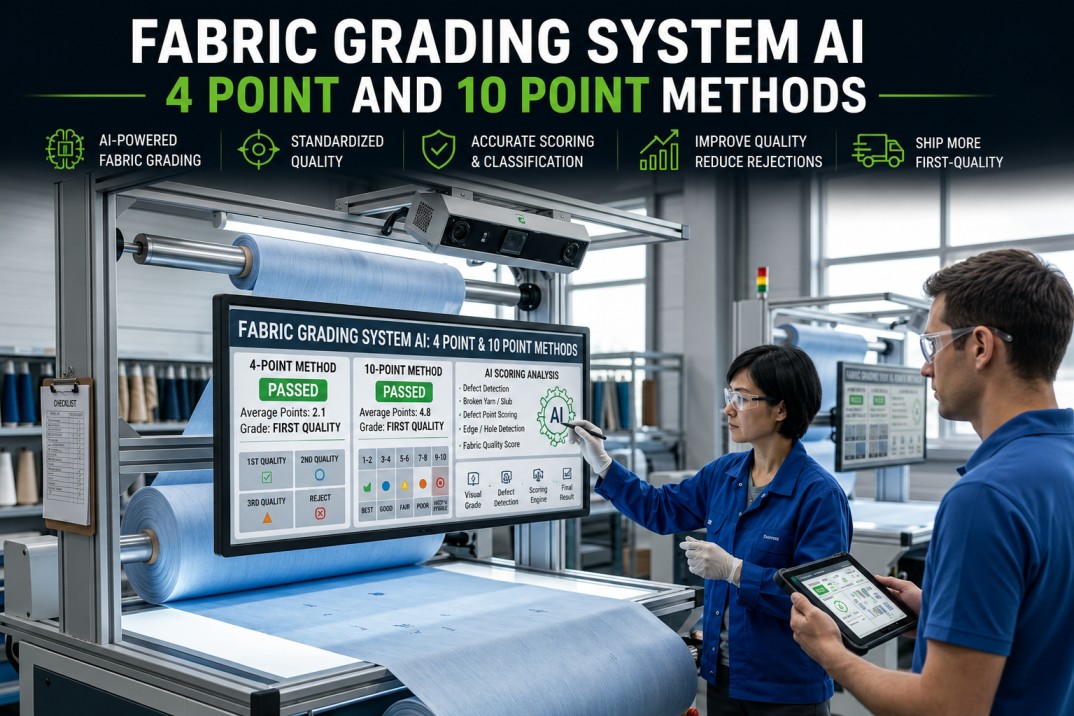
A 60-inch wide fabric roll running 100 linear yards contains roughly 667 square yards of woven material, and under the American 4-Point System that roll fails first-quality acceptance the moment its cumulative penalty score crosses 40 points per hundred square yards — which for this roll means a ceiling of roughly 267 total points before it drops to seconds. Most mills know this number exists. Far fewer can explain, when a merchandiser questions a shipment, exactly how a 9-inch oil stain and a 14-inch reed mark were scored, why one inspector called a slub "minor" and the night-shift inspector called an identical slub "major," or why the point table applied doesn't match ASTM D5430 at all. This guide is the reference document that removes that ambiguity. See how iFactory's automated fabric inspection layer applies 4-point scoring consistently across every shift without the light-table variance that creates buyer disputes.
The 4-Point Fabric Inspection System: Grading Standards Under ASTM D5430
The complete point-assignment reference for woven and knitted fabric grading — defect classification, penalty scoring, acceptance thresholds, and the worked calculations quality teams need to grade rolls consistently, shift after shift.
What the 4-Point System Actually Measures — And Where It Applies
The 4-Point System, standardized in the United States under ASTM D5430 (Standard Test Methods for Visually Inspecting and Grading Fabrics), is a penalty-scoring method that converts visible fabric defects into a numerical point count per hundred square yards of material. It exists to answer one question objectively: is this roll first-quality, or does it need to be sold, discounted, or rejected as seconds? The system assigns between one and four points to each defect based on its length, with a hard ceiling of four points per single flaw regardless of how severe or long that flaw is — a rule that surprises most people encountering the standard for the first time.
The 4-Point System traces its origin to work coordinated through the American Society for Testing and Materials in cooperation with major apparel manufacturers seeking a common language for fabric quality that would hold up across different mills, different countries of origin, and different inspection teams. Before standardization, each mill and each buyer effectively invented its own defect vocabulary, which meant a "second" from one supplier might be tighter than a "first" from another. ASTM D5430 solved this by anchoring every point assignment to a measurable, physical quantity — defect length — rather than a subjective severity judgment, which is what makes the system teachable, auditable, and defensible in a way that purely descriptive grading never was.
In practice, most mills train new inspectors on the point table within a day but spend months building the visual recognition skill that makes the table meaningful. A trainee can memorize that a 7-inch defect scores 3 points; recognizing that a particular mark on the fabric surface actually measures 7 inches and correctly qualifies as a reed mark rather than a warp streak takes repeated exposure under supervision. Mills that skip this apprenticeship period and rely solely on the point table as a training document tend to produce the inter-inspector variance that shows up in buyer audits, because the table only resolves the math — it does not teach defect recognition.
How Defect Length Converts to Penalty Points
Every defect found during inspection is measured along its longest dimension and assigned points according to a length-based scale. The same scale applies whether the defect runs along the warp (lengthwise) or weft (widthwise) direction, with one adjustment: warp-direction defects are measured in linear inches, while weft-direction defects that run the full fabric width receive an automatic 4-point maximum regardless of measured length, because a full-width flaw compromises every garment panel cut across it.
| Defect Length (Warp Direction) | Points Assigned | Defect Length (Weft Direction) | Points Assigned |
|---|---|---|---|
| Up to 3 inches | 1 point | Up to 3 inches | 1 point |
| Over 3, up to 6 inches | 2 points | Over 3, up to 6 inches | 2 points |
| Over 6, up to 9 inches | 3 points | Over 6, up to 9 inches | 3 points |
| Over 9 inches | 4 points | Full fabric width (any width) | 4 points |
| Holes or openings, any size | 4 points | Holes or openings, any size | 4 points |
From Raw Defect Count to Pass/Fail Decision
The formula that converts a tally sheet into an acceptance decision is straightforward once the underlying logic is clear. Total the points assigned to every defect found on the roll, then normalize that total against the roll's actual square yardage to produce a rate comparable across rolls of different lengths and widths.
The most common calculation error mills make is forgetting to normalize for roll length. A 30-yard remnant with 12 total points scores far worse per hundred square yards than a 200-yard roll with the same 12 points spread across far more fabric — treating raw point totals as directly comparable across differently sized rolls produces incorrect grading decisions and is one of the most frequent findings in buyer quality audits.
Eight Defects Every Weaving Mill Inspector Must Recognize on Sight
Point assignment only works if the inspector correctly identifies what they are looking at. The defect names below are the ones that generate the most classification disputes between mill inspectors and buyer quality auditors, and getting the identification wrong — not the point math — is the actual root cause of most grading disagreements.
Two Inspectors, One Roll, Two Different Scores — That Gap Is What Automation Closes
iFactory's vision-based inspection layer applies the same defect classification and point-assignment logic on every roll, every shift, with a full digital audit trail a buyer's quality auditor can review in minutes instead of days. Send sample rolls and see the scoring consistency on your own fabric.
What Point Score Actually Separates First Quality from Seconds
ASTM D5430 itself does not mandate a universal pass/fail threshold — that number is set by the buyer's technical package or the mill's own quality policy, and it varies meaningfully by end use. The ranges below reflect common industry practice across apparel segments, but every mill must confirm the specific threshold in its buyer's quality manual before applying any of these numbers to a shipping decision.
Thresholds are not arbitrary numbers pulled from a general industry table — they are typically negotiated between the buyer's quality department and the mill during the initial vendor qualification process, and they often vary by fabric construction as well as end use. A tightly woven poplin destined for a dress shirt collar carries a stricter threshold than a heavier twill destined for workwear trousers, because visible defects are more conspicuous on finer, more tightly constructed fabric and workwear tolerates cosmetic imperfection that a dress shirt cannot. Mills producing multiple fabric constructions for the same buyer should confirm whether a single blanket threshold applies across the entire program or whether construction-specific thresholds have been set, since applying one threshold universally when the buyer expected differentiated ones is itself a common source of shipment rejection at the receiving warehouse.
A second-quality roll is rarely a total loss. Most mills maintain a formal disposition path for seconds: fabric scoring moderately above threshold is frequently resold into secondary markets, remnant programs, or lower-tier private-label orders at a negotiated discount reflecting the defect density, while fabric with structural defects such as weft distortion severe enough to affect garment construction is typically diverted to non-garment uses or scrapped outright. Tracking the disposition and recovery value of seconds by defect category over time gives quality managers the data needed to prioritize which loom-level root causes — reed maintenance, shuttle lubrication schedules, tension calibration — deliver the best return when addressed upstream rather than caught only at final inspection.
Where Light-Table Inspection Breaks Down at Volume
Manual 4-point inspection on a backlit table remains the industry default, and it works — up to a volume and consistency ceiling that most mills eventually hit. The comparison below reflects what changes operationally when a mill layers vision-based defect detection and automated point tallying onto the existing inspection line rather than replacing it outright.
| Factor | Manual Light-Table Inspection | Vision-Assisted Automated Scoring |
|---|---|---|
| Inspection Speed | 15–25 yards per minute per inspector | 40–90 yards per minute per line |
| Inter-Inspector Consistency | 15–30% variance on identical rolls | Under 3% variance, same scoring logic applied every time |
| Point Calculation | Manual tally sheet, calculator or spreadsheet | Automatic per-defect scoring and roll-level rollup |
| Audit Trail | Paper tally sheets, often not retained past shipment | Digital record with defect image, location, and timestamp per roll |
| Shade Detection Under Varying Light | Dependent on inspector eyesight and table lighting condition | Calibrated spectral imaging, consistent regardless of ambient light |
| Best Fit | Low-volume, sample yardage, final spot-check before shipment | High-volume production lines, multi-shift operations, buyer-audited mills |
The 4-point system looks simple on paper, and that simplicity is exactly what causes disputes. Everyone can read a point table. Far fewer mills can defend, consistently, why the night shift called a mark a slub and the day shift called the same defect type a reed mark on the next roll from the same beam. In twenty years of running weaving quality departments, the audits that went badly were never about the math — they were about two people looking at the same fabric and describing it differently. Any mill serious about buyer relationships needs to solve the classification consistency problem before it worries about point-table precision, because a buyer auditor will find the inconsistency in the first ten rolls they review.
Frequently Asked Questions
Turn 4-Point Inspection From a Judgment Call Into a Consistent, Auditable Process
iFactory's vision-based inspection platform applies ASTM D5430 defect classification and point scoring consistently across every roll, every shift, with a complete digital audit trail ready for the next buyer quality review. Send sample rolls, see the scoring applied to your own fabric, and compare it directly against your current manual tally sheets.