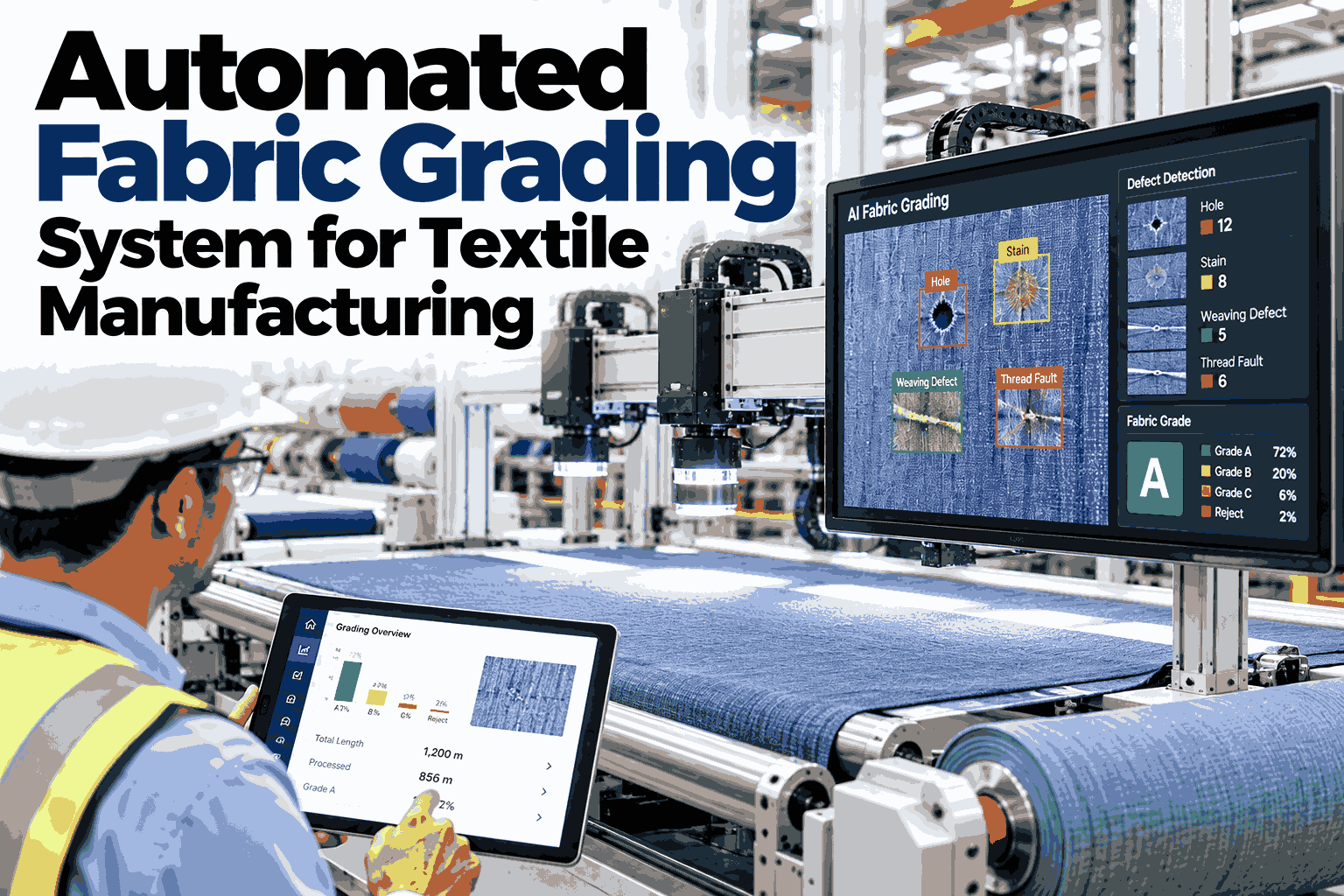
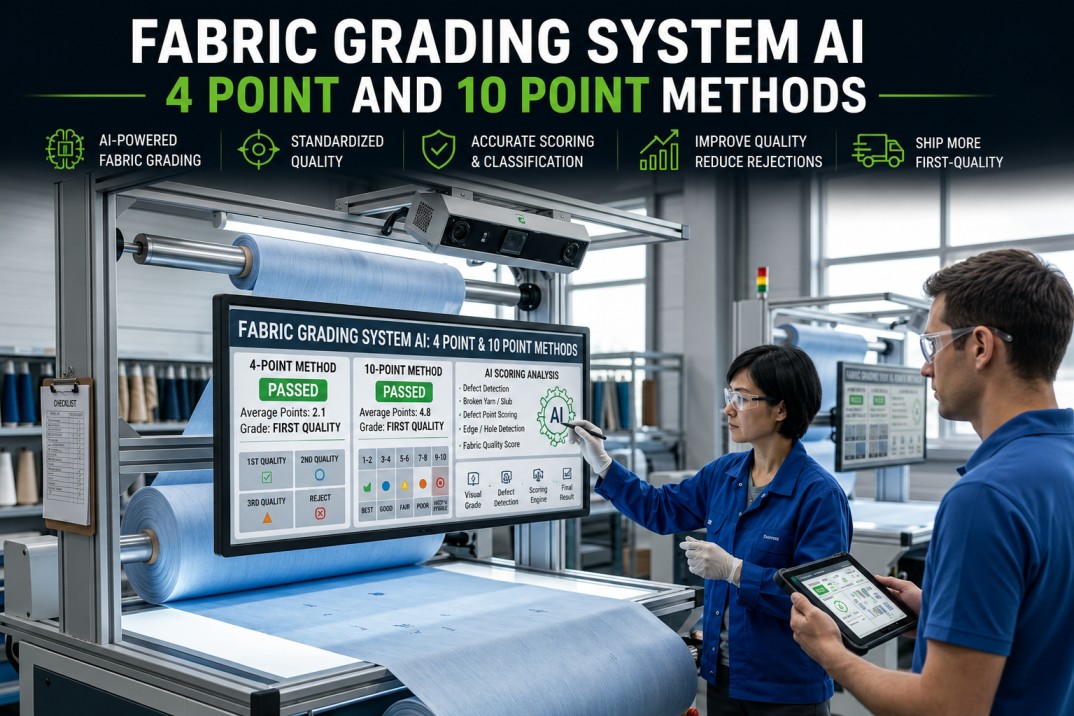
Every roll that comes off a finishing line eventually gets sorted into one of three commercial buckets: first quality headed to a premium buyer at full price, second quality headed to a discount channel at a fraction of that price, or reject headed to salvage or scrap. The grading decision itself takes an inspector seconds to make, but the economic consequence of that single decision can run into tens of cents per yard, multiplied across an entire roll and then across every roll in a shipment. Getting that classification consistent, and getting the downstream allocation and pricing logic to actually follow it, is where most mills lose more margin than they realize. iFactory connects grading decisions directly to allocation and pricing logic, so a classification made on the floor flows straight into the right customer channel without a manual handoff in between. To see this connected workflow running against your own grading standard, book a demo.
TEXTILE QUALITY · FABRIC GRADING · CLASSIFICATION ECONOMICS
The Grading Decision Is Instant, the Economics It Triggers Are Not
iFactory connects consistent first, second, and reject classification directly to customer allocation and pricing rules, closing the gap between what an inspector decided and what actually happens to that roll commercially.
Where One Grading Decision Sends a Roll
First Quality
Premium buyer, full contract price
Second Quality
Discount channel, reduced price per yard
Reject
Salvage, remnant sale, or scrap
The same physical roll, depending on where the grading line falls, can be worth dramatically different amounts — which is exactly why consistency in where that line gets drawn matters as much as the grading criteria themselves.
THE CONSISTENCY PROBLEM
Why the Same Roll Can Get Graded Differently by Different Inspectors
Grading standards on paper are precise: point systems, defect length thresholds, running-defect rules. Grading in practice is a human judgment call made under time pressure, on a moving roll, often at the end of a long shift, and that gap between the written standard and its consistent application is where most grading disputes actually originate.
01
Fatigue Changes Judgment Late in a Shift
An inspector's threshold for what counts as a borderline defect drifts over an eight-hour shift, even with identical training and identical written criteria at the start and end.
02
Borderline Calls Are Genuinely Ambiguous
A defect sitting exactly at a point threshold, or a running flaw close to the maximum continuous-length rule, is a coin flip for two equally trained inspectors applying the same standard in good faith.
03
Multiple Buyer Standards Blur Together
A mill running orders against several buyer-specific grading variations in the same shift makes it easy for an inspector to apply the wrong standard's threshold without noticing.
04
No Independent Record of the Call
Without a photographed, timestamped defect record, a disputed grading decision after shipment comes down to one inspector's memory against a buyer's claim, with no way to verify who was right.
None of these four causes reflects poor training or bad-faith grading. They are the ordinary human factors that make consistent classification hard to sustain at scale, which is exactly why mills increasingly pair inspector judgment with a recorded, auditable grading trail rather than relying on judgment alone. It is worth naming directly that inconsistency is often invisible until a specific dispute forces it into the open — two rolls from the same lot, graded an hour apart by different inspectors, rarely get compared side by side unless a customer complaint or an internal audit happens to surface the discrepancy.
WHAT A GRADE ACTUALLY TRIGGERS
The Chain of Decisions That Follows One Classification Call
A grading decision is rarely the end of a process, it is the start of one. Once a roll is classified, that single call is supposed to trigger a specific, consistent sequence of downstream actions, and the gap between "supposed to" and "actually does" is where a lot of avoidable margin loss hides.
1
Grade Assigned
An inspector or an automated system classifies the roll as first, second, or reject against the applicable standard.
→
2
Inventory Tagged
The roll's grade is recorded against its lot and roll ID, determining which warehouse location and inventory pool it belongs to.
→
3
Customer Allocation Applied
The grade determines which customer or channel the roll is eligible to ship against, since a first-quality contract buyer cannot receive second-quality material.
→
4
Price Applied at Invoicing
The grade sets the price per yard, and a manual disconnect at this step is one of the most common places margin quietly leaks out of a mill's books.
When these four steps are connected automatically, a grading call becomes an enforceable business rule rather than a note that has to be manually carried through inventory, sales, and invoicing systems by someone remembering to do it correctly every time. The most common failure point in practice is not the grading decision itself, it is step three or four — a roll correctly identified as second quality on the floor still shipping against a first-quality order because the allocation system was never actually told about the downgrade before the pick list was generated.
See your grading decisions connected straight through to invoicing
iFactory maps your specific grading standard to inventory, allocation, and pricing rules, so a classification made on the floor can't get lost in a manual handoff.
DOWNGRADING ECONOMICS
What a Second-Quality Call Actually Costs, Beyond the Obvious
The visible cost of a downgrade is the price gap between first and second quality per yard. The full cost is larger than that, and it is worth breaking down because most mills only track the visible portion.
Direct Price Discount
The immediate, visible gap between first-quality contract price and whatever a second-quality channel will pay per yard, often 15 to 40 cents per yard depending on fabric type and market.
Allocation Displacement
A downgraded roll that was originally committed to a first-quality order now leaves a shortfall against that order, which may require pulling from safety stock or expediting replacement production.
Second-Channel Carrying Cost
Second-quality inventory often moves slower than first-quality committed orders, tying up warehouse space and working capital longer than the original production plan assumed.
Disputed-Grade Rework
A buyer disputing a first-quality shipment after the fact, without a documented grading trail to support the original call, can cost far more in credits and relationship damage than the original discount would have.
Seeing all four categories together is usually what convinces a mill that grading consistency is worth investing in deliberately, rather than treating it as an unavoidable cost of doing business that fluctuates with which inspector happened to be on shift.
CUSTOMER ALLOCATION LOGIC
Matching Grades to the Right Buyer Isn't Always a Simple Lookup
Even once a roll is correctly graded, deciding which specific customer or order it should be allocated against is its own layer of complexity, particularly for mills serving several buyers with different grading tolerances against the same underlying fabric.
Buyer-Specific Tolerance Bands
A roll that fails one buyer's strict first-quality threshold may still meet a different buyer's more lenient standard for the identical fabric, meaning allocation depends on the specific order, not a single universal grade.
Lot and Shade Matching Constraints
A first-quality roll can still be ineligible for a specific order if its shade or lot does not match what that buyer's cutting plan requires, adding a second qualification layer beyond the grade itself.
Committed Order Priority
When multiple eligible orders could claim the same first-quality roll, allocation logic needs a consistent priority rule, typically committed delivery date, rather than an ad hoc decision made order by order.
This is why a spreadsheet-based allocation process tends to break down as buyer count grows: the logic is not actually a simple grade-to-channel lookup, it is a small rules engine that most mills are running manually without realizing how much complexity it actually contains.
ROLL-LEVEL VS SHIPMENT-LEVEL
Why Averaging Across a Shipment Can Hide a Real Quality Problem
Many buyer contracts set an acceptable defect threshold as an average across an entire shipment rather than requiring every individual roll to pass independently. This averaging approach is standard practice and usually reasonable, but it creates a specific reporting blind spot worth understanding before it causes a dispute.
A Shipment Average Can Mask a Bad Roll
Several very clean rolls can pull a shipment's average defect score comfortably under the acceptance threshold even while one specific roll sits well outside first-quality tolerance.
Cutting Rooms Experience Rolls Individually
A buyer's cutting operation does not experience a shipment average, it experiences whichever specific roll is loaded onto the cutting table, so a passing average provides no guarantee against a bad single-roll experience.
Per-Roll Records Resolve the Dispute Faster
Retaining the individual roll-level grading record, not just the shipment average that was reported, is what lets a mill quickly confirm or dispute a buyer's claim about a specific problematic roll after the fact.
Contracts Increasingly Specify Both
More buyer technical packages now define both a shipment-average threshold and a maximum per-roll threshold, closing the averaging loophole at the contract level rather than leaving it to trust.
Keeping roll-level grading data available, rather than discarding it once a shipment-level summary has been calculated and reported, costs very little to retain and provides a meaningfully stronger position whenever a specific-roll dispute arises later.
TURNKEY DELIVERY
How iFactory Connects Grading to Allocation and Pricing
iFactory does not replace your grading standard or your inspectors' judgment, it connects the grading decision, however it is made, to the inventory, allocation, and pricing logic that should follow it automatically.
What Gets Built
Grading standard configuration matched to each buyer's specific tolerance
Photographed, timestamped defect record tied to every grading call
Automatic inventory tagging and allocation rules by grade and buyer
Pricing rules applied consistently at invoicing based on assigned grade
Grading consistency dashboards flagging inspector-to-inspector variance
Deployment Timeline
Weeks 1–4: Grading standard and buyer tolerance mapping, system integration planning
Weeks 5–8: Allocation and pricing rule configuration, parallel validation against current process
Weeks 9–12: Go-live, consistency dashboard activation, inspector training
FREQUENTLY ASKED QUESTIONS
What Textile Mills Ask About Grading and Downgrading Workflows
Does connecting grading to pricing mean we lose flexibility to negotiate on a downgraded roll?
No, the automated pricing rule sets the default price that applies at invoicing based on assigned grade, which removes the risk of a downgrade being priced inconsistently or forgotten entirely, but it does not prevent a sales team from negotiating an exception for a specific customer relationship or bulk deal. The value is in making the default consistent and auditable, not in removing human judgment from every pricing conversation.
Book a demo to review how exception pricing works alongside the default rule set.
How do we handle the fact that different buyers accept different grading tolerances on the same fabric?
This is exactly what buyer-specific tolerance configuration is built to handle — a roll's underlying defect record stays the same regardless of buyer, but the tolerance band applied to determine eligibility for a specific order is configured per buyer contract, so the same physical roll can correctly qualify for one buyer's order and not another's without requiring two separate grading passes.
Contact our support team to map your specific buyer tolerance variations into the system.
If a buyer disputes a first-quality shipment after delivery, what evidence do we actually have to respond with?
A photographed, timestamped defect record tied to the specific roll and grading call, captured at the time of inspection rather than reconstructed afterward from memory, is what turns a disputed grade from a he-said-she-said situation into a documented, defensible record. This record is also what lets you distinguish a genuine grading error from damage that occurred after the roll left your facility, which materially changes who bears the cost of a claim.
Book a demo to see the defect record format used to support a grading dispute.
Can this system tell us if a specific inspector is grading more strictly or leniently than the rest of the team?
Yes, this is one of the more direct uses of a consistency dashboard — comparing each inspector's grading outcomes against the team average, and against the same fabric graded by different inspectors when that data exists, surfaces exactly this kind of individual variance. It is not about penalizing an inspector, it is about identifying where a specific person's threshold has drifted from the standard so a targeted conversation or retraining can correct it before it produces a costly grading dispute.
Contact our support team to review what a consistency dashboard would show for your current inspection team.
We already use a spreadsheet to manage grade-to-customer allocation — is that actually a problem?
A spreadsheet can work at small scale, but the allocation logic is rarely as simple as a single grade-to-channel lookup once buyer tolerance variations, shade and lot matching constraints, and committed order priority all factor in, which is more rules-engine complexity than most spreadsheets are built to enforce consistently as buyer count and order volume grow. The practical symptom of an overloaded spreadsheet process is usually an allocation mistake discovered after shipment rather than before, which is exactly the failure mode connected system logic is designed to catch earlier.
Book a demo to see whether your current allocation complexity has outgrown a manual process.
FROM GRADING CALL TO INVOICE
Make Every Classification Decision Consistent and Enforceable
iFactory connects your grading standard to inventory, customer allocation, and pricing logic, so a first, second, or reject call flows straight through to the right outcome without a manual handoff to get lost in.