A fabric inspector who calls a defect "major" and another who calls the identical flaw "minor" are not disagreeing about the fabric — they are working from different mental catalogs, built from years of individual experience rather than a shared reference standard. This inconsistency is not a training failure of any one inspector; it is the predictable result of an industry that has never standardized visual defect identification the way it standardized measurement units. A comprehensive weaving defect catalog — with consistent naming, visual signatures, severity classification, and points-based grading — is the foundation that makes fabric inspection defensible, teachable, and automatable. Without it, two shifts inspecting the same loom output will produce two different quality pictures, and neither can be fully trusted. Book a session with the iFactory textile quality team to see how AI vision inspection applies this catalog consistently, shift after shift, without inspector fatigue or subjective drift.
Fabric Rejection · Weaving Defect Standards
The Weaving Defect Catalog: Classification, Severity Grading, and Acceptance Criteria for Consistent Fabric Inspection
Warp defects, weft defects, and pattern defects — organized by origin, identified by visual signature, and graded by severity class against the Four Point and Ten Point inspection systems. Built for consistent classification across inspectors, shifts, and mills.
Severity Classification Legend
Critical
4 points · Automatic reject zone · Structural or functional failure
Major
3 points · Visible at normal viewing distance · Affects saleable grade
Minor
1–2 points · Visible on close inspection · Second-quality eligible
Cosmetic
0–1 points · Barely detectable · Rarely affects grade alone
Points assigned per the Four Point System (ASTM D5430) — maximum 4 points per defect regardless of length; total points per 100 sq. yards determine fabric grade.
Why a Shared Catalog Matters
The Cost of Inconsistent Defect Classification Across Inspectors and Shifts
Fabric inspection is fundamentally a classification task, and classification tasks performed without a shared reference standard produce inconsistent results even among skilled, well-intentioned inspectors. A study of inter-inspector agreement in textile quality departments consistently finds that without a formal defect catalog, agreement on defect severity classification between two experienced inspectors examining the same fabric sample falls between 65 and 78% — meaning roughly one in four defects is classified differently by two people looking at the identical flaw. This inconsistency has real financial consequences: it means acceptance and rejection decisions on the same objective fabric quality vary by inspector and shift, second-quality allocation is inconsistent, and customer disputes over shipped fabric grade cannot be resolved with confidence because the mill's own internal grading was never consistent to begin with.
Warp Defects
Defects Originating in the Warp Direction — Identification, Cause, and Severity
Warp defects run in the machine direction (lengthwise) of the fabric and typically originate from warp preparation (sizing, beaming), warp yarn quality, or loom shedding motion faults. They tend to be continuous along the fabric length, making them among the most costly defect categories because a single warp-direction fault can affect an entire roll rather than a localized area.
Visual Signature
A continuous line running the full length of the fabric roll where one warp end has broken and either failed to weave in or created a visible gap/float. Appears as a thin void or a raised, uneven line depending on where in the weave cycle the break occurred.
Cause & AI Detection
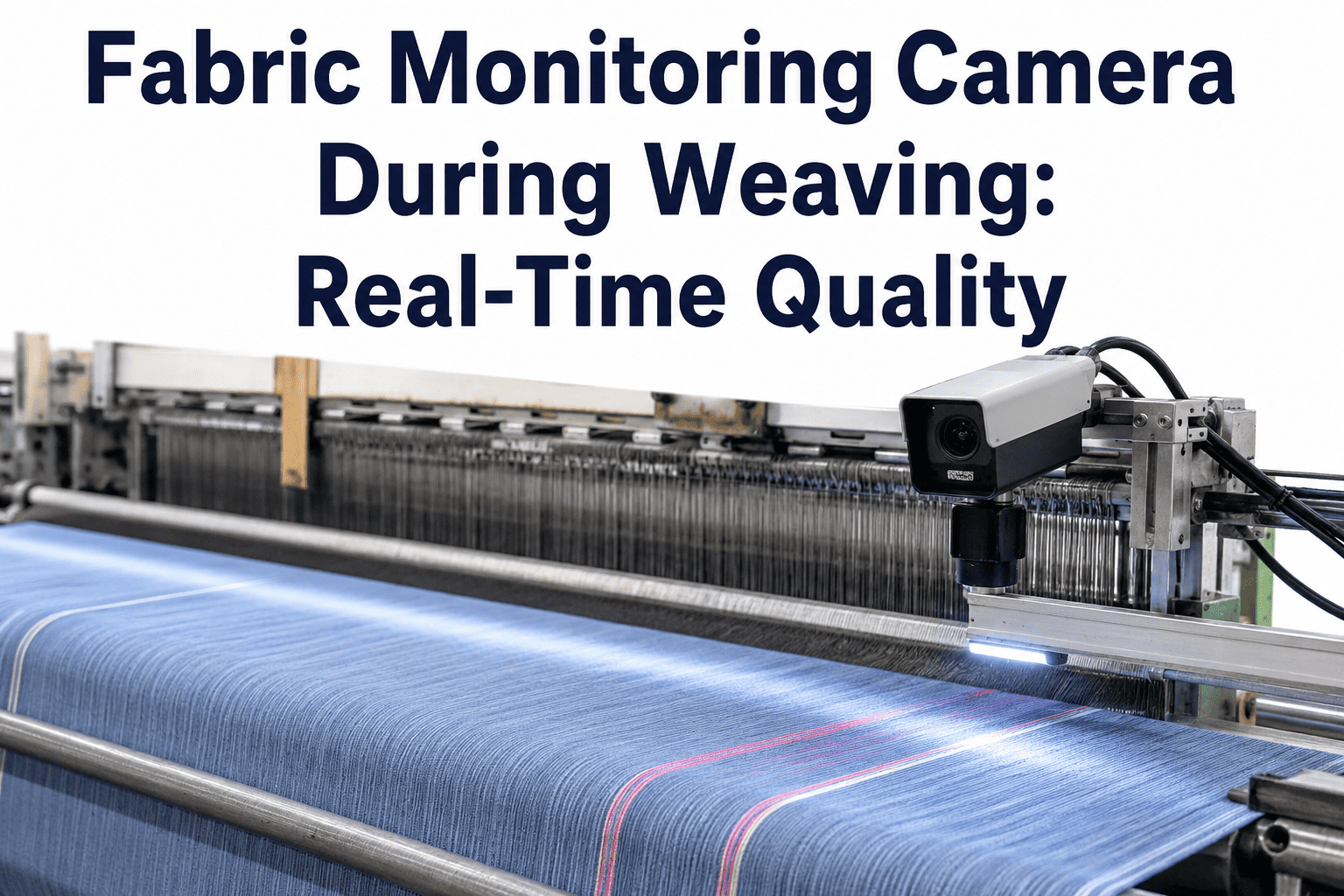
Weak yarn spot, sizing failure, excessive tension, or heddle wire damage. AI vision detection: line-scan camera with edge detection algorithm identifies the continuous linear anomaly against the surrounding weave pattern — near 100% detection reliability due to the defect's continuous, high-contrast nature.
Visual Signature
A subtle but continuous shade or texture variation running lengthwise, visible as a faint stripe under raking light. Distinct from broken warp end in that the yarn is present and woven correctly but differs visibly from adjacent ends.
Cause & AI Detection
Mixed yarn lots in the warp beam, inconsistent sizing application, or dye lot variation in pre-dyed yarns. AI vision detection: requires raking or oblique lighting configuration and texture-analysis algorithms rather than simple edge detection — a more demanding detection case than broken ends.
Visual Signature
Fine, evenly spaced lengthwise lines corresponding to reed dent spacing, appearing as a subtle ribbing or density variation across sections of the fabric width. Often periodic — repeating at regular intervals matching reed construction.
Cause & AI Detection
Damaged or bent reed dents causing uneven warp spacing, or incorrect reed selection for the sett (ends per inch) specified. AI vision detection: periodic pattern analysis (Fourier transform texture analysis) identifies the regular spacing signature distinct from random warp streaks.
Visual Signature
A single warp end absent from the fabric — narrower gap than a broken end since no yarn material is present at all. Often appears as a fine, consistent void that may be less visually obvious than a broken end with float irregularity.
Cause & AI Detection
Warping error during beam preparation — an end was never drawn in during the warping or drawing-in process. AI vision detection: comparison against expected end-count per inch identifies the density anomaly; distinguishable from broken end by absence of any float irregularity at the void location.
Weft Defects
Defects Originating in the Weft (Filling) Direction — Identification, Cause, and Severity
Weft defects run across the fabric width and typically originate from weft yarn quality, weft insertion mechanism faults (shuttle, rapier, air-jet, water-jet), or takeup/beat-up timing issues. Unlike warp defects, weft defects are usually localized to specific picks rather than extending the full roll length — making individual events less costly but often more numerous.
Visual Signature
A single weft pick that terminates partway across the fabric width, leaving a visible gap or float on one side of the break point. Appears as a horizontal discontinuity spanning less than the full fabric width.
Cause & AI Detection
Weft yarn breakage during insertion, tension spike, or weak yarn spot. On shuttleless looms, often caused by weft insertion mechanism timing faults. AI vision detection: horizontal discontinuity detection algorithm — high reliability given the sharp visual contrast at the break point.
Visual Signature
A visible horizontal band or stripe running across the full fabric width, differing in shade, texture, or density from adjacent fabric. One of the most commercially damaging defects because it is highly visible even at a distance and cannot be localized or repaired.
Cause & AI Detection
Mixed weft yarn lots (different dye lots, different yarn suppliers, or different twist levels bobbin to bobbin), weft tension variation, or loom speed change affecting pick density. AI vision detection: full-width band detection via row-wise pixel intensity comparison — one of the more reliably automated defect types due to its distinctive full-width signature.
Visual Signature
A localized kink or loop in the weft yarn visible as a small raised knot or tangle on the fabric surface, typically isolated to a small area rather than extending across the width.
Cause & AI Detection
Excess twist liveliness in the weft yarn combined with insufficient tension during insertion, causing the yarn to kink before it is beaten into place. AI vision detection: localized 3D surface anomaly detection (structured light or shadow-based texture analysis) required — flat 2D imaging alone often misses low-relief snarls.
Visual Signature
A section where the weft yarn passes over or under more warp ends than the weave pattern specifies, creating a visible loose or raised segment that disrupts the intended weave structure locally.
Cause & AI Detection
Shedding motion fault — a heddle or harness failing to lift or lower correctly for one or more picks, or a warp end failing to separate cleanly during shed formation. AI vision detection: weave pattern deviation analysis comparing the actual interlacement pattern against the specified weave structure at pixel level.
Apply the Catalog Consistently — Every Roll, Every Shift
iFactory's Vision Inspection System Classifies Fabric Defects Against This Catalog Automatically
A defect catalog only creates value when it is applied consistently. iFactory's AI vision inspection system is trained against a standardized defect taxonomy — warp, weft, and pattern categories with severity classification matching the Four Point System — delivering the same classification decision on the same defect regardless of shift, inspector fatigue, or time of day.
Pattern and Structural Defects
Defects Affecting Weave Structure, Design Repeat, or Overall Fabric Geometry
Pattern defects affect the intended weave design, dimensional stability, or structural geometry of the fabric rather than originating from a single warp or weft fault. They are often the result of mechanical setup errors, design programming faults, or loom timing issues affecting multiple yarns simultaneously.
Visual Signature
The weft picks are not perpendicular to the warp direction — either uniformly angled across the width (skew) or curved (bow), visible when checking pattern alignment or grid-printed reference lines against the fabric.
Cause & AI Detection
Uneven takeup roller tension across the fabric width, or uneven fabric tentering during finishing. Critical defect for downstream cut-and-sew operations where pattern alignment matters. AI vision detection: geometric line-fitting analysis on weft pick angle across multiple width positions — requires wide field-of-view camera coverage.
Visual Signature
In woven fabrics with a repeating design (jacquard, dobby patterns), a visible shift or discontinuity in the pattern repeat — motifs that do not align consistently across the fabric width or that suddenly shift position mid-roll.
Cause & AI Detection
Jacquard or dobby mechanism timing error, incorrect pattern card/electronic program loading, or harness mistiming. AI vision detection: template matching against the defined pattern repeat — high-confidence detection due to the highly structured, predictable nature of intended pattern geometry making deviations easy to isolate.
Visual Signature
Fabric edge-to-edge width varies beyond specification tolerance along the roll length — not visible defect on the surface but detectable through width measurement rather than visual pattern inspection.
Cause & AI Detection
Temple/stenter setting drift, warp tension variation causing width contraction, or fabric shrinkage during wet processing before final measurement. AI vision detection: continuous edge-detection width measurement integrated with the inspection camera system — measured at every frame rather than sample points.
Visual Signature
Damage, looseness, or curling at the fabric edge (selvage) — the reinforced edge structure intended to prevent fraying and provide a clean edge for downstream cutting and sewing operations.
Cause & AI Detection
Selvage yarn breakage, incorrect selvage weave construction, or temple mechanism damage at the fabric edge. AI vision detection: dedicated edge-zone camera coverage (often a separate, higher-resolution camera focused specifically on selvage regions) since main-field cameras typically lack the resolution needed at the extreme edge of a wide fabric.
Grading Systems
Four Point System vs. Ten Point System — How Points Convert to Fabric Grade
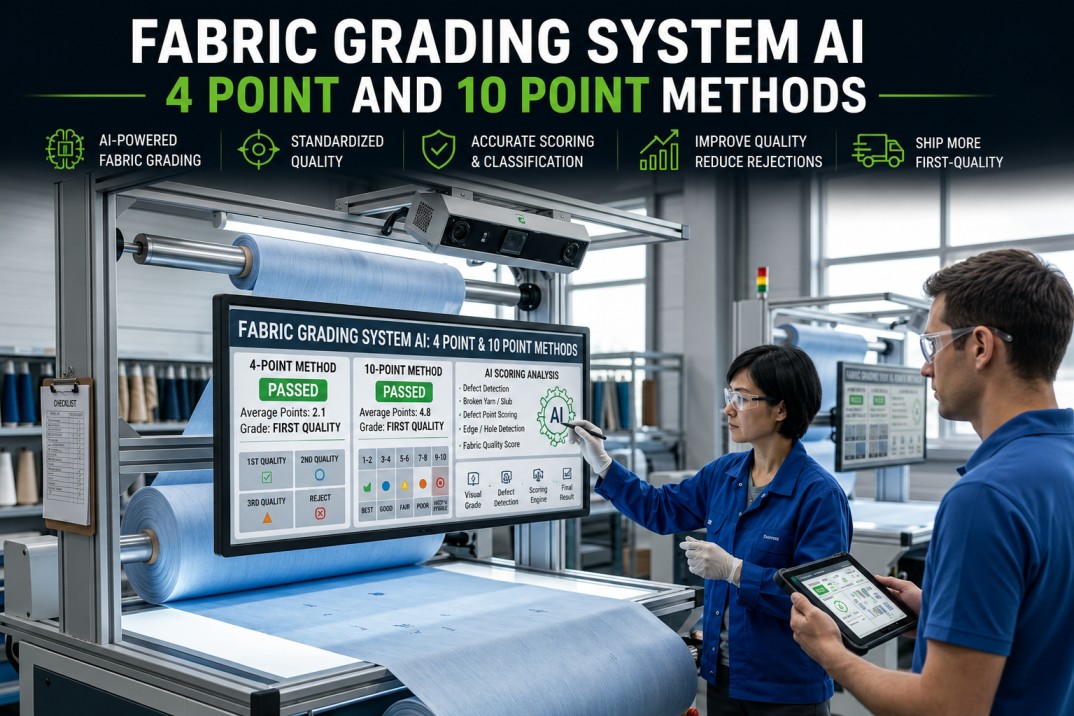
A defect catalog identifies and classifies individual flaws; a grading system converts the total defect load on a fabric roll into an acceptance decision. The two dominant systems in global textile trade are the Four Point System (also called the American Point System, ASTM D5430) and the Ten Point System — both convert defect points per 100 square yards into a grade, but with different point allocations and thresholds.
| Defect Length |
Four Point System |
Ten Point System |
Applies To |
| Up to 3 inches |
1 point |
1 point |
Small, localized flaws |
| 3 to 6 inches |
2 points |
2 points |
Medium-extent flaws |
| 6 to 9 inches |
3 points |
3 points |
Extended flaws |
| Over 9 inches |
4 points (maximum) |
4 points |
Long or continuous flaws (e.g., broken warp end running the roll) |
| Holes / severe structural |
4 points (regardless of size) |
10 points (or automatic reject) |
Critical category defects |
Typical acceptance threshold: First-quality fabric generally requires 40 points or fewer per 100 square yards under the Four Point System, though thresholds vary by customer specification and fabric end-use. Fabric exceeding this threshold is downgraded to second quality or seconds/thirds depending on total point load, with corresponding price reduction.
Where AI Fits
Automated Classification Against the Catalog — Confidence Scoring and Human Escalation
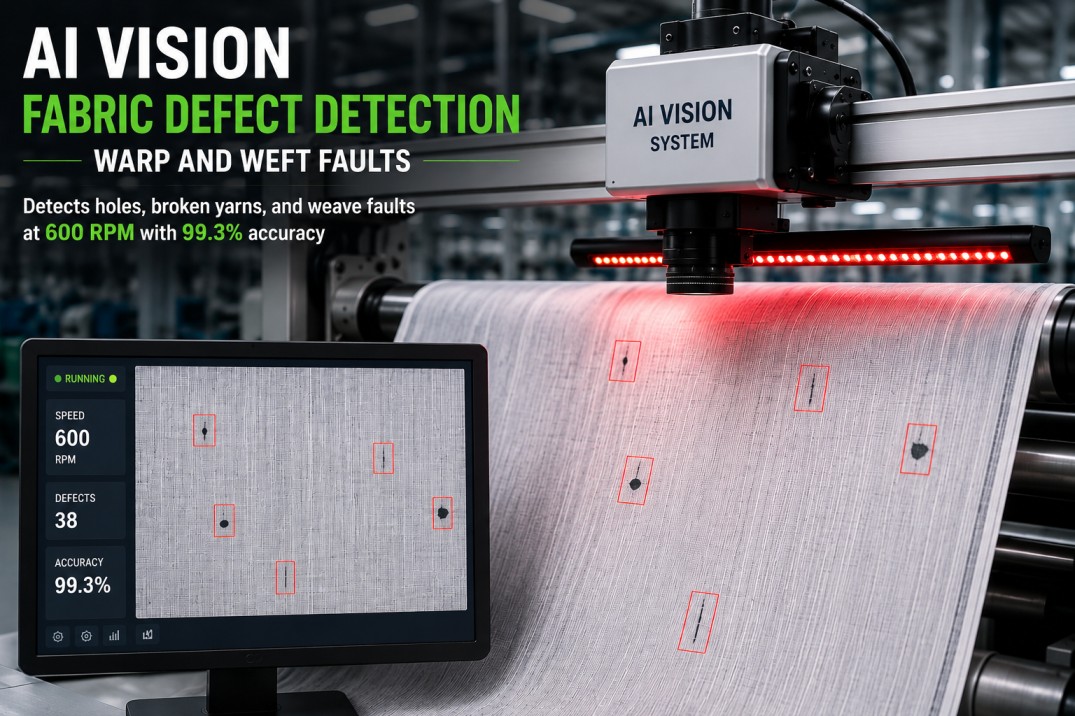
A defect catalog is only as useful as its consistent application, and AI vision inspection is the mechanism that applies it identically across every inch of fabric produced, on every shift, without the fatigue-driven drift that affects even the most experienced human inspectors after several hours of continuous visual attention. The correct AI implementation does not attempt full autonomous classification on every defect — it applies confidence-scored classification and routes uncertain cases to human review.
High-Confidence Auto-Classification
Defects with clear, high-contrast visual signatures matching a trained catalog category with greater than 90% model confidence — broken ends, broken picks, full-width weft bars, pattern misalignment — are classified automatically without human review, with the classification, severity, and location logged directly to the quality record.
Medium-Confidence Flagging
Defects between 60% and 90% model confidence — often subtle texture variations, low-relief snarls, or borderline severity cases near a classification boundary — are flagged with the model's best-guess classification and routed to a review queue for human confirmation, building a continuously improving training dataset from confirmed cases.
Low-Confidence Escalation
Defects below 60% confidence, or visual anomalies that do not match any trained catalog category, are escalated directly to a human inspector with the image captured for immediate review — ensuring novel defect types or unusual fabric conditions are never silently misclassified by the automated system.
Continuous Catalog Refinement
Every human-confirmed classification from the medium and low-confidence queues feeds back into model retraining, progressively increasing the proportion of defects handled at high confidence over time — while the underlying catalog structure (defect names, severity classes, point values) remains stable as the shared reference standard across the organisation.
Catalog and Classification KPIs
Six Metrics That Indicate Your Defect Classification System Is Working
Inter-Inspector Agreement Rate
Target: >92%
Percentage of defects classified identically by two independent inspectors reviewing the same fabric sample. The primary indicator of catalog effectiveness — a well-designed, well-trained catalog should produce agreement above 90%. Below 80% indicates either inadequate catalog documentation or insufficient inspector training against it.
AI High-Confidence Classification Rate
Target: >80%
Percentage of defects the AI system classifies at above 90% model confidence without requiring human review. Rises over time as the training dataset grows from confirmed classifications. Below 60% indicates either an underdeveloped training dataset or a defect catalog with categories that are inherently difficult to distinguish visually.
Severity Grade Consistency
Target: <5% grade dispute rate
Percentage of shipped fabric lots that generate a customer dispute over quality grade. A well-applied catalog and grading system reduces disputes by ensuring the mill's internal grading matches what the customer independently observes — because both parties are effectively grading against the same visual standard.
Points-per-100-Yards Trend
Trend: decreasing
Average total defect points per 100 square yards across production, tracked over time and by loom, shift, and product. The core process improvement metric once classification consistency is established — trending this metric only has integrity once the underlying classification is consistent across the data being trended.
Defect Category Distribution Stability
Monitor for shifts
Whether the relative proportion of warp, weft, and pattern defects remains stable over time or shows sudden shifts. A sudden increase in a specific defect category is a leading indicator of a process or equipment change (new yarn lot, reed wear, mechanism fault) worth investigating before it accumulates into a larger quality problem.
Human Review Queue Turnaround
Target: <2 hours
Time between an AI-flagged medium or low-confidence defect entering the review queue and a human inspector providing confirmed classification. Long turnaround delays the retraining feedback loop and, for defects requiring immediate disposition decisions, can delay production or shipping decisions unnecessarily.
From the Inspection Floor
“
Every mill I have worked with believes it has a defect classification standard, and almost none of them actually do — what they have is an experienced senior inspector whose judgment everyone defers to, and a set of informal conventions that live in the heads of a handful of long-tenured people. That system works reasonably well until that inspector retires, or until the mill needs to defend a quality grade to a demanding customer, or until you try to compare defect rates across two shifts and realise the numbers cannot be trusted because the two shifts were never grading the same way. Building an actual written and photographed defect catalog — not a training manual buried in a binder, but a living reference that every inspector uses every day — is one of the highest-leverage quality investments a weaving mill can make, and it is almost always underinvested relative to its impact. What changes the equation now is that AI vision systems need exactly this kind of formalised catalog to be trained against, which means the discipline of building it properly is no longer optional if you want automated inspection. The catalog stops being a nice-to-have documentation exercise and becomes the literal specification the AI model is built from.
Sunita Ramaswamy-Chen
Textile Quality Standards Consultant · Fabric Inspection Authority · 26 years in woven fabric quality across South and Southeast Asian textile manufacturing · Former Global Head of Fabric Quality, multinational apparel sourcing group · Contributor to ASTM textile testing subcommittee working groups
Quality Team Questions
Weaving Defect Catalog and Classification — Frequently Asked
How many defect categories should a comprehensive weaving defect catalog include?
A practical, usable catalog typically includes 25 to 45 distinct defect categories organized across warp, weft, and pattern/structural origins — enough to cover the vast majority of defects that actually occur in production, without becoming so granular that inspectors cannot reliably distinguish between adjacent categories. Mills that attempt to build catalogs with over 80 hyper-specific categories often find inter-inspector agreement actually decreases, because the boundaries between very similar categories become harder to apply consistently than the underlying defects justify. The right level of granularity groups visually and causally similar defects together — for example, distinguishing broken warp end from missing end (different visual signature, different root cause) while not creating separate categories for warp streak caused by yarn lot mixing versus warp streak caused by sizing variation, since both present identically to an inspector and only differ in root cause investigation, not visual classification. For a catalog review specific to your fabric types and defect history,
book a session with the iFactory textile quality team.
Should the same defect catalog and severity grading apply across all fabric types, or do different fabrics need different standards?
The defect identification catalog — the names, visual signatures, and causes — can generally remain consistent across fabric types, since a broken warp end looks and behaves similarly whether it occurs in a cotton shirting fabric or a technical textile. What must vary by fabric type and end use is the severity classification and acceptance threshold: a weft bar that is a critical defect in a solid-color apparel fabric intended for a visible garment panel may be a minor defect in a heavily textured or patterned upholstery fabric where the same flaw is far less visually apparent, or may be irrelevant entirely in an industrial technical textile evaluated primarily on functional properties rather than visual appearance. The practical implementation is a single master catalog of defect types with severity classification tables that vary by product family or customer specification — the AI vision system applies the same defect detection and identification logic universally, but the severity scoring and disposition logic references the applicable product-specific table.
Contact our support team to discuss multi-product severity table configuration.
How accurate is AI vision inspection compared to experienced human inspectors for weaving defect classification?
Well-trained AI vision systems for weaving defect detection typically achieve detection rates (finding that a defect exists at all) of 95 to 99% for high-contrast defects like broken ends and broken picks, and 85 to 93% for subtler defects like weft streaks or minor pattern deviations — generally matching or exceeding human inspector detection rates, particularly for the fatigue-sensitive later hours of a shift where human detection rates measurably decline. Classification accuracy (correctly identifying which specific defect type and severity) for high-confidence cases typically exceeds 90% agreement with expert human classification once the model has been trained on a mill-specific dataset of at least 2,000 to 5,000 confirmed defect examples. The critical operational advantage is not that AI is dramatically more accurate than a skilled inspector at their best moment — it is that AI applies the same accuracy consistently across every inch of fabric, every hour of every shift, without the well-documented fatigue-driven detection decline that affects even excellent human inspectors after 3 to 4 hours of continuous visual attention. For accuracy benchmarking data specific to your fabric types,
book a demonstration with the iFactory team.
How long does it take to build and deploy a defect catalog with AI vision classification for a new fabric type or mill?
For a mill with an existing informal inspection practice, formalising the defect catalog documentation — photographing representative examples of each defect category, defining severity classifications, and writing clear identification criteria — typically takes 3 to 6 weeks working with the mill's senior quality staff. Training an AI vision model against the newly formalised catalog requires a dataset of confirmed defect examples, which can be assembled from the mill's existing inspection records if photographic documentation exists, or built during a data collection period of 4 to 8 weeks of production if it does not. Overall, mills starting without any existing digital defect documentation typically reach a functioning AI classification system within 3 to 4 months; mills with existing photographic quality records or a prior automated inspection system can often deploy in 6 to 10 weeks by leveraging that historical data for initial model training.
Book a scoping session to assess the timeline for your specific starting point.
How should the defect catalog handle new or unusual defects that don't fit any existing category?
Every well-designed defect catalog must include a formal process for handling novel defects — flaws that do not clearly match any existing category. In the AI vision system, this is handled by the low-confidence escalation pathway: any defect the model cannot classify with reasonable confidence against existing categories is automatically routed to human review rather than forced into the closest-matching category, which would corrupt both the immediate quality record and the training data. The human inspector reviewing an escalated novel defect makes two decisions: an immediate disposition decision for the fabric in question, and a longer-term decision about whether the new defect type represents a recurring pattern significant enough to warrant a formal new catalog entry. Mills should schedule a periodic (typically monthly) review of accumulated novel defect escalations specifically to identify emerging patterns and formally expand the catalog when justified — keeping the catalog a living document that evolves with changes in yarn supply, equipment, and product mix, rather than a static reference that gradually becomes less representative of actual production defects over time.
One Catalog. One Standard. Every Shift, Every Loom, Every Inspector.
Standardize Defect Classification Across Your Weaving Operation — Then Automate It
iFactory helps textile quality teams formalize their defect catalog and deploys AI vision inspection trained against it — delivering the same classification decision on the same defect regardless of shift, loom, or inspector fatigue, with confidence-scored escalation ensuring novel defects always reach human review.