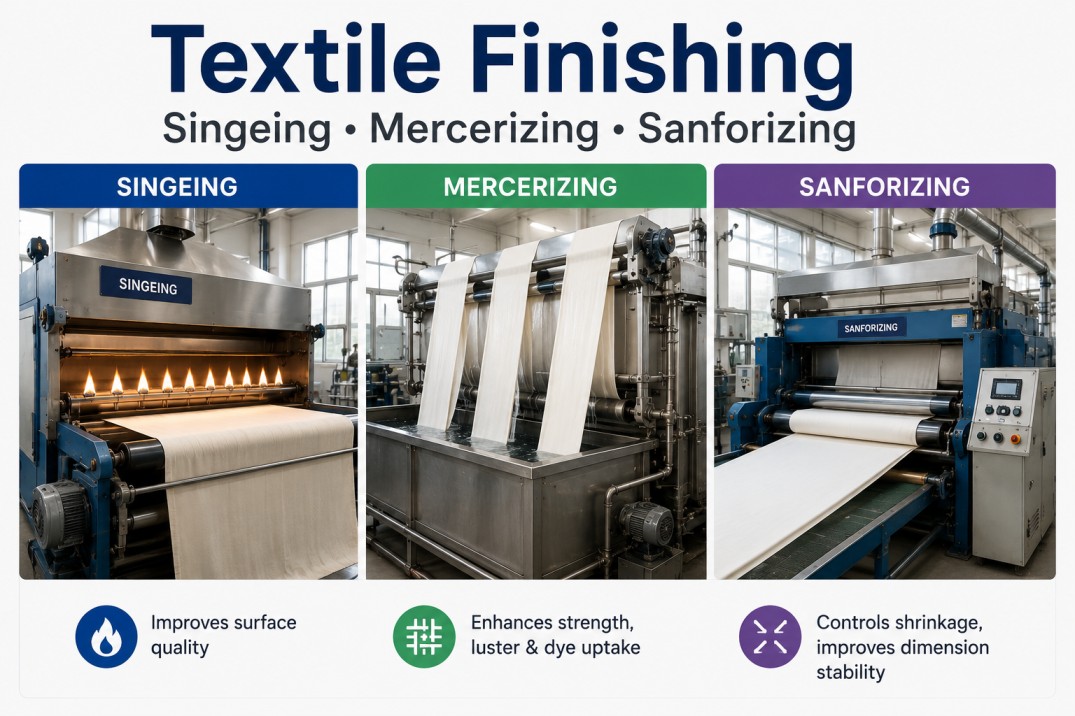
Cotton fabric arrives at pretreatment full of impurities that fabric was never designed to keep — sizing starch applied before weaving to protect the warp, natural waxes and pectins from the cotton fiber itself, and residual husk fragments that survive ginning and spinning. None of these will accept dye evenly, and none of them will disappear on their own. The sequence that removes them — desizing, scouring, bleaching, and mercerizing — has to happen in the right order, at the right concentration, and for the right dwell time, or every downstream dyeing batch inherits the mistake as patchy shade and poor fastness. iFactory gives pretreatment lines the real-time chemical and process visibility that keeps this sequence consistent, batch after batch.
The Four-Stage Pretreatment Sequence: Why Order and Precision Both Matter
Skipping a stage, rushing a dwell time, or running alkali concentration outside tolerance doesn't just weaken one property — it compounds forward into every stage that follows, right through to the final dyed fabric on the buyer's inspection table.
Why Pretreatment Consistency Determines Dyeing Outcomes Downstream
A dye house can run the most precise recipe management system available, but if the fabric reaching the dye bath has inconsistent absorbency from batch to batch, the recipe cannot compensate. Pretreatment is the stage where fabric becomes chemically ready to accept color evenly, and any variation here shows up two or three process steps later as a shading claim that is far more expensive to trace back than it would have been to prevent.
Combined vs Sequential Pretreatment: Which Approach Fits Your Fabric
Many mills now combine scouring and bleaching into a single bath to save time and water, but the decision of whether to combine stages or keep them sequential depends heavily on fabric construction, target whiteness, and the sensitivity of the fiber blend being processed.
| Consideration | Sequential (Separate Baths) | Combined Scour-Bleach |
|---|---|---|
| Process Time | Longer overall cycle, two distinct heating and cooling stages | Shorter cycle since heating happens once for both reactions |
| Water and Energy Use | Higher water and energy consumption from duplicate stages | Lower consumption, often reducing use meaningfully per kilogram processed |
| Whiteness Control | Easier to fine-tune each stage independently for demanding whiteness targets | Slightly less granular control, best suited to standard whiteness requirements |
| Fabric Sensitivity | Preferred for delicate or blended fabrics needing gentler individual reactions | Works best on robust 100% cotton constructions tolerant of simultaneous reactions |
iFactory connects to your desizing, scouring, bleaching, and mercerizing lines to track concentration, temperature, and dwell time against your own tolerance bands, flagging drift before it reaches the dye floor.
Absorbency and Whiteness Testing: The Checkpoints That Catch Problems Early
Every pretreatment stage has a measurable checkpoint, and mills that test consistently at each checkpoint catch drift before it becomes a full batch failure. Absorbency testing after scouring, peroxide residual testing after bleaching, and whiteness index measurement before mercerizing form a simple but effective early-warning system.
Common Pretreatment Defects and Their Root Causes
Most dyeing-related quality claims that trace back to pretreatment share a small set of recurring root causes. Recognizing the pattern early, ideally through continuous process monitoring rather than end-of-batch inspection, is what separates mills with low claim rates from those repeatedly firefighting the same issue.
The Real Cost of Pretreatment Rework: Why Getting It Right the First Time Matters
When a pretreatment batch fails its checkpoint test, the cost rarely stops at the fabric weight involved. A rejected batch typically has to be reprocessed through some or all of the four stages again, consuming additional water, chemicals, steam, and machine hours that were never budgeted into the original production plan. Worse, reprocessing cotton that has already been through one pretreatment cycle can leave the fiber more fragile than fresh fabric, meaning a second pass sometimes trades a shading defect for a strength defect instead of solving the original problem outright. Mills that track pretreatment rework rate as its own metric, separate from overall production efficiency, often discover that a small handful of recurring root causes are responsible for the majority of reprocessing volume across an entire quarter. Identifying that handful of root causes typically takes weeks of manual batch-record review without continuous data, but becomes a matter of minutes once temperature, concentration, and dwell time are logged automatically against every batch and cross-referenced with which batches later required rework.
The downstream cost compounds further once a pretreatment inconsistency reaches the dye floor undetected. A dye recipe formulated for a specific absorbency and pH profile will behave differently on fabric that quietly fell outside tolerance, and the resulting shade variation often isn't caught until the dyed fabric reaches final inspection — several process stages and several days removed from the actual root cause. Tracing a shading claim back through dyeing, to pretreatment, to a specific bath and shift, can take quality teams days of manual investigation without continuous process data to shortcut the search. This is precisely the gap that real-time monitoring closes: instead of reconstructing what happened after the fact, deviations get flagged the moment they occur, while there's still time to correct the batch before it moves forward.
Building a Pretreatment Quality Control Program That Actually Holds
A pretreatment QC program that exists only as a laminated instruction sheet on the wall rarely survives contact with a busy production schedule. The programs that hold up over time share a few common characteristics: they define tolerance bands for every measurable parameter rather than vague guidance, they assign clear accountability for who checks what and how often, and they make the data visible to more than just the operator running that specific bath.
Choosing Pretreatment Equipment and Chemistry for Different Fabric Constructions
Not every fabric construction responds the same way to a standard pretreatment recipe, and mills that run a single fixed recipe across their entire fabric portfolio often see their highest defect rates concentrated in whichever constructions deviate most from that standard. Heavier weight fabrics, for instance, typically need longer dwell times at each stage to achieve the same level of chemical penetration that a lighter fabric reaches more quickly, while blended fabrics containing synthetic fibers alongside cotton require pretreatment chemistry gentle enough not to damage the synthetic component while still adequately preparing the cotton portion for dyeing.
Jigger, jet, and continuous range equipment each interact differently with fabric during pretreatment, and the choice of equipment affects everything from liquor ratio to the mechanical stress the fabric experiences during processing. Continuous ranges process fabric at high speed with relatively short dwell time per stage, making precise temperature and chemical concentration control even more critical since there's less time to correct a deviation before the fabric moves to the next zone. Batch processing in jiggers or jets allows more direct intervention mid-cycle if a test reveals a problem, but at the cost of lower throughput per hour. Neither approach is universally superior — the right choice depends on order volume, fabric sensitivity, and how much flexibility the mill needs to accommodate a diverse fabric portfolio within the same production week.
Chemical selection follows a similar logic. Enzyme selection for desizing needs to match the specific starch type used in warp sizing, since a generic enzyme formulation may work adequately across common sizing agents but underperform against less common or heavily modified starches. Surfactant selection for scouring needs to balance cleaning effectiveness against foam generation, since excessive foaming can interfere with even liquor circulation in certain equipment types. These are the kinds of decisions that benefit enormously from historical process data — a mill that can see exactly which chemical and equipment combinations have produced the most consistent absorbency and whiteness results across past orders makes far better decisions than one relying purely on supplier recommendations or industry convention.
Water, Energy, and Chemical Efficiency: Pretreatment's Hidden Sustainability Lever
Pretreatment is one of the most water and energy-intensive stages in the entire textile production chain, since desizing, scouring, and bleaching each require heated liquor and multiple rinse cycles to reach the fabric condition dyeing depends on. This makes pretreatment an unusually high-leverage point for sustainability improvement, because even modest gains in process efficiency here translate into proportionally larger reductions in total facility water and energy consumption compared to optimizing a less resource-intensive stage elsewhere in the mill.
Combining stages where fabric construction allows it, recovering and reusing rinse water between compatible stages, and optimizing liquor ratio to the minimum level that still achieves full chemical penetration are among the most direct levers available. None of these levers work safely, however, without reliable process monitoring to confirm that a reduced liquor ratio or combined bath still delivers the same absorbency and whiteness result the fabric needs. Mills that pursue efficiency gains without this verification step risk trading water savings for a quality regression that costs far more in rework and rejected fabric than the original resource savings were worth. The mills that successfully reduce pretreatment resource intensity are consistently the ones treating efficiency and quality as a single connected optimization problem, verified with the same process data rather than as two separate initiatives running in parallel.
Beyond the direct cost savings, buyers across most major apparel categories now request environmental performance data as a standard part of vendor qualification, and pretreatment water and energy intensity is frequently one of the specific metrics requested. Mills that can produce accurate, continuously tracked consumption data by process stage are increasingly better positioned in vendor selection than those relying on estimated or annual-average figures, since the specificity and traceability of the data itself has become part of what buyers evaluate alongside the raw numbers.
Operator Training and Shift Consistency: The Human Factor in Pretreatment Quality
Even the best-documented pretreatment recipe depends on operators executing it consistently, shift after shift, and this is where many otherwise well-designed quality programs quietly break down. A new operator unfamiliar with why a particular tolerance matters may treat a borderline reading as acceptable when an experienced operator would have flagged it immediately, not because the newer operator is careless but because the reasoning behind the tolerance was never fully explained during training. Effective pretreatment training goes beyond teaching the mechanical steps of a recipe and explains the chemistry behind each checkpoint, so operators understand what a failing absorbency test or an off-target whiteness reading actually means for the fabric moving forward.
Shift-to-shift consistency is a related but distinct challenge. Two equally well-trained operators can still produce different outcomes if one runs slightly hotter baths as a personal habit or extends dwell time slightly out of caution, and without shared visibility into process data, these small individual variations can persist for months without anyone noticing the pattern. Bringing pretreatment process parameters into a shared, continuously visible dashboard — rather than leaving them in individual logbooks or on separate control panels per machine — gives supervisors the ability to spot and correct these individual variations before they accumulate into a measurable quality gap between shifts. This kind of visibility also makes training itself more effective, since new operators can be shown real historical examples of what a well-run batch looks like against one that drifted, rather than learning purely from written instructions.
Frequently Asked Questions
iFactory brings continuous, correlated visibility to desizing, scouring, bleaching, and mercerizing so every batch reaches the dye floor in the same chemically consistent condition.