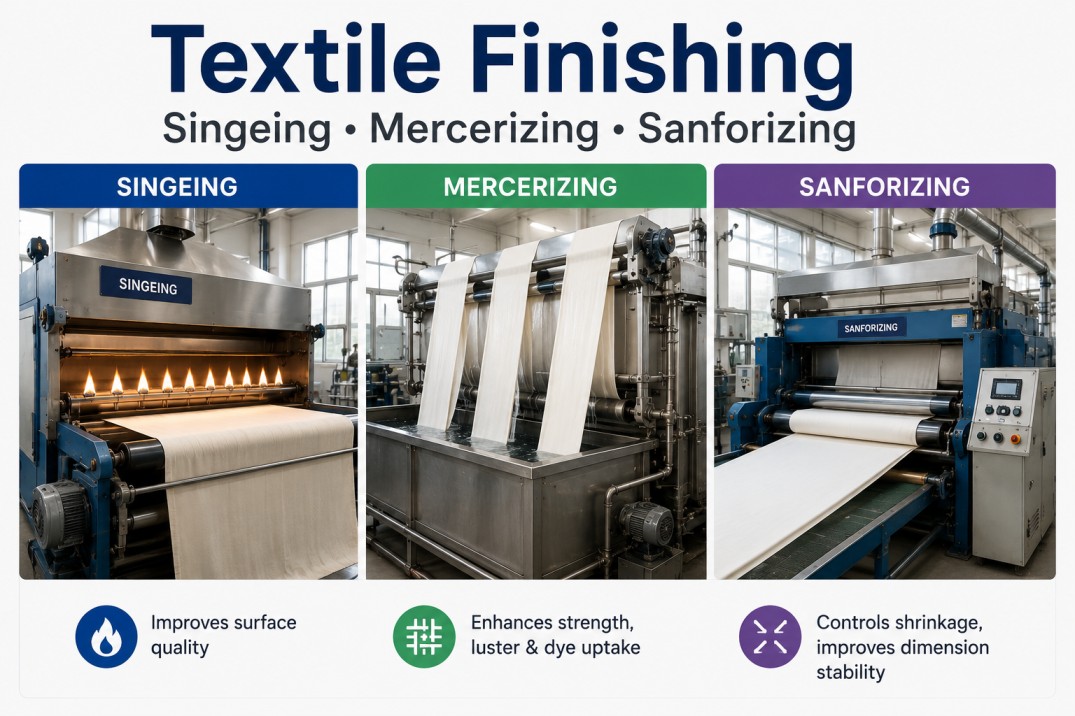
Singeing looks like a simple step compared with dyeing or finishing, but getting it wrong quietly undermines everything that happens afterward. Run the gas flame too cool or too fast, and protruding fibers survive to cause pilling and a dull, hairy surface after washing. Run it too hot or too slow, and the fabric scorches, weakens, or picks up a yellow tint that no amount of downstream finishing can fully correct. Because singeing happens at line speed with no practical way to inspect the result until the fabric has already cooled, burner temperature and fabric speed have to stay synchronized automatically rather than depending on an operator's eye. Process engineers refining this step can Book a Demo to see burner-to-speed synchronization running on a live singeing line.
Keep the Flame and Fabric Speed in Sync, Every Meter.
iFactory synchronizes burner intensity with fabric speed changes in real time, preventing both under-singed pilling and over-singed scorch damage.
The Surface Defect That Only Shows Up After Washing
Every woven or knitted fabric leaves the loom or knitting machine with loose fiber ends protruding from its surface. Left untreated, those fibers don't just make the fabric look slightly fuzzy off the roll, they abrade against each other during wear and washing and roll up into visible pills that make a garment look worn out after only a few cycles.
Singeing removes those protruding fibers by passing the fabric quickly across an open gas flame or heated plate, burning off what sticks above the surface while leaving the woven or knitted structure itself intact. Getting that balance right depends entirely on matching flame intensity to how fast the fabric is actually moving underneath it, and that relationship changes every time line speed changes for a style or width transition.
What Happens on Either Side of the Correct Setting
Under-Singed
Fiber ends survive the pass and remain visible on the surface, leading to pilling, a dull hand feel, and reduced perceived quality after the first wash cycle.
Correctly Singed
Protruding fibers are removed cleanly at the surface while the underlying yarn structure and strength remain fully intact.
Over-Singed
Excess heat scorches the fabric surface, weakening tensile strength and often introducing a yellow discoloration that is difficult to correct later.
Why Woven and Knitted Fabrics Need Different Settings
A single burner setting rarely works across both fabric constructions, since woven and knitted fabrics respond to the same flame very differently.
Woven Fabrics
Tighter, more stable construction tolerates slightly higher flame intensity, and fiber protrusion is generally more uniform across the width.
Knitted Fabrics
Looser, more elastic structure is more prone to distortion under heat, requiring lower flame intensity and tighter speed control to avoid stretch marks.
How Automatic Synchronization Keeps the Result Consistent
Real-Time Speed Tracking
Fabric speed is measured continuously rather than assumed from a line setpoint, catching the brief accelerations and decelerations that happen during normal running.
Proportional Burner Adjustment
Gas flow and flame intensity are adjusted proportionally to speed changes so exposure time per unit of fabric stays within the target range.
Fabric-Type Profile Selection
Each fabric construction runs against its own calibrated flame-to-speed profile rather than a single generic setting.
Quenching Verification
Post-singe quenching is monitored to confirm residual heat is removed promptly, preventing afterglow damage once the fabric leaves the burner zone.
Manual Setting vs. Automatic Flame-Speed Synchronization
| Factor | Manual Fixed Setting | Automatic Synchronization |
|---|---|---|
| Response to speed changes | Delayed, operator-dependent | Continuous, real-time |
| Pilling defect rate | Higher during transitions | Consistently low |
| Scorch risk at line stop | Elevated, flame stays constant | Reduced, flame scales with speed |
| Fabric-type changeover | Manual recipe lookup | Automatic profile switch |
What Mills Report After Adding Synchronization
Reduction in downstream pilling-related quality complaints after synchronized burner control is deployed.
Reduction in fabric rejected for scorch damage or discoloration during speed transitions and line stops.
Typical reduction from avoiding excess flame intensity during slower running periods.
Singeing Process Control — Common Questions
Can synchronization be retrofitted onto an existing singeing machine?
Yes, most existing gas singeing machines can have speed sensing and proportional burner control added without replacing the burner assembly itself. The retrofit typically involves adding a speed sensor and a control interface to the existing gas valve system rather than installing new burner hardware.
How does the system handle a full line stop without scorching the fabric?
When fabric speed drops toward zero, flame intensity is reduced proportionally and, if the stop persists, the burner or fabric position is adjusted to prevent prolonged exposure at a single point. This is exactly the scenario where a fixed manual setting is most likely to cause a scorch mark, since the flame keeps running at full intensity regardless of the stopped fabric.
Do woven and knit fabrics require separate calibration on the same machine?
Yes, each fabric construction and weight typically needs its own calibrated flame-to-speed profile, since knits respond to heat and tension differently than wovens. The system stores multiple profiles and selects the correct one automatically based on the style being run, rather than requiring a manual lookup each changeover.
What's involved in building the initial calibration for a new fabric type?
Calibration typically involves running a short sample length at several flame-to-speed combinations and comparing the pilling and strength results in the lab, then setting the profile that achieves clean singeing without measurable strength loss. Teams can review calibration methodology with iFactory Support.
How long does a pilot deployment take on one singeing line?
A pilot typically runs for three to five weeks, covering sensor and control installation, profile calibration across the plant's main fabric types, and validation against lab pilling and strength results. Teams ready to scope a pilot can Book a Demo to review a comparable line's setup.
Give Your Singeing Line a Setting That Never Falls Behind.
Talk to iFactory about synchronizing burner control with fabric speed across your finishing floor.