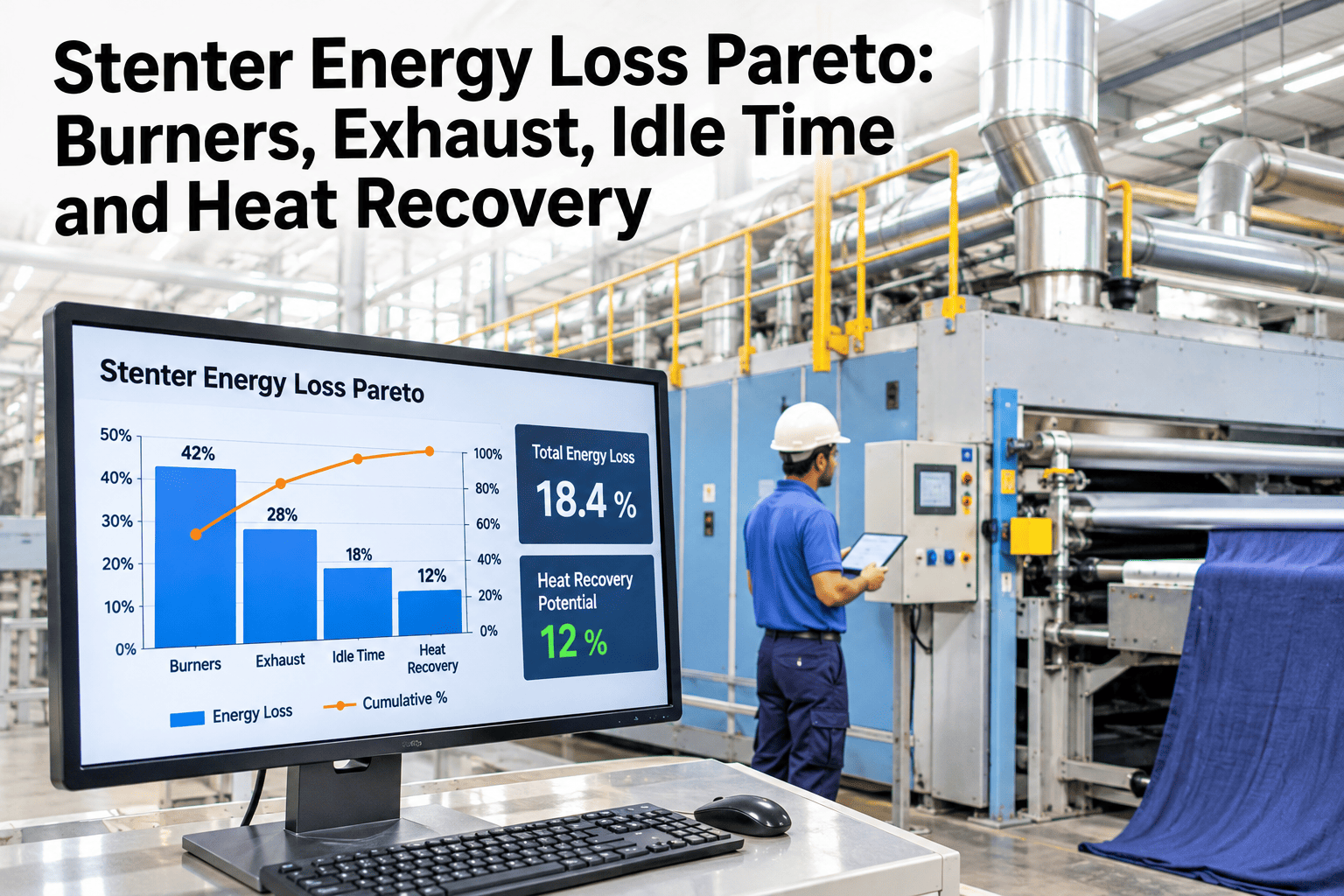
Stenter burner efficiency monitoring tracks how much usable heat each burner delivers per unit of gas, by reading fuel flow, firing rate, chamber temperature profile and exhaust signals together. A burner can waste heat for weeks without tripping an alarm, because air-fuel drift and excess air only appear as a slightly higher gas bill. U.S. DOE guidance treats periodic air-fuel ratio checks as one of the simplest ways to get maximum efficiency from fuel-fired process heating. iFactory, an on-premise industrial AI platform, watches those signals continuously on your stenter. See the trend on your own burners in a live demo.
Stenter Burner Efficiency Monitoring: Reduce Thermal Energy Waste
Know when a burner has slipped out of tune, and what the slip costs, before the next scheduled tune-up.
What is stenter burner efficiency monitoring?
It is continuous tracking of how well each stenter burner converts gas into chamber heat, using fuel, temperature, firing and exhaust data. The aim is to catch drift between tune-ups. These guidance figures set the scale, and this short session applies them to your burners.
Why does a burner waste heat without tripping an alarm?
Because safety alarms watch for failure, not for waste. A burner that still lights and holds temperature can burn extra gas every hour. Four quiet causes account for most of it.
Linkage drift
Worn joints and loose set screws let air-fuel ratios slip, as DOE warns.
Part-load excess air
Single-point linkage is set at high fire, so excess air rises at low load (ACEEE).
Pressure change
Gas pressure shifts move the ratio, so Honeywell advises monthly checks.
Rapid cycling
Burners that cycle on and off fast waste fuel and wear parts, DOE notes.
The rule comes from boiler guidance, and a stenter burner heats air rather than steam, so treat the numbers as a direction, not a forecast. Modern digital servo control, noted by Thermal Processing in February 2026, often cuts excess air.
Which signals prove how well a burner is performing?
Use five signals per burner or chamber: gas flow, firing rate, temperature profile, exhaust temperature and flue oxygen. The first four exist on most lines, and oxygen can be added where the payoff justifies it.
When was each burner last proven in tune?
Share your burner list and last tune-up dates. iFactory shows which burners to check first.
Which burner KPIs should a stenter report?
Report three: gas per unit of heat delivered, temperature swing around setpoint and high-fire duty share. Each turns raw readings into one number a technician can trend, and the cards below define them in plain terms.
Compare each burner with its own tuned baseline and with its sister burners on the same stenter. A single burner that pulls away from its neighbors is the first one to inspect. Trend the swing as well, because hunting often appears before gas use rises.
How do you tell burner waste from process waste?
Compare gas against heat delivered and fabric moved. If gas rises while speed and chamber temperature hold, suspect the burner. If gas rises because the load changed, the cause is the process. The two sets of signs below keep teams from tuning the wrong thing.
Burner-side signs
Process-side signs
Annual tune-up or continuous burner monitoring?
Do both. A tune-up resets the burner, and monitoring tells you when it has left that setting. Standard tune-up guidance measures oxygen, combustion efficiency and smoke before and after the work, which gives monitoring its baseline.
How do you roll out burner monitoring in four steps?
Baseline at tune-up
Record oxygen, gas and temperature at known-good settings.
Log the profile
Capture gas, firing rate and temperature every minute.
Alert on drift
Flag rising gas for constant heat, hunting and cycling.
Trigger maintenance
Send a work order when drift crosses its cost threshold.
How does iFactory deliver burner monitoring on-premise?
iFactory ships a pre-configured NVIDIA AI server with software pre-loaded. Rack it, plug in power and Ethernet, and the AI is live. Scope covers cabling, network, PLC and SCADA integration, operator training and 24×7 remote monitoring. Ask for a scope check for your stenter.
Ship, network, data
Server arrives; burner tags connect.
Train and pilot
Drift alerts proven on one stenter.
Go live and train
All burners tracked, teams trained.
Frequently asked questions
What does stenter burner efficiency monitoring track?
It tracks gas flow, firing rate, chamber temperature profile and exhaust signals, and adds flue oxygen where a sensor exists. Together they show whether each burner turns gas into heat well. See burner trends live or ask which sensors you need.
How much excess air should a gas burner run?
U.S. DOE guidance says an efficient natural gas burner needs only 2% to 3% excess oxygen, about 10% to 15% excess air. Many direct-fired systems run 10% to 20% at high fire. Book a tuning review to compare your burners, or contact support.
Can we monitor burners without an oxygen sensor?
Yes, partly. Gas flow, firing rate, chamber temperature and exhaust temperature reveal drift as rising fuel for the same heat. An oxygen sensor confirms the cause, and DOE suggests online oxygen monitoring to spot trends early. Request a demo or ask about retrofits.
Does monitoring replace the annual burner tune-up?
No. A tune-up adjusts the burner, and monitoring shows when it has moved away from that setting. Honeywell advises checking burner pressures monthly, which software can do continuously. Plan monitoring around your tune-up or talk to the team.
How long does a rollout take?
A typical turnkey rollout takes 6 to 12 weeks: ship and network, train and pilot, then go live with operator training. One stenter can pilot first. Book a pilot planning call or ask about scope.
Stop paying for burners that drifted
Get a turnkey on-premise setup that tracks stenter burner drift and heat waste, live in 6 to 12 weeks.