A mill can hold every certificate in the file cabinet and still fail a buyer's chemical audit, because ZDHC MRSL conformance is tracked at the level of individual chemical formulations, not the facility as a whole. One uncertified drum of finishing auxiliary sitting in the chemical store is enough to break an otherwise clean inventory. See how iFactory ties chemical inventory, safety data sheets, and MRSL conformance level together in one place with a Book a Demo.
Every Chemical In Your Inventory Needs Its Own Proof Of Conformance
The ZDHC Manufacturing Restricted Substance List governs what can be intentionally used in textile processing chemical formulations, and conformance is verified drum by drum, batch by batch, not once for the whole facility. Mills that manage this at spreadsheet level tend to discover the gap during a buyer audit, not before.
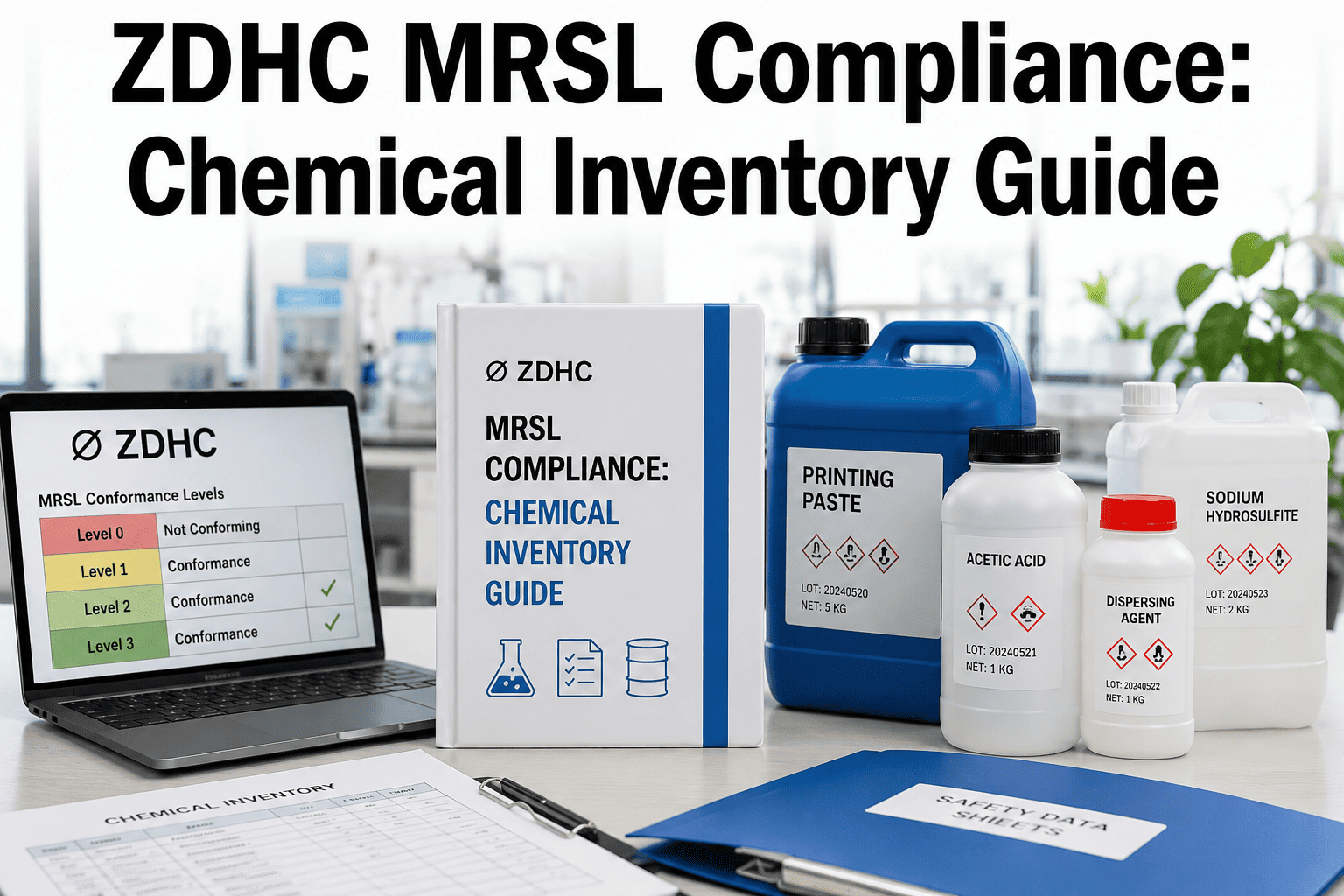
Three Conformance Levels, Each Building On The Last
ZDHC MRSL conformance is structured as three progressive levels, and most buyer requirements specify a minimum level rather than accepting any conformance as equivalent. Understanding what each level actually verifies is the difference between choosing a chemical supplier that meets your buyer's requirement and one that only appears to.
Analytical Verification
Chemical formulations are tested against ZDHC MRSL substance thresholds and reviewed against the associated safety data sheet, establishing the baseline reliability of a supplier's chemical inventory.
Management System Audit
Adds an on-site assessment of the chemical formulator's environmental, health and safety, and quality management systems on top of everything verified at Level 1.
Chemical Hazard Assessment
The highest conformance tier, requiring documented capability to evaluate chemical hazards and maintain ongoing chemical safety expertise, in addition to everything required at Levels 1 and 2.
A Buyer Audit Doesn't Care Which Chemicals You Meant To Track
iFactory links every chemical drum in inventory to its MRSL conformance level and expiry, so gaps surface before an auditor finds them.
Intentional Use Is The Line That Trips Up Most Inventories
The MRSL specifically restricts substances that are intentionally added to a chemical formulation, which is a narrower and more precise scope than a general hazardous substance list. This distinction matters operationally, since a formulation can still fail MRSL disclosure requirements if trace contaminants, by-products, or residuals are not properly documented, even when no restricted substance was deliberately added.
Intentionally Added Ingredients
Substances deliberately incorporated to achieve a specific aesthetic or functional result, the primary and most tightly scrutinized category under MRSL review.
Residuals And By-Products
Substances generated as a side effect of the manufacturing process for the chemical itself, which still require disclosure even though they were not deliberately added.
Contaminants And Impurities
Trace substances present due to raw material quality or manufacturing conditions, disclosed and evaluated against the same threshold requirements as intentional additions.
What A Functioning Chemical Inventory Program Actually Tracks
Spreadsheet-based chemical tracking tends to break down at the point where conformance certificates expire, formulations get reformulated by the supplier without notice, or a new chemical enters the store without a completed MRSL review. A functioning inventory program needs to track more than just a static list of approved chemicals.
| Tracked Element | Why It Matters |
|---|---|
| Conformance Level Per Formulation | Buyer requirements often specify a minimum level, not just any conformance |
| Certificate Expiry Date | MRSL conformance certificates are tied to a formulation version and lapse on reformulation |
| Safety Data Sheet Version | An outdated SDS can misrepresent the actual hazard profile of a chemical in current use |
| Gateway Registration Status | Confirms the formulation is actually listed on the ZDHC Gateway Chemical Module, not just certified on paper |
Certificates Expire. Formulations Change. Spreadsheets Don't Notice Either.
iFactory flags expiring MRSL certificates and reformulation changes automatically instead of relying on someone remembering to check.
Where Chemical Inventory Programs Most Often Break Down
Mills that struggle with recurring buyer audit findings tend to share the same handful of process gaps, most of which have nothing to do with the quality of the chemicals themselves.
Treating Conformance As Facility-Wide
A certification held by one product line is mistakenly assumed to cover every chemical in the store, when conformance is actually verified formulation by formulation.
Missing Reformulation Changes
A supplier changing a formulation without notifying the mill invalidates the existing conformance certificate even though the product name and packaging stay the same.
No Central View Across Sites
Multi-site mills often manage chemical inventory independently per location, making it difficult to confirm consistent conformance across the whole supply base.
Confusing MRSL With RSL
MRSL governs what goes into manufacturing chemical formulations, while RSL governs what remains in the finished product, and the two require separate tracking and separate evidence.
What Mills Typically See After Centralizing Chemical Compliance Tracking
Mills that move chemical inventory and MRSL conformance tracking off spreadsheets and into a connected system tend to see faster audit turnaround and fewer last-minute compliance scrambles ahead of a buyer visit.
Frequently Asked Questions
Q: What is the difference between ZDHC MRSL and ZDHC RSL?
MRSL, the Manufacturing Restricted Substance List, governs substances that cannot be intentionally used during the manufacturing process itself, focusing on the chemical formulations applied at the mill rather than the finished garment. RSL, the Restricted Substance List, instead governs what substances may legally remain present in the finished product that reaches a consumer. A mill can be fully compliant with RSL testing on finished fabric while still having gaps in MRSL conformance on the chemical formulations used to produce it, which is why buyers increasingly require both forms of evidence rather than treating one as a substitute for the other. Reach out through Support Contact if you need help distinguishing which requirement applies to a specific buyer request.
Q: Does a Level 1 conformance certificate cover a chemical formulation permanently?
No, conformance certificates are tied to a specific version of a chemical formulation, and if the supplier reformulates the product, even under the same name and packaging, the existing certificate no longer applies to the new version. This is one of the most common gaps mills discover during an audit, since a supplier relationship built on trust does not automatically flag reformulation events, and a mill relying on a certificate issued a year or more earlier may be unknowingly out of conformance on current stock.
Q: How does a mill choose between MRSL Level 1, 2, and 3 conformance for its chemical suppliers?
The choice usually comes down to what the buyer or brand contractually requires rather than a mill's own preference, since Level 2 and 3 conformance both build directly on top of Level 1 analytical verification rather than replacing it. Mills serving buyers with more stringent sustainability commitments increasingly find Level 1 conformance alone insufficient, and moving chemical suppliers toward Level 2 or Level 3 conformance ahead of a contractual deadline avoids a scramble closer to the buyer's audit date. A Book a Demo session can walk through how conformance level tracking maps to specific buyer requirements across a supplier base.
Q: What happens if a restricted substance is found as a contaminant rather than an intentional ingredient?
The MRSL still requires disclosure and evaluation of contaminants, residuals, and by-products against the same threshold limits applied to intentionally added substances, even though the substance was never deliberately incorporated into the formulation. This means a chemical manufacturer with a genuinely unintentional contamination issue in its raw material supply chain can still fail MRSL conformance if the contamination is not disclosed and kept below the applicable threshold, which is why chemical hazard assessment at Level 3 conformance places specific emphasis on this category.
Q: Can a mill be MRSL conformant on its own chemical inventory but still fail a buyer audit?
Yes, this happens most often when documentation exists but is not organized in a way that can be quickly retrieved and cross-referenced against the actual chemicals physically present in the store during the audit. Auditors typically spot-check physical inventory against paperwork, and a mismatch between what a spreadsheet says should be in stock and what is actually on the shelf, even for a single uncertified drum, is enough to generate a negative audit finding regardless of how compliant the rest of the inventory is.
Stop Preparing For Audits. Stay Ready For Them.
iFactory keeps chemical inventory, conformance level, and certificate status connected and current across every site.