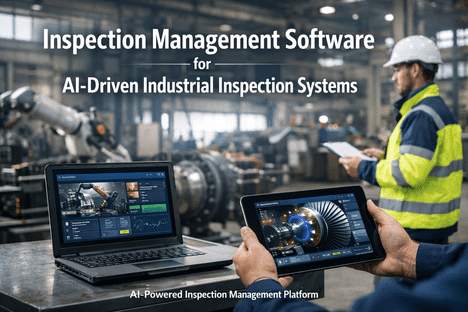
Every year, manufacturers lose an estimated $8 trillion globally to poor quality — and nearly 23% of all product defects slip past traditional visual inspection. A single missed weld crack, a misaligned component, or an uncalibrated torque reading can trigger warranty claims worth millions, regulatory penalties, and brand damage that takes years to repair. Clipboards and spreadsheets simply cannot keep pace with modern production speeds. AI-powered inspection management software is rewriting the rules — catching defects human eyes miss in milliseconds, automating compliance documentation, and turning inspection from a cost center into a competitive advantage.
99.7%
AI Defect Detection Accuracy
10x
Faster Than Manual Inspection
67%
Reduction in Inspection Costs
$8T
Annual Cost of Poor Quality Worldwide
The Inspection Problem Nobody Wants to Talk About
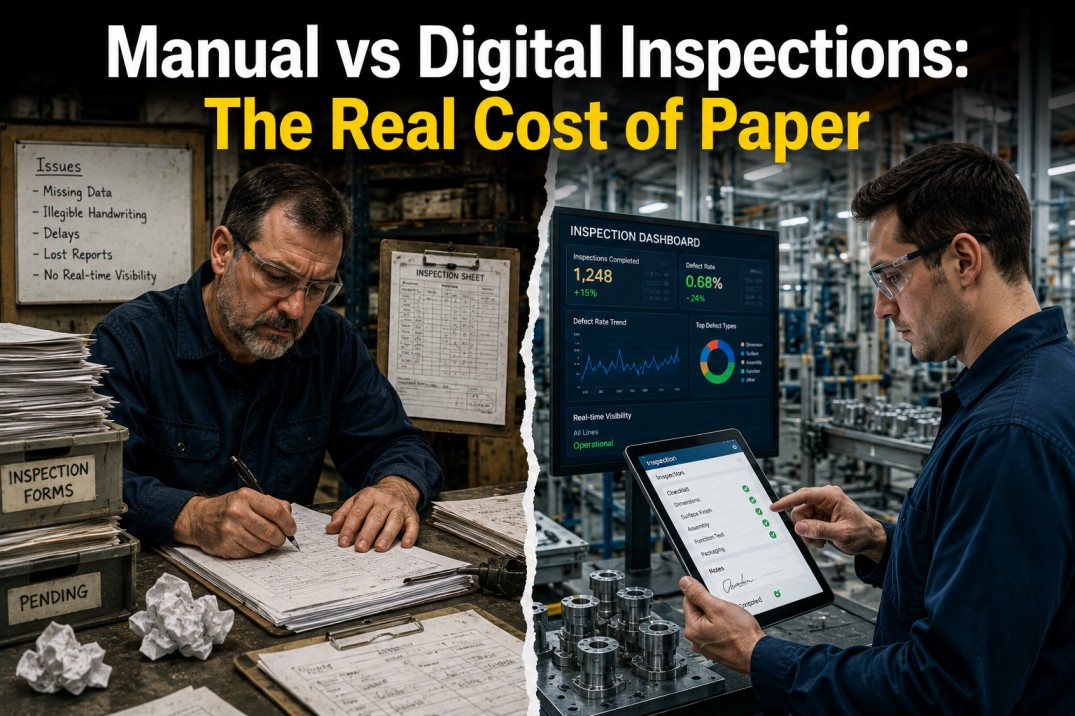
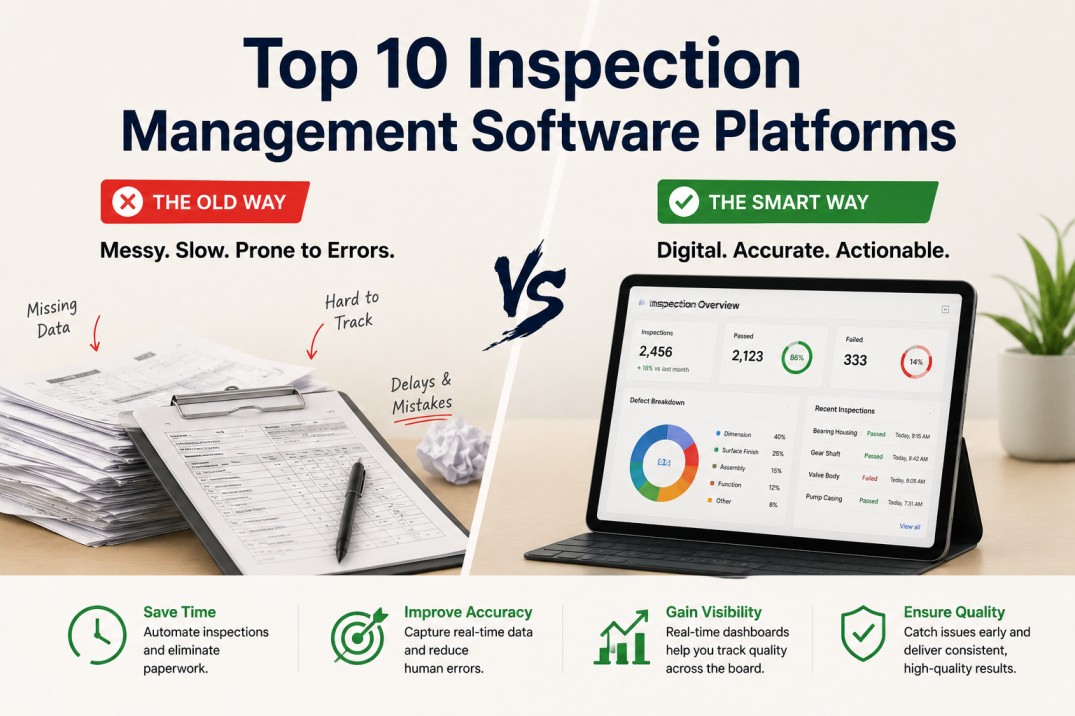
Traditional industrial inspection is built on a fragile foundation: human attention. Inspectors work 8 to 12-hour shifts, eyes fatiguing after the first hour, checklists filled out from memory, defects missed because nobody can stay at 100% focus for that long. Paper records get lost. Spreadsheets get outdated. Audit trails have gaps. And when something fails downstream, nobody can trace exactly what was inspected, when, by whom, or under what conditions.
Traditional Inspection
Paper. Pressure. Pain.
Checklists filled from memory at end of shift
Defects missed due to inspector fatigue after hour 2
No photographic evidence, no timestamp, no traceability
Audit prep takes weeks of manual record hunting
Training a new inspector takes 6 to 12 months
Defect root cause analysis is guesswork
Inspection happens. Quality doesn't.
AI Inspection Management
Automated. Accurate. Auditable.
Digital workflows guide every step in real time
AI vision catches microscopic defects at production speed
Every inspection timestamped, geotagged, photographed
Audit-ready reports generated in under 5 minutes
New inspectors productive within days, not months
Pattern recognition reveals systemic root causes
Inspection becomes intelligence.
How AI-Powered Inspection Actually Works
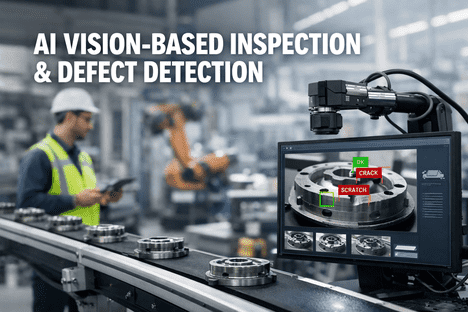
Modern inspection management platforms combine computer vision, machine learning, and mobile-first workflows into a single connected system. High-resolution cameras feed real-time images to trained AI models that classify defects in milliseconds. Mobile checklists replace paper. Sensor data flows automatically into records. Every finding connects to a work order, a responsible team, and a resolution path.
Surface Defect Detection
AI vision models identify scratches, dents, porosity, and surface anomalies smaller than the human eye can reliably see at production speed.
Dimensional Accuracy
Automated measurement verification catches out-of-tolerance parts by comparing real-time captures against CAD specifications with sub-millimeter precision.
Weld & Joint Integrity
Deep learning models trained on millions of weld images detect cracks, undercuts, porosity, and incomplete fusion with specialist-level accuracy, 24/7.
Assembly Verification
Multi-point visual checks confirm component presence, orientation, and correct installation across complex assemblies in seconds, not minutes.
The 5-Stage Inspection Workflow, Reimagined
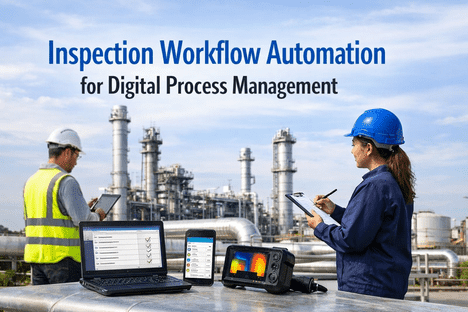
An inspection management platform doesn't just replace your checklist — it orchestrates the entire inspection lifecycle from scheduling to closure. Here's how the workflow unfolds when AI and automation replace manual tracking.
01
Schedule & Assign
System auto-generates inspections from PM schedules, regulatory cycles, or sensor triggers. Assigns to qualified inspectors based on skill matrix and shift availability.
Automated triggers · Skill-matched assignment
02
Guided Execution
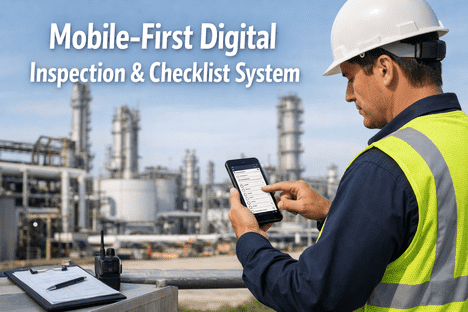
Mobile app walks inspector through every step. Embedded reference images, tolerance specs, and voice-to-text notes remove interpretation errors on the shop floor.
Mobile-first · Zero paperwork
03
AI-Assisted Detection
Camera captures are analyzed in real time. AI flags anomalies, suggests defect classifications, and auto-fills findings — inspector validates with one tap.
Computer vision · Millisecond analysis
04
Auto Work Orders
Failed inspections automatically generate prioritized work orders with photos, location, severity, and suggested parts — routed to the right maintenance team instantly.
Zero-touch dispatch · Parts pre-linked
05
Analytics & Audit
Every inspection builds the quality data lake. Dashboards surface failure patterns. Audit reports generate in minutes with full traceability for ISO, FDA, or FAA compliance.
Pattern detection · One-click audits
Built for Industrial Quality Teams
Turn Every Inspection into Actionable Intelligence
iFactory replaces paper, spreadsheets, and disconnected tools with a single AI-powered inspection platform. Schedule smarter, catch more defects, close audit gaps, and build a quality data asset that compounds in value every shift.
Where AI Inspection Delivers the Biggest Wins
Industrial inspection is not one-size-fits-all. The same core platform adapts to very different failure modes, compliance regimes, and inspection cadences depending on the industry. Here are six verticals where AI-driven inspection is already reshaping quality operations.
Automotive & EV
Surface, Welds, Assembly
Paint defect detection, body-in-white weld inspection, battery cell integrity scanning, and assembly line verification — catching defects that trigger recalls worth hundreds of millions.
40%Warranty Claim Reduction
Aerospace
NDT, Composites, Turbines
Non-destructive testing of composite panels, turbine blade crack detection, rivet inspection, and FAA-compliant record keeping — where a single missed defect can ground a fleet.
60%Faster NDT Cycles
Food & Beverage
Packaging, Hygiene, HACCP
Foreign object detection, label verification, fill-level monitoring, and digital HACCP checklists — keeping product safe and audit trails unbroken for FDA and BRCGS compliance.
85%Less Audit Prep Time
Pharma & Biotech
Vial, Blister, Cleanroom
Particulate inspection of injectables, blister pack integrity, cleanroom compliance, and 21 CFR Part 11-ready audit trails — the non-negotiable quality baseline in regulated pharma.
99.9%Audit Readiness
Electronics & Semicon
PCB, Solder, Wafer
Solder joint inspection, PCB component placement verification, wafer defect classification — catching micro-scale flaws invisible to manual inspection at production speed.
10xInspection Throughput
Metals & Heavy Industry
Coils, Pipes, Castings
Surface defect mapping on rolled coils, weld seam inspection on pipes, casting porosity detection — reducing scrap rates and customer claims on high-value shipments.
50%Scrap Rate Drop
The Measurable ROI of AI Inspection
The business case for AI-powered inspection is not theoretical. These are the performance deltas documented across manufacturing deployments — the kind of numbers that move quarterly reviews and board conversations.
Defect Detection Rate Improvement
Reduction in Inspection Labor Hours
Reduction in Customer Quality Claims
Increase in First-Pass Yield
Cost Savings on Warranty & Recalls
What to Look For in an Inspection Management Platform
Not every platform is built for industrial environments. Use this capability checklist when evaluating inspection management software — the difference between a tool you tolerate and a system that transforms your quality operations.
AI Vision Integration
Native computer vision that runs on shop-floor cameras and mobile devices — not a bolt-on add-on. Models should be retrainable on your specific defect library.
Offline Mobile Capability
Inspectors in remote plant areas or metal-shielded zones need the app to keep working without connectivity, syncing automatically when reconnected.
CMMS & ERP Integration
Inspection findings must flow directly into work orders, parts requisitions, and quality dashboards — not live in a data silo disconnected from execution.
Compliance-Ready Audit Trails
Built-in support for ISO 9001, FDA 21 CFR Part 11, FAA Part 139, IATF 16949 — with tamper-proof logs, e-signatures, and one-click audit packages.
Configurable Workflows
Drag-and-drop workflow builder that lets quality managers design inspections without IT involvement — with conditional logic, escalations, and approvals.
Pattern & Root Cause Analytics
Dashboards that surface recurring failure modes across assets, shifts, suppliers, and operators — turning inspection data into continuous improvement fuel.
Ready in 30 Days. Scalable Across Every Plant.
Stop Inspecting for the Sake of Records. Start Inspecting for Intelligence.
iFactory delivers the AI inspection platform modern industrial operations demand — mobile-first, compliance-ready, deeply integrated with your maintenance and quality workflows, and backed by vision models trained for real-world shop-floor conditions.
Frequently Asked Questions
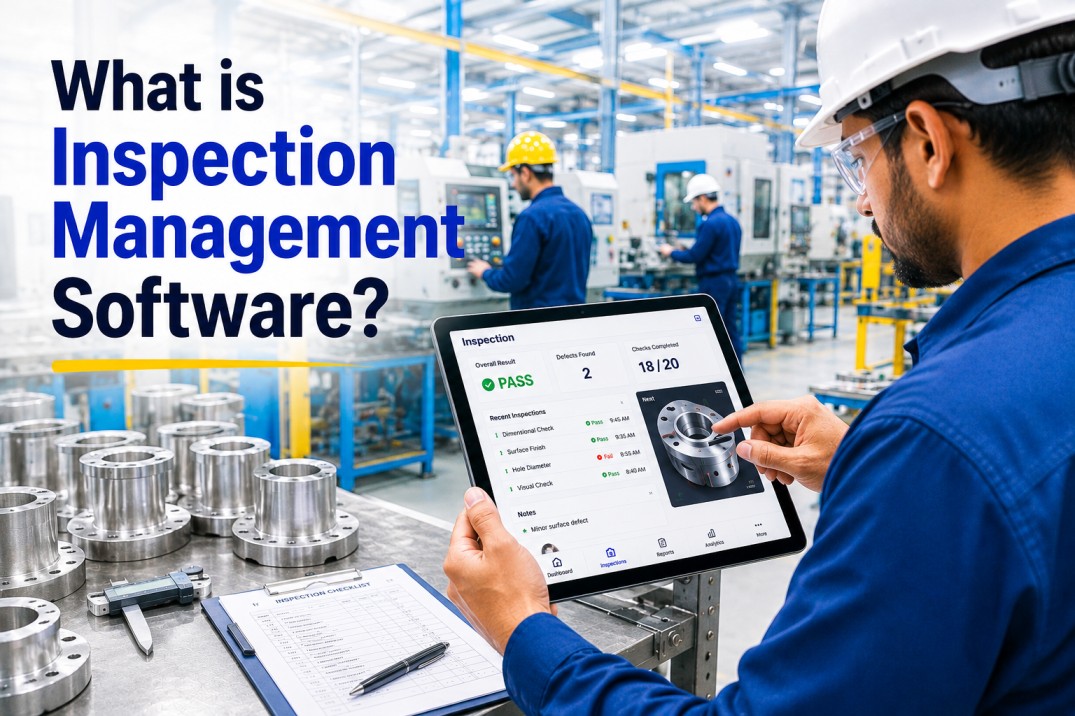
What is inspection management software?
Inspection management software is a digital platform that replaces paper checklists and spreadsheets with automated workflows for scheduling, executing, documenting, and analyzing industrial inspections. Modern platforms add AI vision, mobile execution, CMMS integration, and compliance-ready audit trails — transforming inspection from a recordkeeping task into a live quality intelligence system.
How does AI improve industrial inspection accuracy?
AI vision models are trained on large libraries of defect images and can detect surface flaws, dimensional deviations, weld issues, and assembly errors at speeds and accuracy levels that consistently exceed human inspectors — often above 99%. AI never fatigues, works 24/7, and builds a growing knowledge base with every inspection, meaning detection accuracy actually improves over time rather than degrading with shift changes.
Does AI inspection replace human inspectors?
No. AI inspection augments human inspectors — handling repetitive visual checks at production speed and flagging anomalies for human judgment. Skilled inspectors focus on complex cases, root cause investigation, and process improvement, while AI handles volume-heavy routine detection. The result is better quality outcomes with teams working on higher-value tasks instead of burning out on manual scanning.
How long does implementation typically take?
A modern cloud-based inspection management platform can be rolled out across a plant in 4 to 8 weeks — starting with digitizing existing checklists, then adding AI vision on priority lines, and finally integrating with your CMMS or ERP. Most quality teams see measurable improvements in inspection throughput and audit prep time within the first 30 days of go-live.
What compliance standards does inspection software support?
Enterprise-grade platforms support ISO 9001, IATF 16949, AS9100, FDA 21 CFR Part 11, FAA Part 139, BRCGS, HACCP, GMP, and industry-specific frameworks. Support typically includes tamper-proof audit logs, electronic signatures, role-based access, version-controlled procedures, and automated report generation — dramatically reducing audit preparation time from weeks to hours.
How does inspection management software integrate with maintenance systems?
Leading platforms like iFactory integrate natively with CMMS and ERP systems. A failed inspection automatically generates a prioritized work order with attached photos, location, defect classification, and linked parts — routed to the right maintenance team without manual handoffs. This closed loop between inspection and action is what turns defect detection into actual quality improvement.