Data Center Avoids $2.8M Outage with Chiller Predictive Maintenance
By Christopher Hayes on June 18, 2026
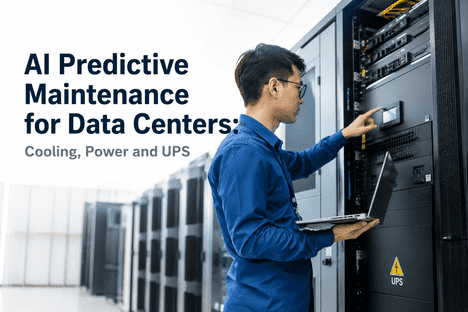
In mission-critical data center environments, the cooling infrastructure — including centrifugal chillers, cooling towers, pumps, and air handling units — ranks among the most operationally significant assets on the facility floor, where unplanned chiller failures, refrigerant charge loss, compressor bearing degradation, and condenser fouling are leading causes of thermal events that threaten server uptime. A single chiller failure in a 10+ MW data center can escalate cooling tower temperatures beyond server intake thresholds within 12 to 18 minutes, triggering emergency load shedding, IT equipment throttling, and potential full facility shutdown. According to the Uptime Institute's 2023 outage analysis, the average cost of a data center outage has risen to $1.58 million, with cooling system failures accounting for 22% of all unplanned downtime events. Traditional time-based chiller maintenance — quarterly oil changes, annual tube cleaning, and calendar-driven refrigerant top-offs — cannot address the variable operating conditions — part-load centrifugal compressor surge, refrigerant micro-leaks that develop between seasonal maintenance windows, cooling tower fouling that accelerates condenser degradation, and bearing wear patterns that vary with compressor runtime and load cycling — that drive the majority of chiller failures in data center applications. iFactory's AI predictive maintenance platform fuses vibration sensors, refrigerant pressure transducers, compressor motor current telemetry, condenser approach temperature trends, and BMS data into machine learning models that forecast chiller compressor bearing failure, refrigerant charge degradation, condenser fouling, and pump cavitation 3 to 6 weeks in advance, enabling facilities teams to intervene before a thermal event threatens server availability. Book a Demo to see how iFactory connects your chiller plant telemetry to predictive intelligence.
AI Predictive Maintenance · Data Center Cooling 2026
Data Center Avoids $2.8M Outage with Chiller Predictive Maintenance
Why Reactive Chiller Maintenance Fails in Mission-Critical Data Center Environments
Centrifugal chillers in data center applications operate under conditions that accelerate wear beyond what scheduled maintenance intervals can predict. The compressor in a typical 500 to 1,500-ton centrifugal chiller spins at 10,000 to 40,000 RPM on oil-lubricated or magnetic bearings, where a minor refrigerant charge loss can degrade evaporator performance by 12 to 18% before any alarm threshold is crossed — silently reducing cooling capacity while the data center load increases. Bearing micro-wear from repeated start-stop cycling and part-load surge events accumulates undetected between quarterly oil analysis samples, progressing from stage 1 to stage 4 damage in as little as 300 operating hours. Condenser tube fouling from cooling tower water chemistry drift develops gradually over weeks, increasing compressor lift and energy consumption by 8 to 15% before the approach temperature rise triggers a manual investigation. Fixed-interval chiller maintenance replaces oil, cleans tubes, and tops off refrigerant based on calendar time rather than actual condition — meaning compressors are serviced prematurely during unnecessary outages or too late after a thermal event has already impacted server inlet temperatures. iFactory's condition-based approach replaces the calendar with sensor-driven prediction tailored to each chiller's actual load profile, ambient conditions, and operating hours.
LIMITATIONS OF TIME-BASED MAINTENANCE FOR DATA CENTER CHILLERS
1
Variable cooling loads ignored — same maintenance interval applied regardless of partial vs full load operation, ambient temperature swings, or condenser water quality variation
2
Sensor-blind to refrigerant micro-leaks — refrigerant charge degradation of 5 to 10% per month is undetectable in quarterly pressure checks but progressively reduces chiller capacity below IT load requirements
3
Catastrophic failure domino effect — a single chiller trip cascades across the plant, overloading remaining chillers and triggering a full facility thermal event in 12 to 18 minutes
4
No plant-wide efficiency visibility — compressor lift, condenser approach, evaporator delta-T, and kW/ton trends are evaluated in isolation rather than correlated to predict the next chiller failure event
Three Chiller Failure Categories iFactory Predicts
01
Centrifugal Compressor Bearing and Refrigerant Charge Failure Prediction
Centrifugal chillers in data center plants operate at 500 to 2,500 tons with compressor speeds of 10,000 to 40,000 RPM. Compressor bearing degradation — whether oil-lubricated journal bearings or magnetic bearing systems — accounts for over 40% of all chiller failures in mission-critical cooling applications. Simultaneously, refrigerant charge loss through micro-leaks at shaft seals, gaskets, and valve stems silently reduces chiller capacity by 8 to 15% before low-pressure alarms activate — at which point the refrigerant loss has already impacted the facility's ability to maintain server intake temperatures during peak load. Each unplanned chiller failure costs $500,000 to $2.8M in IT load shedding, emergency repair mobilization, and potential server downtime — with a single full facility thermal event capable of exceeding the $2.8M threshold when business interruption costs are included. iFactory ingests compressor vibration data, bearing temperature trends, refrigerant suction and discharge pressure telemetry, motor current signature, and condenser approach temperature to train ML models that predict bearing and refrigerant charge failures 3 to 6 weeks in advance. Facilities running these systems report 30 to 45% reductions in unplanned chiller-related thermal events. Book a Demo to see iFactory's chiller prediction models in production.
3-6 week lead time70-85% accuracy30-45% event reduction
02
Condenser Fouling and Cooling Tower Performance Monitoring
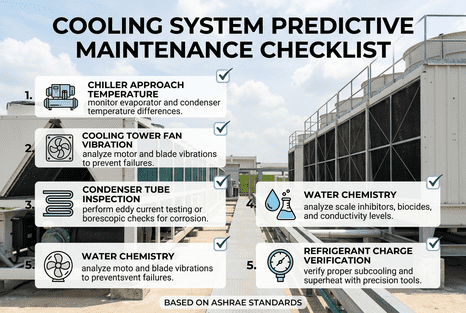
Condenser tube fouling is the most common cause of gradual chiller efficiency degradation in data center plants — developing from cooling tower water chemistry drift, airborne particulate ingress, and biological growth in open-loop condenser water systems. As fouling increases, condenser approach temperature rises, compressor lift increases, and kW/ton efficiency degrades by 8 to 15% before the condition is identified through manual tube inspection during the next scheduled maintenance shutdown. In severe cases, fouling-induced high condenser pressure triggers a chiller safety trip during peak summer load — potentially cascading into a facility-level thermal event. iFactory monitors condenser water supply and return temperature differential, refrigerant condensing pressure and temperature, cooling tower fan vibration, and approach temperature trending to detect fouling progression 2 to 4 weeks before condenser performance degrades enough to affect chiller capacity or trigger a high-pressure trip. The Shift Logbook captures tube cleaning records, water treatment chemical addition logs, and cooling tower basin inspection findings alongside sensor data to build increasingly accurate fouling prediction models.
Chilled Water Pump Cavitation and Valve Actuator Degradation
Chilled water pumps and control valves in data center hydronic distribution systems are susceptible to cavitation-induced impeller damage from poor suction-side conditions, shaft seal wear from dry-running and particulate contamination, and valve actuator degradation from the continuous modulating duty cycle required to maintain supply water temperature setpoints. These conditions produce distinct signatures in pump motor current draw — a fluctuating current pattern indicates cavitation, a rising trend indicates seal drag, and valve position calibration drift appears as increasing deviation between commanded and actual position. iFactory's ML models learn to recognize these patterns and separate them from normal operating variation. While prediction accuracy on hydronic distribution components ranges from 55 to 75% initially due to variable system configuration, the platform's continuous learning loop improves precision as more telemetry and maintenance event data accumulates across the chiller plant.
Ensemble ML modelsContinuous learning loopShift Logbook correlation
How iFactory Transforms Chiller Plant Telemetry Into Predictive Intelligence
iFactory is the AI software intelligence layer — not a sensor manufacturer or hardware vendor. The platform integrates with existing chiller plant telemetry from BMS systems (Siemens Desigo CC, Honeywell Niagara, Johnson Controls Metasys), chiller controller panels (Carrier, Trane, York, Daikin, Mitsubishi), EPMS platforms, VFD drives, vibration sensors, pressure transducers, and flow meters already deployed on your cooling infrastructure. The Shift Logbook captures facilities operator shift reports, daily inspection findings, refrigerant log entries, and maintenance notes alongside the real-time sensor stream, creating a unified data fabric for predictive model training and plant-wide chiller reliability analysis.
Asset Class
Telemetry Sources
iFactory Prediction Output
Business Impact
Centrifugal Chillers
Vibration · bearing RTD · refrigerant pressure · motor current
Centrifugal chillers are the highest-value asset in any data center cooling plant, where unplanned failure directly threatens server inlet temperatures and facility uptime. iFactory monitors compressor vibration, bearing temperature, refrigerant suction and discharge pressure, and motor current draw continuously. ML models trained on historical failure patterns predict bearing degradation, refrigerant charge loss, and surge-induced impeller damage 3 to 6 weeks in advance. Predicted failures include a confidence score and recommended intervention window — facilities teams schedule chiller overhauls during planned maintenance windows or low-load periods, avoiding emergency repairs that cost $500,000 to $2.8M plus uptime risk. Every prediction event is logged in iFactory's Shift Logbook with full traceability to the sensor data that triggered the alert.
Condenser Fouling Detection and Cleaning Optimization
Continuous
In continuously operating data center chiller plants, condenser tube fouling is the leading cause of gradual efficiency degradation — increasing kW/ton by 8 to 15% before the condition is identified during scheduled maintenance. iFactory detects early-stage fouling patterns through condenser approach temperature trending, refrigerant condensing pressure monitoring, and cooling tower water quality correlation. The platform identifies which chiller in the plant is developing the most rapid tube fouling and predicts when cleaning will be required — enabling targeted tube cleaning during planned outages rather than reactive shutdowns triggered by high-pressure trips. Alerts route directly to the facilities shift in the Shift Logbook with chiller identification, fouling severity score, and recommended cleaning scope.
Pump Cavitation and Valve Actuator Health Surveillance
Continuous
Chilled water pumps and control valves face variable operating conditions — different flows, differential pressure setpoints, and valve modulating cycles throughout the day — producing complex vibration and motor current signatures that challenge conventional threshold-based monitoring. iFactory applies ensemble ML models with a continuous learning loop that improves prediction precision for pump cavitation, seal wear, and valve actuator drift detection as more operating data accumulates. The Shift Logbook captures operator-reported anomalies — unusual pump noise, valve position deviation, pressure fluctuations — alongside sensor data to build richer training corpora for variable-duty-cycle hydronic distribution equipment.
3-6 week advance warning vs emergency thermal event
30-45%
Reduction in unplanned chiller-related thermal events
Planned intervention replaces emergency response
8-15%
kW/ton efficiency recovery through optimized condenser cleaning
Fouling detection · cleaning scheduling · energy savings
$2.8M
Prevented loss per catastrophic chiller failure avoided
IT load shedding + emergency repairs + business interruption
FAQ
iFactory is the AI software intelligence layer — not a sensor manufacturer or hardware vendor. The platform integrates with vibration sensors, pressure transducers, temperature RTDs, motor current transducers, flow meters, BMS systems (Siemens Desigo CC, Honeywell Niagara, Johnson Controls Metasys), chiller controller panels (Carrier, Trane, York, Daikin, Mitsubishi), EPMS platforms, and IoT gateways already deployed on your chiller plant equipment. Your facilities team selects the sensor and telemetry hardware; iFactory turns the data into predictive intelligence, maintenance alerts, and shift-ready work orders.
Model tuning typically requires 3 to 6 months of operation on a specific chiller plant to calibrate refrigerant charge loss models against seasonal ambient temperature variation, tune threshold parameters for compressor bearing vibration monitoring, and establish baseline KW/ton efficiency envelopes for each chiller. The platform's continuous learning loop improves precision over time as more operating data and failure events accumulate across different chiller makes, models, and load profiles. iFactory recommends starting with one chiller and one failure mode — such as refrigerant charge monitoring — proving value before expanding to the full chiller plant fleet.
Yes. iFactory connects to BMS platforms (Siemens, Honeywell, Johnson Controls), EPMS systems, SAP, Oracle, Maximo, and major CMMS platforms. The Shift Logbook captures operator defect reports, shift handover notes, and maintenance actions alongside sensor-generated predictions. Every prediction event, sensor reading, and maintenance action is recorded with full traceability for uptime audit, compliance, and continuous model improvement — enabling your facilities team to move from reactive chiller repairs to data-driven reliability.
iFactory's chiller models incorporate ambient wet-bulb temperature, facility IT load, and chiller plant configuration as direct input variables — allowing the AI to distinguish between performance changes caused by seasonal operating condition variation and those caused by genuine refrigerant charge loss, condenser fouling, or bearing degradation. The model establishes separate baseline envelopes for each season and load range, alerting only when the deviation exceeds the normal operating envelope for the current ambient and load conditions. This approach virtually eliminates false positive alerts during seasonal transition periods.
Yes. iFactory's platform is compatible with all chiller compressor types including centrifugal, screw, scroll, and magnetic-bearing (Turbocor) compressors. For magnetic bearing chillers, the platform monitors bearing controller telemetry, levitation gap consistency, VFD harmonic distortion, and motor current signature in addition to standard vibration and temperature parameters — enabling detection of bearing controller faults, levitation instability, and VFD harmonic interference before they trigger a protective compressor shutdown.
Deploy iFactory for Data Center Chiller Predictive Maintenance
AI-powered predictive maintenance platform connecting centrifugal chillers, cooling towers, pumps, and BMS telemetry into one unified intelligence layer — with ML-based failure prediction, refrigerant charge forecasting, condenser fouling detection, Shift Logbook integration, CMMS workflow automation, and plant-wide chiller reliability analytics.