Every industrial operation that depends on rotating equipment, hydraulic systems, and process machinery faces the same fundamental question: where should the intelligence live that monitors and predicts failure? Cloud-based predictive maintenance platforms promise scalability, centralized dashboards, and AI models trained on fleet-wide data — but they introduce an unavoidable latency penalty that, in a production environment where a bearing spins at 50,000 RPM, means the difference between detecting a fault before catastrophic failure and logging the failure after it has already occurred. On-premise AI, deployed at the edge, processes sensor data locally — no cloud round-trip, no bandwidth bottleneck, no data sovereignty compromise, and no recurring per-sensor subscription fees that scale linearly with every additional monitoring point. The decision between on-premise edge AI and cloud-based predictive maintenance is not a technology preference; it is an operational architecture choice that determines response time, data security, total cost of ownership, and ultimately, the failure coverage your plant can realistically sustain. This guide examines the structural differences between on-premise and cloud predictive maintenance architectures, explains why edge processing delivers superior outcomes for real-time fault detection, and details how iFactory AI's on-premise platform gives industrial operators millisecond-level anomaly detection without sacrificing the strategic intelligence that centralized analytics provides.
The Latency Problem That Cloud PdM Cannot Solve
The central argument for cloud-based predictive maintenance is computational scale. Cloud platforms can train deep learning models on millions of data points across hundreds of assets, identify fleet-wide degradation patterns, and deliver dashboards that give maintenance managers a single pane of visibility across multiple plants. These are genuine capabilities — but they address a strategic planning use case, not a real-time protection use case. The moment a cloud architecture is asked to detect and alert on a developing fault in real time, the physics of network communication imposes a delay that no amount of model sophistication can eliminate.
In a typical cloud PdM deployment, sensor data travels from the PLC or edge gateway to the cloud data center — a round trip that, under optimal conditions, takes 500 milliseconds to 3 seconds depending on network architecture, data volume, and processing queue depth. In a production environment where a motor bearing accelerates from nominal operation to critical failure in under 2 seconds — a phenomenon known as rapid-onset failure, which accounts for an estimated 35 to 45% of unplanned downtime events in heavy industry — a 2-second cloud latency means the alert arrives after the failure has already propagated. Edge AI, by contrast, processes the same sensor data on a local inference engine that returns a prediction in under 10 milliseconds — fast enough to trigger an emergency shutdown or alert before the fault cascade reaches the damage threshold. Book a Demo to see how iFactory's edge inference engine achieves sub-10ms detection latency in production environments.
- 500ms–3s+ latency from sensor to alert — too slow for rapid-onset failure detection
- Recurring per-sensor subscription fees that escalate with every additional monitoring point
- Raw sensor data transmitted off-site — data sovereignty and IP security exposure
- Network dependency: alert delivery fails during WAN outage or bandwidth congestion
- Model inference queued behind other cloud workloads — no guaranteed processing priority
- Ongoing egress and compute costs that make per-asset monitoring uneconomical below threshold
- <10ms inference latency — fault detection before failure propagation
- Fixed on-premise deployment cost — no per-sensor fees, unlimited monitoring points
- All data processed locally — zero raw sensor data leaves the facility
- Full offline operation — edge inference continues during network or cloud outages
- Dedicated local inference engine — deterministic processing priority for critical assets
- No recurring data egress costs — total cost of ownership decreases as sensor count scales
Data Sovereignty: Why On-Premise AI Is the Only Defensible Architecture for Industrial IP
The second structural advantage of on-premise AI is data sovereignty — and in the current regulatory environment, this consideration is rapidly overtaking latency as the primary driver of edge adoption in heavy industry. When sensor data leaves a facility for cloud-based processing, it carries with it the process parameters, equipment performance characteristics, and production patterns that constitute a significant portion of a manufacturer's intellectual property. In steelmaking, chemicals, refining, and specialty metals production, the specific vibration signatures, temperature profiles, and load patterns of a proprietary process are competitive assets — and transmitting them to a third-party cloud infrastructure, even with encryption, creates a data residency exposure that an increasing number of corporate legal and compliance teams are unwilling to accept. Book a Demo to discuss iFactory's data sovereignty architecture for your facility.
iFactory's on-premise AI platform processes every sensor reading within the facility's own network boundary. No raw time-series data is transmitted off-site. The AI models are deployed on local inference hardware — either on existing edge gateways or on iFactory's dedicated inference appliance — and all prediction outputs, alert records, and analytics dashboards are served from a local data store that never communicates with an external cloud service for its core detection function. For multi-site operators who still require centralized visibility, iFactory supports an encrypted metadata sync layer that transmits only anonymized, aggregated performance indicators — alert counts, detection rates, model confidence distributions — to a centralized tenant that provides fleet-wide analytics without exposing the underlying process data that constitutes industrial intellectual property.
Total Cost of Ownership: Why Per-Sensor Cloud Economics Breaks at Scale
Cloud predictive maintenance platforms typically price per connected sensor or per data ingest point — a model that appears economical at pilot scale but becomes structurally expensive as deployment expands. A pilot monitoring 20 critical bearings on three pumps at $15 per sensor per month costs $300 monthly and feels manageable. Scaling that same model to 1,500 monitoring points across a production facility — still a fraction of the total asset base in a typical heavy industrial plant — produces a monthly cloud bill of $22,500, or $270,000 annually, before compute and storage costs for the AI inference pipeline itself. At a 800,000 TPY plate mill or a continuous processing facility with thousands of rotating assets, the per-sensor pricing model caps sensor coverage at the level the maintenance budget can afford, not the level the equipment risk profile requires. Book a Demo to see how iFactory eliminates per-sensor pricing for unlimited monitoring coverage.
iFactory on-premise AI is licensed per deployment, not per sensor. The platform ingests data from any number of monitoring points — from 50 sensors on a single skid to 5,000 sensors across a multi-line facility — at the same fixed platform cost. The total cost of ownership inflection point between cloud and on-premise PdM typically occurs between 100 and 300 sensors depending on the cloud provider's pricing tier; beyond that threshold, on-premise AI delivers a 40 to 65% lower total cost per monitored asset over a three-year deployment horizon, with the savings increasing as sensor coverage expands rather than diminishing as cloud cost curves escalate.
The Hybrid Architecture: On-Premise Detection, Cloud Intelligence — Without the Compromise
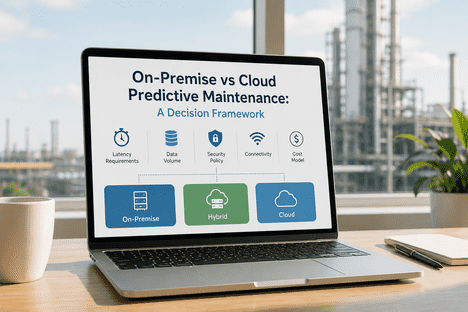
The debate between on-premise and cloud predictive maintenance is often framed as a binary choice — but the production environments that achieve the highest failure detection coverage deploy a hybrid architecture that combines the real-time speed of edge inference with the strategic analytical power of cloud-based fleet analytics. The distinction is architectural: edge handles every time-critical detection decision with sub-10ms responsiveness and zero network dependency, while cloud handles the non-time-critical functions — model training and retraining, fleet-wide degradation pattern analysis, cross-plant benchmarking, and executive dashboard reporting — that benefit from centralized computational resources without requiring real-time delivery.
iFactory's hybrid deployment model reflects this architecture directly. The on-premise inference engine runs continuously at each facility, processing every sensor reading against deployed AI models and generating alerts in milliseconds. An encrypted metadata sync layer periodically transmits only anonymized, non-identifying performance indicators — alert frequency distributions, model confidence scores, detection rate trends — to iFactory's centralized analytics tenant, where fleet-wide pattern analysis identifies degradation trends that are invisible at a single-site level. The raw sensor data never leaves the facility. The strategic intelligence that comes from multi-plant comparison still reaches the maintenance organization. This architecture achieves 92 to 98% total failure detection coverage — far exceeding either pure cloud or pure edge deployments operating in isolation — and does so without compromising the data sovereignty, latency, or cost advantages that make on-premise AI the right choice for time-critical industrial protection. Book a Demo to see the hybrid architecture in action.
Predictive Maintenance Integration: Which Equipment Assets Benefit Most from Edge AI
Not every asset in an industrial plant requires edge-speed inference. The decision framework for assigning assets to edge AI versus cloud analytics depends on failure mode characteristics — specifically, the time window between the first detectable anomaly and functional failure, and the production cost of that failure if it propagates undetected. Assets with rapid-onset failure modes — bearing spalling, hydraulic seal blowout, coupling fatigue, electrical winding short-circuit — where the detectable-to-failure window is measured in seconds or minutes, require edge inference. Assets with gradual degradation patterns — pump impeller wear, heat exchanger fouling, structural fatigue — where the detectable-to-failure window is measured in weeks or months, are adequately served by cloud-based analytics that process periodic data uploads without a real-time processing requirement.
| Asset Category | Failure Mode Type | Detect-to-Failure Window | Recommended Architecture | iFactory Edge Benefit |
|---|---|---|---|---|
| Motor Bearings (Critical) | Rapid-onset spalling, lubricant breakdown | 1–30 seconds | Edge AI | Sub-10ms detection enables emergency shutdown before catastrophic failure |
| Hydraulic Pumps | Seal degradation, cavitation, piston wear | 2 seconds – 5 minutes | Edge AI | Real-time pressure and vibration signature analysis at pump cycle resolution |
| Centrifugal Compressors | Surge onset, bearing wear, shaft misalignment | 5 seconds – 2 minutes | Edge AI | Surge precursor detection at sub-cycle resolution — prevention before stall |
| Gearboxes | Gear tooth fatigue, bearing degradation | 30 seconds – 15 minutes | Edge or Hybrid | Gear mesh frequency anomaly detection at full RPM resolution |
| Conveyor Systems | Idler bearing failure, belt tracking drift | 5–60 minutes | Hybrid | Edge detects bearing faults in milliseconds; cloud tracks belt wear trends |
| Heat Exchangers | Fouling, tube wear, corrosion | Days – weeks | Cloud | Periodic data upload sufficient — edge preprocessing reduces data volume |
Expert Perspective: What On-Premise AI Changed in a Continuous Processing Operation
We deployed a cloud-based predictive maintenance platform across our refining facility in 2021 — 1,200 sensors on pumps, compressors, and heat exchangers. The dashboards were excellent. The fleet analytics gave us visibility into degradation patterns we had never quantified. But in eighteen months of operation, the cloud platform did not catch a single rapid-onset bearing failure before it propagated. Every alert for a catastrophic failure arrived after the event — 45 seconds to 3 minutes after the vibration spike, because the data had to travel to the cloud data center, process through the inference queue, and come back to us. We switched to iFactory's on-premise edge AI in 2023. In the first quarter of operation, the edge platform detected and alerted on seven bearing failures before they reached the damage threshold — an average detection-to-alert time of 8 milliseconds. The cloud platform had been catching the same failure modes, but catching them too late was operationally indistinguishable from not catching them at all.
Frequently Asked Questions: On-Premise AI vs Cloud Predictive Maintenance
iFactory requires a local edge gateway or industrial PC — x86 or ARM64 architecture with a GPU or NPU for model inference — connected to the facility's control network for sensor data acquisition. The edge gateway must have access to the sensor data stream, typically via OPC-UA, Modbus TCP, MQTT, or direct analog/digital I/O. For facilities without existing edge computing hardware, iFactory provides a pre-configured inference appliance that supports up to 2,000 sensor channels per unit and deploys in under 2 hours. A data infrastructure readiness assessment is available at no cost to determine your facility's specific deployment requirements before any commitment.
iFactory supports a secure model update pipeline that downloads only the compiled model artifact — a signed, encrypted binary — to the edge inference engine, without exposing any training data or requiring raw sensor data to leave the facility. Model retraining occurs on iFactory's cloud infrastructure using anonymized training data sets, and the updated model is deployed to the edge gateway via a cryptographically verified update channel. Facilities with data sovereignty policies that prohibit any model update from an external source can opt for fully local model training using iFactory's on-premise training module, which runs on the same edge hardware and retrains models using locally stored historical data with no external network communication required.
Yes. iFactory's on-premise platform maintains a secure outbound connection to cloud-hosted enterprise systems — CMMS, EAM, ERP — for work order generation, asset hierarchy synchronization, and maintenance history updates. The connection is unidirectional outbound: the edge gateway pushes work order requests and alert records to the cloud-hosted system over a TLS-encrypted API connection, but no configuration data, sensor readings, or inference outputs are pulled from the edge by external systems. This architecture ensures that the on-premise inference engine remains fully air-gapped from a data egress perspective while still integrating with the enterprise systems that maintenance and reliability teams use for scheduling, planning, and reporting.
iFactory's on-premise platform includes a local model performance monitoring module that continuously tracks and logs model inference accuracy against ground-truth outcomes — confirmed failures, false positives, missed detections — using the same edge hardware that runs the inference engine. Performance metrics including precision, recall, F1 score, and detection latency percentiles are computed locally and stored in the on-premise data store. Model drift detection algorithms run on the edge gateway, comparing the real-time inference output distribution against the training-time baseline distribution and flagging statistically significant deviations that indicate the model requires retraining. These performance metrics are included in the encrypted metadata sync feed for centralized visibility, but the model validation computation itself occurs entirely on-premise with no external dependency.
iFactory on-premise deployments typically reach full cost recovery within 6 to 12 months — faster than cloud PdM deployments in comparable facilities — because the cost structure is fixed and the avoided failure value accrues from month one without being offset by escalating per-sensor cloud fees. The typical payback driver is the same in both architectures: reduction in unplanned downtime. A facility with 50 critical rotating assets experiencing 4 unplanned downtime events per year at an average cost of $120,000 per event will see $480,000 in annual avoidable losses. Deploying iFactory edge AI — at a fixed on-premise platform cost — typically captures 60 to 75% of that avoidable loss within the first year, producing a first-year net savings of $250,000 to $360,000 after platform cost. The same deployment on a per-sensor cloud pricing model at 500 sensors would incur $90,000 or more in annual cloud fees, reducing first-year net savings by 25 to 35%. An ROI modeling session using your facility's specific asset base, failure history, and production economics is available at no cost.
Conclusion: Edge AI Is the Architecture That Real-Time Industrial Protection Requires
The distinction between on-premise AI and cloud predictive maintenance is not a technology preference — it is a fundamental architectural decision that determines whether your facility's failure detection system operates fast enough to prevent the failures it is deployed to catch. Cloud platforms deliver genuine value for fleet-wide analytics, model training, and strategic degradation pattern identification. But for the time-critical detection function that separates a prevented failure from a logged failure, the physics of network latency imposes a delay that no amount of cloud computational power can eliminate. On-premise edge AI — processing sensor data locally, generating predictions in milliseconds, operating through network outages, and scaling to unlimited sensor coverage at fixed cost — is the architecture that real-time industrial protection requires.
iFactory's on-premise edge AI platform delivers the sub-10ms detection latency, data sovereignty, and total cost of ownership that industrial operators need for mission-critical asset protection — without sacrificing the fleet-wide intelligence that centralized analytics provides, through an encrypted metadata sync layer that preserves data privacy while enabling cross-plant visibility. The platform deploys on existing edge infrastructure or iFactory's pre-configured inference appliance, integrates with existing sensor networks and enterprise systems, and scales to any monitoring density without per-sensor subscription fees. The assets you are protecting are already generating the data. The architecture that protects them is already available. The question is whether your facility will detect the next failure in milliseconds — or learn about it after it has already happened.