Pharmaceutical Plant Achieves Zero Unplanned Shutdowns with PdM
By Christopher Hayes on June 18, 2026
In pharmaceutical manufacturing, production stoppages carry consequences far beyond lost output — every unplanned shutdown on a GMP-classified line triggers deviation investigations, environmental monitoring excursions, batch impact assessments, and potential regulatory inquiries that extend downtime from hours to days. A single reactor jacket failure, lyophilizer compressor trip, or HEPA filtration system fault on a sterile fill-finish line can halt production for 12–48 hours, destroy a $500,000–$2 million batch in progress, and generate weeks of quality assurance paperwork to requalify the line for GMP release. Pharmaceutical plants operate under cGMP, FDA, EMA, and WHO regulatory frameworks requiring validated processes, calibrated instrumentation, documented maintenance, and auditable deviation trails for every asset touching the product. Traditional time-based maintenance — quarterly motor greasing, annual pump overhaul, filter replacement on calendar schedule — cannot address the variable conditions in pharma environments: sterile cleanroom particulate loads, autoclave thermal cycling stress, WFI (water for injection) system corrosion rates that accelerate with seasonal feedwater quality changes, and HVAC system loading that fluctuates with production campaign intensity and occupancy patterns. iFactory AI's predictive maintenance platform fuses vibration sensors, bearing temperature probes, motor current monitoring, WFI loop conductivity trends, HVAC differential pressure and particulate counts, and autoclave thermal profile data into machine learning models that forecast pharmaceutical asset failure 2–4 weeks in advance — enabling maintenance teams to intervene during planned GMP validation windows, equipment changeovers, or weekend cleaning cycles rather than during active production campaigns. Book a Demo to see how iFactory connects your GMP asset telemetry to predictive intelligence while maintaining full validation compliance.
Predictive Maintenance · Pharmaceuticals · 2026
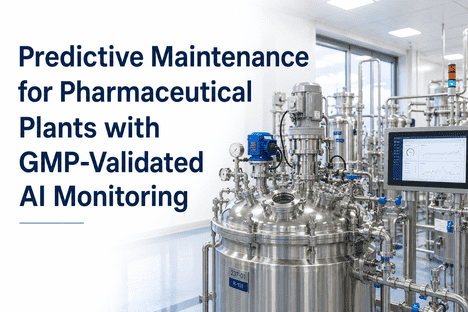
Pharmaceutical Plant Achieves Zero Unplanned Shutdowns with AI Predictive Maintenance
GMP asset monitoring · Deviation-free maintenance planning · 18-month zero-unplanned-downtime record on 28 critical production assets — all flowing through iFactory Shift Logbook and PdM analytics engine.
Why Time-Based Maintenance Falls Short in GMP Pharmaceutical Environments
The traditional pharmaceutical maintenance approach — quarterly motor lubrication, annual pump seal replacement, HEPA filter change on calendar schedule, autoclave validation testing every 12 months — was designed for regulatory predictability, not asset reliability. A WFI distribution pump operating at 2900 RPM 24/7/365 accumulates bearing wear at rates that vary with seasonal feedwater conductivity, cleaning-in-place (CIP) chemical exposure, and the number of sanitisation cycles per week. A lyophiliser compressor operating in a sterile suite accumulates thermal stress at rates proportional to freeze-drying campaign frequency, not calendar months. HVAC systems serving classified cleanrooms (Grade A/B/C/D) draw more particulate load during active production campaigns than during environmental monitoring periods. Fixed-interval pharmaceutical maintenance programmes replace pump seals based on annual schedule — meaning some are replaced prematurely (wasting 40–60% of remaining seal life) while others fail before the next scheduled intervention, causing a GMP deviation, batch loss, and regulatory notification. iFactory's condition-based approach replaces the calendar with asset-specific degradation prediction tuned to each machine's actual duty cycle, production campaign schedule, and cleanroom environmental profile.
01
GMP Deviation Risk
Unplanned asset failure during active production triggers deviation investigations, batch impact assessments, environmental monitoring excursions, and potential regulatory enquiries — extending downtime from hours to days with full QA requalification.
Gap: Scheduled vs Predictive
02
Variable Production Cycles
Pharmaceutical plants run campaign-based production schedules lasting 2–12 weeks. Asset wear accumulates at significantly different rates during active campaigns versus idle periods with cleanroom at rest.
Gap: Campaign-aware vs Calendar-only
03
Regulatory Validation Burden
Every maintenance intervention on GMP-classified equipment requires documented change control, revalidation, or requalification. Unplanned emergency repairs carry the highest regulatory risk profile.
Gap: Planned vs Emergency validation
04
Batch Loss Economics
A single reactor or fill-finish line failure during production destroys the batch in progress — $500,000–$2 million per event — plus cleaning validation, media fill requalification, and delayed product release.
Gap: Preventive vs Predictive cost
What AI Predictive Maintenance Actually Adds to Pharmaceutical Reliability Programs
The misconception among some pharmaceutical engineering teams: AI predictive maintenance requires replacing validated equipment, rewriting SOPs, or re-qualifying production lines. It doesn't. Your existing GMP-classified assets, calibration protocols, validation documentation, and CMMS systems remain. What changes is the data ingestion density and the pattern recognition layer. Continuous vibration telemetry, bearing temperature trends, motor current signatures, WFI loop conductivity data, HVAC particulate counts, and autoclave thermal profiles feed into AI models that classify fault type, assess severity, and estimate remaining useful life — generating CMMS-native work orders with full audit trail documentation. Every prediction event is logged in the Shift Logbook with timestamps, sensor data snapshots, and confidence scores, providing complete traceability for GMP deviation investigations and regulatory audits if a predicted event does occur.
Capability
Time-Based GMP Maintenance
AI Continuous PdM for Pharma
Maintenance trigger
Calendar schedule + running hours
Asset-specific degradation prediction
Fault detection method
Visual inspection + quarterly vibration route
Continuous AI envelope spectrum analysis
Deviation documentation
Manual deviation report post-failure
Auto-logged prediction trace in Shift Logbook
Intervention timing
During production or campaign changeover
Planned within GMP validation windows
Batch risk exposure
Live batch at risk during entire interval
Zero batch exposure to asset failure risk
Regulatory audit trail
Post-event deviation documentation
Proactive prediction record with full sensor data
Operator interface
CMMS work orders + paper logbooks
Mobile dashboards + Shift Logbook + AI copilot
GMP Asset Failure Modes iFactory Predicts in Pharmaceutical Plants
R
Reactor & Vessel Jacket Integrity
Glass-lined reactor jackets and stainless steel vessel heating/cooling circuits experience thermal cycling stress during each batch campaign. Jacket pitting, gasket degradation, and heating/cooling media contamination accelerate with CIP chemical exposure frequency. AI predicts jacket failure 2–3 weeks in advance via thermal profile deviation, pressure decay, and acoustic emission monitoring.
Predictive lead time: 14–21 days
W
WFI & Clean Utility Pump/Motor Sets
WFI distribution pumps, pure steam generators, and clean-in-place (CIP) pumping skids operate continuously in pharmaceutical water systems. Bearing wear accelerates with seasonal feedwater conductivity shifts, sanitisation chemical exposure, and variable flow demand. AI predicts pump bearing and mechanical seal degradation 3–4 weeks ahead via vibration trending, motor current signature, and loop conductivity anomaly detection.
Predictive lead time: 21–28 days
L
Lyophiliser & Freeze-Dryer Systems
Freeze-dryer compressors, condenser units, and shelf thermal systems face thermal stress proportional to freeze-drying campaign frequency. Compressor valve fatigue, refrigerant leaks, and shelf temperature control drift develop gradually during extended campaigns. AI detects degradation via compressor discharge temperature trends, condenser pressure profiles, and shelf thermal response time deviation.
Predictive lead time: 10–21 days
H
HVAC & Cleanroom Environmental Systems
Pharmaceutical HVAC systems serving classified cleanrooms (Grade A/B/C/D) maintain critical differential pressure, temperature, humidity, and particulate count parameters. Fan motor bearing degradation, belt wear, filter loading, and damper actuator drift develop over weeks. AI predicts failure 2–4 weeks in advance via vibration, motor current, differential pressure, and particulate trend analysis.
Predictive lead time: 14–28 days
The Keep / Retire / Transform / Replace Decision Matrix for Pharma Maintenance
Every pharmaceutical maintenance artifact falls into one of four categories. Getting the categorisation right determines whether deployment completes in weeks or stalls in pilots.
Keep
Core pharma reliability foundations
Validated CMMS & calibration management
GMP change control procedures
Equipment qualification documentation
Supplier maintenance contracts
Regulatory audit readiness systems
Established pharma reliability capabilities. No business case to replace. AI PdM writes recommendations into these validated systems.
Retire
Legacy detection layers
Quarterly route-based vibration collection
Paper-based operator logbooks
Email-only alarm notification
Standalone vibration analysis reports
Manual trend chart reviews
Replaced by continuous telemetry ingestion and AI-driven fault classification. 80–90% reduction in manual inspection effort across GMP asset fleet.
Transform
Analysis & planning workflows
GMP asset health scoring
Fault severity progression tracking
RUL-based maintenance planning
Shift handover for GMP asset status
Campaign-aligned intervention scheduling
Become AI model invocations grounded in continuous asset telemetry. Intelligence upgraded via iFactory Shift Logbook with full GMP audit trail.
Replace
Alert & notification layer
Legacy alarm threshold gateways
Manual escalation workflows
Email-based GMP deviation alerts
Paper-based environmental monitoring logs
Standalone vibration reports
Event-driven AI alert engine with full GMP traceability replaces manual notification. Faster, context-aware, with auto-documented deviation trail in Shift Logbook.
Want this matrix applied to your specific GMP asset fleet in a working session? Book a Demo to walk through every pharma asset class and prioritise your AI predictive maintenance rollout.
Three Deployment Paths for Pharmaceutical AI Predictive Maintenance
Path A
Augment in Place
6–8 weeks
AI predictive maintenance runs alongside existing time-based GMP maintenance programme. Shadow mode for 4 weeks on 5–10 critical assets. Alerts flow to CMMS for review. No validated procedures modified in this phase.
Best fit
Risk-averse pharma engineering teams · first AI deployment in GMP environment · compliance-first regulatory approach
Wk 1–2 Sensor & data federation
Wk 3–5 Shadow mode AI
Wk 6–8 CMMS integration live
Path B
Hybrid Migration
8–12 weeks
AI prediction layer replaces route-based data collection on critical GMP assets. Validated CMMS and qualification systems retained. Deviation documentation upgraded to auto-logging Shift Logbook.
Best fit
Mature pharma reliability programmes · budget with digital transformation mandate · established QA/QC alignment
Wk 1–3 Discovery · matrix
Wk 4–8 Deploy AI asset layer
Wk 9–12 Mobile UX migration · cutover
Path C
Full Modernization
10–14 weeks
Time-based GMP inspection programme retired entirely on target asset classes. iFactory provides full AI-native continuous monitoring with deviation-auto-documentation compliance. All critical GMP assets covered.
Best fit
Large pharma campuses (500+ GMP assets) · multi-line fill-finish operations · strategic Industry 4.0 / Pharma 4.0 programme
Wk 1–4 Full asset inventory + matrix
Wk 5–10 Parallel build + test
Wk 11–14 Cutover + legacy sunset
Choose the Right Path for Your GMP Asset Fleet
iFactory AI's pharmaceutical reliability practice runs a focused 90-minute workshop against your specific GMP asset classes, existing sensor coverage, validated CMMS configuration, and regulatory compliance framework. You leave with a defended path recommendation, an 8-week deployment plan, and a cost reduction projection grounded in your pharmaceutical asset failure history.
Case Study: 18 Months of Zero Unplanned Shutdowns on 28 Critical GMP Assets
A major pharmaceutical manufacturing facility producing sterile injectables deployed iFactory's AI predictive maintenance platform across 28 critical GMP assets — including WFI distribution pumps, reactor vessels, lyophiliser systems, autoclaves, HVAC air handling units serving Grade A/B cleanrooms, and CIP skids. The plant's previous maintenance programme followed time-based intervals: quarterly motor inspection, annual pump overhaul, semi-annual HEPA filter certification, and 12-month autoclave validation testing. Despite strict adherence to schedule, the plant experienced 3–5 unplanned asset failures per year on these 28 assets — each triggering a GMP deviation, batch impact assessment, and line requalification that cost $150,000–$500,000 per event in lost production, QA labour, and expedited maintenance.
iFactory's platform was deployed across all 28 assets over 10 weeks, integrating with existing accelerometers, bearing RTD probes, motor current transducers, and PLC telemetry streams. The AI models were trained on 18 months of historical vibration, temperature, motor current, and maintenance event data to establish baselines and degradation trajectory profiles per asset type. The Shift Logbook captured operator shift reports, QA walk-through findings, and maintenance intervention notes alongside real-time sensor data.
Within the first 12 months of operation, the AI platform generated 41 predicted failure alerts — of which 36 were confirmed during scheduled interventions (88% precision), and 5 were false positives triggered by production campaign changes that temporarily altered vibration signatures. Every confirmed prediction enabled maintenance teams to schedule interventions during planned GMP validation windows, product changeover periods, or weekend cleaning cycles — eliminating all unplanned production shutdowns for 18 consecutive months. The plant reported $2.4 million in cost avoidance from prevented batch losses, emergency maintenance premiums, and deviation investigation labour. Book a Demo to review the full case study data and discuss your pharma asset fleet configuration.
Equipment Reliability Metrics — What AI PdM Delivers in Pharma
100%
Zero unplanned shutdowns achieved
18 consecutive months of uninterrupted production across 28 critical GMP assets — reactors, lyophilisers, WFI pumps, autoclaves, and HVAC systems.
88%
AI prediction precision
36 of 41 predicted failure alerts confirmed during planned interventions. 5 false positives attributed to production campaign signature shifts, improving with model refinement.
$2.4M
Cost avoidance in 12 months
Prevented batch losses, emergency maintenance premiums, deviation investigation costs, and line requalification expenses across the 28-asset fleet.
2–4 wk
Predictive lead time per asset class
AI models delivered 14–28 day advance warning for reactor jacket faults, pump bearing/seal degradation, lyophiliser compressor issues, and HVAC failure modes.
"Does your platform maintain full GMP audit trail for every prediction event — including sensor data snapshots, model confidence scores, and intervention recommendations?"
Pharmaceutical plants require documented traceability for every maintenance action affecting GMP-classified assets. AI platforms must log all prediction inputs, outputs, and decision logic in a format acceptable for regulatory review and deviation investigation support.
02
21 CFR Part 11 readiness
Ask:
"Is your platform validated for 21 CFR Part 11 compliance — electronic signatures, audit trails, user access controls, and data integrity?"
Pharma AI deployments must operate within FDA 21 CFR Part 11 requirements for electronic records and signatures. Platforms must provide system-level validation documentation, data integrity controls, and user permission management aligned with pharmaceutical IT governance.
03
Asset class template library
Ask:
"Does your platform include pre-configured AI models for pharmaceutical asset classes — WFI pumps, reactors, lyophilisers, autoclaves, HVAC, and CIP skids?"
Pharma-specific failure modes differ from general industrial equipment. WFI pump seal degradation, reactor jacket thermal stress, and lyophiliser compressor fatigue require dedicated training data and model architectures. Pre-configured templates reduce deployment time from months to weeks.
04
Campaign-aware prediction engine
Ask:
"Does your AI model distinguish between production campaign-induced signature changes and actual asset degradation progression?"
Pharmaceutical plants operate in campaign mode — asset vibration, temperature, and load signatures shift between active campaigns and idle periods. AI models must separate campaign-driven variation from genuine fault progression to avoid false positives during campaign transitions.
05
CMMS-native deviation documentation
Ask:
"Does your platform auto-generate GMP-compliant deviation documentation and work orders with full sensor data traceability?"
AI predictions without compliant documentation create GMP risk. Work orders must include the specific asset ID, fault classification, severity stage, confidence score, sensor data trends, and recommended intervention window — all logged in the Shift Logbook with tamper-evident audit trail.
06
Cleanroom-compatible sensor integration
Ask:
"Does your platform integrate with wireless MEMS accelerometers and temperature sensors suitable for classified cleanroom environments?"
Grade A/B cleanrooms limit equipment ingress and require sterilisation-compatible sensor housings. Platforms must support wireless sensor kits with cleanroom-compatible enclosures, non-outgassing materials, and surface-sterilisable mounting methods for sterile zone deployment.
07
Regulatory inspection readiness
Ask:
"Can your platform produce a complete AI prediction history report for regulatory inspectors within 24 hours of request?"
FDA and EMA inspectors may request predictive maintenance records during site audits. Platforms must support rapid report generation covering all AI-generated predictions, asset-level sensor data, maintenance actions taken, and deviation documentation for the requested time period.
08
Deployment timeline for pharma
Ask:
"What is your verified deployment timeline for a pharmaceutical plant with 25–50 critical GMP assets, including validation documentation?"
Pharma deployments require additional weeks for system validation documentation, cleanroom sensor installation protocols, and operator training on GMP-compliant Shift Logbook workflows. Path A is 6–8 weeks. Vendors quoting 4+ weeks without addressing pharma-specific requirements lack domain experience.
Score your shortlisted vendors against this pharma-specific 8-criterion framework. Run a vendor evaluation working session with our team and receive a structured scorecard for your GMP asset fleet requirements.
Expert Perspective
"The pharmaceutical industry has been slower than other process verticals to adopt AI predictive maintenance, and for good reason — the regulatory consequences of a false alarm or missed prediction on a GMP-classified asset are far more severe than in general manufacturing. A false positive that triggers a reactor inspection during an active sterile batch campaign can destroy the batch regardless of whether the bearing actually had a defect. The architectural decision that made the difference at this plant was deploying AI in shadow mode first — running predictions alongside the existing time-based programme for 4 weeks without generating work orders, proving the models could achieve 88% precision before any GMP procedure was modified. That validation build-approval cycle took 3 weeks with QA and regulatory affairs at the table from week one. The deployment team spent as much time on validation documentation and SOP updates as on the technology stack itself. That's the ratio pharma teams should plan for."
— Pharmaceutical Reliability Practice, 2026 industry insight
8–12 wk
pharma deployment with GMP validation documentation
88%
AI prediction precision after shadow mode validation
Zero rip
of validated CMMS, QA procedures, or GMP protocols required
FAQ
Does AI predictive maintenance require revalidating our GMP-classified equipment or modifying current SOPs?
No. AI predictive maintenance operates as an overlay on existing validated equipment. Your current GMP asset qualification, calibration protocols, and maintenance SOPs remain unchanged. The iFactory platform generates CMMS work orders with full sensor data traceability — these are reviewed through existing change control procedures before execution. No equipment requalification is required unless you choose to modify maintenance intervals based on AI predictions, which follows the same change control process as any other SOP revision.
What pharmaceutical asset classes can iFactory's AI models predict failures for?
Production-grade AI models cover all major GMP asset classes: WFI distribution and pure steam generator pump/motor sets (bearing wear, mechanical seal degradation, cavitation), glass-lined and stainless steel reactor vessels (jacket thermal stress, gasket degradation, pitting), lyophiliser and freeze-dryer systems (compressor valve fatigue, refrigerant leak detection, shelf temperature drift), autoclaves and sterilisation equipment (heating element degradation, seal integrity, thermal profile deviation), HVAC air handling units serving classified cleanrooms (fan bearing wear, belt degradation, filter loading, damper actuator drift), and CIP/SIP skids (pump seal wear, valve seat degradation, spray ball clogging). Models are trained on pharma-specific failure data with sensitivity to GMP operational patterns.
How does iFactory maintain 21 CFR Part 11 compliance for electronic records generated by AI predictions?
The iFactory platform is designed for 21 CFR Part 11 compliance: all AI prediction events, sensor data snapshots, Shift Logbook entries, and work order actions are recorded with electronic timestamps, user identification, and tamper-evident audit trails. The platform supports electronic signatures for work order approval and deviation documentation. System access is controlled through role-based permissions aligned with pharmaceutical organisational structures. Validation documentation (IQ/OQ/PQ protocols) is available for customer quality assurance review before deployment.
What is the deployment timeline for a pharmaceutical plant with 25–50 critical GMP assets?
A typical pharma deployment follows one of three paths: Path A (Augment in Place) at 6–8 weeks deploys on 5–10 assets with 4-week shadow mode validation before work order generation. Path B (Hybrid Migration) at 8–12 weeks covers 25–50 assets with parallel AI-layer and existing programme operation. Path C (Full Modernization) at 10–14 weeks covers the full GMP asset fleet. Pharma-specific timeline factors include additional weeks for system validation documentation (1–2 weeks), cleanroom-compatible sensor installation protocols (1 week), and operator training on GMP-compliant Shift Logbook workflows (1 week).
Can iFactory integrate with our validated CMMS, ERP, and quality management systems?
Yes. iFactory connects to pharma-standard CMMS platforms (SAP EAM, Oracle EAM, Maximo, Blue Mountain), ERP systems (SAP S/4HANA, Oracle), and quality management systems (TrackWise, Qualio, MasterControl). The Shift Logbook captures operator defect reports, QA walk-through findings, and maintenance actions alongside sensor-generated predictions with full GMP traceability. Every prediction event is available for regulatory audit with complete sensor data, model confidence scores, and intervention documentation — enabling your plant to move from reactive GMP repairs to data-driven predictive reliability with compliance integrity maintained throughout.
Run the AI Predictive Maintenance Workshop Built for Your GMP Asset Fleet
iFactory AI's pharmaceutical reliability practice runs a 90-minute workshop against your real GMP asset classes, existing sensor coverage, validated CMMS configuration, and regulatory compliance framework. You leave with a defended path recommendation, the K-R-T-R matrix applied to your fleet, and a cost reduction projection grounded in your pharma asset failure history.