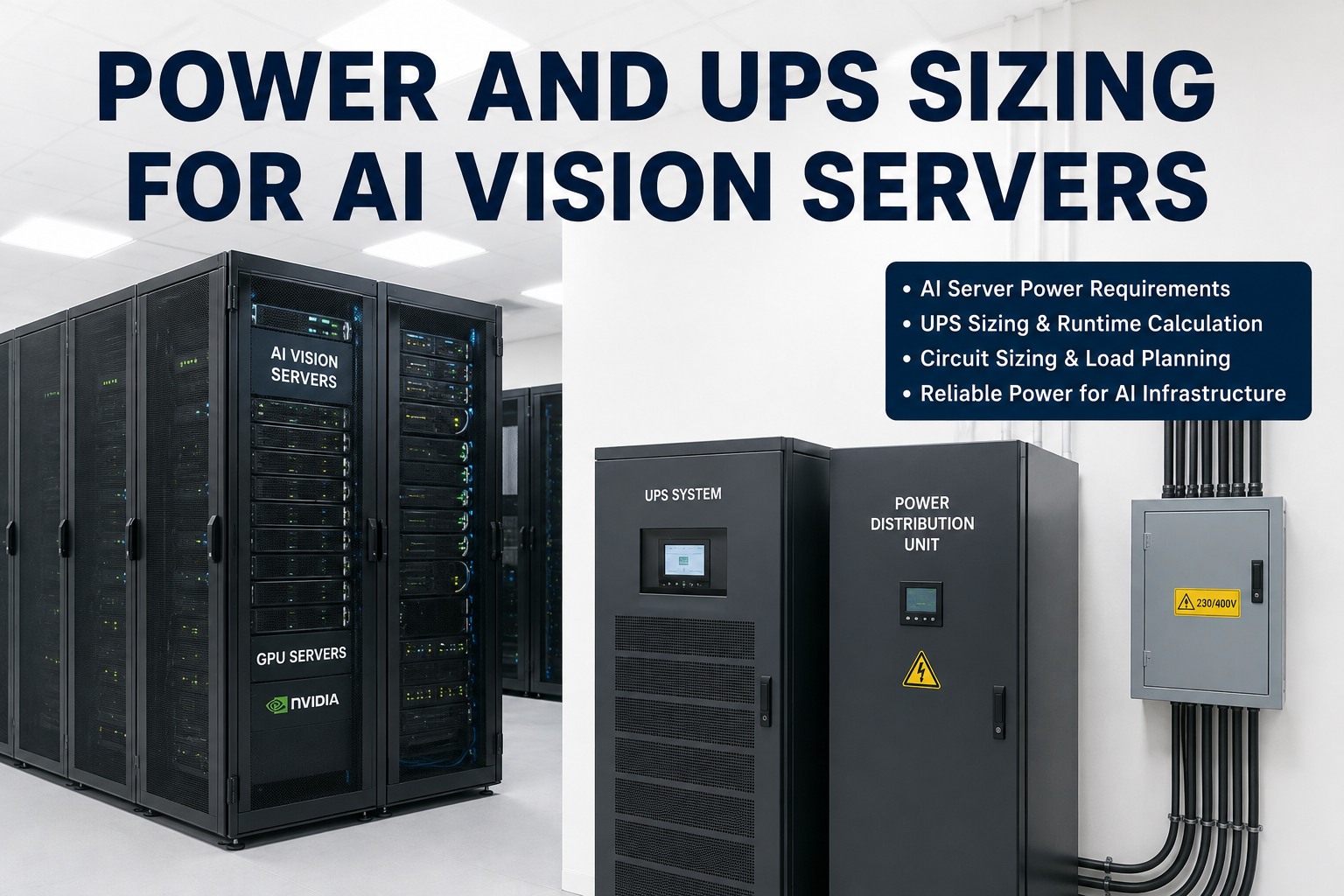
An AI vision server is one of the most power-hungry things you'll put on a plant floor, and getting its electrical planning wrong fails in two expensive directions. Undersize the circuit or breaker and the server trips under peak GPU load — usually mid-shift, taking inspection down with it. Undersize the UPS and a brief power dip corrupts an inference in progress or hard-kills the system before it can shut down cleanly. Both are avoidable with straightforward sizing: know the server's peak and sustained draw, size the circuit and breaker with headroom, and match the UPS to the runtime you actually need — enough to ride out short dips and shut down gracefully on a longer outage. This guide walks power and UPS sizing for AI vision servers — peak load, sustained draw, circuit and breaker capacity, UPS runtime, and graceful shutdown — and how iFactory delivers a correctly-sized on-premise appliance or a managed cloud alternative.
Power and UPS Sizing for AI Vision Servers
A GPU vision server draws serious, spiky power — size the electrical wrong and it trips a breaker mid-shift or dies in a power dip. Right-sizing means knowing peak and sustained draw, sizing the circuit and breaker with headroom, and matching the UPS to real runtime for ride-through and graceful shutdown. iFactory sizes and ships it floor-ready, or runs the same vision engine in the cloud.
Two Ways Bad Power Sizing Bites
The failures land in two distinct places, and each needs its own part of the sizing. One is about the circuit feeding the server; the other is about what happens when that circuit loses power. Plan for both.
Trips under peak load
GPU inference draws in spikes. If the circuit or breaker is sized to average rather than peak, a load spike trips it — taking inspection offline mid-shift, often intermittently and hard to diagnose.
Dies in a power dip
Without enough battery, a brief sag or outage hard-kills the server before it can finish an inference or shut down cleanly — risking corrupted state and a rough restart.
Start With the Server's Real Power Profile
Every sizing decision flows from two numbers, and the mistake is using only one. Peak determines what the electrical must survive; sustained determines your thermal load and running cost. You need both, measured under real inspection load, not a nameplate guess.
Peak load
The maximum instantaneous draw when GPUs spike during heavy inference. This is what the circuit, breaker, and UPS must all be able to supply without faulting.
Sustained draw
The continuous power under normal running load. This drives heat output, cooling needs, energy cost, and how long a given UPS battery will actually last.
The Sizing Sequence
Put together, correct power and UPS sizing is a short, ordered calculation. Each step builds on the profile and adds the margin that keeps the server up.
Circuit and Breaker — Size Above Peak
The electrical feed has to comfortably supply the peak, not just the average, with margin on top so a normal spike never approaches the breaker's trip point. Under-provisioning here is the classic cause of mysterious mid-shift outages.
Want your server's real peak and sustained draw measured before you spec the circuit? Book a 30-minute demo — iFactory will profile the power draw of your vision configuration and specify the circuit, breaker, and UPS to match. Sessions available this week.
UPS — Runtime for Ride-Through and Shutdown
A UPS for an AI vision server isn't there to run it for hours — it's there to do two specific jobs. Size it for both, based on the server's sustained draw, and a power event becomes a non-event instead of a corrupted shutdown.
Survive short dips
Most power events are brief sags and flickers. Enough UPS runtime lets the server keep inspecting straight through them, so a momentary dip never interrupts the line at all.
End cleanly on a real outage
For a longer outage, the UPS must hold long enough to finish any inference in progress and shut the server down cleanly — no corrupted state, no rough restart when power returns.
Not sure how much UPS runtime your line actually needs? Ask iFactory Support with your sustained draw and how long your typical dips and outages last, and the team will size the UPS for ride-through plus a clean shutdown — typically a response within 3 business days, no obligation.
How iFactory Sizes and Ships It
Rather than leave the electrical to guesswork, iFactory profiles the actual power draw of your vision configuration and delivers the appliance with matched sizing guidance — so the circuit holds, the UPS covers you, and the shutdown is always clean.
On-Premise or Cloud — Power Is One Reason to Choose
Power and UPS sizing is precisely the kind of on-site burden that pushes some sites toward cloud, and iFactory offers both. Where inspection images must stay in-fence and latency matters, the on-prem appliance comes with the electrical sized for you. Where a site would rather not provision heavy circuits and UPS at all, the same vision engine runs as a managed cloud service. Many manufacturers mix the two across plants.
iFactory On-Premise Electrical sized, images in-fence
- Sizing done for you — circuit, breaker, and UPS matched to measured draw.
- Images never leave — full data residency behind your firewall.
- Ride-through & clean shutdown — UPS sized for real power events.
- Line-latency inference — local, no round-trip, outage-independent.
iFactory Cloud No on-site power or UPS to provision
- Fully managed — no heavy circuit or UPS on your floor.
- Same vision engine — identical models, SPC, and analytics.
- Cross-site consistency — one model version everywhere.
- Elastic scale — add cameras and sites without local power builds.
Size the power right, or the server trips when you need it most.
An AI vision server needs its electrical planned: measure peak and sustained draw, size the circuit and breaker above peak, and match the UPS for ride-through and graceful shutdown. iFactory profiles your configuration and ships the appliance with the sizing done — or runs the same vision engine as a managed cloud service when you'd rather not provision on-site power at all. ROI proven on one line first.
Frequently Asked Questions
Why size to peak load instead of average power?
Because GPU inference draws in spikes, and it's the spike that trips a breaker, not the average. A circuit sized to average draw looks fine most of the time, then faults when a heavy inference load pushes instantaneous draw past the breaker's limit — usually mid-shift and intermittently, which makes it maddening to diagnose. Sizing the circuit and breaker above measured peak, with headroom, is what prevents those outages.
What's the difference between peak and sustained draw?
Peak is the maximum instantaneous power when GPUs spike during heavy inference — it sets what the circuit, breaker, and UPS must be able to supply. Sustained is the continuous draw under normal running load — it sets your heat output, cooling requirement, energy cost, and how long a UPS battery will last. You need both numbers: peak for what the electrical must survive, sustained for thermal and runtime planning.
How much UPS runtime does an AI vision server need?
Enough for two jobs, not hours of operation. First, ride-through: enough to keep inspecting straight through the brief sags and flickers that make up most power events. Second, graceful shutdown: enough, on a longer outage, to finish any inference in progress and power down cleanly without corrupting state. The exact runtime depends on the server's sustained draw and how long your typical dips and outages last.
Why does graceful shutdown matter?
Because a hard power loss mid-inference can corrupt state and force a rough, slow restart — sometimes needing manual intervention just when the line is trying to come back. A UPS that holds long enough to trigger an automatic clean shutdown lets the server finish what it's doing and power down safely, so when power returns it restarts cleanly and inspection resumes without a mess to untangle.
Do I need to account for cooling in the power budget?
Yes. The server's own draw isn't the whole load — enclosure fans, active cooling, or a sealed enclosure's cooling loop all draw power on the same feed, especially on a hot plant floor. A sizing that covers only the GPUs and misses the cooling can still trip the circuit. iFactory includes cooling load in the power profile so the circuit and UPS are sized for the complete appliance.
Can I avoid power and UPS provisioning with cloud?
Yes — that's one reason iFactory offers both. If a site would rather not provision heavy circuits and UPS hardware, the same vision engine runs as a managed cloud service with no on-site server to power. On-premise stays the default where images must stay in-fence and reject decisions need line latency, delivered with the electrical sized for you. Many manufacturers mix the two across sites. Contact iFactory Support to choose the right deployment.
Power that holds under load — and rides out the dips.
Correct power and UPS sizing keeps an AI vision server up: circuit and breaker sized above peak, UPS matched for ride-through and graceful shutdown, cooling included in the budget. iFactory profiles your configuration and ships the appliance with the sizing done, or runs the same vision engine in the cloud when you'd rather skip on-site power builds. ROI proven on one line first. The next step is a 30-minute demo and a power assessment of your configuration. Sessions available this week.