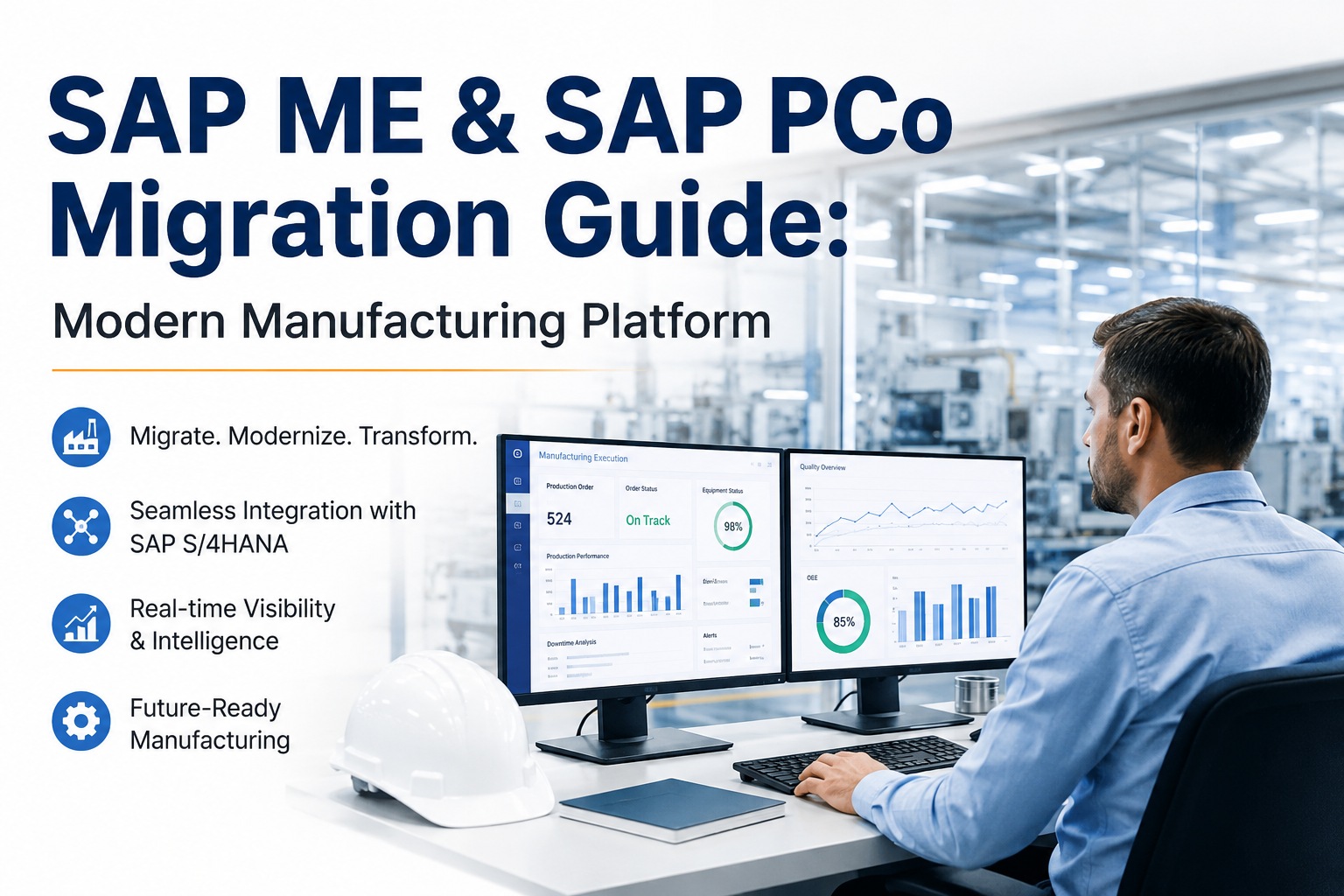
SAP ME and SAP PCo are two halves of the same shop-floor backbone, and they're sunsetting together: mainstream maintenance ends December 31, 2027, with paid extended support only to December 2030. SAP ME runs your execution — work orders, routings, WIP tracking, traceability. SAP PCo is the machine-connectivity layer underneath it, speaking OPC UA, OPC DA, and Modbus to your PLCs and CNCs. SAP's successor path replaces them with different pieces — Digital Manufacturing on BTP for execution, ProdCon for connectivity — and it's cloud-mandatory, with no automatic conversion for custom logic. For plants that need execution and connectivity to stay on-premise and integrated with S/4HANA, there's a cleaner route. This guide lays out a practical 12-week migration from SAP ME and SAP PCo to a modern on-prem manufacturing platform native OPC UA, REST APIs, AI-powered SPC, parallel-run deployment, and a zero-downtime cutover.
SAP ME & SAP PCo Migration: The Modern Platform Guide
Migrate from SAP ME and SAP PCo to a modern manufacturing execution platform with native OPC UA, REST APIs, AI-powered SPC, and seamless SAP S/4HANA integration. A practical 12-week roadmap with parallel-run deployment and a zero-downtime cutover — execution and connectivity stay on-premise, and you gain AI SPC the old stack never had.
Two Layers, One Migration — ME and PCo
The reason ME and PCo migrate together is that they do different jobs in the same stack. Replace one without the other and you've only solved half the problem. A modern platform has to cover both the execution layer ME owned and the connectivity layer PCo owned — and a clean migration maps each, one to one.
What ME did
- Work orders, routings, dispatching
- WIP & serial-number tracking
- Buy-offs, holds, traceability
- Operator workflow guidance (POD)
What PCo did
- OPC UA / OPC DA / Modbus to PLCs
- Tag subscriptions & data collection
- Historian feeds & notifications
- Machine-to-system protocol bridge
Want a one-to-one map of your ME functions and PCo tags onto a modern platform? Book a 30-minute scoping call — iFactory will inventory your execution workflows and connectivity points and show the migration mapping for each. Sessions available this week.
The Connectivity Swap — Keep the Tags
PCo's job was protocol translation, and that's the part teams fear most about migration. It's actually the most straightforward: the iFactory edge connector speaks the same industrial protocols PCo did — OPC UA, OPC DA, Modbus TCP, MQTT, REST, plus native drivers for major controller brands. For protocols PCo handled, the migration is essentially "swap the gateway, keep the tags" — your tag definitions and addressing carry over.
Not sure every controller and protocol you run is covered? Send your equipment list to iFactory Support — controller brands, protocols, and any custom PCo agents — and the team will confirm connector coverage and the tag-migration approach, typically within 3 business days.
The 12-Week Migration Framework
The whole point of a 12-week framework is that it's parallel, not big-bang. The new platform runs alongside SAP ME on the same machine data and SAP traffic, you validate it line by line, and you cut over module by module only once each one matches. Production never stops.
Want this 12-week framework mapped to your plant? Schedule a demo and iFactory will tailor the week-by-week plan to your ME/PCo estate and identify the first modules to cut over. Slots open this week.
Native S/4HANA Integration — Bi-Directional
Through the whole migration, S/4HANA stays the system of record. The platform integrates over native OPC UA on the floor side and REST plus standard SAP hooks on the business side — orders and master data come down, confirmations, consumption, and yield go back up. The same hooks ME used, so S/4HANA needs no change.
On-Prem
What You Gain: AI SPC, Built In
ME and PCo collected mountains of machine data and charted it after the fact. The modern platform does what they structurally couldn't — turns that same data stream into predictive quality, on-premise, from day one of cutover.
ME and PCo are retiring together. Replace both — and gain AI SPC in the process.
You don't have to rebuild your shop floor in the cloud to move off SAP ME and PCo. iFactory replaces the execution layer and the connectivity layer on-premise, swaps the gateway to native OPC UA while keeping your tags, integrates with S/4HANA over REST, and adds AI SPC natively — all on a 12-week parallel-run framework with a zero-downtime cutover. First value before the program even finishes.
Frequently Asked Questions
When do SAP ME and SAP PCo reach end of life?
SAP ME and SAP MII — with PCo as a connectivity component — reach end of mainstream maintenance on December 31, 2027. Paid extended support runs to approximately December 2030 at premium pricing, with no new features and no roadmap. SAP's successor path is Digital Manufacturing on BTP for execution plus ProdCon for connectivity, which is cloud-oriented and not a drop-in replacement for custom ME or PCo logic.
How does the platform replace SAP PCo's connectivity?
The iFactory edge connector speaks the same industrial protocols PCo did — OPC UA, OPC DA, Modbus TCP, MQTT, and REST — plus native drivers for major controller brands like Fanuc, Siemens, Mitsubishi, Allen-Bradley, Heidenhain, Mazak, and Beckhoff. For protocols PCo handled, migration is essentially "swap the gateway, keep the tags": your tag definitions and addressing carry over, so the floor-side change is minimal.
What does "zero-downtime cutover" actually mean?
The new platform runs in parallel with SAP ME on the same live machine data and SAP traffic. You validate its execution and OEE output against ME line by line, then cut over module by module only once each matches. Because production keeps running on ME until each module is proven, there's no big-bang switch and no production stoppage during the transition.
Can it really be done in 12 weeks?
For a focused ME/PCo estate, yes — assess and map (weeks 1–3), build and connect (4–7), parallel run (8–10), cutover and gain (11–12). Heavily customized or multi-site landscapes take longer overall, but the parallel-run model delivers first production value early — typically the connectivity swap and analytics layer — while the broader rollout continues. Production runs throughout.
Does it integrate with SAP S/4HANA?
Yes, bi-directionally and natively. It receives orders, routings, and master data via REST and IDoc, collects live machine signals over OPC UA on the floor side, and pushes confirmations, goods movements, yield, and live OEE back to S/4HANA using the same standard hooks ME used. S/4HANA stays the system of record and needs no change to its integration configuration.
How do I book a demo or get a migration assessment?
Two routes. For a live walkthrough on your landscape, schedule a 30-minute migration demo — it covers the ME-and-PCo layer mapping, the OPC UA connectivity swap, the 12-week framework, and the AI SPC you gain. For a written assessment against your actual estate, contact iFactory Support with your ME workflows, PCo tags, and controller list and expect a response within about 3 business days. No obligation either way.
One 12-week move: off ME and PCo, onto a modern on-prem platform with AI SPC.
Execution and connectivity replaced together, native OPC UA keeping your tags, S/4HANA integration over REST, AI-powered SPC added on day one — on a parallel-run framework that never stops production. The teams that start now migrate on their terms. The next step is a 30-minute demo mapped to your own ME/PCo estate. Sessions available this week.