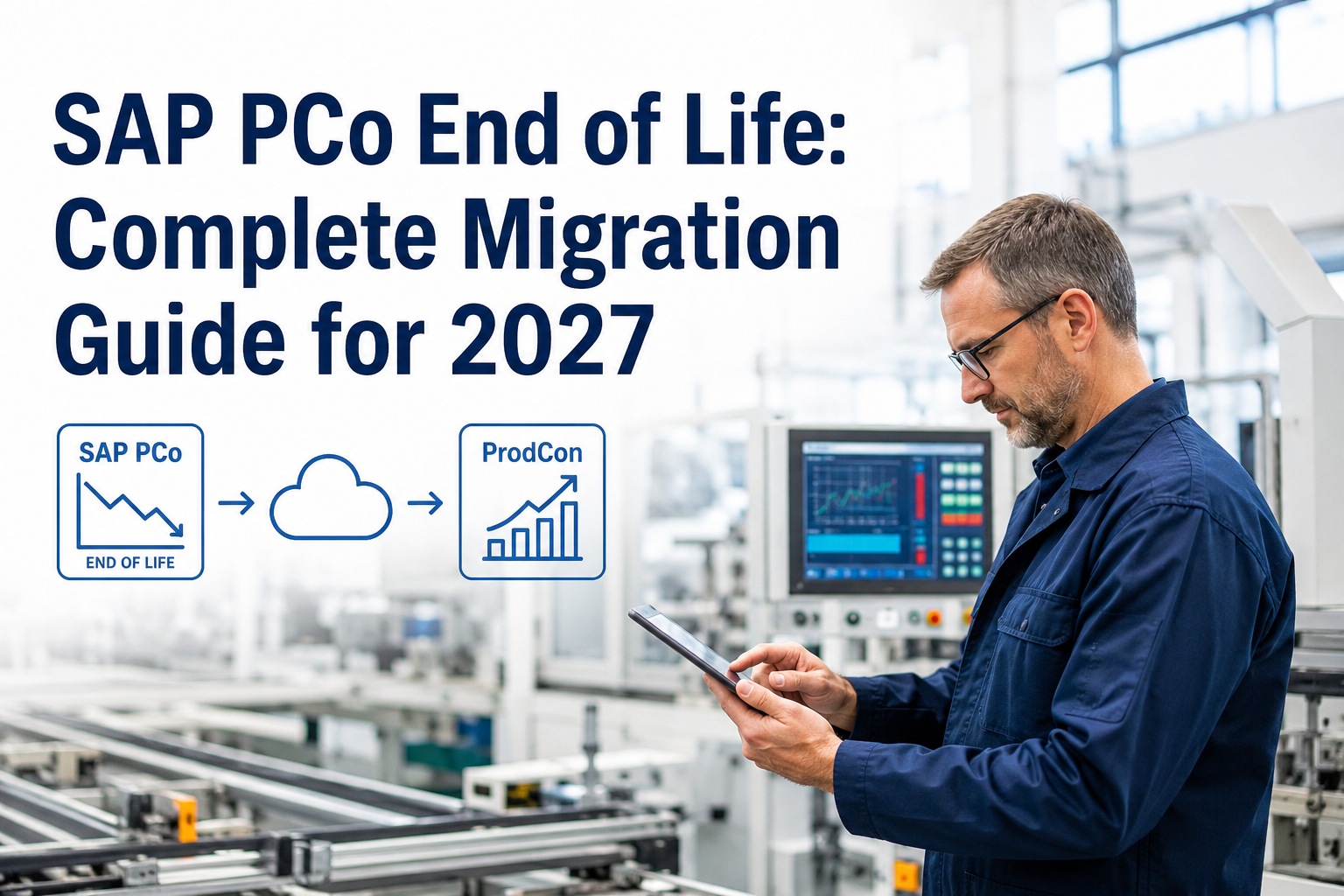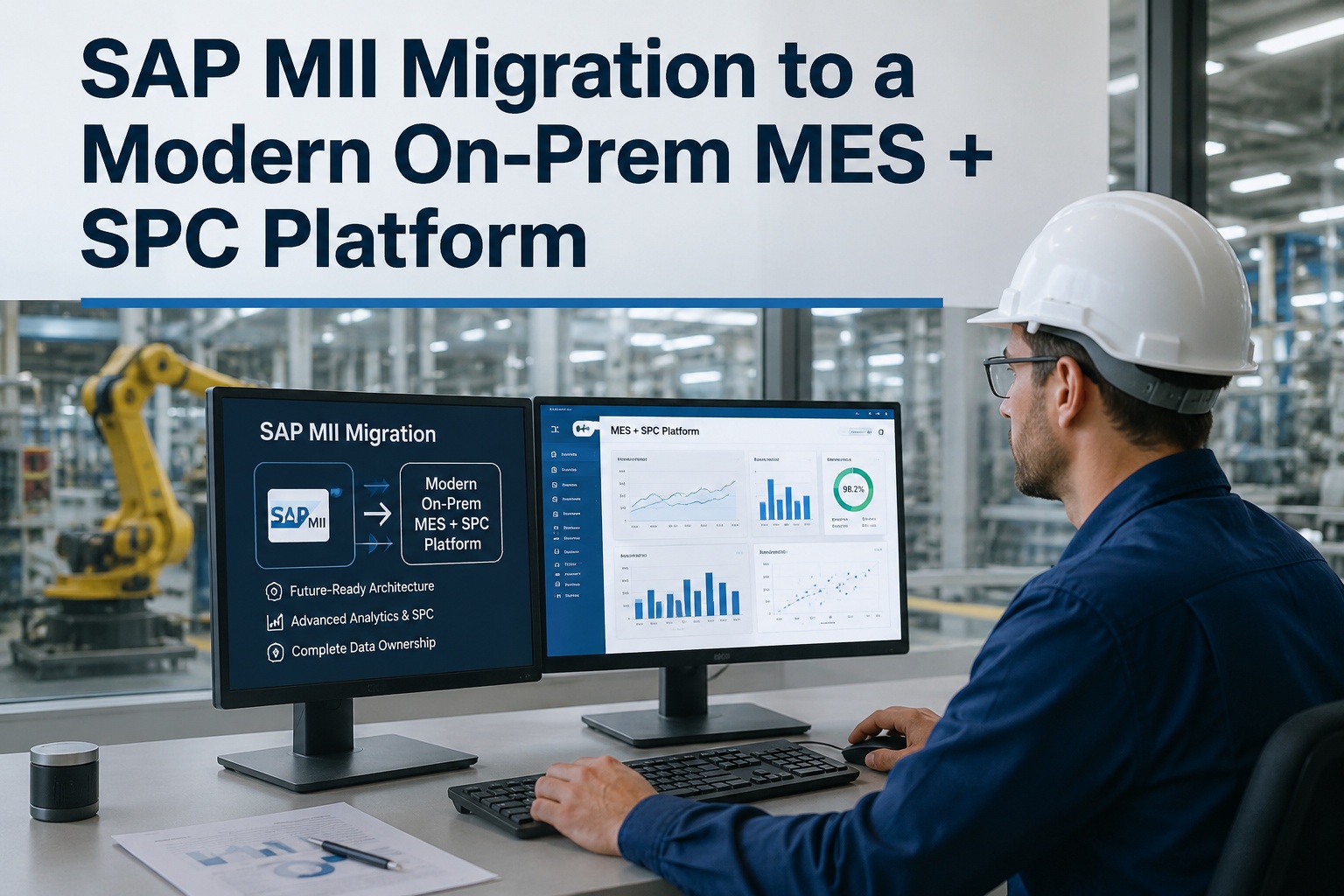
The clock on SAP MII is real. Mainstream maintenance ends December 31, 2027; paid extended support runs only to December 31, 2030, and only if you've activated it under your licensing agreement. Version 15.5 is the last release — it runs on NetWeaver AS Java 7.5, a J2EE architecture built for early-2000s data volumes, and no 15.6 is coming. Every SAP ERP upgrade after 2027 becomes a potential break point for your custom BLS transactions and xMII queries, with no patch on the way. The catch most teams miss: a structured MII migration for a complex landscape takes 12–36 months, so the decisions made in the next 12–18 months decide whether your move is orderly or forced. This guide lays out the MII migration path to a modern on-prem MES + SPC platform — one that mirrors your existing MII bus over REST, IDoc, and MSMQ, keeps data in the plant, and bakes AI SPC in natively, with first production value in weeks rather than years.
SAP MII Migration to a Modern On-Prem MES + SPC Platform
MII support is ending. Migrate to a modern on-premise MES + SPC platform with native SAP S/4HANA integration and AI Copilot baked in. A REST + IDoc + MSMQ bridge mirrors your existing MII bus, so the cutover is parallel — not big-bang — and AI SPC is added on day one. No forced cloud. First value in weeks.
The Timeline — and the Trap
The dates look comfortable until you subtract the migration duration from them. SAP set two hard markers; the planning window is the gap between today and the point where a 12–36 month program must already be underway. And there's a documented trap: treating an infrastructure refresh as a way to buy time. MII 15.5 is bound to NetWeaver 7.5, which hits the same 2027 deadline — upgrading the infrastructure spends budget without extending the support window.
Want to know exactly how much runway your landscape really has? Book a 30-minute scoping call — iFactory will map your MII estate against the timeline and show where a parallel-run path buys back months. Sessions available this week.
Three Paths Off MII — Pick by Workload
SAP's recommended successor is SAP Digital Manufacturing on BTP — but it's a cloud-mandatory rebuild with no automatic conversion path for custom MII logic. That's the right fit for some, the wrong fit for others. The honest answer for many manufacturers is a third path.
SAP DM (cloud)
Natural fit if MII pairs with SAP ME and customization is moderate — continuity of SAP semantics and an SAP-supported roadmap. Expect clean-core API redesign; there's no lift-and-shift.
On-prem best-of-breed
Keep MES, OEE, and ISA-95 on-prem behind your firewall, with AI SPC added natively. A REST + IDoc + MSMQ bridge mirrors the MII bus, so custom logic ports as code modules — not a rebuild.
Hybrid
SAP DM for execution where it fits, iFactory for the on-prem analytics-and-SPC layer and the sites that can't go cloud — coexisting during and after transition. The right answer for many multi-site enterprises.
The Migration Path — Five Phases, No Big-Bang
Every successful MII migration follows the same five phases — the names vary by consultancy, the work doesn't. Each has defined inputs, outputs, and exit criteria you shouldn't cross until they're met. iFactory can plug in at any phase and compress the timeline with proven playbooks.
Want this roadmap tailored to your actual MII estate? Send your landscape to iFactory Support — custom transaction count, ERP version, historian, and constraints — and the team will return a phased plan with effort estimates and the first use cases that pay back inside a quarter, typically within 3 business days.
The Bridge: iFactory Mirrors Your MII Bus
This is what makes the cutover safe. MII's job was to be the bus between SAP and the shop floor. iFactory mirrors that bus with the same integration mechanisms — a REST + IDoc + MSMQ bridge — so during the parallel run, both systems see the same orders and emit the same confirmations. Your S/4HANA doesn't know the difference, which is exactly why you can validate side-by-side and cut over module by module.
What MII Never Had: AI SPC, Native
MII's J2EE architecture has no upgrade path for the sensor coverage, OEE, and real-time analytics workloads plants have piled onto it. The migration isn't just a like-for-like replacement — it's the moment to add what MII structurally couldn't: AI-native statistical process control, predictive quality, and an AI Copilot, all running on-premise.
The MII deadline is fixed. Your migration path doesn't have to be painful.
Migrating off MII is a transformation program, not a basis upgrade — but it doesn't have to be a cloud-mandatory rebuild or a big-bang cutover. iFactory mirrors your MII bus over REST, IDoc, and MSMQ for a safe parallel run, ports 60–70% of your logic as code modules, keeps everything on-premise, and adds AI SPC natively. First production value in weeks while the broader program continues.
Frequently Asked Questions
When does SAP MII actually reach end of life?
Mainstream maintenance ends December 31, 2027 — after which SAP releases no new features or standard patches. Paid extended support runs to December 31, 2030, but only if your organization has activated it under your licensing agreement, and at premium cost with no roadmap. Version 15.5 is the final release; there is no 15.6. MII 15.5 is bound to NetWeaver 7.5, which shares the 2027 deadline, so an infrastructure refresh won't buy time.
Is SAP DM a drop-in replacement for MII?
No. SAP Digital Manufacturing on BTP is the recommended successor but it's a cloud-mandatory rebuild — there's no automatic conversion path for custom MII logic, and clean-core means custom BLS transactions and xMII queries must be redesigned as APIs. It's a strong fit for SAP-centric, cloud-ready plants with light customization. For air-gapped, heavily customized, or residency-bound operations, an on-prem best-of-breed or hybrid path is often better.
How does the iFactory bridge make migration safer?
iFactory mirrors the MII bus with a REST + IDoc + MSMQ bridge, so it exchanges the same orders and confirmations with S/4HANA that MII did. That lets both systems run in parallel on identical SAP traffic — you validate the new platform's output against MII for several weeks, then cut over module by module. No big-bang switch, and S/4HANA needs no change to its integration hooks.
What happens to our custom MII transactions?
They port as code modules rather than being rebuilt in a proprietary low-code designer. In typical migrations, 60–70% of custom transactions port as-is, 20–30% are modernized to clear accumulated tech debt, and 10–15% are retired as redundant. You own the resulting source code, and the scoping phase tags every customization keep, retire, transform, or replace before any work begins.
How long does it take, and how fast is first value?
A full structured migration for a complex, multi-site MII estate runs 12–36 months end-to-end. But because iFactory's best-of-breed path is a parallel architecture rather than a port, it can deliver first production value in weeks — typically by standing up the analytics-and-SPC layer first — while the broader program continues. Start with the 2–3 use cases that pay back inside a quarter.
How do I book a demo or get a migration assessment?
Two routes. For a live walkthrough on your landscape, schedule a 30-minute migration demo — it covers the five-phase path, the MII-bus bridge, parallel-run cutover, and the AI SPC you gain. For a written assessment against your actual MII estate, contact iFactory Support with your customization count, ERP version, and constraints and expect a response within about 3 business days. No obligation either way.
Don't let the deadline force the decision. Migrate on your terms.
The teams that move early get an orderly, parallel-run migration; the ones that wait get a forced one. iFactory mirrors your MII bus over REST, IDoc, and MSMQ, ports your logic as code you own, keeps the stack on-premise, and adds AI SPC natively — with first value in weeks, not years. The next step is a 30-minute scoping call against your own MII estate. Sessions available this week.