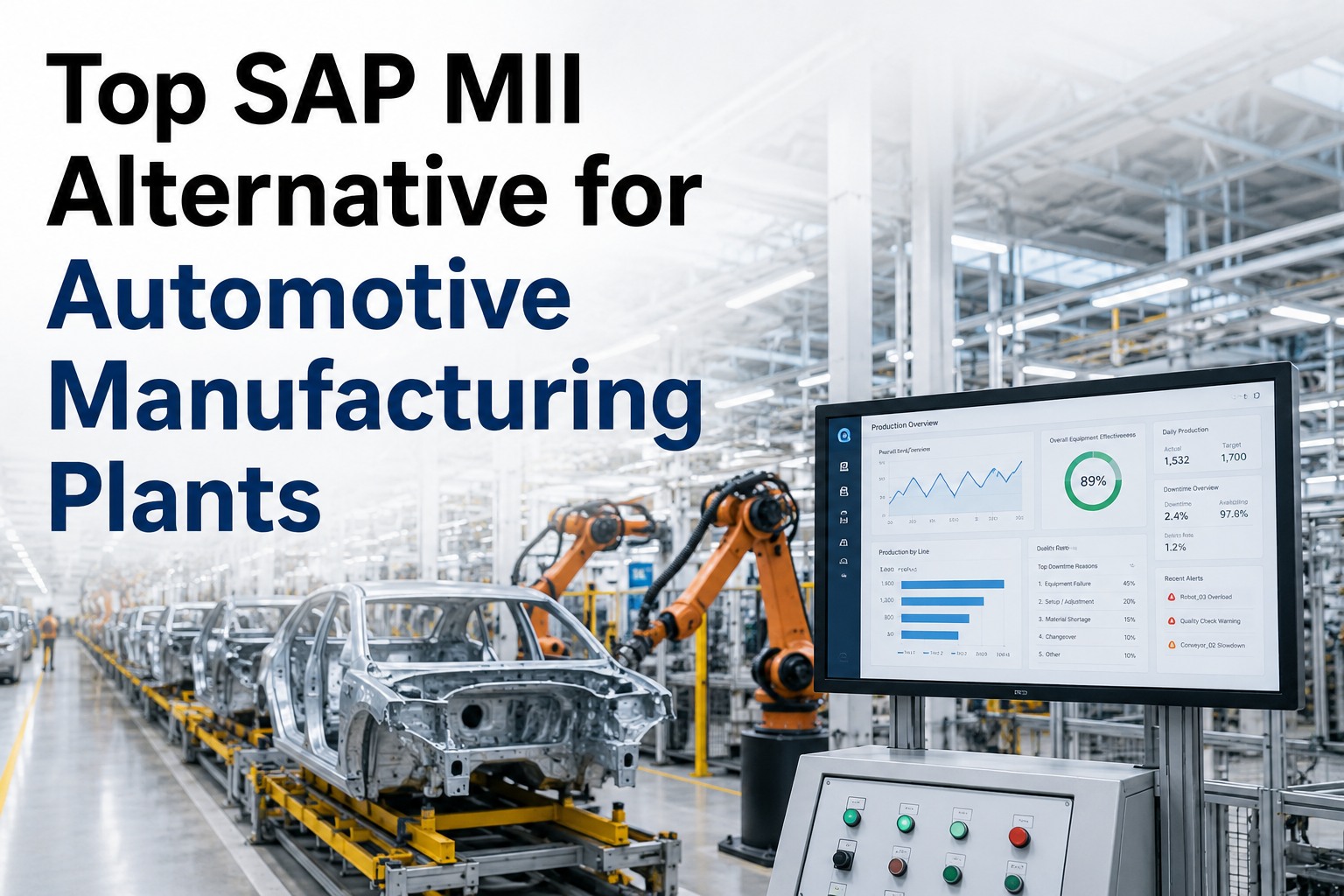
Automotive manufacturing plants running SAP MII for SPC monitoring, OEE, and shop-floor reporting in 2026 are working with a platform that hit its capability ceiling years ago. SAP MII was the standard automotive MES software for descriptive analytics — univariate Shewhart control charts, static control limits, batch reports — but the next-gen manufacturing AI capabilities that connected car manufacturing and Industry 4.0 demand simply cannot be retrofitted into the MII architecture. AI control charts that adapt to multivariate process state, predictive SPC software that catches drift hours ahead of out-of-control, adaptive SPC limits that learn per-platform and per-shift conditions, an operator AI assistant for line-side natural-language queries, real-time shop floor AI software running at sub-50ms inference, and the connected manufacturing intelligence that feeds connected car platforms — all of these require a structurally different platform. iFactory AI is the top SAP MII alternative for automotive manufacturing plants — a next-gen MES platform purpose-built for AI-native automotive manufacturing, delivered as a pre-configured NVIDIA appliance running on-premise, with full bill of materials included and 6–12 week deployment timelines instead of the multi-year transformations legacy MES modernization projects typically demand. The business case for plant managers and manufacturing IT leaders is direct — modernize from legacy MES to a next-gen MES platform that delivers the AI-native capability connected car manufacturing requires, while preserving the SAP S/4 HANA investment and the plant-floor L1/L2 control architecture. This page is the automotive plant manager and manufacturing IT leader's guide to the top SAP MII alternative — the legacy-vs-next-gen MES comparison, the AI control charts and adaptive SPC limits that define the capability difference, the MES modernization roadmap, and how the full BOM is structured for transparent deployment.
Top SAP MII Alternative for Automotive Manufacturing Plants
The automotive plant manager and manufacturing IT leader's guide to the top SAP MII alternative — a next-gen MES platform with AI control charts, adaptive SPC limits, predictive SPC software, operator AI assistant, and connected manufacturing intelligence for connected car manufacturing. On-prem NVIDIA appliance, full BOM included, 6–12 week deployment.
Legacy MES vs Next-Gen MES Platform — The Architectural Shift
The MES modernization conversation in automotive manufacturing comes down to a structural choice. Legacy MES platforms — SAP MII, SAP xMII, and similar — were designed for descriptive analytics and rule-based workflows in the manufacturing software paradigm of fifteen years ago. Next-gen MES platforms are designed for AI-native intelligence at line speed, with predictive analytics, adaptive control, and connected manufacturing as core capabilities rather than retrofitted features. The architectural comparison below shows what the actual shift looks like for an operating automotive plant.
The architectural shift is decisive. Legacy MES (SAP MII) sits at a capability ceiling that cannot extend to the AI-native intelligence connected car manufacturing demands — univariate Shewhart cannot become multivariate, static limits cannot become adaptive, descriptive dashboards cannot become predictive without a structurally different platform. Next-gen MES platforms are AI-native from inception. The shop floor AI software runs at sub-50ms inference at the edge. The operator AI assistant is a native interface, not a bolted-on feature. The intelligence layer feeds connected car manufacturing programs directly without integration plumbing.
Want this MES modernization architecture mapped against your specific automotive plant? Schedule the AI Manufacturing Transformation Workshop — iFactory's automotive team will diagram your current SAP MII setup and the next-gen equivalent. Sessions available this week.
AI Control Charts & Adaptive SPC Limits — The Capability Reality
The two capabilities that define the difference between legacy MES SPC and next-gen MES SPC are AI control charts and adaptive SPC limits. Both are absent from SAP MII (and largely absent from SAP DMC's basic descriptive layer). Both define what predictive SPC software actually means in operational terms. The comparison below shows what each capability delivers vs the SAP MII equivalent.
The capability gap is not incremental. AI control charts replace Shewhart univariate methodology with multivariate ML-learned pattern detection — catching drift signatures that don't even appear on individual-variable charts. Adaptive SPC limits replace static periodic baselining with continuous per-platform, per-shift, per-state adaptation — eliminating the false alarms that erode operator trust in legacy SPC while improving genuine detection sensitivity. Together, these two capabilities define what predictive SPC software actually means in 2026 vs what SAP MII delivered in 2010.
MES Modernization Roadmap — Four Phases from SAP MII to Next-Gen
The four-phase path from SAP MII legacy MES to the next-gen MES platform
MES modernization in automotive does not have to be a multi-year transformation. The roadmap below is the four-phase, 6–12 week structured program that iFactory uses for SAP MII migrations across automotive plants. Each phase has defined entry criteria, deliverables, and validation steps. The L1/L2 control architecture is not touched. SAP S/4 HANA stays intact.
The four-phase roadmap is the practical answer to the "legacy MES modernization takes years" objection. Each phase compresses what historically required quarters into weeks because the platform is purpose-built for migration — pre-loaded AI models, ready integration adapters, validated reference architectures, and a structured deployment methodology. The customer team's effort is also bounded — most of the heavy lifting (installation, AI tuning, parity validation) is on the iFactory deployment team. The customer team focuses on operator training, workflow validation, and production sign-off.
Want the roadmap detailed for your specific plant? Send your current SAP MII setup, plant scope, and target use cases to iFactory support and the automotive team will return a customised four-phase plan — typically within 3 business days, no obligation.
Five AI-Native Capabilities on the Next-Gen MES Platform
AI Control Charts
Multivariate ML pattern detection beyond Shewhart
Adaptive Limits
Per-platform, per-shift, per-state limit learning
Predictive SPC
Hours-ahead drift detection and intervention
Operator AI
Natural-language plant queries from line-side terminals
Connected Car
Manufacturing intelligence feeds connected car platforms
iFactory's Full Bill of Materials — Everything Included for Automotive
Everything that ships with the appliance — no separate procurement
- Pre-configured NVIDIA AI server (production-grade)
- Automotive AI models pre-installed and pre-tuned
- Edge inference devices for line-side decisions
- Network gear, cabling, integration adapters
- SAP MII / xMII / DMC / S/4 integration connectors
- MES, ERP, plant historian integration adapters
- IATF 16949 SPC evidence configuration pack
- Operator AI assistant configuration
- Deployment, configuration, training services
- First-year support and model tuning included
The full BOM is what makes the 6–12 week deployment timeline realistic for automotive plants. There is no separate procurement for hardware, AI software licensing, integration consulting, validation services, or operator training. Everything required for a working next-gen MES platform — hardware, AI models, integration adapters, configuration, services — arrives as one package. Plant managers and manufacturing IT teams see a single transparent BOM that scales predictably with plant size.
Three Migration Paths for Automotive MES Modernization
Stay on SAP MII
Extended SAP maintenance. Univariate Shewhart, static limits, no AI control charts, no operator AI. Capability gap with connected car manufacturing remains.
SAP DMC (Cloud)
Cloud MES modernization. WAN-bound inference unsuited for automotive line speed. 18–30 month deployment. OpEx-growing AI compute charges.
iFactory AI Next-Gen MES
Top SAP MII alternative. AI control charts, adaptive limits, operator AI, full BOM included. NVIDIA appliance on-prem, 6–12 weeks.
Six Automotive Operations Where MES Modernization Pays Back Fastest
Body-in-White
Highest-leverage AI control charts deployment — weld quality MSPC catches degradation that univariate Shewhart cannot detect.
Paint Shop
Adaptive SPC limits per-color and per-shift catch defect precursors hours ahead. AI vision integrates with predictive SPC.
Powertrain Machining
AI control charts catch tool wear signatures before parts go out of Cpk. Cycle time MSPC detects machining issues.
Assembly & Trim
Operator AI assistant gives line-side teams natural-language access to torque, sequence, and OEE data. Connected car build records.
EV Battery Operations
New capability vs ICE-only legacy MES. Cell-level state, pack quality, BMS data integrated for connected car platforms.
Connected Car Build
Manufacturing intelligence per VIN feeds connected car warranty, telematics, and customer experience platforms continuously.
Want operation-specific projections for your automotive plant? Send your automotive segment and current MES state to iFactory support and the automotive team will return a customised projection — typically within 3 business days, no obligation.
IATF 16949 SPC & Automotive Quality — Native to the Platform
Pre-built workflows for automotive quality frameworks
- IATF 16949 — automotive QMS & SPC requirement
- PPAP — Production Part Approval Process
- APQP — Advanced Product Quality Planning
- MSA — Measurement Systems Analysis
- Process Capability (Cpk / Ppk) — auto-computed
- Control Plans — live with predictive evidence
- FMEA — design and process modes
- OEM customer-specific requirements (CSRs)
The IATF 16949 SPC evidence assembles continuously as a byproduct of running the next-gen MES platform. Cpk on critical CTQs flows automatically. Control plan execution becomes auditable continuously. Auditors typically respond favorably to the granular evidence base produced by AI control charts and adaptive SPC limits.
Two Real Automotive MES Modernization Outcomes
Automotive OEM modernizing from SAP MII across three plants
An automotive OEM operating three vehicle assembly plants ran on SAP MII for SPC, OEE reporting, and shop-floor analytics across all three sites. The MES modernization business case targeted retiring SAP MII as the legacy descriptive layer and replacing it with a next-gen MES platform capable of AI control charts, adaptive SPC limits, predictive SPC software, and the connected car manufacturing intelligence the corporate platform team needed for emerging connected-car programs. The executive team specifically excluded SAP DMC due to the 24-month proposed timeline and cloud-bound architecture.
Connected car manufacturing program requiring next-gen MES across multi-plant operations
An automotive manufacturer launching a multi-product connected car program faced a structural problem — SAP MII at each plant could not provide the per-VIN manufacturing intelligence that the connected car platform required for warranty, telematics, and customer experience features. The connected car business case required next-gen MES capability that integrates manufacturing intelligence with the connected car platform as a built-in capability rather than as an integration project.
Neither scenario matches your situation? Send your automotive segment and connected car program targets to iFactory support and the automotive team will return a customised analysis with 12-month roadmap — typically within 3 business days, no obligation.
iFactory's Automotive Deployment — On-Premise or Cloud
Same next-gen MES platform on either deployment model. On-prem is the recommended default for automotive given sub-50ms line-speed inference requirements, process IP sovereignty, full BOM economics, and production-grade reliability.
iFactory On-Premise Appliance Recommended for automotive · full BOM included · the top SAP MII alternative
- Pre-configured NVIDIA AI server — full BOM, ready in 6–12 weeks.
- <50ms edge inference — automotive line-speed decisions.
- Connected car-ready — manufacturing intelligence layer native.
- SAP MII migration covered — descriptive workloads replaced with predictive.
iFactory Cloud For multi-plant automotive groups with central governance
- Fully managed — no rack, no facility requirements.
- Same next-gen MES capability — full platform available.
- Portfolio-level connected car intelligence consolidation.
- Fastest deployment — first plant live in 2–4 weeks.
The top SAP MII alternative for automotive manufacturing plants.
Next-gen MES platform with AI control charts, adaptive SPC limits, predictive SPC software, operator AI assistant, and connected car manufacturing intelligence — on a pre-configured NVIDIA appliance with on-prem deployment and full BOM included. Beats SAP MII on every capability dimension that matters for 2026 automotive manufacturing. 6–12 week MES modernization timeline. The AI Manufacturing Transformation Workshop sizes the alternative for your specific automotive plant.
FAQ: SAP MII Alternative for Automotive Manufacturing
What makes iFactory the top SAP MII alternative for automotive?
The decisive factors automotive plant managers and manufacturing IT leaders consistently cite — AI control charts and adaptive SPC limits that replace univariate Shewhart and static limits, predictive SPC software that catches drift hours ahead, an operator AI assistant for line-side natural-language queries, connected car manufacturing intelligence native to the platform, sub-50ms edge inference at line speed, on-prem deployment that preserves process IP, full BOM included for transparent procurement, and a 6–12 week MES modernization timeline vs the multi-year transformations legacy approaches require. Book a demo to see the platform on representative automotive scenarios.
How is MES modernization actually executable in 6–12 weeks?
The four-phase roadmap — Discover (2 weeks), Install (3 weeks), Parallel (3 weeks), Cutover (3-4 weeks) — compresses what historically required quarters because the platform is purpose-built for migration. NVIDIA appliances ship pre-configured with automotive AI models pre-installed. Integration adapters are validated against major MES and ERP platforms. Tag mapping from SAP MII can be largely automated. The customer team's effort is bounded to operator training, workflow validation, and production sign-off; the heavy lifting is on the iFactory deployment team.
What do AI control charts actually deliver vs Shewhart legacy?
AI control charts run multivariate analysis across the full variable set rather than univariate Shewhart on individual variables. ML-learned pattern recognition replaces hard-coded WECO (Western Electric) rules — catching plant-specific drift signatures that the generic rules cannot encode. Contribution plots show which variables drove a multivariate alert, supporting root cause analysis directly. The detection sensitivity improves while false alarm rate drops, which means operators actually trust the alerts. The capability gap vs Shewhart univariate is structural — there is no parameter tweak that brings legacy SPC up to AI control chart capability.
How do adaptive SPC limits work in an automotive context?
Adaptive SPC limits learn per-platform, per-shift, and per-process-state appropriate control limits rather than applying static limits uniformly. In automotive paint shops with color campaigns, for example, the platform learns per-color-campaign defect risk profiles and adjusts limits accordingly. In machining lines with multiple part numbers, the platform learns per-part-number normal process state. The learning runs continuously rather than at periodic re-baselining intervals. The result is fewer false alarms (because limits are appropriate for current state) and better genuine drift detection (because the model knows current state).
How does the platform support connected car manufacturing programs?
The platform assembles per-VIN manufacturing intelligence continuously — process conditions at every station, quality evidence at every inspection, operator actions logged, equipment state captured. This intelligence feeds connected car platforms directly through standard data integration patterns. The connected car business case typically values this in three places — warranty cost reduction (manufacturing root cause traceability for field failures), customer experience features (vehicle history transparency), and telematics correlation (matching field behavior to manufacturing context). The capability is built into the platform rather than added as an integration project.
Can we keep our existing SAP S/4 HANA / ERP investment?
Yes — and it is the typical pattern. iFactory replaces the manufacturing intelligence and SPC workloads but integrates natively with SAP S/4 / ERP for production orders, BOM, material master, financial reporting, and downstream business processes. The S/4 investment stays intact through standard adapters. SAP MII can also remain in a parallel-run window during Phase 3 of the migration before being retired in Phase 4.
What's actually in the full BOM, and why does it matter?
The BOM includes — pre-configured NVIDIA AI server, automotive AI models pre-installed and pre-tuned, edge inference devices, network gear and cabling, SAP MII / xMII / DMC / S/4 integration connectors, MES / ERP / historian adapters, IATF 16949 SPC evidence configuration pack, operator AI assistant configuration, deployment and configuration services, training, and first-year support including model tuning. The full BOM matters because most enterprise MES platforms require separate procurement for each of these — hardware, software licensing, integration consulting, validation, training. Each separate procurement adds time, cost, and coordination burden. iFactory's full BOM lets the plant team see total cost transparently and lets the deployment timeline stay realistic.
Do I have to buy NVIDIA servers separately?
No. iFactory's on-premise appliance ships fully loaded — the NVIDIA AI server is part of the appliance with everything pre-configured. You provide rack space, line power, Ethernet, and integration points. The deployment team handles installation, validation, and configuration across the 6–12 week window. No separate hardware procurement, no separate software licensing, no separate integration project.
Move automotive SPC monitoring off SAP MII. The on-prem AI alternative built for connected car manufacturing.
AI control charts, adaptive SPC limits, predictive SPC software, operator AI assistant, and connected car manufacturing intelligence — all on a pre-configured NVIDIA appliance with full BOM included. 6–12 week MES modernization timeline. Beats SAP MII on every capability dimension that matters for 2026 automotive manufacturing. The Workshop is the fastest way to size the migration — sessions available this week.