A regional operations director managing four plants across three states learned about a conveyor belt failure at the Detroit facility when the plant manager called at 2:14 PM on a Tuesday. The failure had started at 11:50 PM the night before. The night shift supervisor logged it in a paper notebook, told the incoming day crew verbally during a rushed handover, and assumed the regional office would see it in the morning summary email. The email arrived at 8:00 AM and summarized shift totals — not events. Fourteen hours of production loss. Three states away. Zero visibility until someone picked up the phone. This is not an exceptional failure. It is the standard outcome of managing distributed manufacturing teams through paper logs, verbal briefings, and email chains — and it plays out across multi-site operations every single day. Book a Demo to see how iFactory AI gives remote operations leaders real-time shift visibility across every site, every shift, from any location.
DISTRIBUTED OPERATIONS INTELLIGENCE
Your Remote Teams Are Running on Information They Don't Have
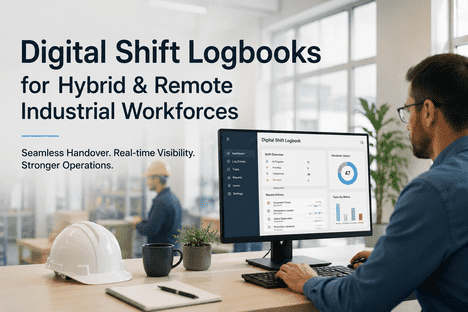
Digital shift logbooks built for distributed manufacturing give every supervisor, every site, and every remote manager the same complete operational picture — in real time, from anywhere, with zero dependency on phone calls or morning emails.
Multi-Site Unified
Offline-Ready
Mobile-First
21 CFR Part 11
LIVE MULTI-SITE FEED — ALL PLANTS
14:02:47
13:58
Plant C · Detroit — Conveyor Belt Alert
Auto-logged from SCADA · Remote manager notified instantly
13:45
Plant A · Houston — Shift Handover Signed Off
All 18 items acknowledged · J. Rivera e-signed
13:22
Plant B · Chicago — Quality Deviation Flagged
Batch 4418 · Defect rate 2.3% · QC lead notified
12:55
Plant D · Denver — PM Completed on Unit 7
WO #5102 closed · CMMS updated automatically
12:00
All Sites — Midday Shift Compliance: 96%
4 of 4 sites reporting · 2 open corrective actions
The Remote Operations Gap That Paper Logs Were Never Built to Close
Paper shift logs and verbal handovers were designed for a single-site world where supervisors walked the same floor as their teams. Distributed manufacturing changed that permanently — but the tools didn't follow. A remote manager responsible for four facilities across different time zones cannot walk the floor, cannot verify a handover happened, and cannot know what events occurred overnight until someone chooses to tell them. The information retention numbers across common methods tell the story clearly.
Verbal + Phone Updates
~30% retained
Email / WhatsApp Chains
~50% retained
Shared Excel / Drive
~60% visible
Multi-Site Digital Shift Logbook
100% visible
Want to know exactly what your remote teams are missing right now? Book a Demo — we'll walk through your current multi-site logging setup and show you the specific visibility gaps in under 20 minutes.
How Information Flows — and Disappears — Across Distributed Sites
A connected digital shift logbook does not just replace paper at each site. It creates a unified operational intelligence layer that aggregates data from every source at every facility into one real-time feed accessible to managers regardless of location. These are the six information sources that iFactory AI connects into a single distributed operations dashboard.
01
Plant Floor Operators
Mobile log entries, offline-capable, syncs on reconnect
02
Shift Supervisors
Structured handovers, mandatory sign-off before shift start
03
CMMS / Maintenance
Work orders auto-created and closed from log events
One live feed. Every site. Zero information gaps.
04
Quality Systems
Deviations, SPC alerts, inspection results auto-logged
05
Safety and Compliance
Near-misses, permit status, audits tracked across all sites
06
Remote Managers
Live alerts, cross-site dashboards, mobile access anywhere
The Distributed Operations Maturity Ladder
Most multi-site operations believe they are further along than they actually are when it comes to remote shift visibility. The honest assessment of where your distributed teams sit today — and what the next level requires — is the fastest path to eliminating the gaps that are costing you incidents, downtime, and compliance exposure right now.
1
Paper Logs and Phone Calls
Remote managers call each site to find out what happened overnight. Events known to plant floor operators are invisible to anyone more than 50 feet away. Zero searchability, zero compliance trail, no cross-site correlation possible.
Remote visibility: ~10%
2
Email, WhatsApp, and Shared Spreadsheets
Sites send shift summary emails, WhatsApp group messages, or update a shared Excel file. Remote managers see a filtered summary — not events as they happen. Data is fragmented, unstructured, and varies by who chose to report what. No enforcement of completeness or acknowledgment.
Remote visibility: ~35%
3
Single-Site Digital Logbook (Siloed)
Each site runs its own digital logbook with better data capture. But each platform is separate — remote managers must log into four different systems to see what happened at four sites. No unified view, no cross-site pattern recognition, no consolidated compliance reporting. Better than paper; still a fragmented picture for distributed leadership.
Remote visibility: ~60%
4
Multi-Site Connected Logbook — The Target State
All sites on one platform. Remote managers see every event from every facility in real time on one dashboard — with push alerts for critical events, enforced handover completion at every site, cross-site pattern analysis, and unified compliance documentation. iFactory AI delivers this from a single deployment program that runs all sites concurrently within 6 weeks.
Remote visibility: 100%
Not sure which level your distributed operation is actually at? Book a Demo — iFactory AI benchmarks your current multi-site shift visibility in under an hour and shows you exactly what the next level requires.
The Multi-Site Dashboard Remote Managers Have Been Waiting For
Visibility into distributed operations stops being theoretical the moment you can see every site on one screen without logging into multiple platforms or waiting for morning emails. This is what iFactory AI's unified remote operations dashboard gives distributed manufacturing leaders — live, from any device, at any hour.
Remote Operations Dashboard — All 4 Plants
Live · Updated 8 sec ago
Active Issues
18
Across 4 sites · 3 critical
Sites Reporting
4 / 4
All sites online · Last sync <10s
Shift Compliance
96%
Handovers complete · All sites
Open Actions
11
2 overdue · 9 in progress
Cross-Site Event Volume by Hour — Last 24h
Four Workflows That Transform Remote Shift Management
Real-time multi-site visibility only delivers value when it changes how remote managers act — before issues escalate, not after. These are the four operational workflows that shift the moment a distributed operation moves from email-based reporting to live shift intelligence.
TRACK
Awareness: hours → real-time
Know what's happening at every site simultaneously
Remote managers see every event from every facility on one live dashboard — without calling the site, without waiting for a summary email, and without logging into four separate systems. A production stoppage at Plant C and a quality deviation at Plant B appear on the same screen at the same time.
ALERT
Response time: 62% faster
Critical events reach remote managers the moment they happen
Configurable severity thresholds trigger immediate push notifications to remote managers' mobile devices — no intermediate step, no relay through a phone chain. Unacknowledged critical alerts escalate automatically on a time schedule defined per site and per event type.
HANDOVER
Completion rate: 95%+
Enforce complete shift handovers without physical presence
Structured handover templates require incoming supervisors at every site to electronically acknowledge every open issue before the new shift officially begins. Remote managers see handover completion status for all sites in real time — and receive alerts for any site where handover is incomplete past shift-start time.
COMPLY
Audit prep: days → minutes
Full compliance documentation across all sites on demand
Every log entry across every facility is timestamped, attributed, e-signed, and immutable. Unified compliance reports — OSHA 300, GMP batch records, PSM incident documentation — generate automatically from shift data across all sites, eliminating the manual assembly process that previously consumed 40+ hours per month per facility.
SEE IT ACROSS YOUR SITES
Watch iFactory AI Manage a 4-Site Operation in Real Time
A 20-minute live walkthrough using your site configuration — see the unified dashboard, multi-site alert routing, enforced handover workflows, and cross-site compliance reporting before committing to anything.
What Distributed Operations Measure After Deploying a Digital Shift Logbook
The gap between what multi-site operations could measure before a connected digital logbook and what they measure after is not incremental — it is categorical. The metrics that previously required compiling reports from four sites over two days are now available on a single dashboard in real time.
Scroll horizontally to view all metrics
Built for How Distributed Manufacturing Actually Operates
A multi-site digital shift logbook only works if it handles the operational realities that single-site tools ignore — patchy plant floor WiFi, different shift patterns across facilities, varying regulatory requirements by location, and managers who need the same information whether they're at headquarters or on a flight between plants.
01
Works Offline
Plant floor operators log events, capture photos, and complete checklists with zero internet. Data syncs automatically when connectivity resumes — nothing lost, no duplicates.
02
Multi-Site Native
Each facility runs its own templates, shift patterns, and escalation rules. Regional managers see all sites on one unified dashboard without logging into separate systems.
03
Mobile-First for Everyone
Remote managers monitor all sites from a phone. Floor operators log from tablets. Shift supervisors sign off handovers from any device. The same information layer accessible from any location.
04
Deep System Integration
Bidirectional sync with SAP, Oracle, CMMS, SCADA, DCS, MES, and quality systems across all sites. The logbook becomes the connective tissue of your distributed operations stack — not another silo.
Still managing remote teams through email chains and phone calls? Book a Demo — most distributed operations go live on iFactory AI across all sites within 6 weeks and see measurable improvement in remote visibility within the first 30 days.
Frequently Asked Questions About Shift Logbooks for Remote and Distributed Teams
How does a digital shift logbook help remote managers who cannot physically walk the plant floor?
iFactory AI gives remote managers the functional equivalent of walking every floor simultaneously — a live dashboard showing every logged event from every site in real time, with push alerts for critical events that arrive on their phone within seconds. Remote managers can review active events, check handover completion status, query log history across sites, and verify corrective action progress without calling a site or waiting for a morning report. The information gap that physical absence creates is closed by real-time digital visibility.
Can each site have its own shift templates and procedures while sharing one regional dashboard?
Yes. iFactory AI is designed specifically for this configuration. Each facility runs its own logbook templates, shift patterns, escalation thresholds, and compliance categories — reflecting the actual operational and regulatory differences between sites. Regional managers and operations directors see all sites on one unified dashboard with aggregated metrics, cross-site event feeds, and consolidated compliance reporting. Site-level specificity and enterprise-level visibility are not a trade-off; they run simultaneously on the same platform.
How does the system perform where plant floor WiFi is inconsistent or unavailable?
iFactory AI's mobile application operates fully offline. Operators log events, capture photos and video, scan barcodes, and complete checklists without any network connection. All data is stored locally on the device with a full integrity timestamp at the moment of entry. When the device reconnects to WiFi or cellular — even in the parking lot after a shift — all entries sync automatically to the unified dashboard with conflict resolution for overlapping entries. Remote managers receive the data as soon as sync completes, typically within seconds of the device reconnecting.
How long does it take to deploy iFactory AI across multiple facilities simultaneously?
iFactory AI's 6-week program deploys all sites concurrently rather than sequentially. Weeks 1–2 cover baseline audit and system configuration for all facilities, with CMMS, ERP, and SCADA integrations initiated. Weeks 3–4 bring the mobile logbook live, structured handover templates active, and supervisor alert routing confirmed at every site. Weeks 5–6 complete multi-site dashboard activation, cross-facility compliance reporting, and regional manager analytics. Multi-site operations with 4–8 facilities regularly complete full deployment within this 6-week window.
Does iFactory AI handle different time zones and shift patterns across distributed sites?
Yes. iFactory AI is built for operations where no two sites run identical schedules. Each site configures its own shift timing, break patterns, and handover windows. The unified dashboard displays all site events in the regional manager's local time while preserving site-local timestamps for compliance purposes. Shift compliance metrics — handover completion rates, mandatory check completion, corrective action closure — are calculated against each site's own shift pattern, not a global template. A 2-shift plant and a 3-shift plant in different time zones report into the same regional dashboard without configuration conflicts.
BUILT FOR DISTRIBUTED OPERATIONS
Give Every Remote Manager Complete Visibility Across Every Site — Live in 6 Weeks
iFactory AI delivers unified multi-site shift visibility, enforced structured handovers, real-time remote alerts, cross-site compliance documentation, and full offline capability — across all your distributed facilities on one platform within 6 weeks.