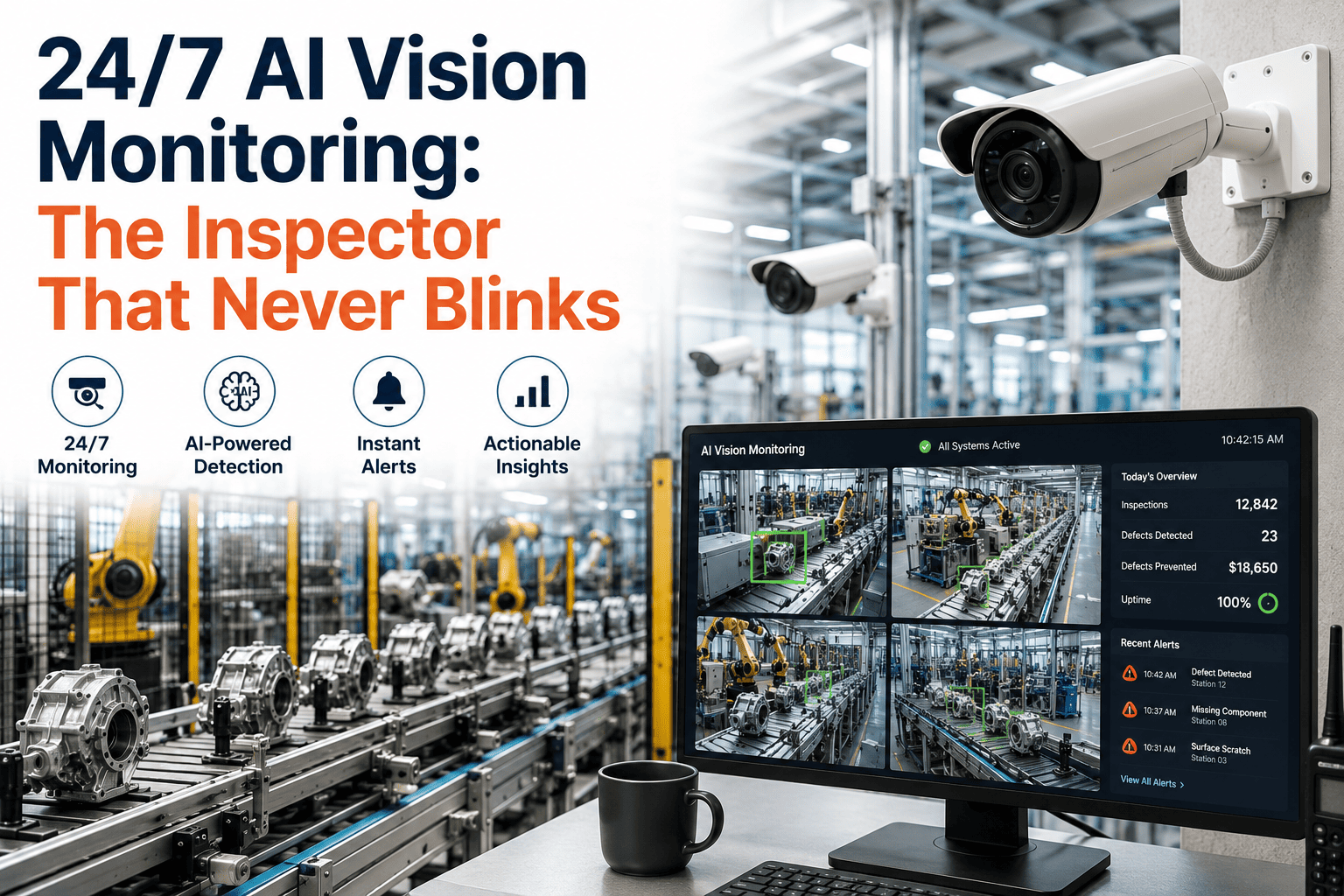
At 3 AM on a Tuesday, the third-shift inspector at a mid-size plant has been looking at the same conveyor for six hours. Her lighting is worse than day shift. She missed her break. The line is running the same speed as it did at 9 AM — but her ability to catch a sub-millimetre burr is nothing like it was at 9 AM. She is not the problem. The job is. Human visual inspection was never designed to sustain 99 percent accuracy across three shifts, seven days a week, forever. AI vision monitoring was. To see what continuous 99.4 percent accuracy looks like across your night shift, Book a Demo with iFactory AI.
The Inspector That Never Blinks — Every Part, Every Shift, Every Night, No Drift.
iFactory AI ships the full 24/7 monitoring stack: fatigue-free CNN inference on NVIDIA edge servers, identical detection thresholds at 3 AM and 3 PM, and hot-failover redundancy so the inspection line never goes dark.
Why Night Shift Escapes Cost More Than Day Shift Escapes Ever Will
Every plant knows this pattern even if the finance team has never quantified it: the defects that reach the customer, become warranty claims, or trigger recalls disproportionately originate from third shift. Not because night-shift inspectors are less skilled — they are often the most experienced — but because human visual attention is a biological system that degrades predictably with hours on task, circadian misalignment, and reduced supervision. AI vision does not have any of those variables. It applies the same detection threshold to the 3 AM part that it applied to the 3 PM part. That single fact is the entire foundation of why 24/7 monitoring exists.
Based on published ergonomics research: human inspection accuracy degrades 20 to 30 percent after the first hour of continuous visual work, with miss rates peaking in the final two hours of every shift.
What Coverage Actually Looks Like: Three Human Shifts vs One AI System
The word "24/7" gets used loosely in inspection contexts. What most plants actually run is three overlapping human shifts with fatigue gradients, handover gaps, break coverage that varies, and weekend rotations that never quite match weekday performance. AI vision monitoring is a genuinely continuous curve. Below is what a full 24-hour window looks like under each model.
Where the Accuracy Gap Actually Opens Up — Shift by Shift
The headline "95 percent human accuracy" that most plants quote is a day-shift number, taken in the first two hours, under optimal conditions. It is not what the customer sees. The customer sees the aggregate output across all three shifts — and the defect escape rate is dominated by the worst hours. Below is what a typical head-to-head looks like when you separate the shifts.
Fresh crew, best lighting, active supervision. This is the strongest hour humans get all day — and AI still catches 17 points more defects.
Cumulative fatigue builds. Natural light changes. Attention drifts in the second half. The gap widens to 26 points before night shift even starts.
Circadian misalignment plus reduced supervision. This is where escape rates double and where most warranty-generating defects originate every plant runs.
See What Continuous 99.4% Accuracy Would Do to Your Night-Shift Escape Rate.
Book a 30-minute walkthrough with an iFactory solutions engineer — bring your last quarter's shift-tagged defect data, and see the projected escape reduction on your worst-performing hours.
Six Places 24/7 Consistency Changes the Outcome You Actually Care About
Continuous monitoring is not an abstract capability — it is a specific advantage in six concrete operational contexts. Each one is measurable, each one is currently costing plants money they attribute to other causes, and each one becomes visible the moment shift-to-shift variance disappears from the quality record.
Regulated Audit Trail
21 CFR Part 11, GMP, and IATF audits demand identical inspection standards at every hour. AI vision produces the same timestamped, signed record whether the part passed at 09:14 or 03:47, closing a persistent gap in audit defensibility.
Batch Release Integrity
Pharmaceutical and food batches released overnight carry the highest field failure rate. A consistent detection threshold across the release window eliminates the "night batch" quality risk that finance teams currently absorb as insurance premium.
Warranty Root-Cause
Field failures that trace back to specific production windows become surfaceable when every part has an inspection record. Night-shift-origin escapes stop being untraceable and start being fixable at the source station.
Throughput at Full Speed
The line no longer slows down at 4 AM because the inspector is fatigued or the visual gate is a bottleneck. Continuous inference at line speed means throughput is constant across all 24 hours, not just prime time.
PPE & Safety Compliance
Safety compliance monitoring is where fatigue costs bite hardest — an unnoticed hard-hat violation at 2 AM is a real incident. AI vision applies identical safety zone monitoring across every shift, unblinking.
Predictive Wear Signals
Thermal and vibration signatures indicating early wear only surface when the same camera looks at the same asset with the same threshold thousands of times. That data density only exists when the inspector never blinks.
Four Engineering Guarantees Behind True 24/7 Vision Monitoring
Any camera vendor can claim "continuous monitoring." The engineering discipline that makes 24/7 vision actually reliable is a different question. iFactory ships four guarantees that separate production-grade continuous monitoring from proof-of-concept setups that degrade after the first weekend.
Deterministic Inference
The same image produces the same output every single time, regardless of hour, temperature, or system load. No stochastic drift, no accuracy variance shift-to-shift. Every detection is reproducible for audit.
Thermal Stability
Industrial-grade NVIDIA edge servers with active cooling maintain inference stability across ambient temperature swings from 0 to 45 Celsius. No throttling, no shutdown, no accuracy dips during summer afternoon peaks.
Hot-Failover Redundancy
Paired edge servers with instant failover mean a hardware fault takes seconds to recover, not shifts. Camera streams are automatically re-routed to the standby unit with zero manual intervention required.
Model Version Lock
The model version deployed at 09:00 Monday is the identical model version deployed at 03:00 Sunday. Updates land through a controlled release window with rollback capability — never mid-shift, never uncoordinated with production.
What Removing Shift-to-Shift Variance Actually Does to the Numbers
The financial signature of eliminating shift-to-shift accuracy variance is not spread evenly across the P&L — it concentrates in four specific line items where the night-shift-tax has always lived. Below is what iFactory-deployed plants consistently report inside the first two quarters after 24/7 monitoring goes live.
Reduction in defect escape rate on the third shift specifically, where the human vs AI accuracy gap is largest and financial exposure per escape is highest.
Zero measurable difference in detection accuracy between day and night shifts once AI vision replaces manual visual QC as the primary inspection layer.
Reduction in time spent assembling inspection records for regulatory audits — every part has an identical, timestamped, signed record.
Continuous inspection uptime across the full 24-hour window, with hot-failover redundancy ensuring hardware faults recover in seconds rather than shifts.
24/7 AI Vision Monitoring — FAQs for Operations Leaders
Does 24/7 AI vision monitoring replace human inspectors?
No — it redeploys them. The AI handles the physically demanding and error-prone task of continuous visual scanning across every shift. Human inspectors shift to higher-value work: analysing defect trends, investigating root causes, and driving process improvements from the data the AI generates. Every iFactory-deployed plant retains its quality team — the team simply stops burning three shifts on repetitive visual scanning that fatigue makes them poor at anyway. To scope a redeployment model, book a session.
How does the system maintain identical accuracy at 3 AM as at 3 PM?
The CNN model that processes each frame is deterministic — the same input pixels produce the same output classification regardless of the time on the clock. Illumination is provided by dedicated industrial lighting that does not vary with the sun. The NVIDIA edge server runs at constant temperature with active cooling. There is no biological variable in the loop, so there is no shift-to-shift drift. Model version is locked and only updates through controlled release windows. For an architecture walkthrough, contact our team.
What happens if the AI vision system itself goes down overnight?
iFactory deploys paired edge servers configured for hot-failover. If the primary unit encounters a hardware fault, the standby unit takes over camera streams automatically within seconds, with no manual intervention required. Failover events log to the dashboard and trigger a maintenance work order for the affected hardware, so the on-call team is aware even if production continues uninterrupted. Total inspection uptime typically holds at 99.9 percent across the full 24-hour window. To review redundancy architecture, book a demo.
How do we prove to auditors that inspection standards are actually identical across shifts?
Every AI inspection produces a timestamped, geotagged, digitally signed record with the annotated image, defect classification, severity score, and model version. Auditors can pull the full inspection record for any part inspected at any hour and verify that the same model version, same threshold, and same detection logic applied. This is a stronger audit posture than any manual inspection program can provide because it removes the variability of the human element entirely. For an audit-defensibility walkthrough, reach out to support.
Does 24/7 monitoring require different hardware than day-shift-only vision deployments?
Yes and no. The cameras and models are identical — but 24/7 deployments require industrial-grade lighting to eliminate ambient variability, active cooling on the edge servers for thermal stability, and paired hardware for hot-failover redundancy. iFactory ships all three as part of the standard turnkey stack when the deployment scope is continuous monitoring, so the customer does not have to specify the difference. To confirm sizing for your line, book a demo.
The Real Value of 24/7 Vision Is Not Coverage — It Is Consistency
Most plants sell themselves the wrong story about AI vision. They talk about coverage, accuracy, and throughput as if the value comes from getting more inspections done. The actual value is that every inspection is identical to every other inspection. The 3 AM part gets the same threshold as the 3 PM part. The night-shift record is the same quality as the day-shift record. The audit answer is the same regardless of which hour the auditor asks about. That consistency is what makes AI vision defensible in regulated industries, financeable in a CFO's ROI model, and durable as a competitive advantage. iFactory ships the full 24/7 stack — deterministic inference, thermal stability, hot-failover, and model version lock — as a single turnkey deployment engineered for the shifts that matter most.
Bring 24/7 Consistency to Your Worst-Performing Shifts — In a Single Quarter.
Book a 30-minute session with an iFactory solutions engineer to review your shift-tagged defect data, size a continuous monitoring deployment with hot-failover redundancy, and receive a phased plan built around your current inspection landscape.