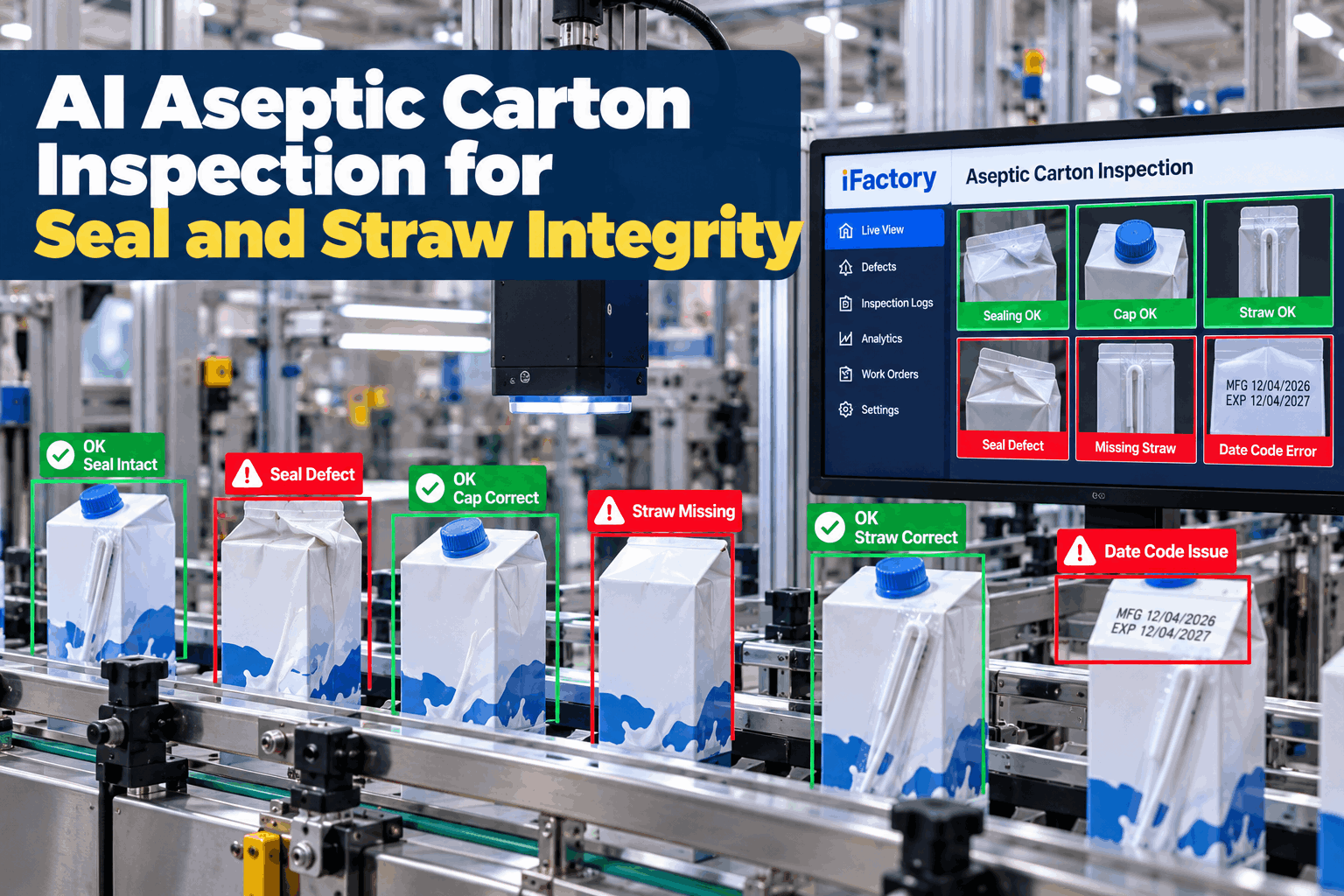
An aseptic carton earns its ambient shelf life at the moment of sealing. A weak transversal seal, a missing straw or a smudged date code can travel the whole line looking almost normal, then show up later as a leaker, a complaint or a recall question. Aseptic carton inspection with AI vision checks every pack as it leaves the filler, flags what can be seen, and sends the finding to the people who can fix the cause. Dairy and beverage teams can see it on their own filler in an aseptic carton inspection demo.
AI Aseptic Carton Inspection for Seal and Straw Integrity
Verify transversal seals, cap and straw placement, date codes and package shape on aseptic fillers with AI vision. Every reject comes with an image and a likely cause, on a turnkey on-prem server.
- Every pack imaged at line speed
- Seal, straw, cap, code and shape in one view
- Reject images grouped by filler and cause
Why Aseptic Carton Defects Are Hard to Catch
The pack leaves the filler looking fine.
Cartons run fast, and the flaws that matter are small: a wrinkle in the seal area, a straw a few millimetres off, a cap that sits crooked. Spot checks catch a few of them. A camera on every pack catches the pattern, which is what points to the jaw, the applicator or the changeover that caused it. Our packaging specialists can map where inspection helps most on your line.
Small seal flaws
Wrinkles and contamination are easy to miss.
Applicator drift
Straws and caps slip out of position slowly.
Code errors
A wrong or blurred date code is a quality event.
Late discovery
Problems surface after the pack has shipped.
What AI Vision Checks on Each Carton
Each check has a visible sign and a defined response.
The table below shows what the cameras look at and what happens next. Vision checks the visible attributes of the pack. It supports your filler controls, seal integrity tests, laboratory checks and release procedures, and does not replace them. Scope the checks for your formats in a working session.
A camera sees the outside of the pack and the sealed area. It cannot confirm sterility, so keep your incubation, lab and seal integrity tests. The value of vision is more evidence, earlier, on every pack.
From Reject to Root Cause
A reject only helps if the cause is found.
Each rejected pack carries its image, time, filler and format. Grouped together, those records show whether a flaw is random or repeating, and where to look first. Operators confirm the pattern, maintenance gets a work order, and the fix is logged against the same record. Plan the workflow with our implementation team.
Image
Every pack is imaged at the station.
Judge
AI flags the visible defect.
Reject
The pack is diverted and the image saved.
Group
Rejects are grouped by cause and filler.
Fix
A work order is opened and closed.
See Your Own Cartons Through the Model
Bring a filler, a pack format and a list of past defects, and leave with a camera plan for the checks that matter most.
Ask the Line What Happened
Questions about rejects get answers with images.
Quality and line leads can ask plain questions about rejects and get the images, the counts and the time. That shortens investigations and keeps shift handovers factual. See it on your own events in a live walk-through.
Where the Cameras Go
A few stations cover the five checks.
Cameras sit after the sealing and application steps, where each feature can be seen clearly. Lighting and mounting are planned with the filler's layout, and a short survey with our vision team confirms the positions.
After sealing
Views the transversal seal area.
After straw
Checks straw presence and position.
After cap
Checks cap fit and placement.
Code and outfeed
Reads the date code and checks shape.
What Is in Scope and What You Add
Plan the whole project, not just the server.
The turnkey package covers the system from server to training. A few items sit with the plant team, and agreeing them early keeps the schedule steady. Your quote lists every item, and you can request one through our quote team.
Included in the turnkey scope
- NVIDIA AI server, installed and networked
- Vision models for seals, straws, caps, codes and shape
- Camera, lighting and reject gate integration
- Training and 24×7 remote monitoring
Worth arranging on your side
- Filler access for the camera survey
- Samples of good and defective packs
- Agreed reject and quality hold rules
- Operators and QA staff for review sessions
How iFactory Inspects Your Cartons
Vision, OCR and work orders from one server.
iFactory reads the camera streams on a server inside your plant, applies defect detection and OCR to each pack, and sends results to the people who act on them. Reject trends and work orders sit beside your other maintenance and quality data. Questions about fit go to our solutions team.
Defect detection
Seal, straw, cap and shape flaws.
OCR reading
Date codes read and matched to the order.
Line-speed checks
Every pack judged as it passes.
Reject trends
By filler, shift, format and cause.
Image records
Reject images kept for investigations.
On-prem
Images stay inside the plant network.
The figures, timelines and exchanges on this page are illustrative. Detection accuracy and results depend on camera views, lighting, pack design and filler speed, and we measure them on your line during the pilot.
Turnkey AI: Delivered, Connected and Live in 6–12 Weeks
You do not build this. It arrives ready.
iFactory ships as a pre-configured NVIDIA AI server with the software pre-loaded, racked and ready. Rack it, plug in power and Ethernet, and the AI is live on your network. Our team handles cabling, network setup, camera and lighting links, reject gate and CMMS integration, operator training and 24×7 remote monitoring. Images stay on your network. For an implementation guide and a quote matched to your line, request a turnkey quote.
Ship, network and survey
Server installed. Cameras and lighting planned on the filler.
Setup and pilot
Checks tuned on your formats. Live pilot runs on one filler.
Go-live and review
Roll-out across fillers. Teams trained. Results reviewed against baseline.
Frequently Asked Questions
How does aseptic carton inspection with AI work?
Cameras after the sealing and application steps image each pack. An on-site AI server checks the seal area, straw, cap, date code and shape, then diverts flagged packs and saves the image.
Can it check the transversal seal?
It checks the visible seal area for wrinkles, channels, offset and contamination. It does not replace seal integrity tests or laboratory checks, which stay part of your quality plan.
Can it verify straw and cap placement?
Yes. It flags missing, bent, misplaced or detached straws, and missing, crooked or damaged caps, and shows the trend by applicator and format.
Does it read date codes?
Vision OCR reads the printed code and compares it with the expected text from your order data. Missing, smudged or wrong codes are flagged and the pack is rejected.
Does it help with shelf life and spoilage?
It finds visible defects that can be linked to package integrity and helps trace their cause. It cannot confirm sterility, so your incubation and release tests continue.
Will it work on our formats and filler speed?
That depends on camera views, lighting and pack design, so we confirm it during a short survey and tune it on your formats during the pilot.
Does it connect to our reject gate and CMMS?
Yes. It can drive the reject gate and open maintenance work orders for the applicator or sealing jaw, with the images attached. Integration scope is confirmed during scoping.
What does it cost?
Cost depends on the number of fillers, stations and integrations, so we issue a turnkey quote after a short scoping call. The pilot then tests the results on your own line.
How do we start?
Start with a short session on your filler and past defects. A 6-week pilot then installs cameras on one filler and measures rejects against your baseline. To plan it, contact our team.
Put a Camera on Every Pack Leaving the Filler
In thirty minutes we walk through your filler and past defects and show where AI vision would help first. You keep the plan either way.
- 1Your filler models and speeds
- 2Pack formats, straw and cap types
- 3Past seal and complaint records
- 4Date code format and printer type
- 5Your reject and quality hold procedure