A barcode that scans perfectly on the warehouse floor can still fail the moment it reaches a retailer's distribution center. The reason is simple: a handheld scanner is a go or no-go device, while a distribution center's automated line reads that same code at speed, under fixed lighting, expecting near-perfect print quality every single time. The gap between "it scanned for me" and "it meets the standard" is where chargebacks, rejected pallets, and rework lines are born. Most plants only discover that gap after a retailer deduction shows up on a remittance statement weeks later. iFactory's support team can walk you through how real-time verification closes that gap before a single pallet leaves the dock.
A Barcode That Scans Is Not the Same as a Barcode That Passes — And Retailers Only Tell You After They Deduct Your Payment
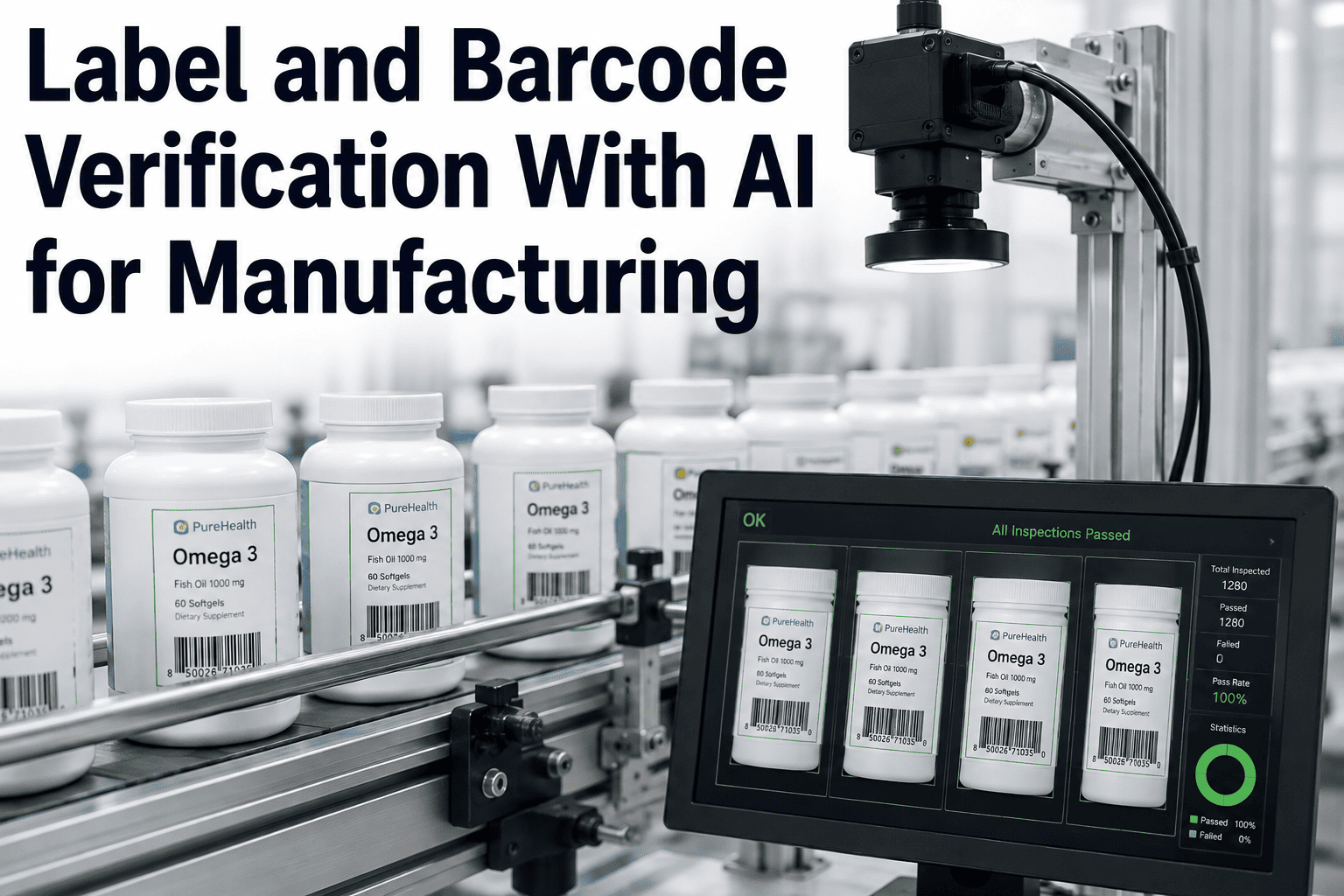
Retail distribution centers reject unreadable or misplaced labels automatically, and the penalty lands on your remittance long after the shipment has left your dock. iFactory verifies every label and barcode inline, against the exact ISO/ANSI grading standard your retail partners use, so a printer drifting out of spec gets caught on your line instead of on their scorecard.
Why "It Scanned Fine" Is the Most Expensive Sentence in Label Quality Control
A scanner and a verifier are not the same tool doing the same job. A scanner decodes a barcode and moves on — it either reads the data or it doesn't, with no insight into how close that code was to failing. A verifier measures the barcode the way a distribution center's high-speed automated reader actually sees it: contrast, edge definition, quiet zone, print consistency, all quantified against a published standard. A code can scan reliably by hand in a well-lit office and still fail on a conveyor moving at production speed under a fixed-angle scanner, because the tolerance for a human-assisted read is nothing like the tolerance for full automation.
This is also why relying on a phone-based scanning app to spot-check labels gives a false sense of security. Consumer scanning software is built to succeed wherever possible, actively compensating for weak contrast or a marginal quiet zone the same way a determined cashier squints and tries again from a different angle. A dedicated verifier does the opposite: it refuses to compensate, because its entire purpose is reporting exactly how close a code is to the edge of failure before that edge gets tested for real at a receiving dock running thousands of cartons an hour.
Under ISO/IEC 15416 and ISO/IEC 15415, a verifier grades a code on a 4.0-to-0.0 scale that maps directly onto these letters, and the overall grade is set by the single worst-performing parameter measured, not an average of the good ones. A barcode that is nearly perfect on eight measurements and weak on contrast alone can still drop from an A to a D, which is exactly the kind of failure a visual inspection or a quick phone-app scan will never catch.
Nine Parameters Decide Whether Your Barcode Passes or Costs You Money
Every 1D or 2D barcode verification comes down to a fixed set of measurable print-quality parameters. Understanding what each one catches makes it much easier to trace a failing grade back to a specific printer, ribbon, or substrate problem on the floor.
Minimum Reflectance & Symbol Contrast
Measures how dark the bars are against the background; faded ribbons, low print pressure, or dark-on-dark color choices are the most common causes of failure here.
Minimum Edge Contrast
Checks the sharpness of every individual bar-to-space transition, which smudged or bleeding print can degrade even when the overall symbol looks fine at a glance.
Modulation
Evaluates how consistent the light and dark elements are across the entire symbol, catching the kind of uneven print density a worn printhead produces long before a human notices.
Defects & Decodability
Flags dirt, voids, and spots inside the bars and spaces, then checks how closely the printed symbol matches its intended geometric design, both of which drift as tooling ages.
Every Major Retailer Penalizes Barcode Failures Differently — And All of Them Penalize Hard
There is no universal retailer chargeback schedule. Each major account publishes its own routing guide, and the penalty for the exact same unreadable label varies significantly depending on where the pallet is headed.
| Retailer | Barcode / Label Penalty | Trigger Threshold |
|---|---|---|
| Walmart | $5 per carton, rising to $10 per carton | Unreadable barcodes above 1% and 2% of shipment volume |
| Amazon | Roughly $10 per box, up to $26 per defect | Unscannable or mismatched item-level barcode |
| Target | Approximately $0.75 per defective carton barcode | Any carton barcode that fails to scan at receiving |
| Home Depot | $5 to $10 per carton across full shipment | Unreadable barcode rate exceeding 1% of volume |
The detail that catches most suppliers off guard is that these penalties are usually applied to the entire shipment once a defect threshold is crossed, not just to the individual cartons that failed. A handful of bad labels in a truckload can trigger a fee across every case on that load, which is why catching the problem at the printer matters far more than catching it at the dock. You can review current program specifics through your support contact if your team needs help mapping this against a specific retailer's routing guide.
Stop Finding Out About Bad Labels From a Chargeback Report
iFactory verifies every label against ISO/ANSI grading standards inline, before the pallet ever leaves your dock, and flags the exact printer or substrate issue causing the drop.
Placement, Skew, and Print Quality Fail a Label Just as Often as a Bad Symbol Does
A perfectly graded barcode printed in the wrong spot on a carton still triggers a chargeback, because automated scanners at a distribution center expect the label within a defined zone and orientation. AI vision verification catches the placement and print defects that a barcode-only check will always miss.
Label Placement & Zone Compliance
Confirms the label sits within the retailer's required zone on the correct panel of the carton, since a barcode outside the expected scan window is invisible to an automated line reader no matter how clean the print is.
Skew & Orientation
Detects a rotated or crooked label before it ships, since even a few degrees of skew can push a marginal barcode's grade from a pass to a fail under automated scanning conditions.
Human-Readable Text Legibility
Verifies the printed PO number, item description, and quantity below the barcode are legible, since retailers fall back to manual entry when a scan fails and an unreadable text line stops that fallback cold.
Data Match Against the ASN
Cross-checks the decoded barcode data against the advance shipping notice in real time, catching the mismatched PO or SSCC number that causes a receiving-side rejection even when the print itself is flawless.
Four Root Causes Behind Most Failing Labels
Barcode grades rarely fail randomly. They drift downward gradually as physical print hardware wears, and catching the pattern early prevents a slow decline from ever reaching a shipment.
Real-Time Verification Built to Match the Standard Your Retail Partners Actually Use
iFactory's AI vision stations sit directly on the line after print-and-apply, grading every label against ISO/IEC 15416 and ISO/IEC 15415 in real time and rejecting anything below the threshold your retail program requires, before it reaches a pallet. The same platform that verifies label quality can also feed that data straight into the maintenance and quality workflows your team already uses, so a failing grade turns into a work order instead of a spreadsheet nobody checks until the next audit.
Inline Grading at Full Line Speed
Every carton is graded as it passes, with no separate offline verification step slowing down the production line or creating a sampling gap between checks.
Automatic Retailer Threshold Matching
Configurable pass thresholds mean the same platform can enforce Walmart's Grade C floor on one line and a stricter pharmaceutical DPM requirement on another, without manual reconfiguration.
Root-Cause Trending by Printer
Grade data is trended per printer and per shift, so a slow decline in modulation or contrast gets traced back to the specific printhead or ribbon lot causing it, not discovered after the fact.
Automatic Reject and Reprint Trigger
A failing label triggers an automatic reject and reprint signal before the carton reaches the palletizer, keeping a compliance failure off the truck entirely instead of catching it after the fact.
What Catching a Bad Label on the Line Is Actually Worth
The value of inline verification is easiest to see next to the alternative. A plant shipping into two or three major retail accounts typically discovers a labeling defect one of two ways: on the line, in the seconds after it prints, or weeks later on a remittance statement after the deduction has already been taken and disputing it has become a paperwork exercise with no guarantee of recovery.
The Reactive Path
A defect ships, the retailer's automated system rejects or flags it at receiving, a chargeback posts weeks later, and someone on the finance or compliance team spends hours pulling BOLs, ASN logs, and photos just to file a dispute that may or may not be honored.
The Inline Path
The same defect is caught in the seconds after printing, the carton is automatically rejected and reprinted before it reaches the palletizer, and the root cause — a worn printhead, a bad ribbon lot, a drifting applicator — gets flagged to maintenance the same shift it started.
Because chargebacks are frequently applied across an entire shipment once a defect threshold is crossed, the cost of a handful of bad labels is rarely limited to those specific cartons. Catching the problem before the truck leaves protects the whole load, not just the units that would have failed, which is why plants that adopt inline verification typically see the return show up in reduced deduction volume within the first full shipping cycle after go-live.
Questions Manufacturers Ask About Label and Barcode Verification
Verify Every Label Against the Standard Retailers Actually Enforce
iFactory grades barcodes and labels inline, in real time, against ISO/ANSI standards and your retail partners' thresholds, before a single defect ever reaches a pallet.