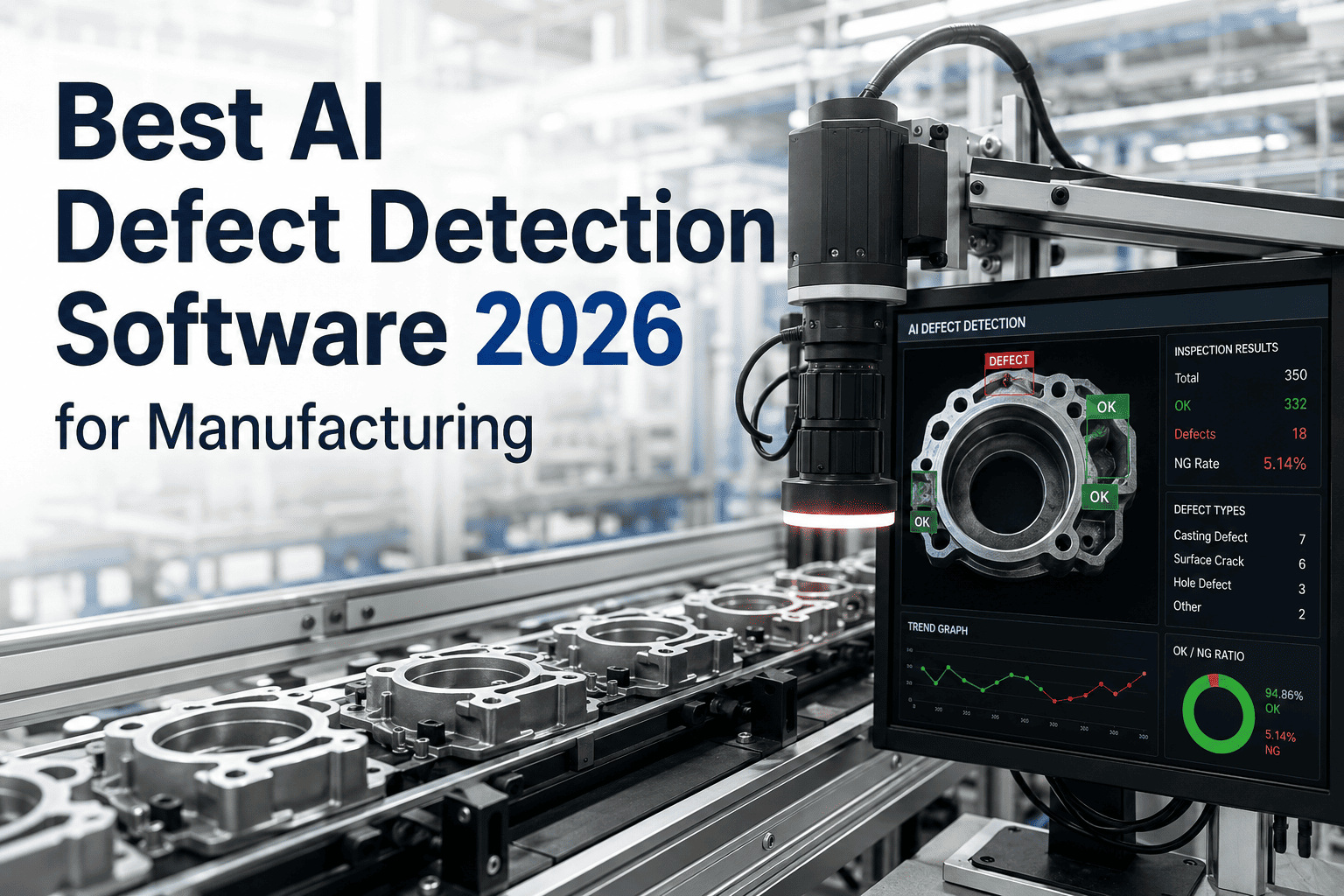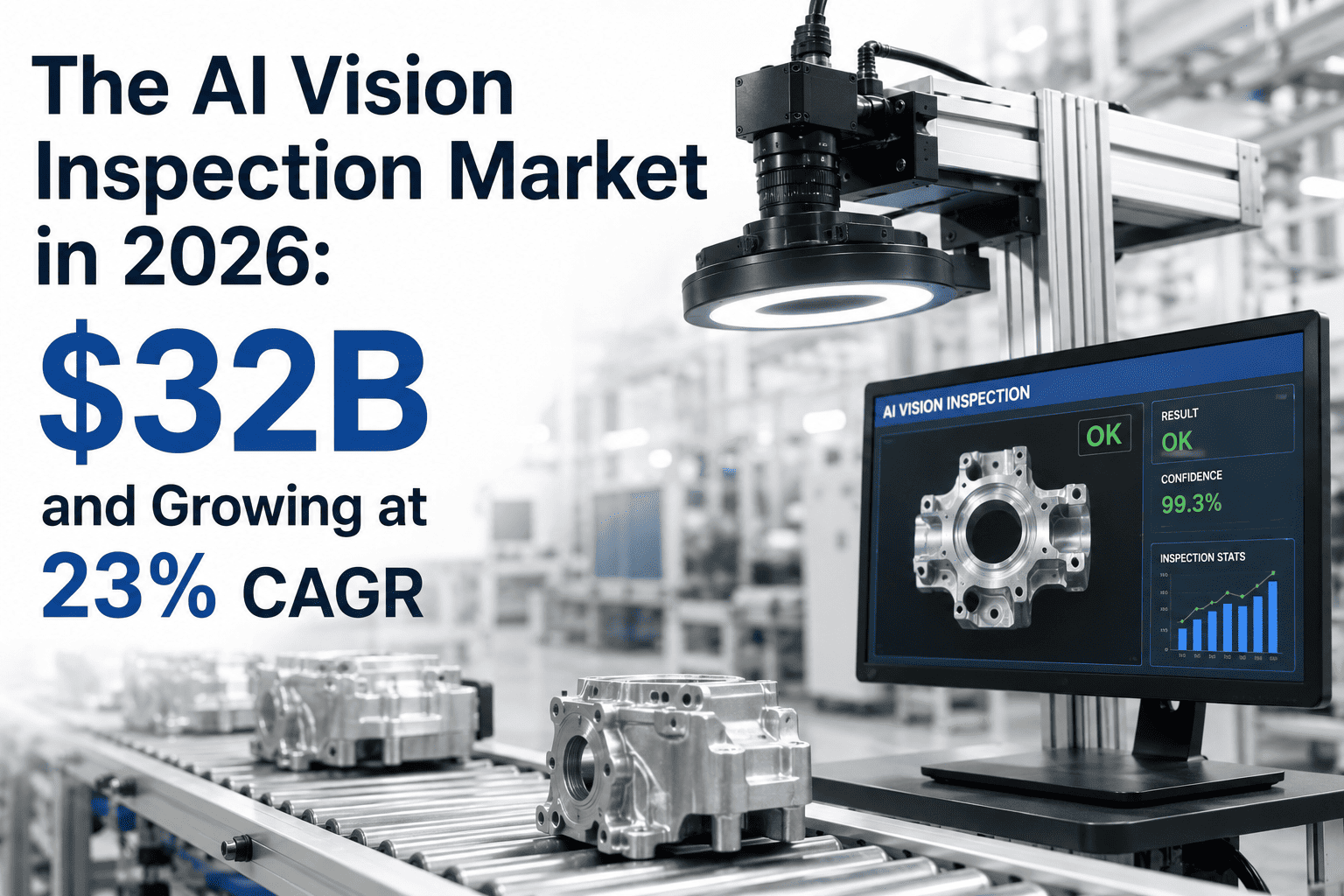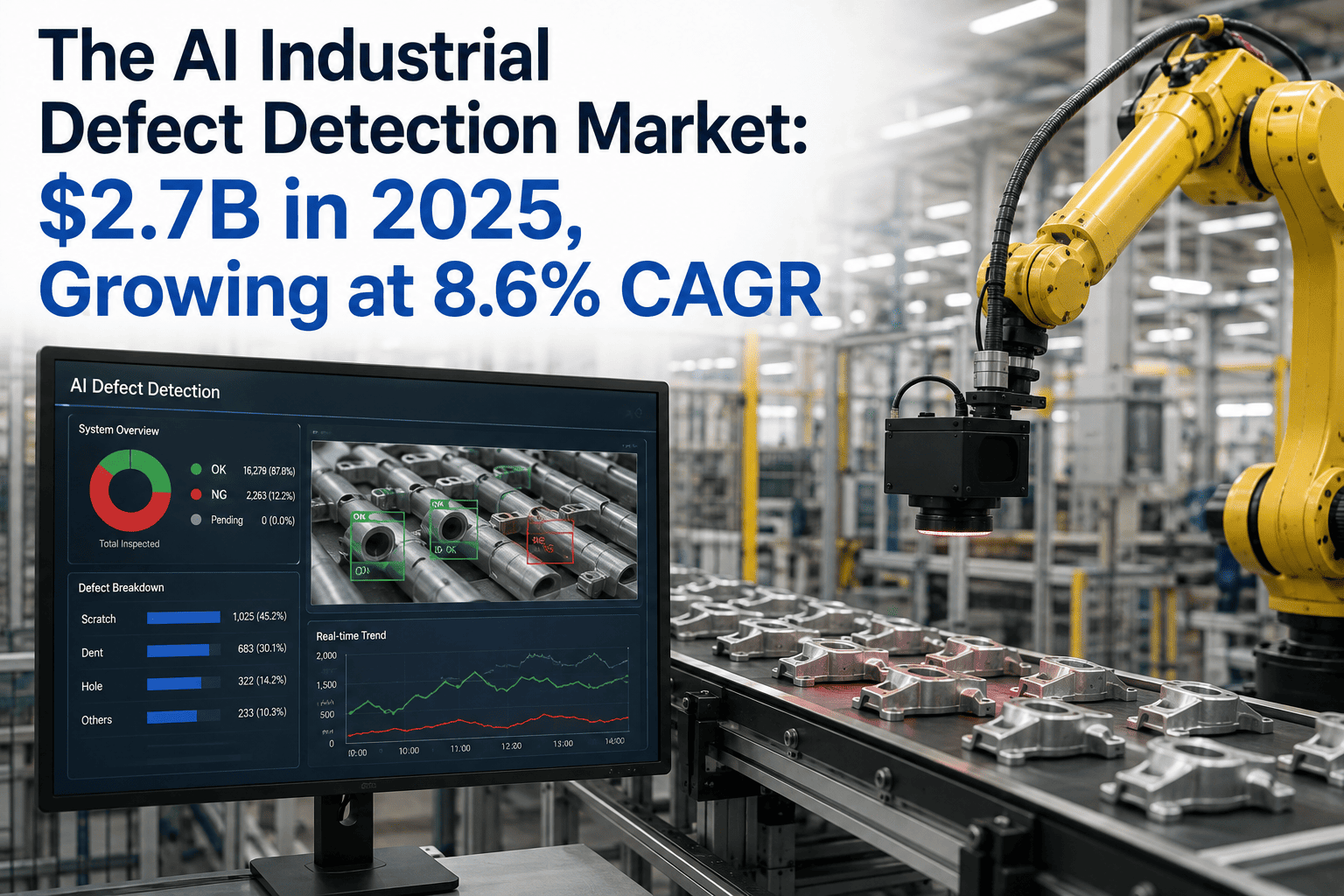
The AI industrial defect detection market is valued at $2,660.8 million in 2025 and is projected to reach $6,071.8 million by 2035 — a CAGR of 8.6% and total growth of 128.2% over the decade. Deep learning-based detection already commands 56% of that market, electronics manufacturing leads every application segment at 34% share, and edge deployment is becoming the default as manufacturers move inspection processing on-premise rather than to the cloud. The numbers below break down exactly where that growth is concentrated and what it signals for anyone evaluating a vision system purchase this year. See where iFactory fits against this curve — book a demo to walk through a deployment scoped to your production line.
$2.7B In 2025, Growing At 8.6% CAGR Toward $6.1B By 2035
Deep learning holds 56% market share. Electronics manufacturing leads application demand at 34%. Edge deployment is becoming the standard architecture as manufacturers prioritize on-premise processing over cloud dependency.
Ten-Year Growth Trajectory: 2025 To 2035
Growth is not spread evenly across the decade. Nearly 40% of the total ten-year value increase lands in the first five years — the market expands from $2,660.8 million in 2025 to $4,019.5 million by 2030, an increase of $1,358.7 million that represents 39.8% of the full decade's growth. That front-loaded curve reflects where the technology sits on the adoption cycle right now — deep learning has matured past early pilots and manufacturers are moving to production deployment faster than the back half of the decade will see, when growth normalizes into steadier, more incremental expansion.
The absolute dollar increase over the full ten years comes to $3,411.0 million, translating into total growth of 128.2% between the 2025 base year and the 2035 forecast endpoint. Multiple independent research firms have published overlapping estimates that support this trajectory even where their exact scope or absolute figures differ — several place the broader AI industrial defect detection category in the $2.5 to $3.7 billion range for 2025 with CAGR estimates clustering between 8.6% and 11.9%, depending on how narrowly or broadly each report defines the category boundary. The consistency across independent analysts on direction and rough magnitude, even amid different scoping choices, is itself a signal that this is durable structural growth rather than a single research firm's optimistic outlier.
Market Segmentation: Where The Money Is Actually Going
Three segmentation cuts explain the shape of this market — the detection technology buyers choose, the industries driving the spend, and the deployment architecture manufacturers now demand. Deep learning's 56% share is the clearest signal: traditional rule-based machine vision is being displaced, not supplemented, by neural-network-based defect classification that adapts to new defect types without a full reprogram.
Deep Learning-Based Detection
Neural network models dominate the technology segment, ahead of traditional computer vision and emerging unsupervised learning approaches. Deep learning's advantage compounds over time — the more inspection data a model sees, the better it gets at flagging subtle defect variants traditional rule-based vision never catches.
Electronics Manufacturing
Electronics leads every application segment, driven by micro-component inspection needs where defects are invisible to the human eye at production speed. Automotive manufacturing, metal processing, aerospace, and packaging follow as the next-largest application categories.
Edge AI Processing
Edge AI solutions that process inspection data locally without cloud dependency are commanding premium positioning as manufacturers prioritize data sovereignty, lower latency, and freedom from network reliability issues on the plant floor.
Regional Growth Map: Who Is Adopting Fastest
China, India, and Germany are named as the three key growth regions driving this market, but the reasons behind each are distinct — China on raw manufacturing digitization scale, India on a rapidly expanding precision engineering base, and Germany on Industry 4.0 maturity layered onto an already-dominant automotive sector.
Europe as a whole is projected to grow from $695.3 million in 2025 to $1,585.7 million by 2035 at the regional average of 8.6% CAGR, with Germany alone accounting for well over a third of that entire regional value. East Asia stands out as the fastest-growing region overall, with China's manufacturing base joined by Japan and South Korea's mature technology ecosystems reinforcing regional demand for advanced inspection systems beyond China's borders. Regulatory context shapes deployment choices as much as raw growth rates do — data localization requirements in several fast-growing regions are part of why on-premise, edge-based AI vision architecture is gaining ground faster than cloud-routed alternatives, since keeping production floor data physically on-site sidesteps a compliance conversation that cloud deployments cannot avoid.
China
Fastest-growing major market, driven by massive manufacturing sector digitization and rapid AI technology adoption, supported by Japan and South Korea's broader regional technology ecosystem.
India
Second-fastest growth rate globally, fueled by expanding automotive manufacturing and a rapidly maturing precision engineering sector adopting automated inspection at scale.
Germany
Commands 38.5% share of the entire European market, anchored by automotive manufacturing excellence and Industry 4.0 frameworks already embedded across German production lines.
United States
Steady growth driven by automation investment and reshoring of precision manufacturing, with strong demand concentrated in electronics, aerospace, and automotive quality control.
Why Deep Learning Is Winning The Technology Segment
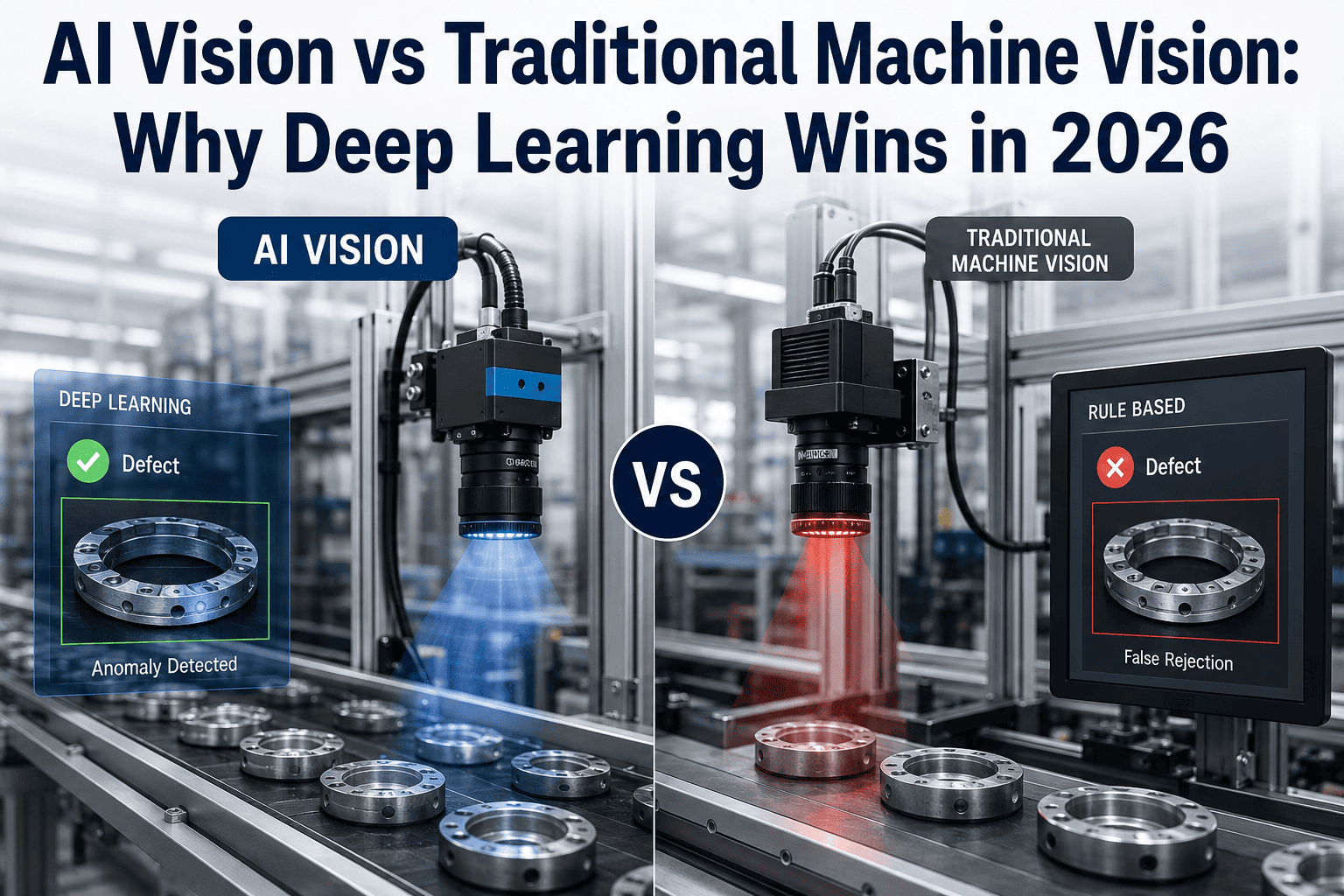
The shift from rule-based machine vision to deep learning is not a marginal upgrade — it changes what a vision system can actually do on your line. Rule-based systems need explicit programming for every defect type; deep learning models generalize from labeled examples and catch variants nobody explicitly coded for. That difference is the core driver behind deep learning's 56% share and why it is projected to keep pulling share from traditional computer vision through the forecast period.
Behind that 56% figure sits a second, smaller but fast-growing category worth watching — unsupervised learning approaches that reduce labeled training data requirements and adapt automatically to novel defect types the model has never explicitly seen before. This matters most for lines with genuinely low defect rates, where collecting thousands of labeled defect examples for supervised training simply is not realistic. Analysts tracking the technology segment identify unsupervised anomaly detection as one of the clearer emerging opportunity pockets within the broader deep learning category, alongside multi-modal inspection systems that combine visual data with thermal, X-ray, or ultrasonic sensing for a more complete defect picture than any single sensor type can deliver alone.
| Capability | Traditional Rule-Based Vision | Deep Learning Detection |
|---|---|---|
| New Defect Types | Requires manual reprogramming per defect | Learns from new labeled examples |
| Subtle / Complex Defects | Limited to explicit rule thresholds | Detects patterns beyond fixed rules |
| Lighting / Angle Variation | Highly sensitive, needs re-calibration | More tolerant with representative training data |
| Improves Over Time | Static until manually updated | Retrains on accumulated production data |
| Setup Complexity | Lower initial complexity | Higher upfront, lower long-run maintenance |
iFactory's vision platform is built deep-learning-first for exactly this reason — the model that inspects your line today keeps improving as it sees more of your actual production data. Book a demo to see the model training workflow live.
Why Electronics Manufacturing Leads Every Application Segment
Electronics manufacturing's 34% application share is not an accident of market size — it reflects a specific inspection problem that only AI vision solves well. Micro-component defects on circuit boards, connectors, and semiconductor packaging happen at scales and speeds no human inspector can reliably catch, and a single missed defect at that scale can fail an entire downstream assembly. Automotive, metal processing, aerospace, and packaging follow behind electronics — each driven by their own version of the same core problem: high production speed colliding with zero tolerance for missed defects.
End-use industry data reinforces the same pattern from a different angle. Electronics and automotive dominate overall end-use spending, but the fastest incremental growth is showing up in precision manufacturing, photovoltaics, and healthcare-related production — sectors where quality standards have historically lagged electronics but are now tightening fast enough to justify the same investment. Solar panel manufacturers, for example, face a defect-detection problem structurally similar to semiconductor inspection — micro-cracks and cell-level flaws that are invisible at normal viewing distance but directly determine long-term panel output, which is pushing photovoltaics adoption of AI vision well ahead of where it sat even a few years ago.
Electronics Manufacturing
Micro-component inspection at production speed — circuit boards, connectors, semiconductor packaging.
Automobile Manufacturing
Body panel, weld, and paint inspection across high-volume assembly lines.
Metal Processing
Surface defect detection on rolled, cast, and machined metal components.
Aerospace
Zero-tolerance defect inspection on precision-machined and composite components.
Packaging
Seal integrity, label accuracy, and fill-level verification at line speed.
Photovoltaics & Healthcare Production
Emerging application categories with growing penetration as precision manufacturing standards rise.
See Where iFactory Fits Against This Growth Curve
30 minutes with our team. We map deep learning-based inspection, edge deployment architecture, and a deployment timeline against your specific production line and defect profile.
Why Edge Deployment Is Becoming The Default
Cloud-dependent inspection made sense when vision models were small and network latency didn't matter to a production line running at full speed. Neither is true anymore. Edge AI solutions that process inspection data locally without cloud dependency are commanding premium positioning precisely because manufacturers have run into the same three walls repeatedly with cloud-based architectures.
Data Sovereignty & Compliance
Regional data localization requirements are pushing foreign AI vendors to establish on-premises server clusters rather than route production floor footage through external cloud infrastructure — on-prem processing sidesteps the compliance question entirely.
Latency At Production Line Speed
A defect call that arrives after the part has already moved past the reject gate is useless. Edge processing keeps inference local to the camera station, eliminating round-trip network latency from the accept/reject decision loop.
Network Reliability Independence
A plant-floor network outage should never take quality inspection offline. On-premise AI servers keep the vision pipeline running continuously regardless of upstream connectivity issues.
iFactory ships inspection as a pre-configured NVIDIA AI vision server — rack it, plug power and Ethernet, and the AI is live processing production imagery on-site. No cloud upload of your production floor footage, no dependency on plant network uptime for quality decisions, and no compliance conversation about where your data physically lives.
What This Growth Means If You Are Evaluating A Vision System Now
Market growth data is only useful if it changes a real decision. Here is what the trajectory above actually signals for a plant manager or quality director deciding whether — and when — to move on AI vision.
The Deep Learning Bet Is Settled
With 56% share and growing, deep learning is not the riskier emerging option anymore — it is the market-standard technology. Buying a rule-based system today means buying into the declining half of the market.
Edge Is No Longer A Premium Add-On
On-premise processing is moving from nice-to-have to expected architecture. A vision platform still routing inspection data through the cloud is increasingly the exception, not the norm.
Early-Decade Growth Is Front-Loaded
39.8% of the entire decade's growth lands by 2030. Manufacturers moving now are riding the steepest part of the adoption curve — waiting means competing against plants that already have years of production data training their models.
Electronics-Grade Precision Is Spreading
The inspection standards proven in electronics manufacturing — catching micro-defects at production speed — are the same capability now expanding into automotive, metals, aerospace, and packaging lines.
Frequently Asked — AI Defect Detection Market
Market sizing depends heavily on scope — some reports cover only pure AI industrial defect detection software and services, while others fold in the broader machine vision hardware market including cameras, sensors, and GPUs, or extend into adjacent categories like industrial AI vision systems generally. The $2.66 billion 2025 figure and 8.6% CAGR referenced throughout this page reflect the narrower AI industrial defect detection category specifically. Broader machine vision and inspection hardware markets are correctly reported at higher absolute values with different growth rates because they are measuring a larger category.
Not obsolete, but clearly the minority approach going forward. Rule-based machine vision still has a place for simple, well-defined inspection tasks with stable lighting and consistent part geometry — presence/absence checks, basic dimensional measurement, barcode reads. Where rule-based systems struggle is exactly where deep learning wins: subtle surface defects, high part variation, and inspection tasks where the defect definition itself evolves over time. The market share trend reflects buyers increasingly choosing deep learning even for tasks rule-based vision could technically handle, because the long-run flexibility outweighs the higher initial setup cost.
Electronics manufacturing combines three conditions that make AI vision close to mandatory rather than optional — extremely high production speed, defects at a physical scale invisible to human inspectors, and near-zero tolerance for a defective unit reaching final assembly where the cost of failure multiplies. Automotive and aerospace share the zero-tolerance requirement but run at somewhat lower line speeds, which is part of why electronics leads the application segment specifically. Industries now catching up — metals, packaging, photovoltaics — are adopting the same underlying technology as their own production speeds and tolerance requirements tighten.
Edge deployment typically carries a higher upfront hardware cost since processing happens on local infrastructure rather than shared cloud compute, but the total cost picture usually favors edge once you account for ongoing cloud compute fees, data transfer costs, and the compliance overhead cloud-based systems can require in regulated regions. iFactory's turnkey NVIDIA AI vision server model is specifically designed to make edge deployment straightforward rather than a custom infrastructure project — contact support for a cost comparison specific to your production volume.
A properly scoped pilot — camera installation, model training on your actual production images, and a shadow-run comparison against existing inspection — typically runs 30 days before a production go/no-go decision. Full production deployment following a successful pilot generally lands in a 6 to 12 week window, covering server installation, MES/SCADA integration, and operator training. Book a demo to get a specific timeline scoped against your line.
Don't Evaluate AI Vision On Last Year's Technology Curve
The market has already answered the deep-learning-versus-rule-based question and the cloud-versus-edge question. Book a 30-minute walk-through with iFactory's team to see how a modern, on-prem vision deployment maps to your production line.