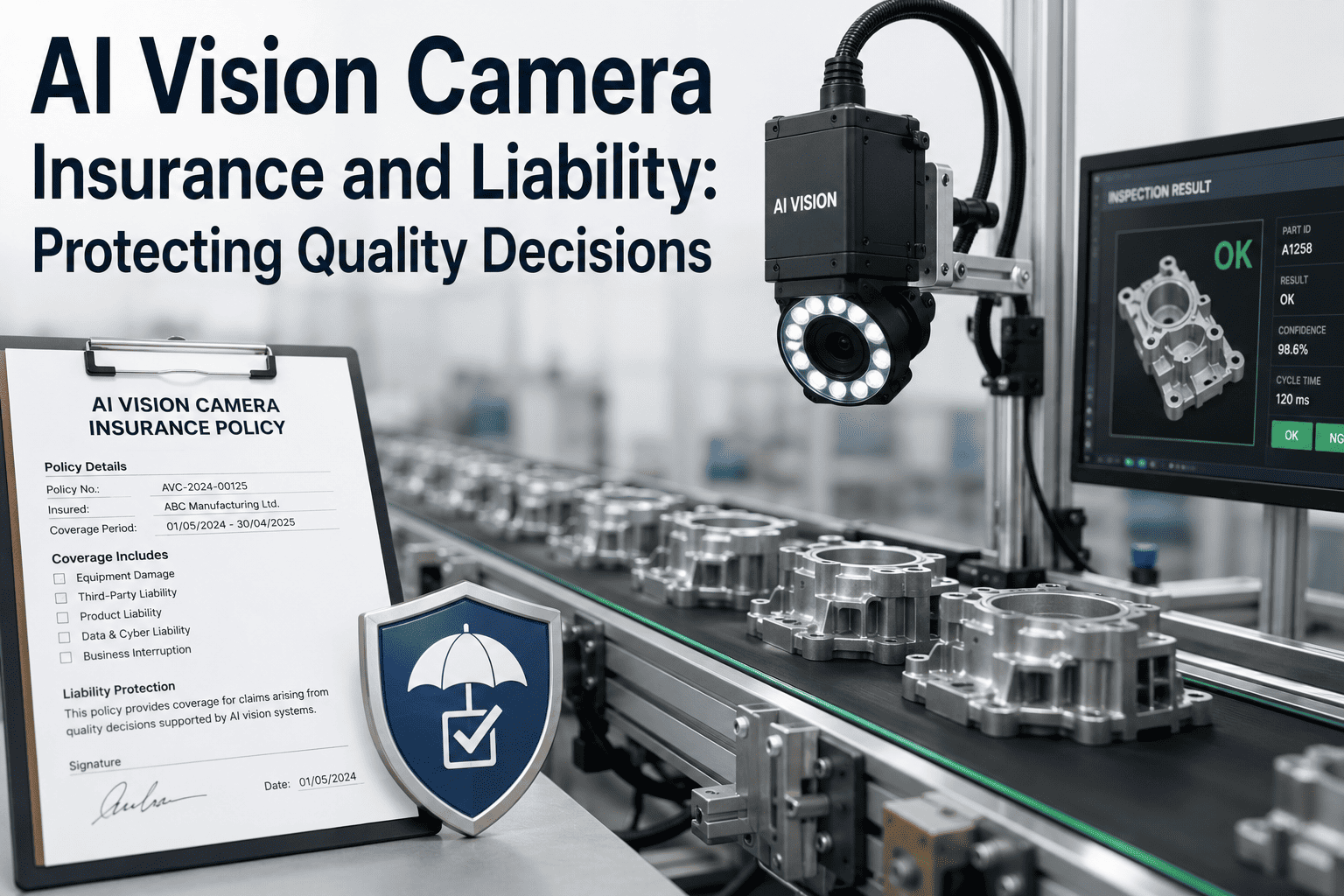
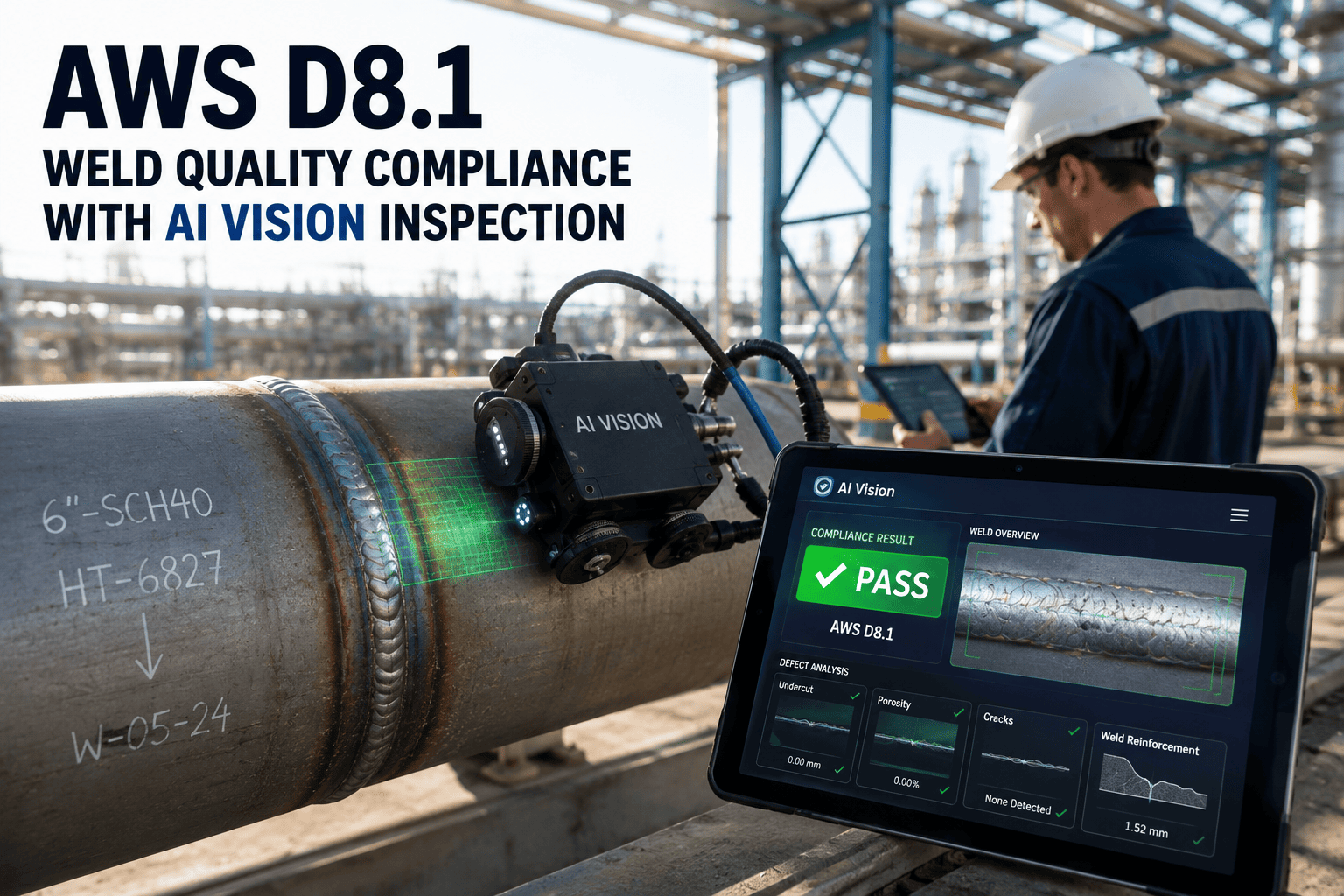
AI Vision Camera Insurance and Liability: Protecting Quality Decisions
By Johnson on August 6, 2026
When an AI vision system approves a part that a human inspector would have flagged, and that part later causes a field failure, the question that follows is not whether the model was well-trained. The question is who is legally responsible for the decision, whether the system's decision-making was validated to a defensible standard, and whether the documentation exists to show a court, an insurer, or a regulator how the decision was made. Manufacturers deploying AI inspection are quietly inheriting a set of liability and insurance obligations that traditional visual inspection never carried, and the plants that treat this as a documentation and validation problem — not just a technology problem — are the ones best positioned when a claim eventually arrives. iFactory's deployment engineering team works with quality and legal leaders on exactly this documentation layer.
Business Case · Product Liability & AI Governance
AI Vision Camera Insurance and Liability: Protecting Quality Decisions
When AI replaces human inspectors, liability doesn't disappear — it shifts, and it lands wherever the documentation trail is thinnest. Product liability, validation obligations, and insurance treatment of automated inspection decisions are the emerging governance questions every manufacturer deploying AI vision needs an answer to before a claim forces the answer for them.
Who is responsible when an AI-approved part fails downstream
02
System Validation
Proving the inspection model was fit for purpose and stayed that way
03
Insurance Treatment
How underwriters read AI-based quality decisions on your policy
The Liability Shift
Automation Doesn't Remove Liability — It Relocates It
Manual visual inspection has a well-understood liability structure built up over decades of product liability case law. A trained inspector applies documented criteria, signs off on the part, and the manufacturer's responsibility is bounded by the inspector's diligence, the training program that qualified them, and the documented procedure they were following. When something goes wrong, the investigation follows a familiar trail: the qualification record, the inspection log, the calibration status of the tools used, and the auditable procedure that governed the decision.
AI vision changes the shape of that trail without necessarily reducing the total obligation. The system still makes the accept-or-reject decision, but now the "training program" is a dataset the model was trained on, the "qualification record" is a validation run showing the model met specified performance criteria, and the "inspection log" is a database of images, decisions, and confidence scores linked to each part. Every element of the traditional liability trail has an equivalent in an AI-based system, but the equivalents look nothing like what the traditional trail looked like — which is why plants that lift-and-shift their old documentation practices into an AI deployment often discover, at the worst possible moment, that they've documented the wrong things.
The manufacturer remains the party a plaintiff, an insurer, or a regulator will typically pursue. The vision vendor is a supplier of a system, and unless a specific fault in the vendor's software or hardware can be isolated as the direct cause, product liability generally travels with the manufacturer who deployed the system to make quality decisions on their product. Understanding this before a claim arrives, rather than after, is the difference between a defensible position and an expensive one.
How the Trail Actually Changes
Manual Inspection Trail vs AI Inspection Trail
Both trails end at the same place — a per-part decision record — but the artifacts required to defend that decision look fundamentally different on the two sides. A shop that treats AI inspection documentation as a copy of its manual inspection paperwork will produce records that neither an insurance underwriter nor a defense attorney can use, because the questions being asked of the two systems are not the same questions.
The Four Risk Categories
Where AI Inspection Liability Actually Sits
Liability exposure from AI vision deployments concentrates in a small number of categories, and understanding which category a specific risk falls into is what makes it manageable. Treating everything as one undifferentiated "AI risk" produces governance that costs a lot and protects against nothing in particular. Separating the risks by category is the first step toward controls that actually match the exposure.
Category A
Missed Defect Liability
The AI system approves a part that a properly-trained inspector would have rejected, and the defective part causes a downstream failure. This is the classic product liability exposure and travels with the manufacturer. The defense depends on being able to show the system met documented validation criteria and continued to meet them at the time of the decision.
Category B
Model Drift Liability
The system worked at deployment but degraded silently over time as product mix, lighting, or camera position changed. If drift was detectable in the data and no monitoring was in place to catch it, the exposure grows because the manufacturer had a reasonable opportunity to detect the degradation and did not act on it.
Category C
Documentation Gap Liability
A defective part shipped, but the inspection record cannot be produced, is incomplete, or cannot be tied to the specific model version and validation state that was active at the time. Even if the system was performing correctly, the inability to prove it converts a defensible position into an indefensible one during litigation or an audit.
Category D
Delegation of Responsibility
A quality decision was delegated to the AI system in an area where the applicable regulation, standard, or contract required human sign-off. The exposure here is not that the AI made a wrong decision — it's that the manufacturer let the AI make a decision it was not permitted to make on its own.
Build the Trail Before You Need It
A Defensible AI Quality Program Is Built at Deployment, Not After a Claim
iFactory's platform is designed so every inspection decision is logged with the image, the model version, the confidence score, and the validation state that was active at the time. That's the record an underwriter, an auditor, or a defense counsel actually needs — and the record most improvised deployments never produced.
What "Validated" Actually Means for an AI Inspection System
Validation in a regulated manufacturing context means demonstrating, with documented evidence, that a system consistently does what it's supposed to do within specified performance bounds. For AI vision, that translates into a small number of concrete requirements that a serious governance program has to meet — and that a lightweight deployment usually skips entirely until an audit or claim forces the conversation.
V1
Defined Performance Criteria
The system's expected performance is specified in numeric terms before deployment — sensitivity to defect classes, false accept rate, false reject rate — with the acceptance thresholds tied back to the quality risk each metric governs. Without this, there's nothing to validate against.
V2
Documented Validation Dataset
A held-out dataset representative of production conditions is used to measure the model's performance against the defined criteria. The dataset composition, source, labeling process, and any exclusions are documented so the validation can be reproduced by an independent party.
V3
Traceable Model Versioning
Every production decision is traceable to the specific model version that made it, and every model version has a linked validation record showing what performance it demonstrated before it was deployed. Untracked model updates are a documentation gap that undoes prior validation work.
V4
Ongoing Performance Monitoring
Validation is not a one-time event. The system's actual production performance is monitored against the validation baseline, and drift beyond defined thresholds triggers documented review. A system that was validated two years ago and hasn't been checked since is validated in name only.
V5
Change Control
Any change that could affect inspection performance — camera repositioning, lighting adjustment, product introduction, model retraining — triggers a documented re-validation before the change goes live on production. Uncontrolled changes are the single largest source of silent performance degradation.
V6
Human Oversight Boundaries
The scope of decisions the AI is authorized to make autonomously, and the scope requiring human review, is documented and enforced by the system itself rather than left to informal practice. Low-confidence decisions and high-risk defect classes are routed to human review by policy, not by hope.
Insurance Treatment
How Underwriters Actually Read AI Inspection Deployments
Product liability insurance underwriting has started catching up with automated quality decisions, and the questions coming from carriers are increasingly specific to how AI is being used and governed. A shop that can answer these questions cleanly typically sees better terms than one that treats AI inspection as an internal technology choice with no insurance implications — because to the underwriter, it isn't just a technology choice, it's a change in how quality decisions get made on covered products.
Question Underwriters Ask
What They're Really Assessing
Is the AI system validated against documented performance criteria?
Whether you can show the system was fit for purpose before it started making decisions on your product.
How is model performance monitored in production?
Whether silent degradation would be detected before it caused escaped defects at scale.
Are inspection decisions logged with model version and confidence score?
Whether the decision trail is reconstructable months or years after a part shipped.
What percentage of decisions involve human review?
Whether high-risk or low-confidence decisions still see qualified human judgment.
How are changes to the model or camera setup controlled?
Whether uncontrolled changes could invalidate the system's validated state without notice.
Is the vendor's software liability position documented in contract?
Whether subrogation against the vendor is meaningfully available if a fault is traceable to their system.
How long are inspection records retained?
Whether records will still be available when a warranty claim or lawsuit is filed years after production.
A quality program that can produce clean answers to these questions is often in a stronger insurance position than it was with purely manual inspection, because the AI system generates a far more complete record than a human inspector's log ever did. The exposure isn't in using AI — it's in using AI without the governance layer that turns the technology's decision records into defensible legal artifacts.
The Claim Timeline
What Happens When a Claim Actually Arrives
The moment liability documentation gets tested is the moment a claim arrives, which is usually months or years after the part in question was produced. The timeline that unfolds from that point is remarkably consistent across cases, and understanding it shapes what documentation you need to have in place before the claim ever appears.
T + 0
Notice of Claim
A customer reports a field failure, or a regulator opens an inquiry, or a warranty investigation escalates. The clock starts on being able to produce a defensible record of how the specific part was inspected.
T + 2 weeks
Records Request
Insurance carrier, opposing counsel, or regulatory investigator asks for the inspection record on the specific serial number. This is where documentation gaps first surface publicly. If the record cannot be produced quickly and completely, the defensive posture collapses early.
T + 1 month
Validation Trail Review
Attention shifts from the individual part to the system that made the decision. Was the model validated? To what criteria? When was validation last refreshed? Was the model version that made this decision the same one that had been validated?
T + 3 months
Change and Drift Review
Investigation examines whether anything changed between validation and the decision date — camera position, lighting, product mix, model retraining — and whether those changes were documented and re-validated. Uncontrolled change history is where most cases start to turn.
T + 6+ months
Settlement or Litigation
The strength of the documentation trail determines whether settlement negotiations start from a defensible position or from acknowledged exposure. Cases with complete records typically settle faster and lower; cases with gaps settle slower and higher, or proceed to litigation with unfavorable odds.
Governance Checklist
The Documentation Layer Every AI Vision Deployment Needs
The controls that separate a defensible AI inspection program from a risky one are not exotic — they are a small number of specific documentation practices applied consistently. This checklist is what a mature program looks like when reduced to its essential elements.
Written Validation Protocol
A document that specifies the performance criteria, validation dataset, acceptance thresholds, and re-validation triggers before the system goes live. Approved by quality leadership and referenced in the quality system.
Per-Decision Record
Every inspection decision written to a database with part identifier, image, model version, confidence score, timestamp, and station identifier. Retention period aligned with product liability exposure horizon, not just internal preference.
Model Version Registry
A tracked history of every model version deployed to production, its training data, its validation results, and the dates it was active. Every decision record points to a specific entry in this registry.
Drift Monitoring Report
Automated comparison of production performance against the validation baseline, with defined thresholds that trigger documented review. Signed off on a defined cadence rather than only when someone remembers to look.
Change Control Log
Every change that could affect inspection performance recorded, categorized by impact level, and linked to the re-validation performed before the change went live. Uncontrolled changes are documented as such and treated as exposure.
Human Review Log
Documentation of which decisions were escalated to human review, who performed the review, and what the outcome was. Demonstrates the system operates within the boundary the governance policy defined.
Vendor Contract Position
Contract terms with the vision system vendor documenting the vendor's warranties, liability limits, and the scope of their responsibility for defects in their software or hardware. Reviewed by legal against the manufacturer's product liability posture.
Insurance Disclosure Package
A compiled overview of how AI inspection is deployed and governed, prepared for underwriting conversations at renewal or when adding a new AI-inspected product line. Transparent upfront disclosure typically produces better terms than surprise discovery during a claim.
Documentation Isn't Overhead — It's the Product
Turn Your AI Inspection Records Into Legal-Grade Artifacts
iFactory's platform produces per-part decision records, model version registries, and drift monitoring reports that meet the documentation bar an underwriter or defense counsel will actually work with. The governance layer is built into the platform, not bolted on after a claim.
The pattern I've watched play out on liability matters for automated inspection is almost always the same. The technology worked well enough in production that leadership stopped asking hard questions about it. When a claim finally landed, the plant could produce inspection results but couldn't produce the model version that made them, the validation state at the time the decision was recorded, or a change history that explained what had shifted since deployment. That gap alone converts a case that should have settled cleanly into a case where the defense has to admit the record isn't reconstructable. What actually protects a manufacturer isn't the AI system being smarter than a human inspector — that's usually not even the disputed question. It's the ability to produce a defensible record of how a specific decision was made on a specific part, months or years after the fact. The plants that build that documentation layer into the deployment from day one almost never end up in the difficult conversations. The ones that leave it for later almost always do.
Isabella Chen-Whitfield
Product Liability Counsel · 19 years advising manufacturers on quality system litigation and industrial automation risk
Common Questions
Frequently Asked Questions
Does deploying AI vision transfer product liability to the vendor?
Generally, no — product liability travels with the manufacturer of the finished product, not with the supplier of a component used to inspect it. The vision vendor is typically supplying a system that the manufacturer chose to deploy in a quality decision role, and unless a specific fault in the vendor's software or hardware can be isolated as the direct proximate cause of the defect that harmed the plaintiff, the exposure sits with the manufacturer. Contract terms with the vendor should still document warranties and liability limits, but the practical planning assumption is that the manufacturer remains the party the claim will pursue. Talk to deployment engineering about how iFactory's documentation model supports that planning assumption.
How long should AI inspection decision records be retained?
The retention period should be tied to the product liability exposure horizon for the product being inspected, not to internal storage convenience. Consumer products often see claims filed years after purchase; industrial equipment can see claims filed decades after installation. The practical minimum is the statute of limitations for product liability in the relevant jurisdictions plus a buffer, and the practical maximum is whatever your legal counsel identifies as the outer edge of realistic claim exposure. Under-retaining is a documentation gap that surfaces at exactly the wrong moment, so retention decisions should be made with legal input rather than IT budget input.
Do we need human review on every AI-flagged decision?
No — but you do need a documented policy that specifies which decisions require human review and which the AI is authorized to make autonomously, and the system needs to enforce that policy rather than leave it to informal practice. Low-confidence decisions, safety-critical defect classes, and any decision category where the applicable standard requires human sign-off should be routed to human review by design. Routine decisions on well-characterized defect classes with strong model confidence can typically be made autonomously if the validation and monitoring documentation supports that scope. Book a demo to see how this policy layer is implemented.
Will using AI inspection increase or decrease our insurance premiums?
It depends almost entirely on how the deployment is governed and documented. A well-governed AI inspection program often produces better documentation than manual inspection ever did — 100% inspection coverage, per-part image records, timestamped decisions with confidence scores — and underwriters have started recognizing that as a favorable risk profile. A poorly-governed deployment with no validation trail and no drift monitoring can raise questions that increase premiums or restrict coverage terms. The technology itself is neutral; the governance layer is what shifts the underwriting conversation in either direction.
What's the biggest liability mistake plants make when deploying AI vision?
Treating AI vision as an operational improvement project without also treating it as a quality system change that requires updated validation, documentation, and change control procedures. The technology gets installed, the operators get trained, the accuracy metrics look good — and the underlying documentation practices continue running on the assumptions that were built for a manual inspection process. When a claim eventually arrives, the plant discovers that its inspection records exist but its validation trail, model versioning, and drift monitoring do not, and the case has to be defended on a documentation posture that was never designed for automated decisions. The fix is straightforward but only if it's built in at deployment, not retrofitted after the fact.
Governance, Not Just Technology
See How iFactory's Platform Produces Legal-Grade Inspection Records
AI vision without a defensible documentation layer is a liability risk waiting to be tested. iFactory's platform is built so per-part decisions, model versions, validation states, and drift monitoring all live in a coherent record that stands up to an underwriting review, a regulatory audit, or a product liability claim.