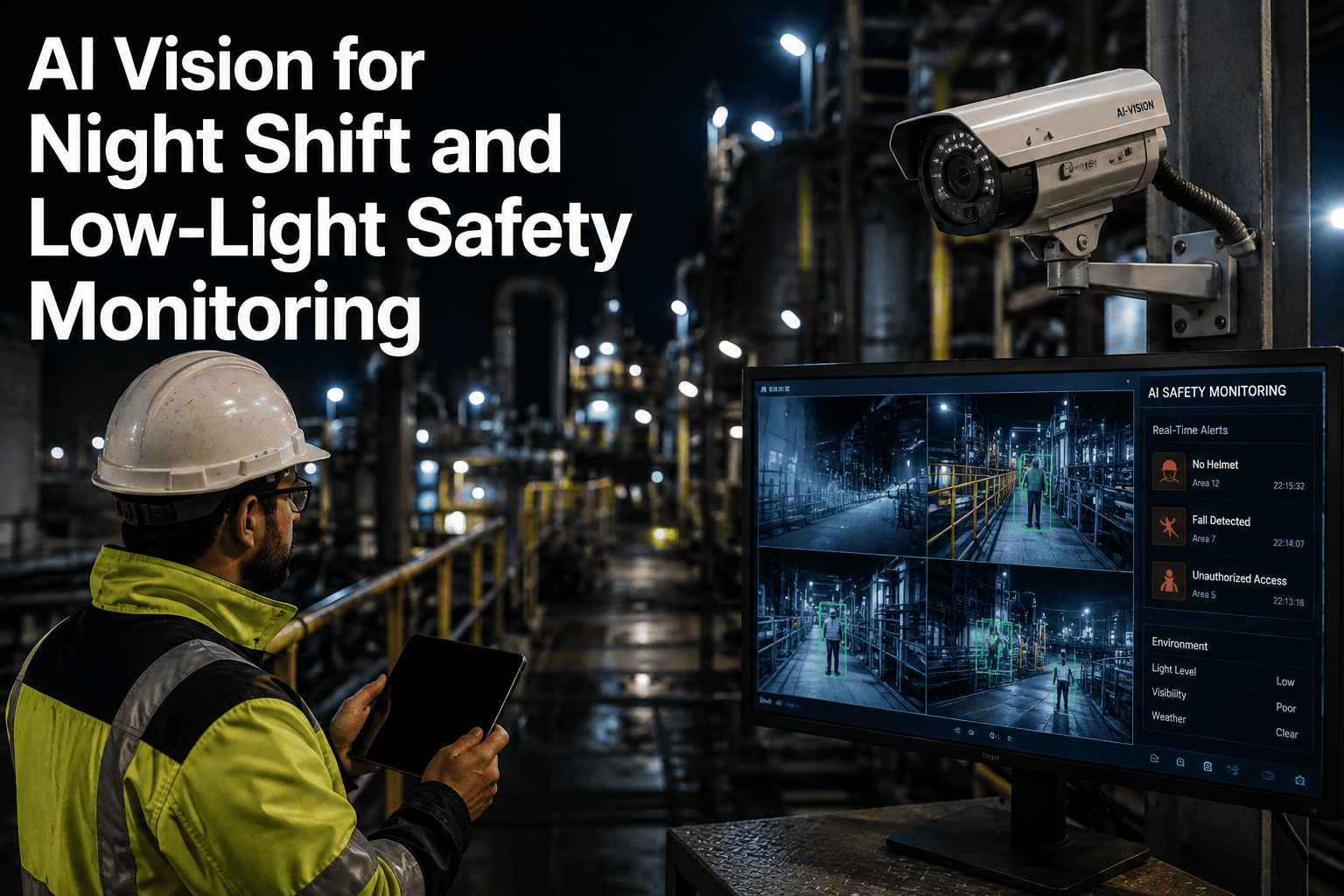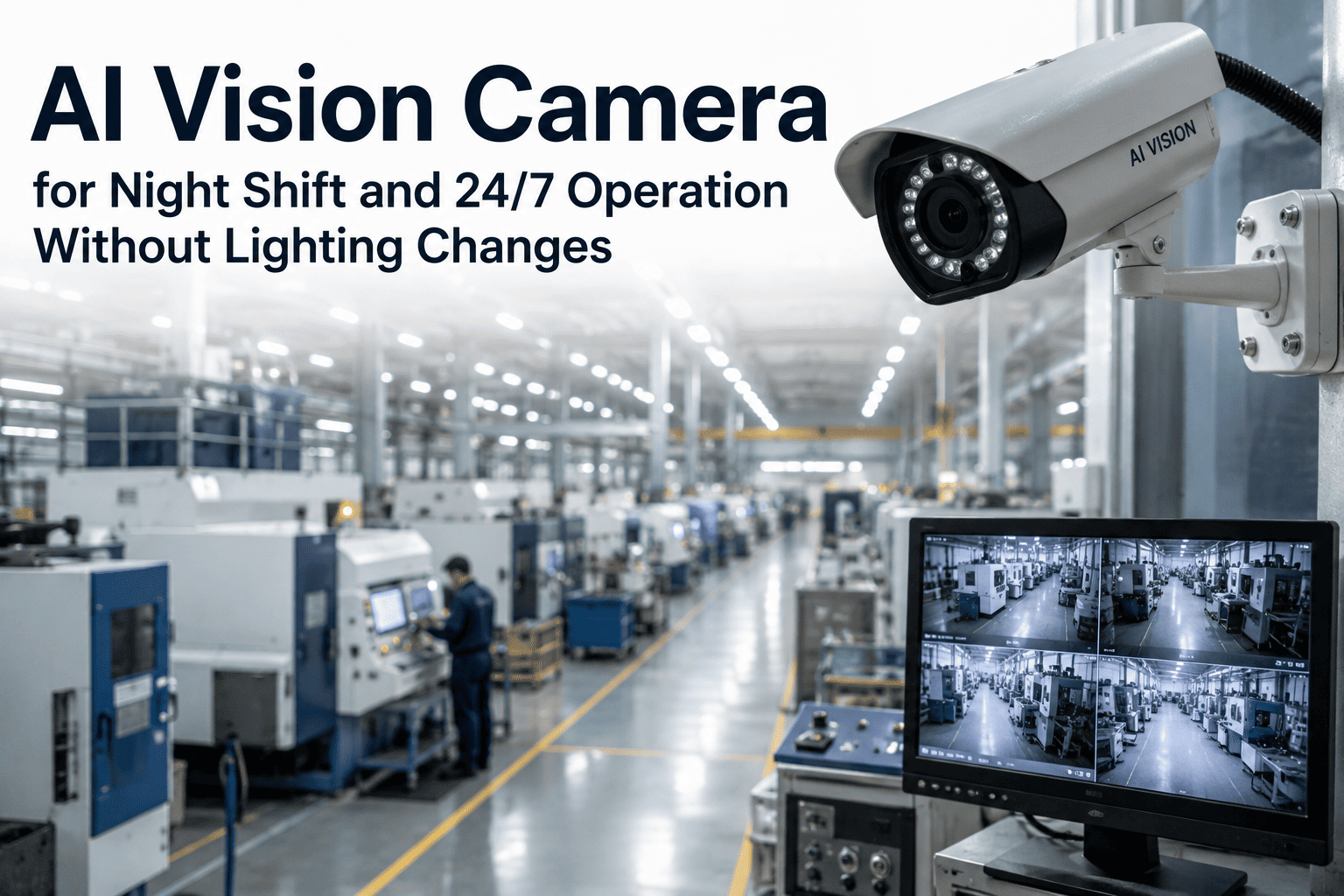
Ask any experienced vision-systems engineer where inspection accuracy actually breaks down, and the answer is rarely the camera or the algorithm — it is the light. Overhead LEDs get swapped out and the color temperature shifts three hundred kelvin. A skylight lets sunlight sweep across the inspection station at 3pm every summer afternoon. An operator flicks on a task lamp for a manual station two meters away and the AI model that was 99 percent accurate on the day shift starts flagging false positives on nights. Controlled-lighting enclosed inspection stations exist to remove all of that variability from the inspection loop — to give the AI model the same photons on the fabric or part at 3am Sunday as it saw at 10am Tuesday when the model was trained. Teams designing round-the-clock inspection can Book a Demo to see how iFactory deploys enclosed inspection stations that hold accuracy constant across shifts, seasons, and facility lighting changes.
Why Ambient Light Is the Silent Killer of AI Inspection Accuracy
An AI vision model is trained on a specific distribution of images. Every training image was captured under some lighting condition — a specific intensity, color temperature, angle, and directionality of illumination striking the part. The model learns to associate visual features with defect classes under that distribution, and its accuracy is highest when the images it sees in production match the distribution it was trained on. When production lighting shifts even slightly, the model starts seeing images outside its trained distribution, and accuracy degrades in ways that are difficult to notice from a monitoring dashboard because the model still returns high-confidence outputs — they are just wrong more often.
The three most common ambient light sources that push production images outside the training distribution are overhead facility lighting, sunlight through skylights or windows, and task lighting from adjacent workstations. Each behaves differently and each requires a different mitigation approach. Overhead lighting shifts when maintenance replaces old fluorescent fixtures with new LEDs of a different color temperature. Sunlight shifts on the hour, on the season, and on the weather. Task lighting from adjacent stations shifts every time an operator adjusts a lamp or turns one on that was off. Systems that do not architecturally isolate the inspection from these three sources are running a performance experiment they did not sign up for, every hour of every shift.
The Ambient Light Threat Map: What Actually Reaches Your Camera
Before designing the mitigation, it helps to name the enemies. The four ambient light sources below are what industrial vision engineers most commonly find contaminating inspection accuracy on production floors — each with distinct behavior, distinct threat profile, and distinct mitigation strategy. A system designed against one source but not the others gets caught out the moment the un-mitigated source drifts, which is almost always why a system that "worked in commissioning" starts throwing false positives in production.
The Three Mitigation Methods: Which One Fits Your Inspection
Vision engineering has converged on three methods for dealing with ambient light, and every production deployment uses one of them or a combination. The three methods have different cost profiles, different physical footprint requirements, and different suitability to different inspection types. Understanding which method fits a specific inspection determines the entire station architecture — and choosing the wrong method for the inspection is the single most common reason vision deployments that looked good in commissioning start drifting in production.
A practical rule for method selection is to start from the inspection first, not the technology first. If the part can move through a defined station on a conveyor and the physical layout allows a box around that station, physical enclosure is almost always the right primary method — it removes ambient light as a variable rather than compensating for it, which is the most durable engineering approach. If the part is too large for enclosure, or the inspection point is mid-line where a shroud would interfere with mechanical flow, high-power strobing becomes the primary method with pass filters added as a complementary layer. The mistake most first-time deployments make is skipping this method-selection step and defaulting to whatever the vision vendor happens to recommend, which produces stations that work for the vendor's typical use case but not necessarily for the specific inspection the mill actually needs to run.
A physical enclosure around the inspection station blocks ambient light from reaching the camera or the part. Inside the enclosure, controlled LED illumination provides all the light the camera sees. The lighting stays constant regardless of anything happening outside — factory lights on or off, sunlight streaming or blocked, adjacent stations bright or dark. This approach is the most effective way to eliminate ambient contamination and supports true day-and-night, seasonal consistency in inspection accuracy.
Overpowering works by pulsing high-intensity light on the part synchronized with camera exposure, and using a very short exposure window. The camera captures during the brief window when the vision-system light is dominant, and the ambient light contribution during that microsecond exposure is too weak to register meaningfully. This approach works without a physical enclosure but requires precise timing coordination between light and camera, and higher-power light sources than continuous illumination would need.
Pass filters attached to the camera lens allow only a specific wavelength band to reach the sensor. When paired with a monochromatic light source at that wavelength, the camera sees the vision-system light strongly and other wavelengths (including most ambient contribution) weakly. Filters can reduce sunlight and mercury-vapor contribution by factors of four or more, and fluorescent contribution by factors of thirty-plus, depending on the filter and source combination.
Inside an Enclosed Inspection Station: The Six-Layer Architecture
A properly designed enclosed inspection station is not just a box with a camera in it. It is a six-layer system where each layer does specific work to hold the imaging condition constant. Skipping any layer — most commonly the thermal management or the reference standard — creates the drift that shows up weeks after commissioning, once the physical environment has cycled through its normal variation. The architecture below reflects what production-grade stations actually include, and what to look for when evaluating vision suppliers on inspection stability rather than just first-day accuracy.
The layers work as a system. Removing any one layer degrades the effectiveness of the others: a station with excellent illumination but no thermal management drifts as LED junction temperature varies; a station with good enclosure but auto-adjusting exposure defeats the purpose of controlled lighting by letting the camera compensate for variation that should not exist in the first place; a station without a reference standard has no way to detect any of these drifts until they show up as accuracy problems on production parts. The full-stack approach is what separates commissioning-day accuracy from twelve-month sustained accuracy, and it is the specification detail that matters most when comparing vision proposals from different suppliers.
The 24/7 Accuracy Comparison: What Changes Between Shifts
The clearest test of whether an inspection station is truly lighting-independent is running the same parts through it at different times of day and comparing the accuracy metrics. The comparison below shows what typically happens on a properly enclosed station versus an open-station deployment relying on ambient light or partially-controlled task lighting. The pattern is consistent across industries: enclosed stations hold within tight accuracy bands across the 24-hour cycle, while open stations show accuracy drift correlating tightly with shift, weather, and season.
The comparison is not about which technology is more sophisticated — it is about which architectural choice removes the largest source of production accuracy drift. Enclosed stations trade a modest amount of physical footprint and up-front engineering for the ability to run the same model against the same lighting conditions across every shift, every season, every year, without retraining and without the mysterious accuracy drops that erode operator and quality-team confidence in the system.
A Concrete Scenario: The Model That Worked Until October
The clearest way to understand why controlled lighting matters is to walk through a scenario that happens in different forms on production floors every year. A precision-machined component supplier commissions an AI vision inspection station in July, running an open architecture with vision-system illumination but relying on facility lighting to fill in the ambient contribution. The commissioning validation runs beautifully — 99.2 percent accuracy across the validation set, false-positive rate under 1 percent, quality team signs off, station goes live on the production floor.
Through July, August, and September the station holds accuracy. In early October, the false-positive rate starts creeping up — 1.3 percent one week, 1.7 percent the next, 2.4 percent by the end of the month. Quality investigates, suspects the model has drifted somehow, plans a retraining cycle. In parallel, a shift supervisor notices that afternoon inspections show more elevated false positives than morning inspections, and mentions this off-hand in a standup. A vision engineer investigates and finds the cause: the days have gotten shorter, the sun angle through the facility skylights has shifted, and every clear afternoon the station now sees a beam of direct sunlight during the 2pm to 4pm window that was not present during summer commissioning.
The fix is a physical shroud around the imaging volume — the same fix that would have been designed in from day one under a controlled-lighting architecture. Installing the shroud takes an afternoon of downtime, the false-positive rate returns to baseline, and the station holds accuracy through winter. But the lesson is not about the shroud itself — it is about the architectural choice. The team that spent three months investigating "model drift" was investigating something that was never the model's fault. The lighting was drifting, the images were drifting, and the model was doing exactly what a well-trained model does when given images outside its training distribution. Enclosed stations do not have this problem because the images do not drift, so the model does not appear to.