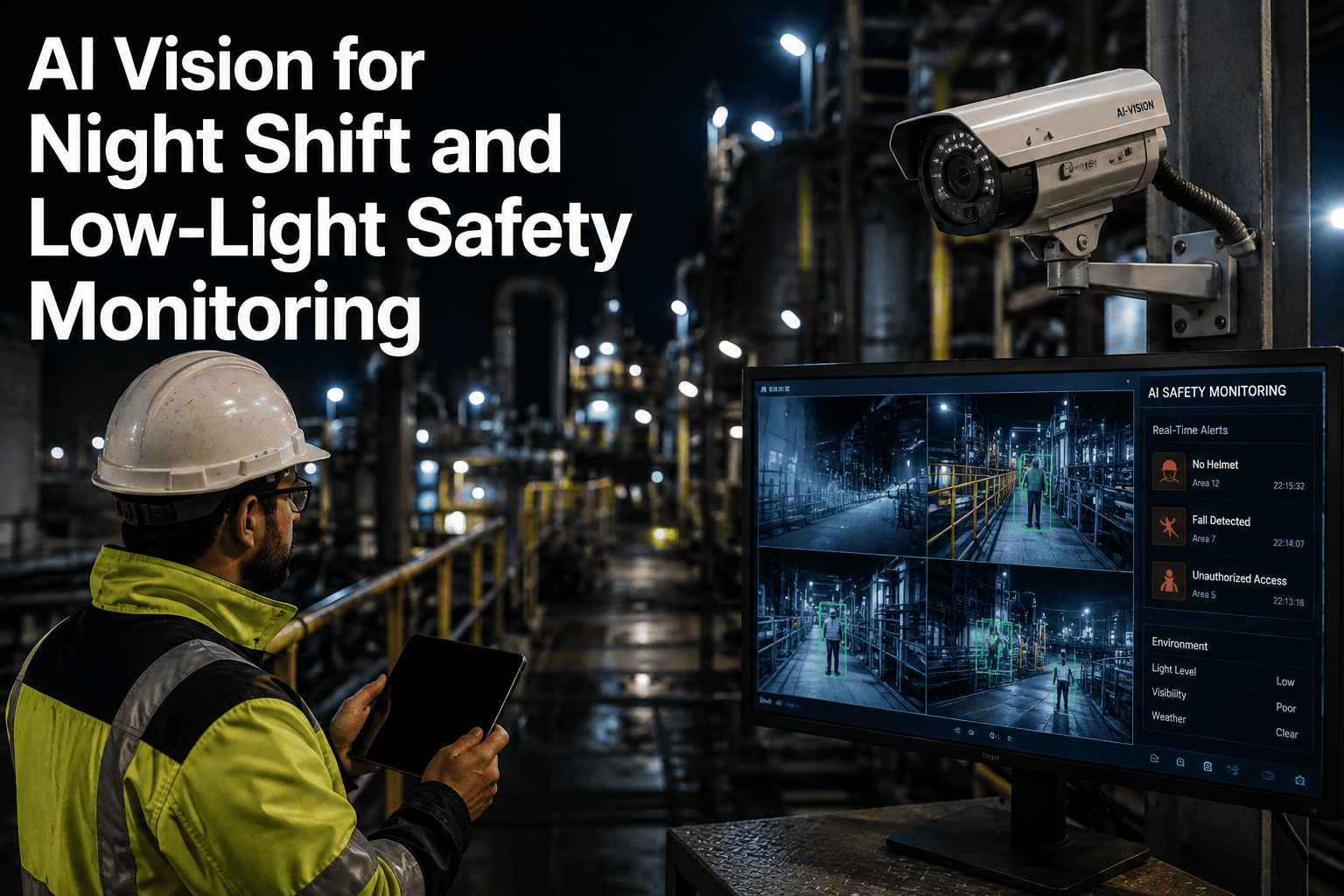
Every safety system built around visible light quietly stops working the moment the sun goes down, and that is precisely when the risk goes up. Federal workplace safety data shows accident and injury rates run meaningfully higher on night shifts than on day shifts, driven by fatigue, reduced alertness, and worse visibility all compounding at once. A camera-based safety system that depends on good lighting is a daytime tool wearing a 24/7 label. AI vision paired with infrared illumination closes that gap, giving night crews, outdoor yards, and dim work areas the same detection coverage as a well-lit day shift floor. If your safety monitoring quietly gets weaker after dark, book a demo to see IR-based detection running in near-total darkness.
Your Safety Cameras Should Not Get Worse the Moment It Gets Dark
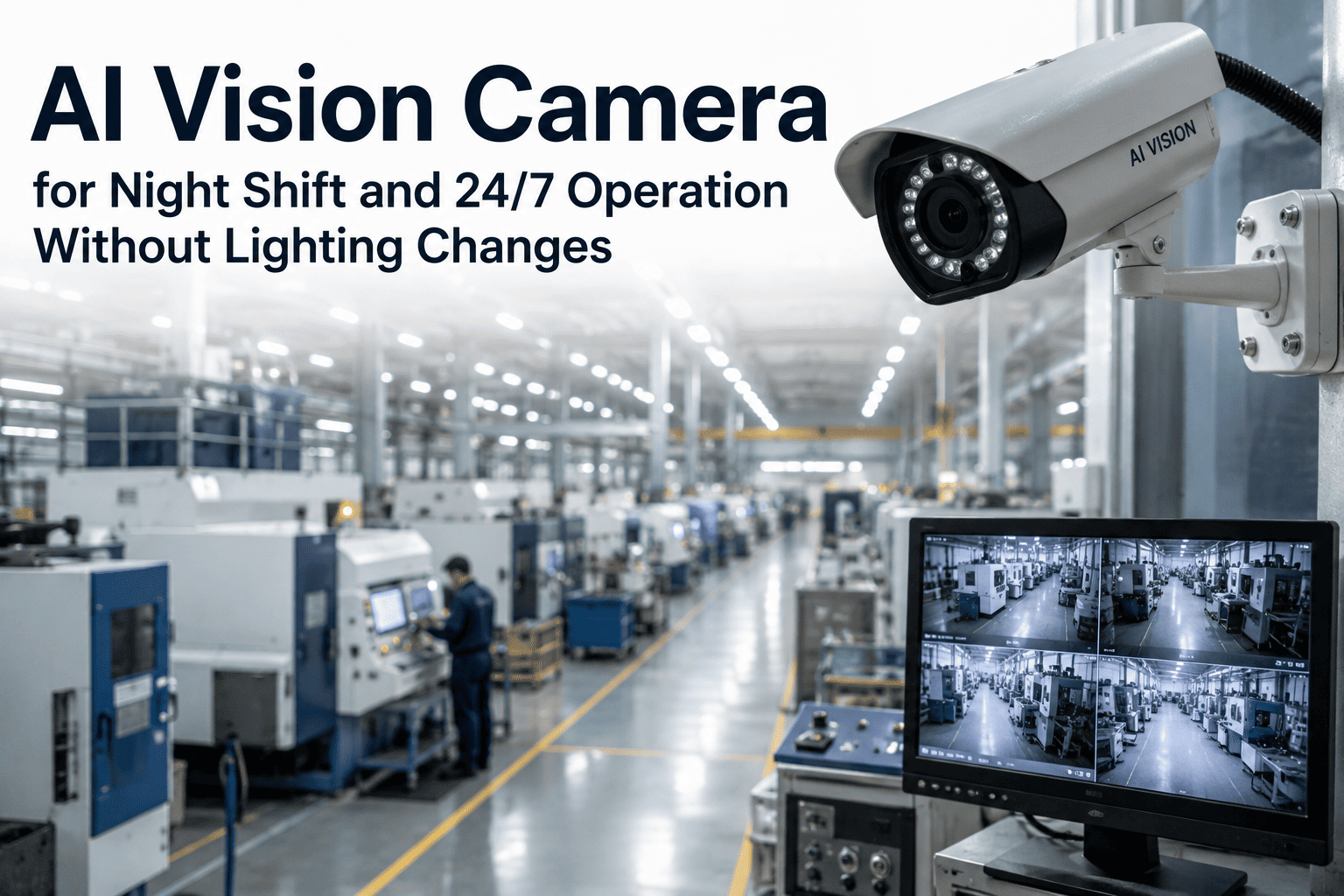
AI cameras with infrared illumination maintain full detection accuracy for PPE compliance, restricted zones, and hazard recognition through night shifts, unlit yards, and low-visibility conditions, closing the exact window when injury risk is highest.
The Data Is Not Ambiguous — Night Shift Is Simply More Dangerous
This is not a marginal statistical difference. OSHA's own published guidance on worker fatigue states that accident and injury rates run eighteen percent higher during evening shifts and thirty percent higher during night shifts compared to standard day shifts. That gap is driven by a combination of factors that all point the same direction: reduced circadian alertness, disrupted sleep patterns among night-shift workers, and, critically, the physical reality that many industrial environments were designed and lit with daytime operations in mind.
Fatigue is only part of the story. A worker who is tired but working in a well-lit, fully monitored environment is still in a better position than one who is alert but working in a poorly lit yard where a camera system simply cannot see what is happening. Visibility and alertness compound each other, and a monitoring system that loses effectiveness after dark is removing one of the few controls that could offset the elevated risk night shift already carries.
The honest conclusion is that night shift needs more monitoring capability than day shift, not the same amount, and it is currently getting less because most vision systems were never built to function without visible light in the first place.
Understanding the Difference Between IR Illumination and Thermal Imaging
These two technologies get confused constantly, and the confusion leads mills and plants to buy the wrong tool. They solve different problems, and a serious night monitoring strategy usually needs to understand both rather than treating "infrared" as one single feature to check off.
Near-Infrared Cameras
These cameras project near-infrared light, invisible to the human eye, and capture the reflected signal to build a detailed, recognizable image — the same way a standard camera works, just using a light source people cannot see. This is what allows AI models trained on visible-light footage to keep recognizing PPE, body posture, and restricted zone boundaries in the dark, because the resulting image still looks structurally like a normal photograph.
Thermal Cameras
Thermal cameras work completely differently, detecting the heat radiated by objects and people rather than reflected light, which means they function in total darkness, smoke, and fog. They excel at spotting a warm body or an overheating machine component, but they do not produce the kind of detailed image needed to confirm whether someone is wearing a hard hat or high-visibility vest.
Most effective night monitoring deployments combine the two. Near-infrared illumination handles the detailed recognition tasks — PPE compliance, restricted zone entry, unsafe posture or behavior — while thermal sensing adds a layer for detecting a person or hot equipment even where NIR illumination does not reach, or through obscurants like dust and light fog that a standard camera struggles with regardless of lighting.
The Same Safety Checks, Running at the Same Standard, All Night
The goal of IR-based AI vision is not a different, lesser version of daytime monitoring. It is the same detection logic, running against a properly illuminated infrared image instead of a visible-light one, so the accuracy a plant expects during the day does not quietly degrade once the lights go down.
PPE Compliance
Hard hats, high-visibility vests, safety glasses, and gloves detected with the same confidence at 2 AM as at 2 PM, since near-infrared illumination provides the contrast and detail the detection model needs.
Restricted Zone Intrusion
Entry into machine guarding zones, forklift lanes, or confined spaces flagged in real time, closing the exact gap where reduced visibility and reduced staffing overlap most dangerously.
Fall and Unsafe Posture Detection
Person-down events, awkward falls, and unsafe lifting posture recognized without needing a worker to be under a light fixture to be seen clearly enough for the model to act.
Vehicle and Pedestrian Conflict
Forklifts, trucks, and pedestrians tracked in yards and loading areas that are frequently among the worst-lit parts of a facility, precisely where struck-by incidents are most likely to occur.
Equipment and Fire Risk Monitoring
Thermal sensing layered alongside IR-illuminated cameras catches overheating equipment or an emerging hot spot before it becomes a visible flame, functioning identically day or night.
Loitering and Unauthorized Presence
Presence in areas that should be empty during a night shift flagged immediately, supporting both safety and security objectives from the same camera infrastructure.
See What Your Cameras Are Actually Missing After Dark
Most plants have never directly compared their current night-shift detection accuracy against an IR-equipped alternative side by side. Bring footage from your lowest-lit zone and we will show you the difference in real time.
Where Detection Accuracy Typically Drops, Hour by Hour
Facility lighting is rarely uniform across a full day, and neither is worker alertness. Mapping the two against each other shows exactly where a plant's current camera coverage is weakest and where the elevated night-shift risk is highest, which is usually the same window.
IR-equipped AI vision is specifically valuable across the 10 PM to 6 AM window, because that is where visible-light camera performance and human alertness are both declining at the same time, with no natural compensating factor helping either one.
What Automated Detection Catches That a Tired Human Eye Might Not
This is the scenario that visible-light-only systems structurally cannot deliver reliably. In that same corner of the yard under standard camera coverage, detection confidence would have dropped along with the available light, right at the moment a real conflict was developing between a person and a moving vehicle.
What Goes Into an IR-Ready Camera Deployment
Retrofitting a plant for reliable night coverage is a more deliberate exercise than simply swapping camera models, since infrared performance depends on more than the sensor alone.
Illumination Range Mapping
Every camera location is assessed for effective IR illumination range and existing ambient light, since IR illuminators have finite reach and coverage gaps between fixtures need to be identified before installation, not after.
Model Validation in Low Light
Detection models are validated specifically against IR-illuminated footage from your site, since a model trained only on daylight images can behave differently against the different contrast profile infrared imaging produces.
Thermal Layering Where Needed
High struck-by risk zones like loading yards and vehicle lanes often warrant thermal sensing layered alongside NIR cameras, adding detection resilience through dust, light fog, and beyond illuminator range.
Alert Routing for Night Staffing Levels
Night shifts typically run leaner staffing, so alert routing is configured for the smaller on-shift team, ensuring a flagged event reaches someone who can respond rather than sitting in an unmonitored dashboard.
What Safety Teams Ask Before Adding Night Coverage
Give Your Night Shift the Same Protection as Your Day Shift
Night shift already carries thirty percent higher accident and injury risk before you factor in a single camera. Do not let reduced visibility compound a risk that is already elevated. See IR-based AI vision running against real low-light and after-dark footage from an environment like yours.