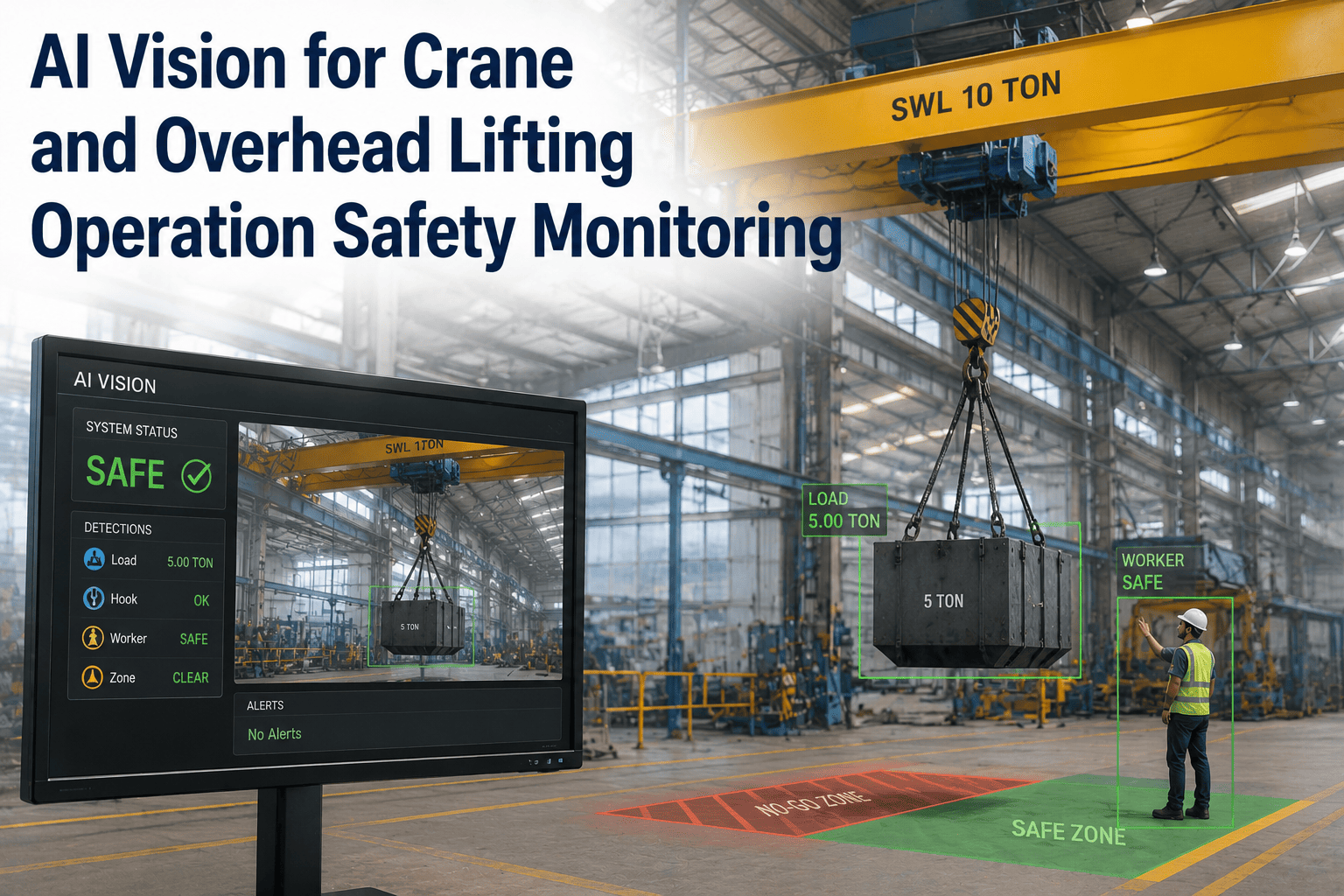
A ten-ton load moving through a plant bay is a problem of perception more than a problem of procedure — the operator running the crane cannot see every worker on the floor beneath the load, cannot judge closing distance to an adjacent crane by eye alone, and cannot verify from the cab that every sling has cleanly disengaged before the hook begins to lift away. The procedures written to control these hazards depend entirely on human vision holding up under noise, time pressure, and fatigue, which is exactly the assumption that fails when a struck-by incident happens. Vision at the load, not just at the cab, is what closes that perception gap — and iFactory places AI cameras where the operator's line of sight cannot reach so exclusion zones, rigging condition, and proximity are enforced by the system rather than by hope.
Environmental Safety · Crane and Overhead Lifting
AI Vision That Watches the Load, the Rigging, and Everyone Beneath It
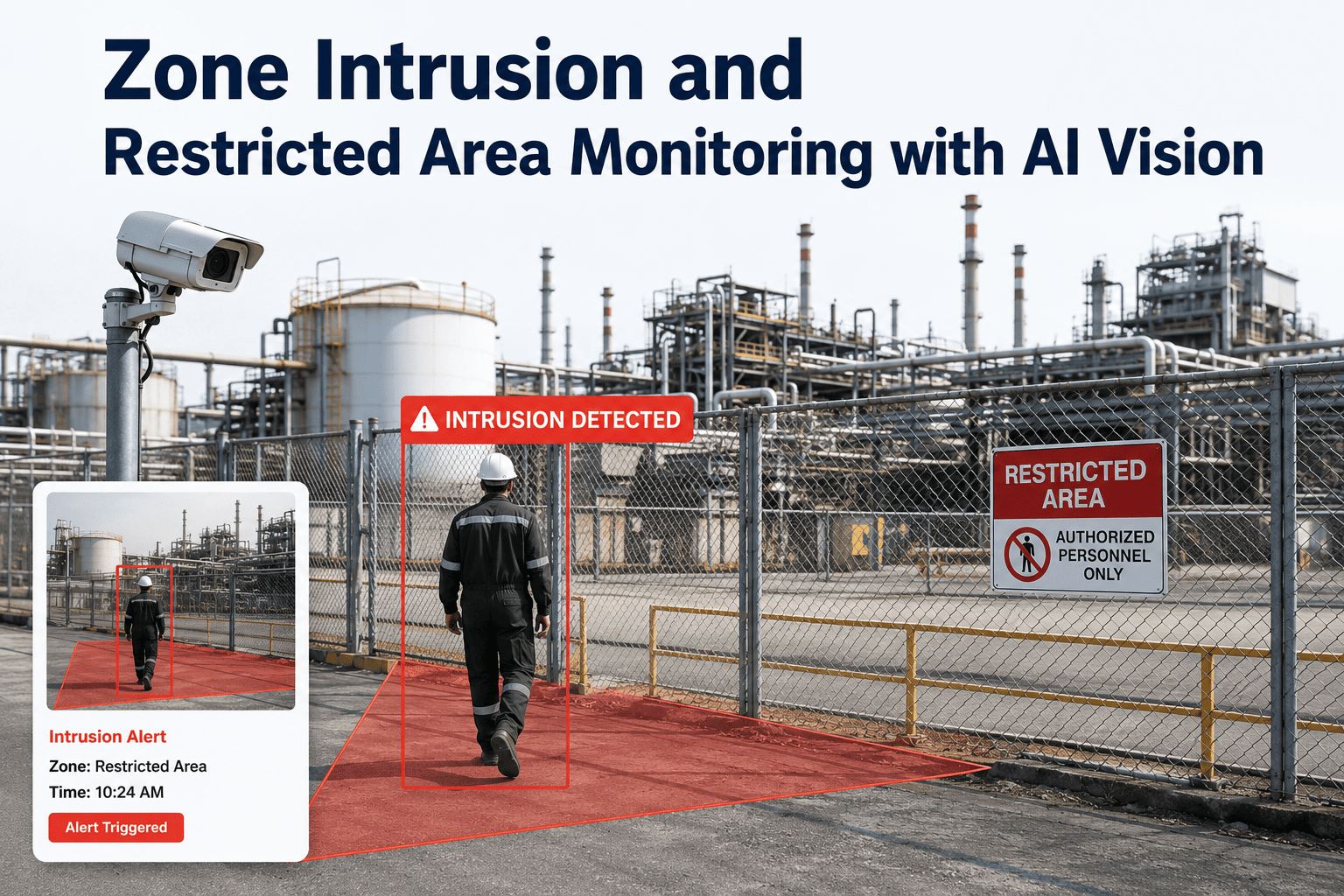
Cameras mounted on trolleys, bay perimeters, and lift areas continuously verify exclusion zones under suspended loads, monitor sling and hook condition, and detect personnel intrusion, triggering interlocks and alerts before struck-by incidents can occur.
The Struck-By Reality
What the Numbers Say About Lifting Fatalities
Crane and overhead lifting fatalities have not improved meaningfully in more than a decade despite significant investment in operator training, procedural controls, and physical barricades. The numbers below come from OSHA, the U.S. Bureau of Labor Statistics, and NIOSH data cited across current industry reporting, and they consistently point in the same direction — the majority of these deaths involve a worker being struck by a load, a hook, or a moving part of the crane itself, in scenarios where the operator either did not see the worker or the worker did not see the load coming.
42–44
Crane-related fatalities per year in the U.S.
BLS annual average, 2011–2017 baseline
52%
Fatal crane injuries from struck-by events
Worker struck by load, hook, boom, or equipment
46%
Serious injuries involving workers under loads
From analysis of 249 overhead crane incidents
97%
OSHA-investigated incidents deemed preventable
Across 319 investigations, preventable with controls
27%
Dropped loads from rigging failure
Leading specific cause of struck-by fatalities
45%
Fatalities in operator or rigger population
Split roughly equally between the two roles
Hazard Anatomy
Four Zones Around Every Lift Where Vision Has to Watch
Every crane lift creates a set of overlapping hazard zones, and each zone has its own dominant failure mode. The value of vision-based monitoring is not that it watches one zone especially well — it is that it watches all four simultaneously, tirelessly, and without the visual fatigue that degrades human spotters after the first two hours of a shift. The zones map to the incident data cleanly, which is why enforcement of these zones is where safety technology earns its keep.
Understanding this zone-by-zone breakdown also explains why single-point solutions like proximity beacons on workers or radar-based anti-collision on cranes address only a fraction of the actual hazard surface. A beacon on a worker helps with zone A but does nothing for zone C swing-radius crush risk to a worker who has no reason to be wearing a beacon on that day. A crane-mounted radar helps with zone D but cannot classify whether a shape in zone A is a worker, a stationary tool, or a piece of stored material. Camera-based classification with dedicated coverage per zone is what makes the enforcement complete rather than partial.
Zone A
Directly Beneath the Load
Failure mode: Falling load from rigging failure, dropped hook, sling slippage
The "fall zone" every safety program tries to keep clear is precisely the zone where struck-by fatalities cluster. Camera views tracking the load footprint and projecting it downward define the exclusion boundary that has to stay clear before the lift proceeds.
Zone B
Load Path Corridor
Failure mode: Load swing during travel, side-loading, sudden stop backlash
A load traveling across a bay does not stay perfectly vertical — it swings, drifts, and can slew unexpectedly during emergency stops. The corridor beneath and around the intended path has to be enforced as an exclusion zone for the duration of travel, not just at the pick and set points.
Zone C
Swing Radius and Counterweight Path
Failure mode: Crush between counterweight and fixed structure
On mobile and slewing cranes, the counterweight extending from the center pin can travel several meters and produces a crush hazard that is easy to underestimate because the load itself is nowhere near the worker. Vision-defined virtual barricades enforce this radius continuously.
Zone D
Adjacent Crane Interference
Failure mode: Crane-to-crane collision, boom fouling, load pendulum interaction
In multi-crane bays common in steel plants, warehouses, and shipyards, the interference zone between overlapping crane paths is a chronic collision risk. Vision-based proximity monitoring between crane positions supports anti-collision interlocks the crane's own encoders cannot fully provide.
From Procedure to Enforcement
The Exclusion Zone Under a Load Should Not Depend on Whether Anyone Is Looking
iFactory continuously monitors every hazard zone around a lift with dedicated AI cameras, triggering alerts, interlocks, and crane-slow signals the moment a worker enters an active exclusion boundary.
Capability Layers
What the Vision System Actually Does During a Lift
AI crane safety is not one feature — it is a stack of capabilities each addressing a distinct failure mode in the incident data. The layers stack together because they use the same camera infrastructure and the same edge inference hardware, so adding capabilities does not require additional cameras once the base install is in place.
This matters commercially because most sites want to start with the highest-consequence capability, prove it out, and then expand coverage against additional failure modes without ripping out and reinstalling hardware for each new function. The stack below represents the typical progression seen across steel plants, heavy manufacturers, and logistics operations that have deployed vision-based lift safety at scale — first person-under-load detection, then rigging verification, then proximity and sway, then evidence and analytics. Each layer earns its place against a specific line in the incident data rather than being sold as a generic "smart safety" feature bundle.
01
Person Detection Under the Load
Cameras mounted below the trolley or on the bay ceiling continuously classify people appearing in the load footprint using deep learning object detection. Detection triggers under one second, which is the response window life-safety scenarios require, and the system operates without needing internet or corporate network connectivity.
02
Dynamic Exclusion Zone Enforcement
The exclusion boundary is not a fixed line painted on the floor — it moves with the load. As the crane trolley traverses, the projected footprint updates continuously, and any personnel intrusion into that moving footprint triggers alerts and, on integrated cranes, control interlocks that prevent further motion until the zone is clear.
03
Rigging and Hook Verification
Before a lift begins, cameras verify that slings are properly seated, hook latches are engaged, and the load is centered on the pick point. After a set-down, the system verifies that every sling has cleanly disengaged before the hook moves away, catching the stuck-sling scenarios that cause loads to flip during hoist withdrawal.
04
Load Stability and Sway Monitoring
During travel, the system tracks load pendulum motion against the trolley position, flagging excessive sway that indicates side-loading, accelerating too quickly, or picking a load that is not centered. Early sway detection lets operators moderate travel speed before pendulum energy builds to a level that threatens control.
05
Crane-to-Crane Proximity
In bays running multiple overhead cranes on shared runways, the system tracks each crane's position and predicts closing distance. Alerts and slow-down signals engage before crane-to-crane contact becomes possible, and the same logic protects against boom fouling and load pendulum interaction between adjacent lifts.
06
Video Evidence and Incident Log
Every alert is captured with synchronized video, timestamped, and stored to a tamper-evident log. When a near-miss or incident does happen, the review is based on actual footage rather than reconstructed statements, which changes the quality of both regulatory response and internal safety learning.
Rigging Failure Deep Dive
The Rigging Chain Where Dropped Loads Actually Originate
A dropped load is almost never the result of a single instant of bad luck. It is the last event in a chain that started earlier — a sling that should have been red-tagged and stayed in service, a hook latch that was bent and never repaired, a load that was never centered before hoisting began. Vision-based rigging verification breaks this chain at each step by turning a manual inspection procedure into a system-enforced pre-lift check.
| Chain Link | Traditional Control | Vision-Enforced Control |
| Sling condition |
Pre-lift visual inspection by rigger |
Camera-based wear, cut, and tag verification before lift |
| Hook and latch |
Frequent inspection checklist |
Real-time latch closure and hook geometry check |
| Load centering |
Operator judgment plus rigger hand signals |
Vertical alignment verification against hook position |
| Attachment count |
Rigger visual confirmation |
Camera counts attached slings, flags missing points |
| Post-set disengagement |
Rigger visual confirmation |
Automated verification all slings cleared before hoist |
| Upper limit two-block |
Mechanical limit switch |
Visual detection of block approach, redundant to switch |
The point of adding vision verification to each of these steps is not to distrust the rigger — it is to add a second independent check that catches the failure modes a human inspection reliably misses. Slings develop internal wire damage that is invisible to the eye. Hook latches spring back into apparent engagement even when the retention pin is worn. Loads look centered from three angles and prove to be off-center on the fourth. Vision does not replace the qualified rigger; it removes the situations where a single overlooked detail becomes a fatality by ensuring the same detail has been checked from a second source before the load leaves the ground.
Alert to Action
What Happens When the System Sees Something It Should Not
Second Zero
Detection
Edge inference on cameras mounted at the crane or bay perimeter classifies the intrusion, rigging anomaly, or proximity event. Detection completes in under one second, matching the response window life-safety scenarios need.
Second One
Multi-Level Alert
Audible and visual alerts trigger at three points simultaneously — in the cab for the operator, on the ground for the worker in the zone, and to supervisor devices for oversight. No single point of failure controls whether the alert is received.
Second Two
Control Interlock
On integrated cranes, the system signals the PLC or radio remote to slow motion, hold hoist, or prevent further travel in the direction of the hazard. The operator retains override authority, but the default is safe rather than default is proceed.
Second Three
Evidence Capture
Synchronized video from the triggering camera and adjacent cameras is written to the incident log with timestamp, crane position, load ID if available, and operator identity. This becomes the record every subsequent review is built on.
Post Event
Learning Loop
Alert data feeds trend reporting so safety leaders see which zones, which times, which loads, and which crews accumulate the most near-miss events. This is where a monitoring system becomes a preventive tool rather than only an incident-response tool.
Regulatory Alignment
How Vision Monitoring Maps to OSHA Crane Standards
OSHA and consensus standards define what a compliant crane operation looks like, but they largely assume that the humans present will do what the standard says needs to happen. Vision monitoring is what turns those assumptions into continuously verified evidence — every exclusion zone the standard requires becomes a zone the system is actively watching, every rigging inspection the standard mandates becomes a check the system has run, and every alert becomes a piece of documentation that supports the site's compliance position rather than depending on operator recollection to reconstruct after the fact.
29 CFR 1910.179
Overhead and Gantry Cranes
Sets requirements for inspection, testing, and operation of overhead cranes in general industry. Continuous vision monitoring provides the frequent inspection evidence for exclusion zone maintenance, rigging condition, and operator behavior that the standard expects to happen but does not itself enforce continuously.
29 CFR 1926.1400
Cranes and Derricks in Construction
Comprehensive construction crane rules covering assembly, operation, and disassembly. Vision-based person detection, exclusion zone enforcement, and swing radius control directly support the "no-go" zone requirements the standard defines around active lifts.
29 CFR 1926.1417
Competent Person Oversight
Requires competent person supervision of specific lifting operations. Vision monitoring extends the effective reach of the competent person by providing continuous coverage of hazard zones the person cannot physically observe from a single vantage point.
ASME B30 Series
Safety Standards for Cableways, Cranes, and Slings
Industry consensus standards for equipment inspection and operation frequently referenced in OSHA enforcement. Camera-based rigging verification aligns with the sling and hook inspection criteria B30.9 and B30.10 lay out, adding continuous evidence to periodic inspection records.
Where Vision-Based Lift Safety Belongs
Environments Where Overhead Lifting Risk Is Persistent
Overhead lifting risk is not evenly distributed across industry — it concentrates in environments where lift frequency, load size, and shared floor space with personnel all run high at the same time. These are the environments where vision-based monitoring has the strongest incident-reduction case, because the underlying probability of a struck-by event is materially higher than in operations where lifts are occasional or exclusion is naturally maintained by layout.
Steel and Metals Plants
Ladle cranes carrying molten metal represent the highest-consequence lift on any industrial site, and the multi-crane bay layout adds crane-to-crane collision risk on top of person-under-load risk.
Heavy Manufacturing and Fabrication
Overhead cranes handling dies, coils, and assemblies move continuously through bays where operators, maintenance staff, and material handlers share floor space with active lifts throughout every shift.
Warehousing and Logistics
Dispatch and receiving operations combine overhead lifts with pedestrian foot traffic, forklift movement, and rapid load turnover, creating exactly the mixed-hazard environment where struck-by events happen most often.
Shipyards and Fabrication Yards
Large lifts of block assemblies and modules use gantry and mobile cranes over long durations with multiple riggers in the load area, giving vision-based sling and rigging verification a large surface to add value on.
Construction Sites
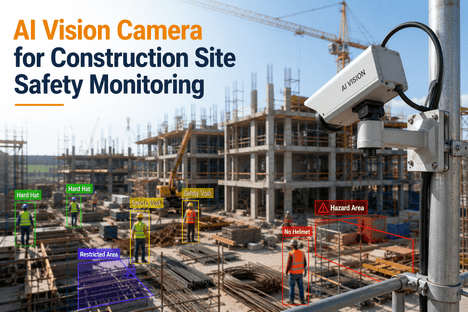
Tower and mobile cranes lifting steel, concrete elements, and rebar cages create hazard zones that shift daily as the structure rises, favoring vision that can be repositioned and reconfigured with the changing site.
Oil, Gas, and Petrochemical
Lift operations in energized process environments carry compounded risk from power-line proximity, congested piping, and confined lay-down areas, all of which benefit from continuous exclusion zone enforcement.
Common Questions
Frequently Asked Questions
Do we need to replace our existing crane control system to use AI vision safety monitoring?
No — vision monitoring works alongside existing crane controls rather than replacing them. Cameras and edge inference hardware install independently of the crane's own PLC or radio remote, and integration with the control system for interlock signals is added through standard industrial protocols where the crane supports it. On cranes without integration capability, the system still functions in alert-only mode, delivering audible warnings and supervisor notifications while relying on operator response to slow or stop motion.
Talk to support to discuss integration options against your specific crane models.
How does the system handle authorized personnel who need to work inside exclusion zones during specific operations?
Authorized entry is handled through operational modes rather than by disabling detection. During pick and set operations, the rigger crew is expected to be in the zone, so the system tracks their presence and identity while enforcing counts and role checks — flagging if an unexpected person enters or if the crew size does not match the lift plan. During travel, the same zone must be clear, and the mode switches automatically as the crane transitions from pick to travel. This preserves the exclusion function without creating friction for legitimate work inside the zone.
Can the vision system operate reliably in bays with poor lighting, dust, heat, or steam?
Yes, though the specific camera and lens selection is adjusted for the environment. Industrial vision hardware handles the lighting range typical of manufacturing bays, and thermal or infrared imaging is added where visible light is unreliable due to steam, welding flash, or dust. Site walkthrough during the initial engagement identifies which zones need which camera types, and the model is trained against footage from the actual environment so accuracy holds up under real operating conditions rather than only in benchmark conditions.
Does relying on AI vision reduce the responsibility of operators, riggers, and safety officers on the floor?
No, and framing it that way is what leads to trouble with adoption. Vision is a force multiplier on the human safety program, not a replacement for it. Operators still operate, riggers still rig, and safety officers still lead corrective action. What changes is that all three now have machine-speed perception covering areas none of them can watch continuously, and the incident data they review comes from actual footage rather than reconstructed accounts. Sites that treat the system as removing responsibility tend to see less benefit than sites that treat it as extending capability.
What is the realistic deployment path for a first bay, and how quickly does the second bay follow?
First-bay deployment typically runs six to twelve weeks from engagement to live operation, covering site survey, camera placement, edge hardware install, model configuration against the bay's specific load types and layouts, integration with crane controls where supported, and operator familiarization. Second bays on the same site deploy meaningfully faster because the integration pattern, camera specification, and operational configuration are already established. Multi-site rollouts follow the same acceleration once one site is live.
Book a demo to walk through a specific deployment timeline for your operation.
Give the Lift the Second Set of Eyes It Should Always Have Had
Stop Trusting That Someone Is Watching. Know That Something Is.
iFactory brings AI vision to every zone of every lift — exclusion zones under the load, rigging condition at the hook, personnel detection across the bay, and evidence capture across every event.