AI Vision for Cross-Dock Operations and Sortation Monitoring
By Johnson on July 29, 2026
A single misrouted parcel at a cross-dock facility does not just get on the wrong truck — it triggers a re-sort at the destination hub, a delayed customer delivery, a service failure penalty from the retailer, and a manual reconciliation task that pulls two people off the sort line for the next 40 minutes. Multiply that by 300 misroutes on a peak-season shift and the operational cost is measured in shifts, not dollars. Cross-dock and sortation environments run at speeds where the naked eye and the barcode scanner alone can no longer keep up, and the wrong box on the wrong outbound lane is invisible until it becomes a customer problem. AI vision watches the flow at conveyor speed and catches the exceptions before they leave the building. See how iFactory's sortation intelligence layer works at real cross-dock throughput.
iFactory Sortation Intelligence
Verify Every Parcel, Every Lane, Every Load — At Conveyor Speed
AI vision cameras track parcels through induction, sortation, and outbound staging in real time, catching misrouted, mislabeled, and misloaded shipments before they leave the dock and cascade into service failures downstream.
parcels per hour verified per sortation line, without slowing the belt
Real-Time
Lane verification
Every SKU
Dimensional check
Auto-Divert
Exception routing
Full Trace
Parcel history
What Actually Goes Wrong on a Cross-Dock Line
The classic model of a cross-dock is elegant on paper — trailers arrive at inbound doors, freight moves across the dock, and the same freight leaves through outbound doors within hours, never touching storage. In practice, at peak-season parcel volumes and mixed-shipper freight, the routing decisions happen in fractions of a second per parcel, and the tolerance for error at that speed is what separates a facility hitting its service commitments from one absorbing chargebacks. Sortation errors do not concentrate in one place. They enter at induction when a label is unreadable, at the divert point when a chute call happens on the wrong signal, at outbound staging when a parcel lands in the wrong lane bay, and at loading when a load plan is not followed correctly under peak-hour pressure.
Induction
Label Read Failures
Damaged, folded, or upside-down labels that a laser scanner cannot read, forcing manual re-scan or default routing that lands the parcel on the wrong lane.
Typical share: 25-35% of errors
Divert Point
Chute Assignment Errors
Correct read at induction but a mistimed divert signal drops the parcel onto the wrong chute — usually a mechanical or timing issue that repeats until caught.
Typical share: 15-25% of errors
Staging
Wrong-Lane Placement
A parcel routed to the right chute gets manually moved to the wrong outbound staging lane during a shift changeover or lane reassignment mid-shift.
Typical share: 20-30% of errors
Loading
Load Plan Violations
The right parcel reaches the right lane, but is loaded onto the wrong trailer at the door — most common when trailer assignments shift late in the shift.
Typical share: 15-20% of errors
The Cross-Dock Flow AI Vision Monitors End-to-End
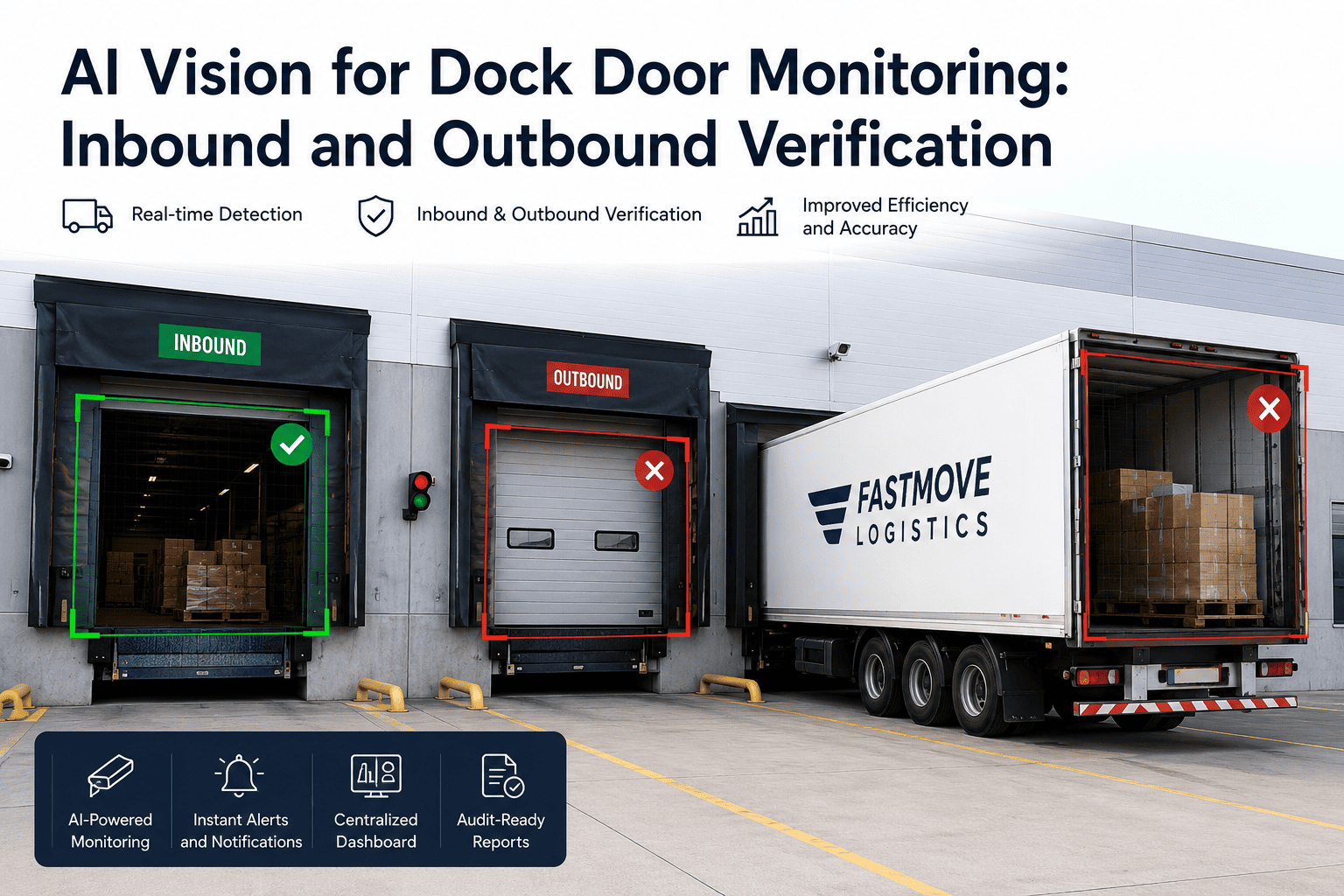
Sortation intelligence is not a single camera at a single point — it is a coordinated layer that watches the parcel journey from the moment freight comes off the inbound trailer to the moment it is loaded onto the outbound. Each stage has a specific vision role and specific integrations with the WMS, sortation controls, and dispatch systems already running the operation. The map below shows what a vision layer sees across a working parcel cross-dock, with detection zones aligned to the physical stages a parcel actually moves through in a typical two-shift facility.
Vision Coverage Across the Cross-Dock Flow
What Each Vision Vantage Point Actually Does
Each of the six vantage points on the cross-dock flow does a specific job, and the job at each point is different because the type of exception that can enter the operation at that point is different. Grouping them into one generic camera role is exactly the mistake that produces disappointing outcomes with off-the-shelf CCTV analytics — the trained models at each stage are tuned for the specific exception classes that stage introduces.
01
Inbound Trailer Unload
Imaging every parcel as it comes off the inbound trailer creates the entry record for the facility. Damaged parcels, wet cartons, and mislabeled freight are flagged at the earliest possible moment — before they enter the induction stream and contaminate the sortation flow behind them.
02
Induction & Dimensional Capture
Vision augments the barcode scanner by capturing dimensional data, package orientation, and label readability. When a scanner fails to read, the vision layer provides a fallback identification path so the parcel does not default-route to the reject lane and stall the belt.
03
Conveyor Flow Tracking
Continuous tracking as parcels move across the conveyor detects flow anomalies — jams building up, parcel accumulation before a divert, and gaps that indicate throughput drift. Alerts route to the sortation lead before the anomaly cascades into a full-line stop.
04
Divert Point Verification
Post-divert cameras verify that each parcel actually landed on the chute assigned by the sortation control system. Any discrepancy between the intended chute and the observed drop is flagged immediately — the single highest-leverage detection point on the entire line.
05
Outbound Staging Lane Check
Staging cameras confirm parcels stay in the correct lane during the buildup to loading. Manual moves during shift changeover or lane reassignment are caught, preventing the frustrating pattern of correct sortation being undone by manual handling downstream.
06
Trailer Loading Verification
Loading cameras verify each parcel entering the trailer against the load plan for that outbound. This last vantage is the final safety net before freight leaves the facility, catching load-plan violations that would otherwise become service failures at the destination hub.
Want to see this six-stage vantage layer running on your own dock footage? Book a 30-minute walkthrough with our sortation team.
Sortation Accuracy Before and After Vision Coverage
The gap between the accuracy a facility believes it is running at and the accuracy it is actually running at is one of the most consistent surprises during a vision deployment. The barcode scan hit rate is often reported as sortation accuracy, but the two measure different things — scan rate is the percentage of parcels successfully read, while true sortation accuracy is the percentage that reach the correct final destination. The gap between them is where the operational cost hides, and the vision layer is what closes it.
Sortation KPI
Typical Baseline
With Vision Layer
Impact Category
Barcode scan hit rate
96-98%
99.5-99.9%
Manual re-scan reduction
True final-destination accuracy
93-96%
99.2-99.7%
Service failure reduction
Load-plan compliance
90-94%
98-99%
Chargeback avoidance
Exception detection time
Post-load discovery
Sub-second at divert
Recovery cost reduction
Damaged parcel identification
At customer receiving
At inbound unload
Claim exposure reduction
Trace record completeness
Barcode events only
Image evidence per stage
Dispute resolution speed
How the Detection-to-Action Loop Actually Runs
Catching an exception is only useful if the operation acts on it before the parcel leaves the building. The loop between vision detection and corrective action needs to be short enough to intercept the parcel while it is still in the facility, and structured enough that response teams know exactly what to do without paging a supervisor to interpret the alert. The five-step loop below is what happens between a vision detection event and the confirmed correction on the floor, and it runs in seconds rather than minutes for critical exceptions like wrong-lane placement.
Detect
Vision model flags an exception — wrong chute, unreadable label, damaged carton, or lane mismatch — with a timestamped image record attached to the parcel ID.
Classify
Event severity is scored based on category and downstream impact. A missed divert on a hot outbound is critical; a minor label smudge is logged but not paged.
Route
The parcel is auto-diverted to the exception lane where the sortation control system supports it, or a mobile alert is dispatched to the nearest available operator on the floor.
Correct
The operator scans the parcel to confirm identification and moves it to the correct staging lane, closing the loop before the outbound trailer is loaded and dispatched.
Log
Full detection, correction action, operator, and time are logged against the parcel ID for later trace review, claim resolution, and pattern analysis at end of shift.
The Cost of Missed Sortation Exceptions
Sortation errors do not stay contained inside the facility that produced them. They radiate outward through the network, and the total cost per incident is a compound of freight, labor, penalty, and reputation impacts across multiple parties. The breakdown below shows the typical cost profile of a single missed sortation error that reaches the customer, based on parcel and LTL cross-dock benchmarks across grocery, retail, and e-commerce distribution networks.
$85-$140
Blended average total cost per missed sortation error reaching the customer
40%
Freight and Re-Sort Cost
Return freight to origin, re-sort labor at the destination hub, and expedited shipping to meet the original service commitment on the corrected route.
25%
Service Failure Chargebacks
Retailer or shipper chargeback for missed service commitment, typically applied per parcel and often at rates that dwarf the actual re-sort cost.
20%
Investigation & Reconciliation Labor
Two to three hours of operator and supervisor time to investigate, document, and reconcile each significant exception, pulling labor off the active sort line.
15%
Customer Experience Impact
Customer service tickets, refund handling, and long-term account impact when the same customer sees repeat exceptions on their shipments over time.
Want to see what your current exception rate is actually costing per shift? Share a sample sort log with our team and we will benchmark it against similar operations.
What Cross-Dock Operations See After Deployment
The four results below reflect what mid-size to large parcel and LTL cross-dock operations typically measure across the first six to twelve months after a vision layer goes live end-to-end. The ranges are honest — smaller operations with tighter existing controls see the lower end, and larger multi-shift facilities with mixed shipper networks see the upper end. Either way, the direction is consistent and the payback typically lands inside the first year.
01
65-80%
Fewer Sortation Errors Reaching the Customer
End-to-end verification catches the misrouted parcels before they leave the facility, closing the gap between scan hit rate and true final-destination accuracy.
02
3-4x
Faster Exception Resolution On Shift
Real-time alerts with image evidence and parcel location cut investigation time from post-shift review to same-moment correction on the floor.
03
50-70%
Reduction in Service Failure Chargebacks
Load-plan verification at the trailer door catches the last-mile mistakes that generate the highest chargeback penalties from shippers and retailers.
04
Full
Parcel-Level Traceability for Every Shipment
Image evidence at every vantage point creates a searchable record per parcel that speeds dispute resolution with shippers, carriers, and customers.
Frequently Asked Questions
Does this work with our existing sortation control system?
Yes, the platform is designed to integrate with the sortation control systems already installed on the site rather than replace them, exchanging parcel identification data, chute assignments, and divert confirmations through the standard interfaces most sortation vendors already publish. That means the vision layer sits alongside the control system, verifying its decisions and catching the exceptions the control system alone cannot see, without any modification to the underlying sort programming. Standard integrations are available for the major cross-dock sortation vendors, and site-specific integrations are handled during the deployment phase. Talk to our integration team to confirm coverage for your specific control system before contracting.
Can the vision layer keep up with our peak-season throughput?
Real-time inference at conveyor speed is the specific capability the platform is built for, with edge compute nodes handling the frame-by-frame processing locally so latency stays under the fraction of a second required to intercept exceptions before divert. Deployments running at 10,000-plus parcels per hour per sortation line are common, and peak-season throughput increases are handled by scaling edge compute rather than by slowing the belt. During deployment planning our team sizes the edge hardware for your peak-shift volumes rather than steady-state, so the layer has headroom when it matters most. Book a walkthrough to see throughput numbers from deployments similar to yours.
How does this handle mixed shipper networks with different label formats?
Label diversity across shipper networks is one of the specific failure modes vision handles better than barcode scanners alone, since the vision models are trained across the label formats used by the major carriers and retailers rather than being tuned to one specification. Where a scanner fails on a folded or damaged label, the vision layer can often still extract the routing information from the visible portion of the label, and unusual label formats can be added to the model during the tuning phase without waiting for a full retraining cycle. For shippers with proprietary label designs, custom training is handled during deployment and does not require ongoing intervention from your team. Reach out to our support team to walk through the label formats your operation handles.
What happens when a detection is a false positive?
False positives are handled at two layers — the severity scoring model routes low-confidence detections to logging rather than immediate operator alerts, and each false positive that does reach the floor is fed back into the model tuning process so the pattern is filtered on subsequent shifts. During the first ninety days of a deployment, false-positive tuning is an active focus of the operations review sessions with our team, so the alert stream that the response operators see becomes progressively more reliable over the first quarter. Alert fatigue is the failure mode we are most focused on preventing, because a distrusted alert stream is worse than no alert stream at all. Book a walkthrough to see how the tuning loop works.
What is the typical deployment timeline for a mid-size cross-dock?
For a mid-size cross-dock operation running one or two shifts across multiple sortation lines with an existing IP camera network in reasonable condition, a typical deployment runs 8 to 14 weeks from contract to live monitoring on the first set of detection classes and vantage points. That timeline includes site assessment, edge compute install, integration with sortation controls and the WMS, model tuning against your specific label mix and parcel types, and a pilot period before cutover to production alerts. Additional vantage points and detection classes can be added incrementally after the initial go-live without redoing the base install. Reach out to our deployment team to get a timeline scoped specifically for your facility.
Verify Every Parcel, Every Load, Every Shift.
See Sortation Intelligence Running on Your Own Sort Data
Bring a sample sort log and a few clips from your busiest lane. We will run our vision stack against them and show what would have been caught in real time — no site visit needed to get a working demonstration.