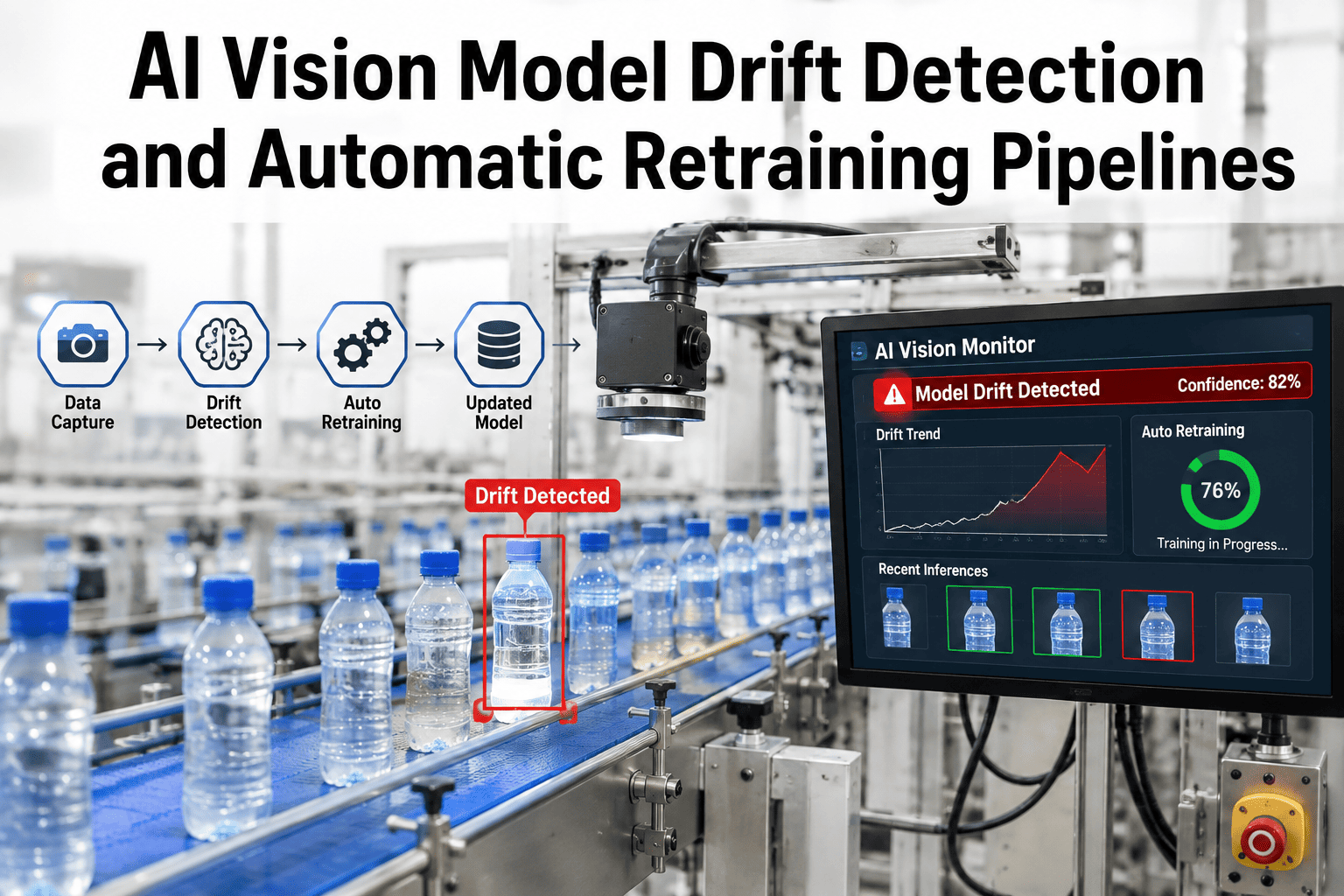
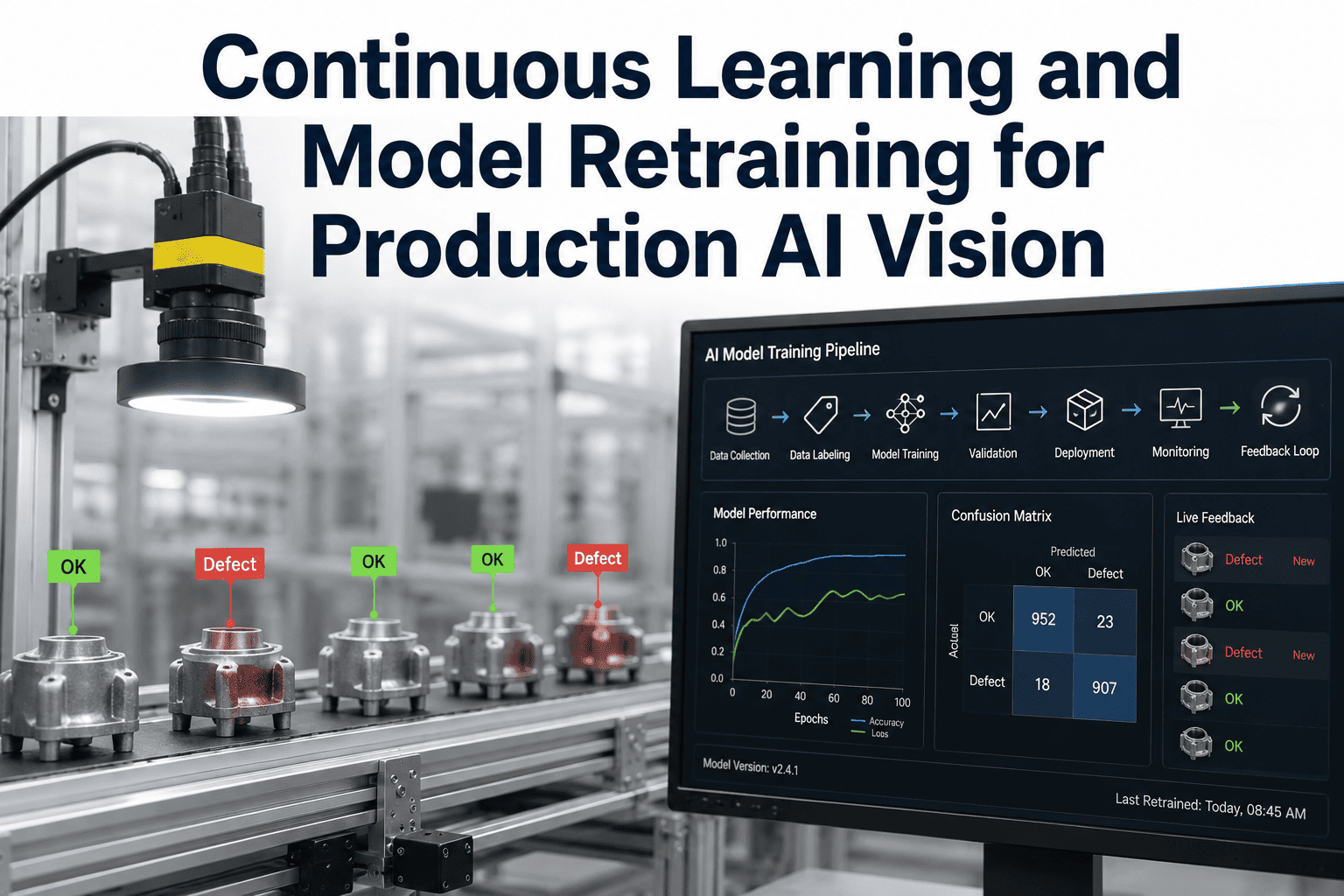
Most AI vision programs are quietly throwing away their most valuable asset. Every inspection image, every defect annotation, every borderline call an operator overrides gets generated, used once to make a pass or fail decision, and then discarded or left scattered across whatever storage happened to be closest at the time. Two years later, when a new defect type starts appearing or a model's accuracy quietly drifts, there's no structured history to retrain against, just a folder of unlabeled images nobody trusts. A data lake built specifically for vision data changes that equation, turning every inspection into a permanent, structured asset instead of a one-time decision. See how iFactory's data lake architecture captures and structures that history from day one.
INTEGRATION · DATA INFRASTRUCTURE
Every Inspection Is Either an Asset or a Missed Opportunity
The difference between a facility that can answer "has this happened before" and one that can't usually comes down to whether inspection data was structured from the very first image.
WITHOUT A DATA LAKE
Images processed and discarded, no structured retraining set, drift caught late, every new defect type starts from zero
WITH A STRUCTURED DATA LAKE
Years of labeled history, retraining sets built automatically, drift caught early, new defect types trained against real examples
WHY THIS MATTERS MORE THAN IT LOOKS
Model Drift Is Inevitable, Historical Data Is What Fixes It
Every vision model degrades over time, not because the model is flawed but because the world it's inspecting keeps changing. Lighting shifts, cameras age, product mixes evolve, and new defect types appear that the original training data never saw. Modern MLOps practice treats this as a certainty to plan for, not a failure to prevent, which is why leading vision programs build automated retraining triggers around performance monitoring rather than hoping a model stays accurate forever. None of that retraining is possible without a structured, queryable history of past inspections to pull from, which is exactly what most facilities discover they don't have the moment they actually need it, usually right when accuracy has already started slipping and the pressure to fix it fast is highest.
The gap tends to reveal itself the same way at most facilities. A new defect type shows up on the line, quality engineering wants to know if it's happened before, and the honest answer is that nobody can say for certain because the images from six months ago were either deleted, buried in an unindexed folder, or never tagged with enough metadata to search. That single missing capability, being able to answer "has this happened before, and under what conditions" turns out to be one of the most valuable things a manufacturing quality program can have, and it's entirely a function of whether the data was structured from the start.
Continuous
drift is the expected state of any production vision model, not an occasional exception
Zero
retraining options available when historical inspection images were never structured or retained
Every
low-confidence prediction is a candidate labeling opportunity a data lake can capture automatically
WHAT ACTUALLY GOES INTO THE LAKE
Structured Storage Means More Than Just Saving Images
A data lake built for vision workloads stores far more than the raw image file. Rich metadata attached to every capture is what makes the archive queryable years later instead of just a pile of pictures nobody can search through. A schema-on-read approach is what makes this practical across heterogeneous camera vendors and station types, since it accommodates data formats from different equipment generations without forcing every station onto identical hardware before it can contribute to the same searchable archive. The five layers below cover what a well-structured record actually needs to carry alongside the image itself.
Raw Inspection Images
Every frame captured at every station, retained at full resolution rather than compressed or discarded after the inference decision is made.
Model Predictions and Confidence Scores
What the model concluded and how certain it was, which is what makes low-confidence cases findable for review and relabeling later.
Human-Verified Labels
Operator overrides and quality team corrections, the ground truth that separates a genuinely useful training set from raw unlabeled footage.
Production Context Metadata
Station ID, timestamp, product SKU, shift, and environmental conditions, all of which turn a defect image into a root-cause-searchable record.
Model Version Lineage
Which model version produced which prediction, essential for auditability and for reproducing exactly why a past decision was made.
FROM RAW CAPTURE TO A BETTER MODEL
The Loop That Turns Inspection Data Into Model Improvement
A data lake is only valuable if it feeds back into the system that generated it. The retraining loop is what closes that gap, turning yesterday's borderline calls into tomorrow's more accurate model without waiting for a scheduled model refresh cycle. This is what separates a passive archive from an active learning system, since the difference isn't just where the images live, it's whether the pipeline actually does something with them on an ongoing basis rather than leaving them to accumulate untouched.
01
Continuous Ingestion
Every inspection image, prediction, and metadata record streams into the lake as it's generated, not on a batch schedule that lags behind production.
02
Active Learning Flags
Low-confidence predictions and edge cases are automatically flagged for human review instead of sitting unnoticed in bulk storage.
03
Curated Retraining Sets
Verified labels and flagged cases are compiled into a structured training set that reflects real production conditions, not a lab dataset.
04
Automated Retraining and Validation
Updated models are trained against the curated set and validated against a holdout before ever reaching the production line.
05
Versioned Deployment
The new model version deploys with full lineage back to the exact dataset that trained it, so any future question about a decision has an answer.
WHY HISTORICAL DEPTH COMPOUNDS
A Data Lake Gets More Valuable Every Month It Exists
Unlike most infrastructure investments, a vision data lake doesn't depreciate, it appreciates. A single month of inspection history tells you what's happening right now. A year of history tells you what's seasonal, what's tied to a specific supplier batch, and what defect rates actually look like across every shift pattern you run. Multiple years of history make it possible to train models for defect types that were rare enough to have almost no examples in any single year, but accumulate into a workable training set once historical depth is available to draw from. This is the opposite of how most manufacturing IT investments behave, where hardware ages and software licenses need renewing just to maintain current capability rather than gaining new capability simply by continuing to operate.
Rare Defect Coverage
Defects that occur once a month accumulate into dozens of labeled examples after a year, enough to actually train against.
Seasonal Pattern Detection
Multi-year history reveals defect rates tied to seasonal humidity, temperature, or supplier changes invisible in any single quarter.
Root Cause Correlation
Cross-referencing defect images against production metadata surfaces patterns tied to specific shifts, machines, or material lots.
New Model Cold-Start Advantage
A new inspection use case can train against years of adjacent historical data instead of starting from an empty dataset.
STRUCTURED LAKE VS. UNSTRUCTURED STORAGE
Not All Image Storage Is Built the Same Way
Plenty of facilities are technically storing inspection images somewhere, a network drive, a camera vendor's proprietary system, cloud object storage with no schema. The difference between that and a purpose-built vision data lake shows up the moment someone actually needs to use the data for something beyond the original inspection decision, whether that's investigating a customer complaint, training a model for a new defect type, or proving to an auditor exactly which model version made a specific call six months ago.
| Capability |
Unstructured Storage |
Structured Vision Data Lake |
| Searchability |
Manual folder browsing |
Query by defect type, station, date range, SKU |
| Metadata |
Filename only, if that |
Full production context per image |
| Retraining readiness |
Requires manual re-labeling from scratch |
Curated sets generated automatically |
| Model lineage |
Not tracked |
Every prediction linked to its model version |
| Audit trail |
Difficult to reconstruct |
Built in for compliance and quality review |
| Cross-station analysis |
Effectively impossible |
Native, since all stations feed one schema |
Turn Years of Scattered Images Into a Usable Asset
Start a pilot that structures your existing inspection archive and connects it to an automated retraining pipeline.
TURNKEY DEPLOYMENT, READY TO INSTALL
Infrastructure and Software Ship Together, Pre-Configured
iFactory ships a pre-configured NVIDIA AI server and data lake architecture, racked and ready, with ingestion, labeling, and retraining pipelines pre-loaded. Rack it, plug power and Ethernet, and every inspection station begins feeding structured data into the lake from day one, whether that's a single line or a full multi-site rollout, with storage tiering configured from the start so recent data stays fast to query while older bulk footage moves to lower-cost archival storage automatically.
Pre-configured NVIDIA edge AI hardware, racked and shipped ready to install
Schema-on-read data lake architecture that ingests images, metadata, and predictions from every connected station
Active learning pipeline that automatically flags low-confidence predictions for review, not billed separately
Automated retraining and validation workflow with full model version lineage
Historical archive migration for existing inspection images where available
Twenty-four seven remote monitoring from day one of production
FROM CONTRACT TO PRODUCTION
Live in 6 to 12 Weeks
Weeks 1–4
Schema Design and Ingestion Setup
Data lake schema designed around your stations, product mix, and defect taxonomy. Ingestion pipelines connected to existing and new camera stations.
Weeks 5–8
Historical Migration and Labeling Pass
Existing inspection images migrated and structured where available, active learning pipeline validated against a labeling backlog.
Weeks 9–12
Go-Live and Automated Retraining
Automated retraining pipeline goes live with full model lineage tracking, and remote monitoring is active around the clock.
FREQUENTLY ASKED QUESTIONS
What Quality and IT Teams Ask Before Building a Vision Data Lake
We already have years of inspection images sitting on a network drive. Can those be migrated in, or do we have to start over?
Existing images can typically be migrated into the structured schema, though the value of that migration depends heavily on what metadata already exists alongside them. Images with timestamps, station identifiers, or even loosely organized folder structures carry enough context to be restructured and made queryable without excessive manual effort. Images with no metadata at all still have value as raw material for relabeling, though that requires more manual effort during migration than data that was already partially organized, since someone has to reconstruct context that was never captured in the first place. A migration assessment early in the process identifies which parts of your existing archive are worth structuring versus which are better treated as a fresh start, so effort goes toward the images most likely to actually improve model performance.
Book a demo to scope a migration assessment for your specific archive.
How much storage does a multi-year, multi-station image archive actually require?
Storage requirements scale with camera count, resolution, capture frequency, and retention policy, and there's no single number that applies across every deployment since a single high-resolution station running continuously generates a very different volume than a handful of lower-frequency spot checks. What matters more than the raw volume is the storage tiering strategy, since not every image needs to live in the same access tier forever. Recent images and anything flagged for active learning typically stay in fast, queryable storage, while older bulk footage that's unlikely to be revisited can move to lower-cost archival tiers without losing its value for eventual retraining work, which keeps long-term storage cost proportional to how often data actually gets used rather than growing linearly and unmanageably with every additional year of retention.
Contact support to size storage for your specific station count and retention needs.
Does this require a data science team on staff to actually use, or can quality engineers work with it directly?
The querying and analysis layer is built for quality engineers and process teams to use directly, searching by defect type, date range, station, or SKU without needing to write code or involve a data science team for routine investigation. The retraining pipeline itself runs largely automated once configured, triggering on performance thresholds rather than requiring someone to manually kick off a training run every time accuracy drifts. A data science or MLOps resource becomes more valuable for tuning the retraining thresholds and reviewing model performance trends over time, but day-to-day use of the historical archive, pulling up every image of a specific defect from the last six months, for example, is designed for the people already doing quality work on your floor rather than requiring a specialist to be looped in for every question.
What happens to model accuracy if the retraining pipeline uses biased or unrepresentative historical data?
This is a real risk with any retraining pipeline, and it's exactly why validated holdout testing sits between a retrained model and production deployment rather than pushing new models live automatically the moment training finishes. If historical data over-represents one shift, one product line, or one camera station relative to actual production volume, a naive retraining pass can shift the model's behavior in ways that hurt performance on underrepresented conditions, sometimes improving overall accuracy metrics while quietly degrading performance on exactly the edge cases that mattered most. Data lake design should include stratified sampling and validation checks specifically to catch this before a new model version reaches the line, not just after a performance complaint comes in from the floor.
Is this worth building before we've scaled past a single inspection station?
A single-station deployment still benefits from structured data capture from day one, since the alternative is starting the data lake conversation later with a gap in history for exactly the period when the model was newest and least tuned to your specific production conditions, which is often when the most valuable edge cases and corrections actually occur. Building the structured foundation early costs relatively little extra at single-station scale and means every additional station added later plugs into an existing schema instead of requiring a retroactive migration project that has to sort through months or years of unstructured images after the fact. Facilities that wait until they have multiple stations before structuring their data usually end up doing the migration work anyway, just with more historical images to sort through by the time they start, and often with less clarity about what conditions produced each image than if metadata had been captured at the time.
Stop Losing Your Inspection History to Scattered Storage
iFactory ships a turnkey data lake architecture that structures every inspection into a searchable, retraining-ready asset from the first image captured.