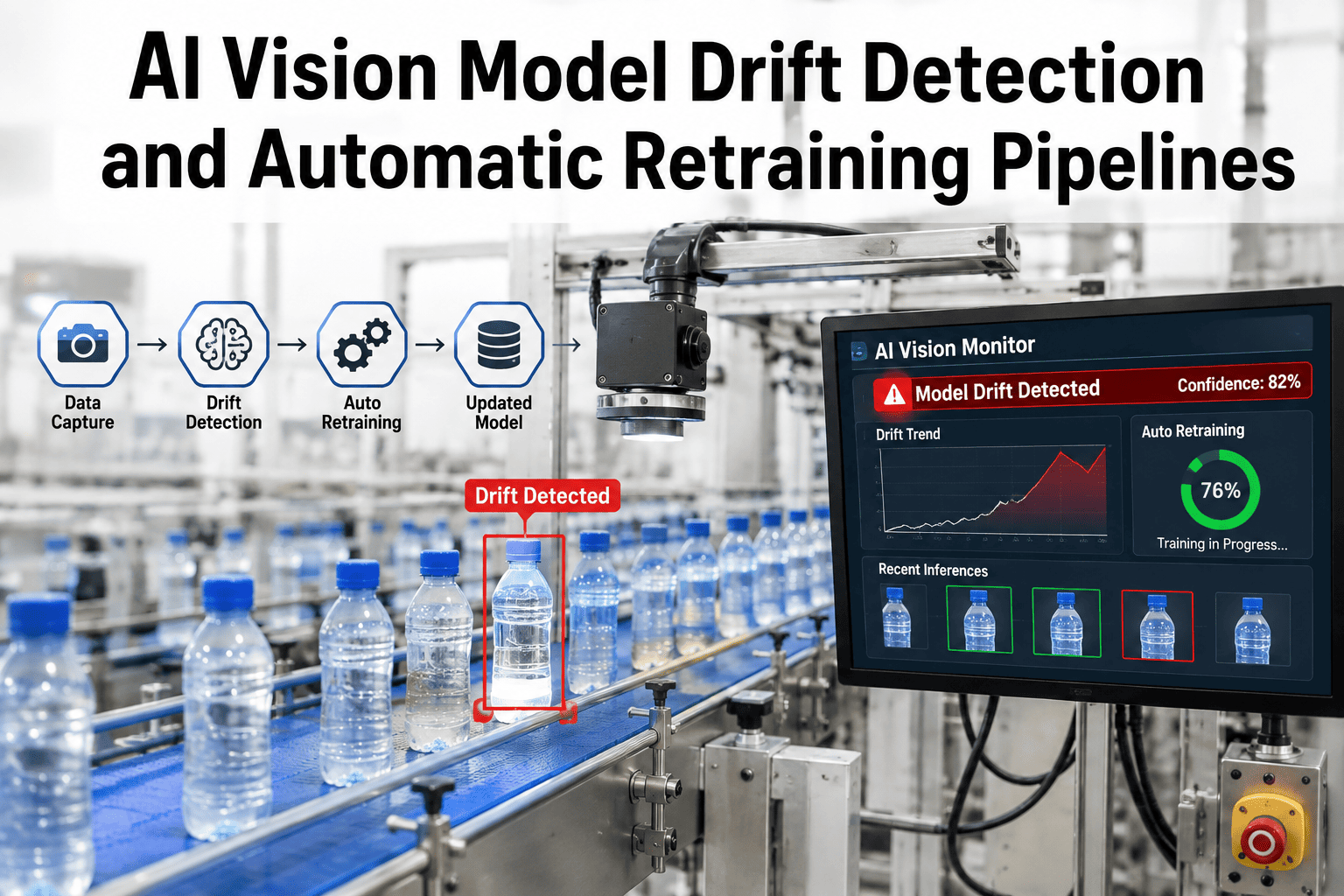
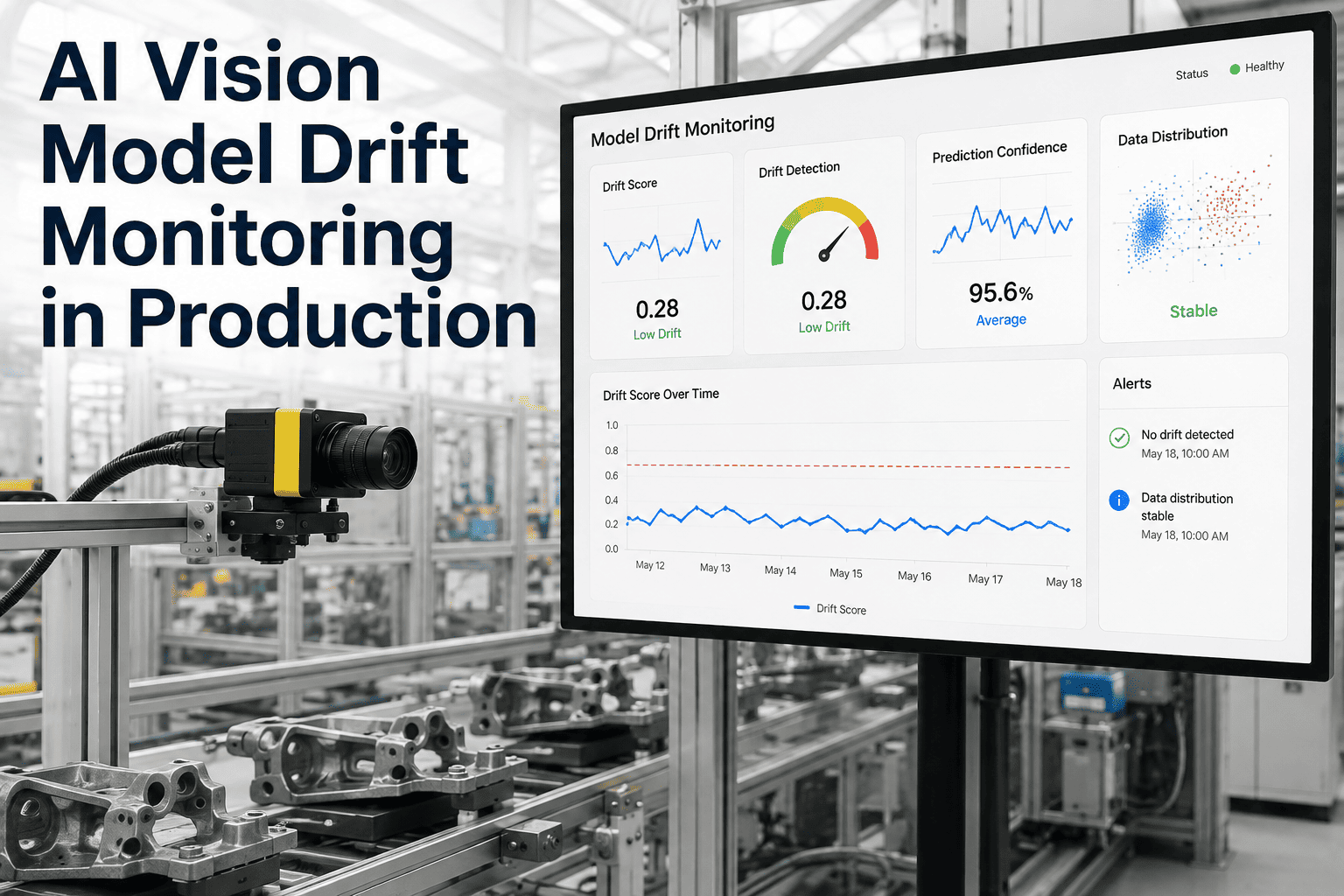
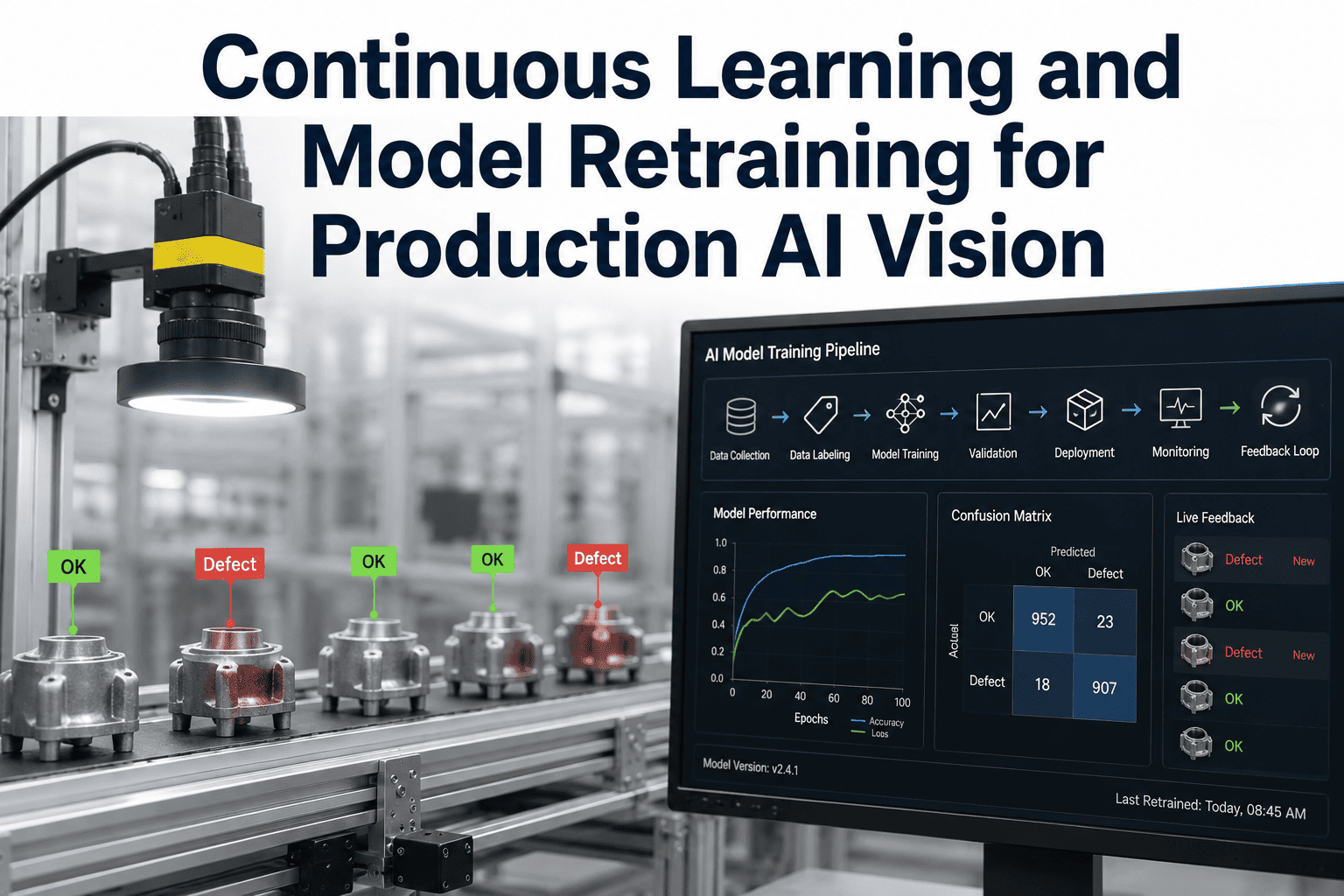
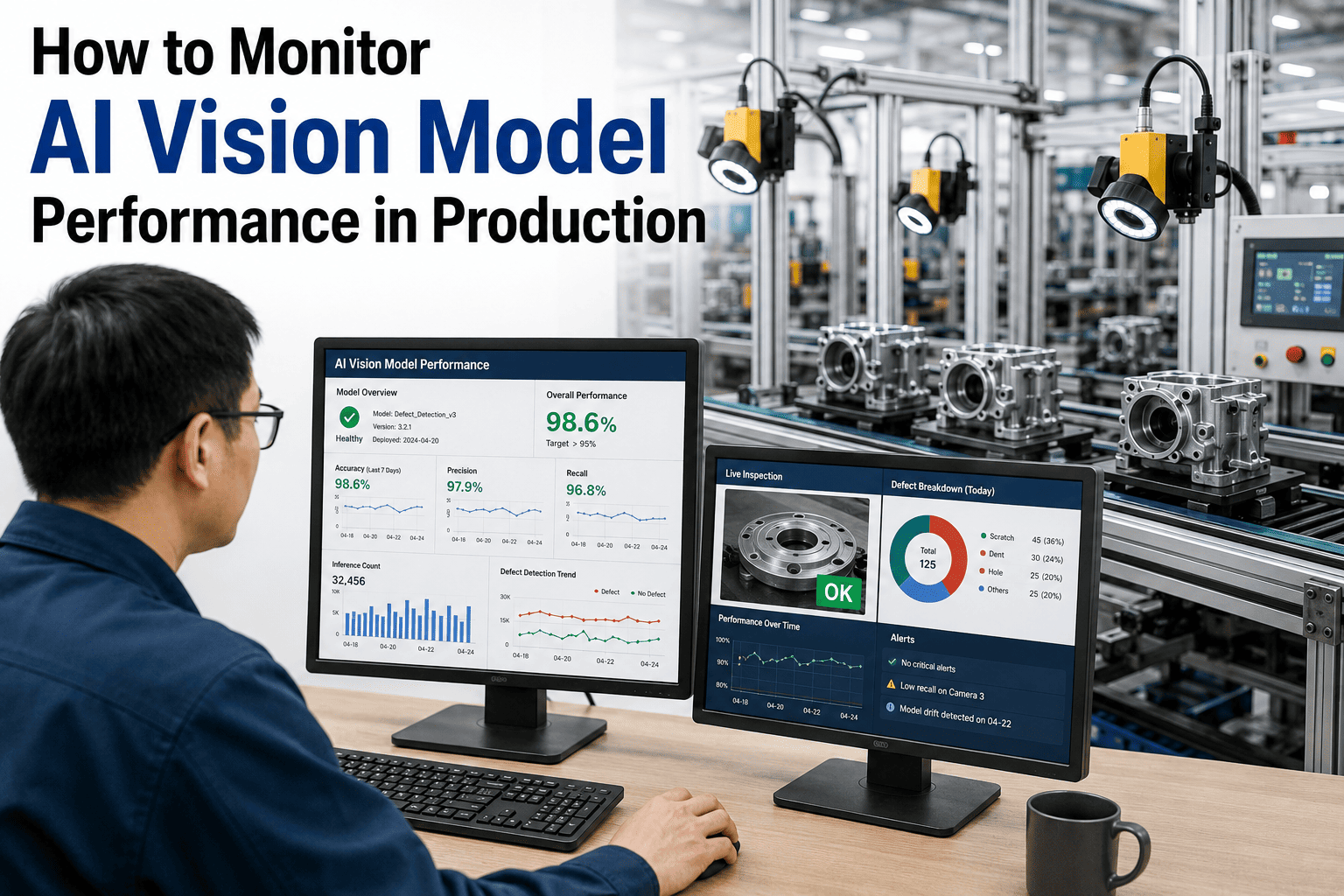
A vision model that scored 98 percent accuracy on the day it went live can be running closer to 90 percent six months later, with nobody on the floor aware anything has changed. A peer-reviewed study testing 128 model-dataset combinations across multiple industries found measurable temporal degradation in 91 percent of them, a pattern researchers now call AI aging. Lighting shifts with the seasons, a camera lens picks up dust, a supplier changes material finish, a tool wears down and starts producing a slightly different part profile, and the model keeps scoring confidently against conditions that no longer match what it was trained on. This article covers how drift is detected before it shows up as a spike in false alarms, and how an automated retraining pipeline closes the loop without waiting for someone to notice the model has gone stale.
Technology — MLOps for Vision AI
Model Drift Doesn't Announce Itself. Monitoring Has To.
Production conditions change continuously. A model that isn't monitored for drift degrades silently until accuracy loss shows up as missed defects or false alarms on the floor.
91%of models tested in a peer-reviewed study showed measurable temporal degradation
Silentdrift produces no error message, only a slow accuracy decline nobody is watching for
Closed-loopdetect, diagnose, retrain pipelines correct drift before it reaches the floor
What Drift Actually Is, and Why It Is Invisible Day to Day
A vision model does not fail the way software fails. There is no crash, no error log, no obvious signal that something is wrong. What happens instead is a gradual mismatch between the conditions the model was trained on and the conditions it is now running against. Statisticians call the underlying pattern data drift when the input distribution shifts, and concept drift when the relationship between inputs and the correct answer changes. On a factory floor, both show up as the same practical symptom: predictions that used to be reliable start being wrong slightly more often, in ways too small to notice from any single frame.
This is what makes drift genuinely dangerous rather than just an inconvenience. A system failure gets fixed because someone notices it immediately. Drift gets tolerated because each individual misclassification looks like ordinary noise, and it is only when someone reviews weeks of accumulated data that the downward trend becomes visible, usually well after the damage has already compounded.
Four Sources of Drift on a Real Production Line
Lighting Shifts
Seasonal daylight changes through skylights, a burned-out fixture replaced with a different color temperature, or a new light source added nearby all change what the camera actually captures, even though nothing on the line itself has changed.
Material Variation
A new supplier, a batch from a different source, or a formulation change alters surface texture, color, or reflectivity just enough that a model trained on the old material starts misclassifying units that are actually within spec.
Tool and Equipment Wear
A cutting tool that wears down gradually changes the part profile it produces, and a camera lens that accumulates dust or slight misalignment changes what the model sees, both without any single dramatic event to flag.
Process and Product Changes
A new SKU variant, an updated packaging design, or a revised process parameter intentionally changes what should pass inspection, and a model trained on the prior specification has no way to know the target has moved.
The Closed Loop: Detect, Diagnose, Retrain
A production-grade drift pipeline runs as a continuous cycle rather than a one-time check. Each stage feeds the next, and the loop repeats automatically as new data flows through the system, without requiring an engineer to manually review dashboards on a fixed schedule.
Detect
Statistical Monitoring on Every Batch
Input distributions are compared continuously against the training baseline using statistical tests such as Population Stability Index and Kolmogorov-Smirnov, flagging when live data has diverged meaningfully from what the model was trained on.
Diagnose
Confirm Drift Actually Affects Accuracy
A distribution shift alone is not automatically a problem. The pipeline checks whether the drift signal correlates with an actual drop in a labeled evaluation slice before treating it as something worth acting on, avoiding retraining triggered by noise.
Retrain
Automated Retraining and Validation
Confirmed drift triggers a retraining job on fresh, representative data. The updated model is validated against a held-out set before deployment, so a retrained model has to prove it performs better before it replaces the one currently running.
How Drift Gets Detected Without Waiting for Labels
The hardest part of drift detection in most production environments is that ground truth labels, confirmation of whether a prediction was actually correct, are not immediately available. Nobody is manually re-inspecting every unit the model already classified. Detection methods are built around this constraint, working from what is observable in real time rather than waiting for delayed feedback.
In practice, the strongest pipelines combine both approaches: label-free statistical monitoring runs continuously across every frame, while a small stream of confirmed labels, often generated through routine quality checks that already happen on the line, periodically validates that a detected distribution shift is actually translating into an accuracy problem.
What Undetected Drift Costs on the Floor
01False alarm spikes erode trust — as a model drifts, false positive rates typically climb before false negatives do, and operators who get paged for issues that turn out to be nothing start ignoring alerts altogether.
02Missed defects slip through quietly — a model losing accuracy on true positives does not announce it, it just lets more defective units pass, and the first sign is often a customer complaint or a downstream rework spike.
03Manual re-verification creeps back in — once floor staff stop trusting the system's calls, they start double-checking manually, which quietly erodes the labor savings the vision system was deployed to capture in the first place.
04The root cause stays hidden — without drift monitoring, a degrading model and a genuine new defect pattern look identical from the floor, and teams can spend weeks chasing a process problem that is actually a stale model.
A model that silently loses accuracy is often worse than no model at all, because the false confidence delays the moment someone starts looking for the real problem. Continuous monitoring closes that gap before it costs a shift's worth of rework.
What an Automated Retraining Pipeline Actually Runs
1
Continuous Baseline Comparison
Every incoming batch of frames is compared against the training distribution in near real time, with drift scores logged alongside standard production metrics rather than in a separate system nobody checks.
2
Threshold-Based Alerting
A drift score crossing a defined threshold generates an alert to the responsible team, with enough context, which input feature shifted and by how much, to start investigating immediately rather than beginning from zero.
3
Impact Confirmation
The pipeline checks the flagged drift against a labeled evaluation slice before proceeding, filtering out distribution shifts that do not actually affect prediction quality and would waste a retraining cycle if acted on.
4
Retraining on Fresh Data
Confirmed drift triggers a retraining job using recent representative data combined with the original training set, so the updated model adapts to new conditions without forgetting what it already learned correctly.
5
Validation Against a Quality Gate
The retrained model is scored against a held-out validation set and has to clear a defined accuracy threshold before it is eligible for deployment, preventing a bad retraining run from replacing a working model.
6
Staged Rollout With Rollback
The validated model deploys gradually, with the previous version kept available for immediate rollback if the new model underperforms in live conditions in a way the validation set did not capture.
Frequently Asked Questions
How do you detect drift if you don't have labeled data confirming whether the model is right or wrong?
Most drift detection runs on the input side rather than waiting for outcome labels. Statistical tests like Population Stability Index and Kolmogorov-Smirnov compare the distribution of live inputs against the distribution the model was trained on, flagging meaningful divergence without needing to know whether any individual prediction was correct. A small stream of labeled data, often produced naturally through existing spot checks, is then used periodically to confirm that a detected distribution shift is actually translating into an accuracy problem before triggering retraining.
Book a demo to see label-free drift monitoring running against a live camera feed.
Won't automatic retraining eventually make the model worse if the drift signal is wrong?
This is exactly why a production pipeline includes a validation gate between retraining and deployment rather than pushing every retrained model straight to the floor. The retrained model is scored against a held-out evaluation set and has to clear a defined accuracy threshold before it becomes eligible for deployment, and the previous version stays available for immediate rollback. A retraining run that produces a worse model simply does not get deployed, which removes the risk of a bad automated update degrading production.
How often does a production vision model actually need to be retrained?
There is no fixed schedule that fits every deployment, because retraining frequency should track the actual rate of drift on a specific line rather than a calendar date. A line with stable lighting and a single consistent material supplier may go months without meaningful drift, while a line with seasonal material changes or frequent SKU rotation may need retraining triggered every few weeks. A well-built pipeline retrains reactively, when confirmed drift crosses a threshold, rather than on an arbitrary fixed interval that either retrains unnecessarily often or waits too long.
Does drift monitoring add noticeable latency to real-time inspection?
No. Drift detection runs as a parallel monitoring process analyzing aggregated statistics across batches of frames, not as an additional step inside the real-time inference path that inspects each individual unit. The inspection decision on any given frame is unaffected by the monitoring layer running alongside it, so line speed and detection latency stay the same whether or not drift monitoring is active.
Contact support to review the monitoring architecture for a specific deployment.
What is the difference between data drift and concept drift, and does it matter operationally?
Data drift means the inputs themselves have changed, different lighting, different material appearance, while concept drift means the relationship between an input and the correct answer has changed, such as a spec update that redefines what counts as a defect. Both produce the same practical symptom of declining accuracy, but they call for different fixes: data drift is usually resolved by retraining on examples that reflect the new conditions, while concept drift requires updating the ground truth labels themselves before any retraining will help, since retraining on old labels against a new definition of correct just reinforces the outdated standard.
A Model That Isn't Monitored Is a Model That's Already Drifting
See a closed-loop detect, diagnose, retrain pipeline running against your own production conditions before accuracy loss shows up on the floor.