Every EPA fugitive dust citation, every visible plume violation, every containment failure that became a reportable spill — all of it left a visual trail on cameras that were already installed. The gap was never sensing; it was that no human could watch every stack, stockpile, transfer point, and containment berm at the same time. AI vision closes that gap by watching every camera continuously, classifying the visual signature of a real event, and turning it into a documented record before the Regional Administrator ever sends a letter. You can book a demo against a live camera on your own site.
EPA · AI VISION · ENVIRONMENTAL COMPLIANCE · 2025
Fugitive Dust, Visible Plumes, and Chemical Spills All Leave a Visual Trail — Now Something Can Actually Watch It
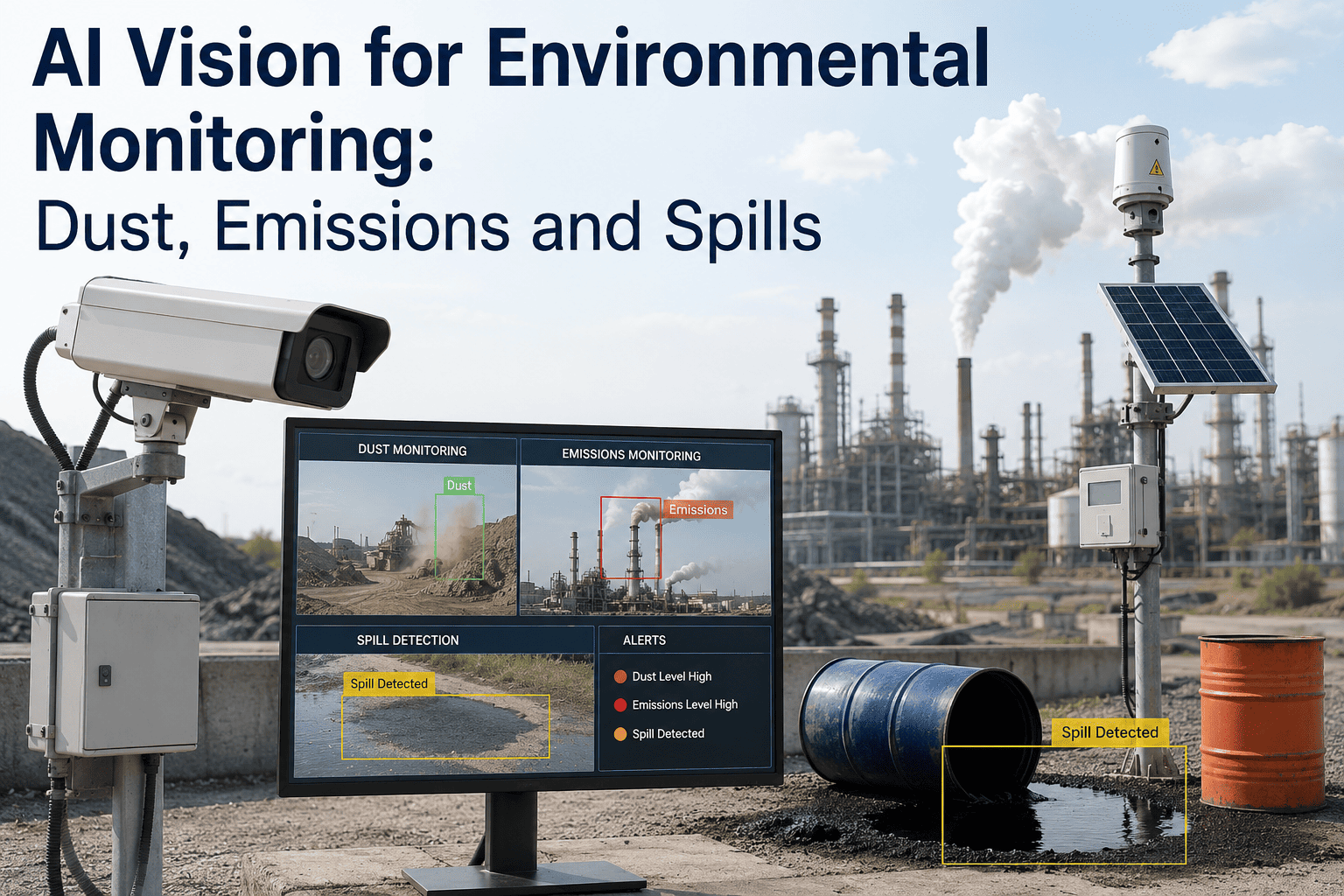
iFactory's environmental vision layer runs continuous computer-vision detection for dust plumes, opacity events, containment breaches, and liquid spills on the cameras you already own — so audit trails write themselves and violations become work orders instead of Notices of Violation.
25M
Tons of fugitive dust the EPA estimates are released across the U.S. every year
$103K
Maximum Clean Air Act civil penalty per day, per violation, adjusted for inflation
80%
Reported reduction in chemical spill response time when vision replaced manual patrols
24/7
Camera coverage that never blinks, never leaves the post, never files a form late
THE MONITORING GAP · WHY MANUAL METHODS BREAK
EPA Method 22 Was Written for a Human With Two Stopwatches — Your Plant Has 47 Emission Points and Three Shifts
The regulatory framework for visible emissions still assumes a certified observer with a stopwatch, a data sheet, and clear line of sight. That model was reasonable in 1974 and impossible to scale to a modern site with dozens of transfer points, stockpiles, flares, vents, and haul roads. The gap between what regulation asks for and what humans can deliver is the space AI vision fills.
Manual Observation
Coverage
One observer, one line of sight, one moment in time
Duration
Bounded observation period — minutes, not hours
Night & Weather
Restricted — needs daylight, sun position, and background contrast
Documentation
Handwritten sheet transcribed later; no image record of the event
Trend Data
Almost impossible — no structured dataset ever gets created
AI Vision Layer
Coverage
Every camera, every second, across every fence-line and process area
Duration
Continuous — 168 hours per week per camera, no gaps
Night & Weather
IR and low-light models keep detecting after sundown and in bad weather
Documentation
Time-stamped clip, camera ID, event class, and confidence score, automatically
Trend Data
Every event feeds a structured dataset ready for heatmaps and reports
FOUR DETECTION DOMAINS · THE ENVIRONMENTAL VISION LIBRARY
Four Detection Domains Sharing the Same Camera Feed, Covering the Environmental Events That Actually Get Cited
AI environmental vision is not one detector — it is a library of models running in parallel on a shared video pipeline. These four domains are where the technology has matured furthest, and where the ROI conversation opens easily with a compliance director facing a Title V renewal.
01
Fugitive Dust & Particulate Plumes
Wind-borne particulate off stockpiles, haul roads, and transfer points is the single largest source category — 25 million tons per year nationally. Vision models flag the visual signature of a dust plume, apply an opacity-band classifier that mirrors Method 22 logic, and log accumulated emission time exactly as an observer would, continuously and without a smoke-school certificate.
Aligned with EPA Method 22 · CAA Title V fugitive dust plans
02
Stack Opacity & Visible Emissions
Point-source stacks, vents, and flares carry hard opacity limits under state SIPs and 40 CFR Parts 60, 61, and 62. Vision models track opacity bands against a contrasting background and hold every event as a video segment tied to a timestamp — the reference footage a manual Method 9 reading has never been able to produce on demand.
Aligned with EPA Method 9 · 40 CFR Part 60 opacity limits
03
Liquid Spills & Containment Breaches
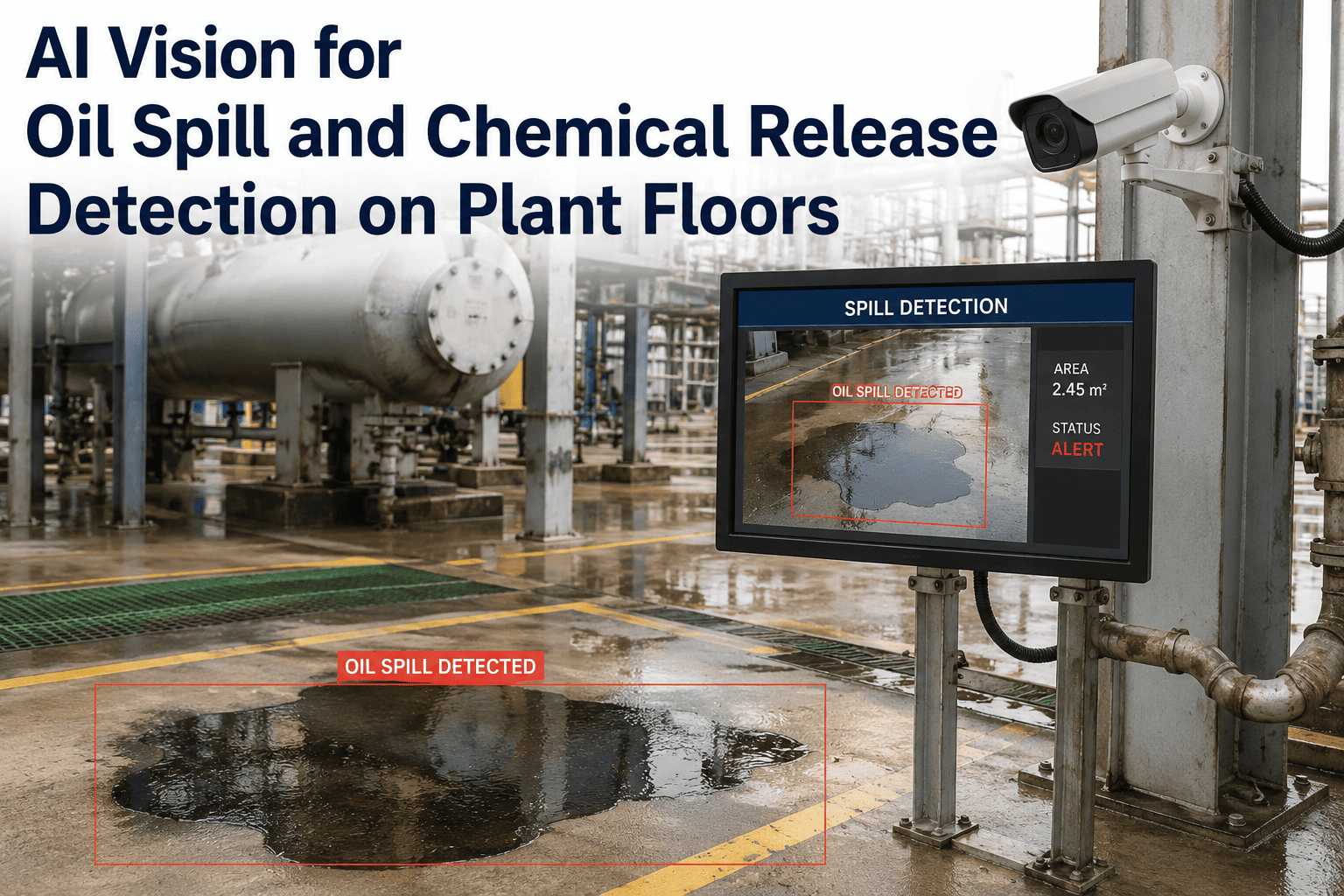
Puddles, drips, sheen on concrete, overflowing bunds, and stained secondary containment are all detectable from overhead and area cameras. Vision models trigger the moment a reflective liquid signature appears — alerting the operator and the environmental coordinator simultaneously, with an evidence clip attached before the puddle has stopped spreading.
Aligned with SPCC · RCRA subtitle C · state spill reporting
04
Trackout, Vehicle Dust & Yard Runoff
Many state programs cite trackout at facility gates, over-height haul loads, and stormwater channels carrying visible sediment. Vision models watch gate cameras and drainage sightlines for the tell-tale mud trail, dust cloud, or turbid outfall — the record a state inspector asks for when a complaint arrives.
Aligned with local trackout rules · MSGP stormwater permits
THE DETECTION PIPELINE · FROM RAW VIDEO TO DOCUMENTED EVENT
What Actually Happens Between a Dust Cloud Appearing and a Work Order Being Cut — Five Stages, All Automated
The pipeline below turns raw video into an environmental event record. It runs on every monitored camera continuously, on-premises or on a hardened edge appliance, so the plant is not depending on a fragile cloud link during a compliance-critical moment.
01
Ingest
Every RTSP feed is decoded on the edge appliance. Existing IP cameras are reused — no rip-and-replace.
02
Classify
Domain models tag the frame — dust, opacity, spill, trackout — with a confidence score on every prediction.
03
Confirm
A temporal filter suppresses transient steam, shadows, and heat distortion, so alerts fire on genuine persistent events.
04
Alert
A structured event is routed to the environmental coordinator on mobile and to the CMMS through a webhook.
05
Archive
The clip, camera ID, timestamp, class, and confidence are stored together — the audit record for any future inspection.
Deployed on-premises by default — the plant retains ownership of every frame and every event record. Nothing about the compliance workflow depends on a cloud connection remaining up.
Point One Camera at Your Highest-Risk Emission Source — See What It Was Recording That Nobody Was Watching
Send us one RTSP stream from a stockpile, stack, transfer point, or containment area. We will show you dust, opacity, and spill models running against it inside a single working session.
AUDIT-READY DOCUMENTATION · WHAT AN EPA INSPECTOR OPENS FIRST
The Documentation Package an EPA Inspector Wants to See Is the Same Package the Vision Layer Assembles on Its Own
When an EPA regional inspector or state environmental officer arrives — for a Title V audit, a citizen complaint, or a post-incident visit — the questions are always the same. The vision layer answers every one per event, without a compliance manager typing into a form.
Question 01
What was released, and how do you know?
Every event record includes the classification, the confidence score, and a short evidence clip showing the visual signature the model identified. Inspectors get a video, not a paragraph.
Question 02
When did it start and stop?
Start and end timestamps are captured to the second, with accumulated emission time calculated automatically for intermittent events — mirroring Method 22 reporting without a stopwatch.
Question 03
How was it detected and responded to?
The alert log shows who was notified on which device, when acknowledgement occurred, and what field action followed. A real audit trail replaces a note in an operator diary.
Question 04
What prevents it from recurring?
Aggregate heatmaps show which zone, shift, and material drive repeat events, tying corrective action to a specific engineering control — wetting cycle, hood upgrade, berm rebuild — not a training tick-box.
Question 05
Can you produce the record on demand?
A single export delivers any date range, camera, or event class as a structured file with evidence clips attached. Weeks of file-cabinet archaeology become a dashboard query.
THE FULL COST OF A SINGLE NOTICE OF VIOLATION
The Fine on the NOV Is Never the Real Cost — Legal, Rework, and Reputation Costs Do the Heavy Lifting
The Clean Air Act authorises fines around $103,000 per day, per violation for most stationary-source infractions — and multi-day fugitive events routinely stack. That headline is still the smallest line in the true cost of an enforcement case. Legal, engineering rework, permit renegotiation, community-relations, and insurance costs quietly multiply it before the CFO sees the total.
Direct — appears on the settlement
Indirect — never on the NOV, always on the P&L
| Line item | Type | Notes |
| Civil penalty (CAA) |
Direct |
Per-day, per-violation basis; stacked for continuing releases |
| Legal & consent-decree |
Direct |
Outside counsel, expert witnesses, technical negotiations |
| Corrective engineering |
Indirect |
Hoods, baghouses, wetting systems, berm rebuilds under deadline |
| Production downtime |
Indirect |
Curtailment during investigation and controls upgrade |
| Permit renegotiation |
Indirect |
Tighter Title V limits, added monitoring, added reporting |
| Community & reputation |
Indirect |
Public-notice hearings, media, local political heat |
| Insurance repricing |
Indirect |
Environmental liability premium reset at renewal |
Vision-based monitoring reduces both halves of the ledger — the direct half by catching the event before it becomes an NOV, and the indirect half by making sure the response was documented well enough that the settlement stays short.
TURNKEY DEPLOYMENT · SIX TO TWELVE WEEKS TO LIVE
Every Deployment Is a Turnkey Bundle — Hardware Shipped Racked, Models Pre-Loaded, Live in Six to Twelve Weeks
Environmental compliance leaders do not want another eighteen-month IT project. Deployment is deliberately turnkey — a pre-configured NVIDIA edge server ships racked and ready, models are pre-loaded before it leaves the warehouse, and site work is scoped so the plant only provides power, network, and camera credentials.
Weeks 1–2
Site Assessment & Camera Audit
Engineer walks the fence line, stockpiles, transfer points, and containment zones. Existing camera coverage is mapped and blind spots flagged. Model shortlist agreed with the environmental team.
Weeks 3–6
Hardware In, Shadow-Run Begins
The edge server ships and is racked. Camera streams connect. Models run in shadow mode with alerts reviewed offline. False-positive tuning happens against real site footage, not lab data.
Weeks 7–12
Go-Live & Coordinator Handover
Alerts route to the environmental coordinator and CMMS in production. First weekly pattern report is issued. Corrective work orders begin cutting automatically.
Quarter 2+
Ongoing · 1000+ Client Footprint
Quarterly model refresh, additional cameras added as capital projects come online, and an environmental heatmap becomes a standing item on the leadership review — with 99.9% uptime committed.
FREQUENTLY ASKED QUESTIONS
What Environmental, Compliance, and Operations Leaders Ask About AI Vision for EPA Compliance
Will an AI Method 22 record actually hold up during an EPA inspection?
ASTM D7520 already recognises camera-based opacity determinations under specific protocols. What matters for defensibility is that the record is contemporaneous, tied to a specific camera and location, includes video evidence, and shows a clear chain of custody. The vision layer produces exactly that record on its own, and pairs well with certified human observers on the highest-risk sources. Your legal and environmental teams should still review the deployment against your state SIP —
book a demo to walk through a sample audit export.
How does the system distinguish a real dust plume from steam, fog, or heat distortion?
This is the most important engineering problem in visible-emissions vision, and the answer combines temporal filtering, atmospheric context, and multi-model consensus. Steam dissipates on a different timescale than dust — condensed water is bright and cloudlike, particulate is darker and more diffuse. The models also read wind, humidity, and background contrast before firing an alert, exactly as a trained Method 22 observer would. The false-positive rate is tuned during the shadow-run phase against your actual site.
Contact support to walk through the tuning process.
Can this integrate with our existing environmental data management or CEMS?
Yes — the vision layer publishes structured JSON records containing event class, confidence, camera ID, timestamp, and a link to the evidence clip. Those records flow into an existing environmental data platform, CEMS control room, EHS system, or CMMS through a standard webhook or REST API. The visual layer sits alongside your CEMS as a complementary data stream — covering fugitive and visible-emission events that stack-mounted CEMS were never designed to see. You can
book a demo that includes a live handoff into your environmental system of record.
What about worker and community privacy around fence-line cameras?
Environmental cameras point at process areas, fence lines, stockpiles, transfer points, and containment zones — not at break rooms or offices. Detection runs on-premises by default, only short evidence clips tied to a genuine event are retained, and the plant retains ownership of every frame. Where cameras cover worker areas, standard employee-monitoring notice policy applies and the model's identity anonymisation stays on. The goal is a cleaner fence line, not surveillance.
Talk to our support team to review the privacy architecture for your site.
What does a realistic pilot look like, and how long before we know if it works?
The shortest useful pilot is one camera pointed at one high-value emission source — a stockpile, transfer point, stack, or containment area — running two to four weeks in shadow mode. During that window you see exactly what the layer detects, review real evidence clips, and calibrate the false-positive rate against a source you already understand. Full site roll-out typically follows six to twelve weeks after the pilot's go-decision. You can
book a demo that scopes the pilot in the working session itself.
START WITH ONE CAMERA · ONE EMISSION SOURCE · TWO WEEKS
Pick One Emission Source. Let AI Vision Document Every Release for Two Weeks. Then Decide.
The fastest way to evaluate an environmental vision layer is to point it at a source you already know has issues. In two weeks, you have a documented record of exactly what was leaving that source — and a false-positive rate calibrated against your own site.