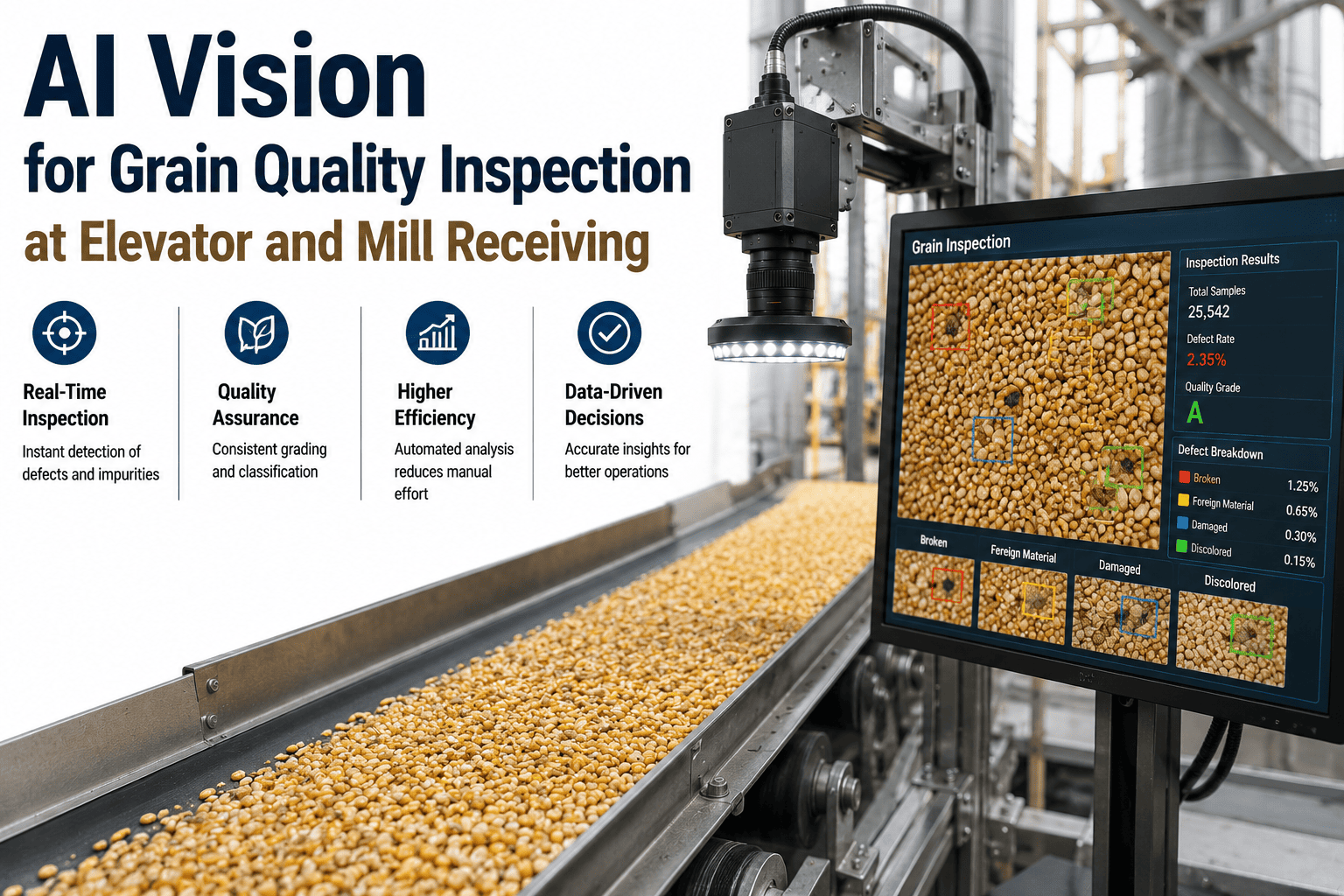
During harvest, a country elevator can see hundreds of trucks a day, and every one clears the same bottleneck: a probe pulls a sample, a lab tech runs it through a dockage tester, and the driver waits. That sample represents a fraction of the load. AI cameras mounted at the pit can screen the full stream of grain for foreign material, insect damage, discoloration, and mold indicators as it moves — grading in seconds instead of minutes. See it running against your own grain samples — book a 30-minute inspection walkthrough.
Agriculture Vision
AI Vision for Grain Quality Inspection at Elevator and Mill Receiving
Every truckload graded on foreign material, damaged kernels, discoloration, and mold indicators — screened continuously at receiving speed instead of sampled once per load, so quality decisions keep pace with harvest instead of holding it up.
→
Grain Streams
Camera Screens
→
Grade Assigned
Seconds, Not Minutes
Why Receiving Is the Bottleneck Every Elevator Knows About
The physical receiving process has barely changed in decades: a truck crosses the scale, an operator sends a probe into the load to draw a sample from several points in the bed, and that sample goes to a lab for moisture, test weight, and visual grading before the truck is cleared to dump. It works — but it is built around a sampling rate, not a full-load rate, and during harvest that rate becomes the line every truck waits behind.
Elevator operators describe the same pattern every season: dozens of trucks queued at once, phone calls and whiteboards trying to sequence deliveries, and farmers who drove ninety minutes stuck behind someone five minutes away because there is no way to grade faster than the lab can process samples. Fully automated receiving facilities that use kiosk check-in and probe automation can move upward of 75,000 bushels an hour — but the quality determination inside that flow is still a sample, not a full-load inspection, which means the bottleneck moves rather than disappears. Even the fastest scale, probe, and pit sequence in the industry is still gating truck throughput on a lab result that only ever represents a fraction of what actually crossed the scale.
The Four USDA Grade Factors — and Where Vision Fits
Grain grading in the US runs on four major quality factors defined by the Federal Grain Inspection Service: moisture, test weight, purity, and soundness. Two of those four — purity and soundness — are determined by looking at the grain, which is exactly the category of inspection a camera can screen continuously rather than on a lab sample pulled once per load.
I
Moisture
Determined by moisture meter on the lab sample. Not a visual factor — stays with existing lab instrumentation.
II
Test Weight
Bulk density measured by weighing a fixed volume. Not a visual factor — stays with existing lab instrumentation.
III
Purity
Dockage, foreign material, and broken corn and foreign material (BCFM) — visually identifiable and screenable by camera on the full grain stream.
IV
Soundness
Damaged kernels — heat, insect, mold, frost, and sprout damage — identified visually. This is where vision adds the most coverage over sample-based lab grading.
What the Camera Is Trained to Catch
Vision inspection on incoming grain works from the same visual defect categories official grading uses, screened continuously instead of on a single dockage-tester run. The taxonomy below reflects the damaged and unsound kernel categories inspectors are trained to identify, applied at the volume a camera stream can cover that a lab sample cannot.
Foreign Material
Chaff, weed seeds, stones, cob fragments, and other matter that is not the grain itself — the core dockage factor
Insect Damage
Insect-bored kernels and visible pest activity — a direct damaged-kernel grading factor and a storage-risk signal
Discoloration
Weather staining, sprout damage, and off-color kernels that indicate field or storage stress before it shows up in the lab
Mold Indicators
Visible mold growth and fungal staining — both a grade-limiting defect and a mycotoxin risk flag for the whole lot
Shriveled & Broken Kernels
Shrunken, cracked, and broken kernels that reduce test weight and contribute to the defects total on the grade certificate
Heat & Frost Damage
Discoloration patterns specific to drying heat exposure or early frost — both materially damaged-kernel categories
Sample-Based Grading vs Continuous Vision Screening
The difference is not accuracy on the sample — USDA-trained graders and calibrated dockage testers are precise on the material they check. The difference is coverage. A probe sample represents a small fraction of a truckload; a vision stream watching the grain move across the pit sees continuously, catching pockets of damage or contamination that a probe sample from a few points in the bed can miss entirely.
Sample-Based Lab Grading
Probe draws from several points in the load
Sample represents a fraction of total volume
Lab turnaround adds minutes per truck
Localized contamination pockets can be missed
Grade decision made once, at intake only
Continuous Vision Screening
Camera watches the grain stream at the pit
Full-flow coverage, not a point sample
Grade signal available in seconds
Contamination pockets flagged as they pass
Continuous data feeds blending and storage decisions
See Vision Screening Against Your Own Grain
Corn, wheat, soybeans, and sorghum each carry different defect signatures and different grading factors. In 30 minutes a vision engineer will walk through what full-stream screening looks like on the grain you actually receive.
Where the Camera Sits in the Receiving Flow
Grain receiving already has a defined sequence — scale, probe, pit, storage — and vision inspection is built to sit inside that flow rather than replace it. The stations below show where a camera adds a continuous quality signal without changing the physical steps a truck already goes through.
01
Scale & Check-In
Truck crosses the scale, driver and load are identified. No change to this step — existing scale and ticketing systems continue as-is.
02
Probe Sample
Standard probe sample is still drawn for moisture and test weight, the two factors that require lab instrumentation rather than visual assessment.
03
Pit Camera Screen
As grain flows through the pit or over the receiving conveyor, cameras screen the stream continuously for foreign material, damage, discoloration, and mold — the visual grading factors — in real time.
04
Grade & Route
Combined lab and vision results determine grade and storage bin assignment — segregating quality tiers automatically instead of relying on a single point-in-time sample decision.
Why Coverage Matters More During Harvest, Not Less
The instinct at a busy elevator is to speed up grading during the peak of harvest, when the pressure to keep the truck line moving is highest. But that is exactly when defect risk is least uniform — wet fields, mixed maturity, and rushed combining all increase the odds that damage and foreign material are unevenly distributed through a load. A probe sample taken faster does not see more of the load; it sees the same fraction, just under more time pressure.
This is also the window where the cost of a missed defect is highest, because the volume moving through the facility is at its peak. A contamination pattern that slips past receiving during a slow week affects one bin; the same miss during the busiest days of harvest can affect several truckloads before anyone notices a pattern, simply because more grain is moving through in less time. Continuous screening does not add time pressure to the sampling process — it removes the dependency on catching everything in a handful of probe insertions per load.
Localized Contamination
Foreign material and damaged kernels are rarely distributed evenly through a load — a probe drawing from a few points can miss a pocket entirely while a continuous stream cannot.
Mixed-Field Loads
Grain combined across variable field conditions in one pass carries inconsistent moisture and damage levels within the same truckload.
Mold Risk Compounds Later
Mold indicators missed at receiving do not stay contained — they spread risk through blended storage and surface again at outbound, at a customer's dock, or in a mycotoxin test.
What a Missed Defect Costs Downstream
A load that clears receiving with an undetected quality problem does not stop being a problem — it moves into storage, blends with clean grain, and the cost of finding it climbs the further it travels. This is the same logic that drives every grading standard in the industry: catch it at the point of entry, or pay to catch it later at a much larger scale.
At Receiving
Single Load
Contaminated or damaged grain identified and segregated before it enters the bin
→
In Storage
Whole Bin
Undetected mold or damage blends through and elevates risk across the entire stored lot
→
At Outbound Sale
Rejected Shipment
Downgrade, discount, or outright rejection at the customer's incoming inspection
What Changes for the Elevator or Mill
Continuous vision screening does not remove the lab or the grader — it gives them a second, full-coverage data stream to work from instead of a single point-in-time sample. The practical outcomes below reflect what shifts once every load gets a continuous quality signal rather than a sampled one.
Full Stream
Coverage instead of a single probe sample per load
Seconds
Visual grade signal available per truck
Continuous
Contamination-pocket detection through the whole load
Auto-Sort
Quality-tier routing to the correct storage bin
Frequently Asked Questions
Does AI vision replace the USDA grading process or the probe sample?
No. The official USDA numerical grade still runs on the four established quality factors — moisture, test weight, purity, and soundness — determined through the standard probe sample and lab procedures set out in the Federal Grain Inspection Service handbook. Vision screening adds a continuous, full-stream data layer alongside that process, specifically covering the two visually determined factors: purity (foreign material and dockage) and soundness (damaged kernels). It is designed to complement lab grading with coverage the point sample cannot provide, not to substitute for the official grade certificate. To see how vision data integrates alongside your existing lab workflow,
book a walkthrough.
Can the system tell the difference between different grain types and their specific defect standards?
Yes. Corn, wheat, soybeans, and sorghum each have different defect categories and grading criteria under official standards — broken corn and foreign material applies specifically to corn, while wheat and barley have their own damaged-kernel and dockage definitions. Vision models are trained per grain type so the same camera installation recognizes the correct defect taxonomy depending on what is currently moving through the pit, rather than applying one generic defect model across every commodity a facility receives. To scope model training across your specific grain mix,
talk to a specialist.
Will this slow down truck throughput during peak harvest?
The opposite is the goal. Vision screening operates on the grain as it already moves through the pit or receiving conveyor, so it adds a data layer to an existing physical process rather than inserting a new inspection step a truck has to wait through. The lab sample for moisture and test weight still runs on its normal timeline; the vision signal for purity and soundness becomes available in parallel, in seconds, rather than adding to the queue. For facilities where truck-line bottlenecks are already a harvest-season problem, faster and fuller quality visibility is a lever for reducing dwell time, not increasing it. A deployment plan that maps to your receiving layout and peak volumes is available —
book a demo.
How does continuous screening catch problems a probe sample misses?
A probe draws from a defined number of points across a truckload, which is representative on average but can miss contamination or damage that is not evenly distributed — a pocket of moldy or insect-damaged grain from one section of a field, for instance, may not fall under any of the probe's sampling points. A camera watching the full grain stream as it flows through the pit does not have this blind spot; every portion of the load passes in view rather than only the points a probe happened to reach. This matters most in mixed-field or mixed-maturity loads, which are common during compressed harvest windows when combining happens faster than field conditions can be sorted. See the coverage difference mapped against your own receiving volumes —
reach out to a specialist.
What happens when the system flags a load for elevated foreign material or mold risk?
A flagged load routes into the same disposition workflow an elevator already uses for a low-grade sample — the load can be segregated into a lower-grade storage bin, held for additional lab confirmation, or discounted at the scale ticket, depending on facility policy. The advantage is that the flag arrives from continuous coverage rather than a single sample, so a marginal load with a genuine contamination pocket is far less likely to clear receiving undetected and blend into clean storage. Full defect-location and image evidence is retained with the load record, giving quality staff documentation they would not otherwise have from a lab sample alone. A demo can walk through the disposition logic for your facility —
book one here.
See Full-Stream Grain Screening in Action
Model AI Vision Grain Inspection Against Your Receiving Volumes
Bring the grain types you receive, your peak-season truck volumes, and the defect issues that cost you the most at outbound. In 30 minutes a vision engineer will map where a camera fits your pit layout, walk through the defect categories it catches, and show what deployment looks like ahead of your next harvest — modeled on your facility, not a generic demo.