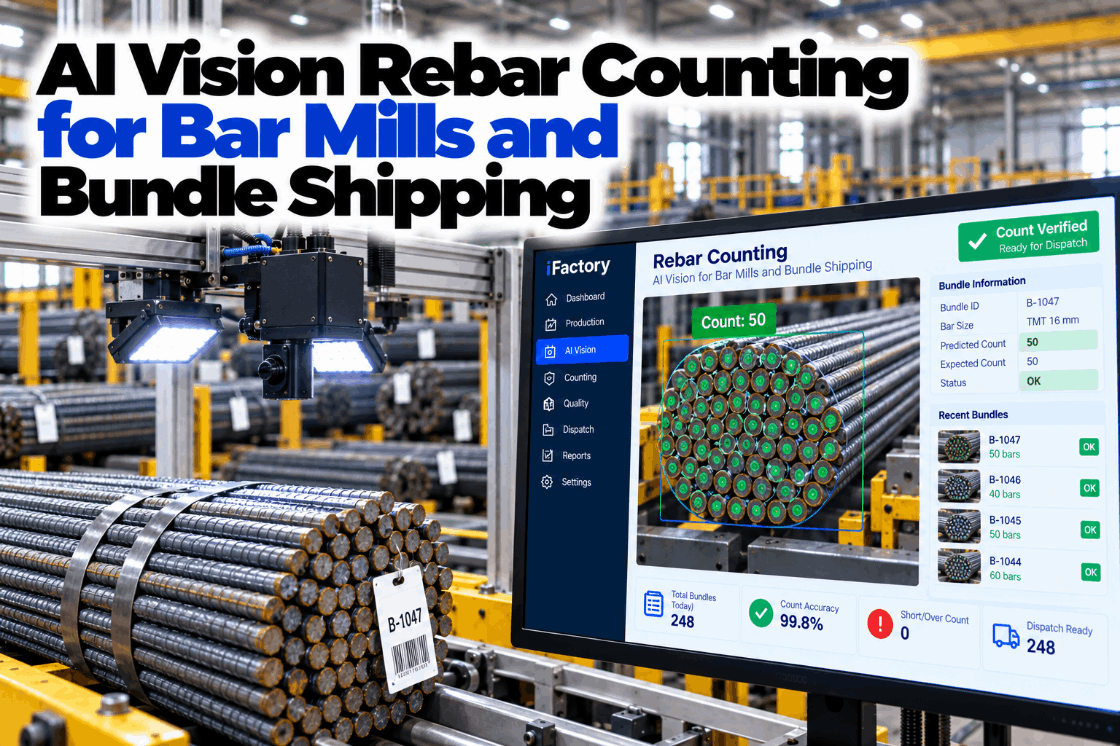
Every rebar bundle that leaves a bar mill carries a promise: the count and weight on the tag match what is inside. One missed bar becomes a short count claim at the customer's yard. One extra bar is steel given away for free. At line speed, with small sizes, touching bars and ends that never sit perfectly flush, people and counting screws both slip. AI vision rebar counting checks every layer and every bundle end before the tag is printed. See it on real bar mill images in a short bundle counting demo.
Count Every Bar, Tag Every Bundle, Ship the Right Number
iFactory Vision Counting & Classification counts bars on the cooling bed transfer and at the bundle end, checks both against the order, and holds any bundle that disagrees. Short counts and over counts stop at the mill, before the tag is printed.
Where Bars Are Counted Between the Last Stand and the Truck
After the finishing stand, bars are cut to multiple lengths and laid on the cooling bed. From there they move in layers to the cold shear, which cuts them to commercial lengths such as 12 m. The counting station then forms each layer and builds the bundle, which is tied, weighed and tagged before it goes to the bay. Many mills still count with mechanical counting screws that must be changed for each bar size. The count is fixed at one step, but it is checked at none of the later ones. Map your own finishing end with our bar mill team.
Five Things That Make a Bar Easy to Miss
A bundle of 40 mm bars is easy to count by eye. A bundle of 10 mm bars, packed tight and seen end on, is not. Research on end-face counting, including a Daido Steel technical paper, traces most errors to uneven brightness on the end faces and to bars that sit back from their neighbours and are partly hidden. Bring your hardest product sizes to a counting trial review.
Two Counts That Check Each Other
A single camera gives one number and no way to know if it is wrong. iFactory uses two independent views. The first counts bars in each layer as they pass the transfer after the cold shear. The second reads the bundle end face after tying. When the two counts agree with the order, the tag prints. When they disagree, the bundle is held and the image goes to the crew. Plan both camera points with our support engineers.
- Camera above the transfer chains after the cold shear
- Bars seen side by side, before they are stacked
- Best for small sizes and touching bars
- Gives a count per layer and a total per bundle
- Camera facing the bundle end at the tying or weighing station
- Counts every end face in the finished bundle
- Catches bars added or lost during forming
- Image kept with the bundle record as proof of count
A Second Count Before the Tag Is Printed
Most short counts are found by the customer. iFactory finds them at the tying station, where a recount takes a minute and nothing has been invoiced yet. The crew sees the image, the reason and the two counts on one screen.
Why the Count Matters Under Every Way Rebar Is Sold
Sales terms vary by market and customer. Some mills invoice the weighed bundle, some invoice theoretical weight worked out from count, length and nominal mass per metre, and some buyers order pieces. A common shortcut for nominal mass is d²/162 kg per metre, with d in mm. Under every one of these terms a wrong count costs money. Check how your contracts treat it with our dispatch specialists.
ASTM A615 allows the measured mass of a deformed bar to be as low as 94% of nominal, and overweight is not a cause for rejection. That tolerance covers rolling variation per bar. It does not cover a missing or extra bar in the bundle.
What the Bar Says, What the Tag Says, What the Camera Confirms
Rebar carries rolled-on marks. Under ASTM A615 and A706 the order is producer, size, type of steel (S for A615 carbon steel, W for A706 low-alloy) and grade, shown as a number or as lines. BS 4449 bars carry rolled-on marks for the maker and grade. Tag content is usually set by the customer or a local regulator. Dubai Municipality, for example, requires a tag on every bundle with maker, origin, standard, grade, size, heat number and its own approval mark. Review your tag layout with our support team.
Prove the Count Before You Trust It
Counting accuracy should be measured on your bundles, by your crews, before the system releases tags on its own. The cleanest method is a manual recount trial scored two ways. At bundle level, ask how often the count was exactly right. At bar level, split errors into missed bars and phantom bars, the same idea as a confusion matrix. The numbers below are an illustration of the arithmetic, not a result. Run a trial plan with our validation team.
A Recount Checklist Your Crews Can Run
A recount is only useful if it is more reliable than the count it checks. Two people counting independently, with marked ends, beats one tired person with a chalk stick. Tick the steps here or print them for the tying station. Ask our support team for a version with your bundle sizes.
Same Method for Rounds, Pipe Bundles and Other Long Products
The two-count method is not limited to rebar. Plain rounds count like rebar without the ribs. Pipe and tube bundles are often packed in hexagons, and the camera counts open ends instead of solid faces. Each product family gets its own trained model and its own trial. Discuss your product mix in a product scoping call.
A Bundle Record That Answers Any Claim
When a customer reports a short bundle weeks later, the question is simple: what did the mill ship? A bundle record with both counts and the end-face image answers it in minutes. These are the fields iFactory keeps for each bundle. Get a sample record from our support team.
A Giveaway Worksheet With Your Own Inputs
Over counts are quiet losses, because no customer complains about an extra bar. The worksheet sizes that loss with assumed inputs only. Swap in your own figures. Short count claims, freight for replacement bars and time spent on disputes come on top. Build the full case with our value team.
Multiply by your own price per tonne. Measure your real over count rate in the validation trial before you use this worksheet for a budget.
Cameras, Counting Models and Edge Server in One Package
iFactory delivers bar counting as a turnkey system. Cameras are fitted at the transfer and the tying station, and a pre-configured NVIDIA AI server ships racked and ready with counting models loaded, so images are processed on site at line speed. You rack it, plug in power and Ethernet, and the AI is live. Scope it for your finishing end with a turnkey quote.
- Pre-configured NVIDIA AI edge server, racked and ready
- Industrial cameras and lighting for transfer and bundle end
- Counting models trained on your sizes and bundle shapes
- PLC link to the counting station and tying machine
- Hold and release logic for the tag printer
- Bundle records with images, linked to heat and order
- 24×7 remote monitoring of models and hardware
Camera points agreed, lighting and server installed, PLC and tag printer signals linked.
Models trained on your sizes, then scored against crew recounts while tags print as usual.
Hold and release switched on, crews trained, weekly accuracy review started.
Vision Counting Built for the Finishing End
iFactory Vision Counting & Classification is designed for scale, glare and fast product changes, where a count must be right before the bundle moves on. Walk through a pilot plan in a short demo.
What Bar Mill Managers Ask About Rebar Counting
Ship the Count on the Tag, Every Time
Count each layer on the transfer, count each bundle at the end, and hold anything that disagrees before it is tagged. The full system is delivered turnkey and goes live in 6 to 12 weeks.