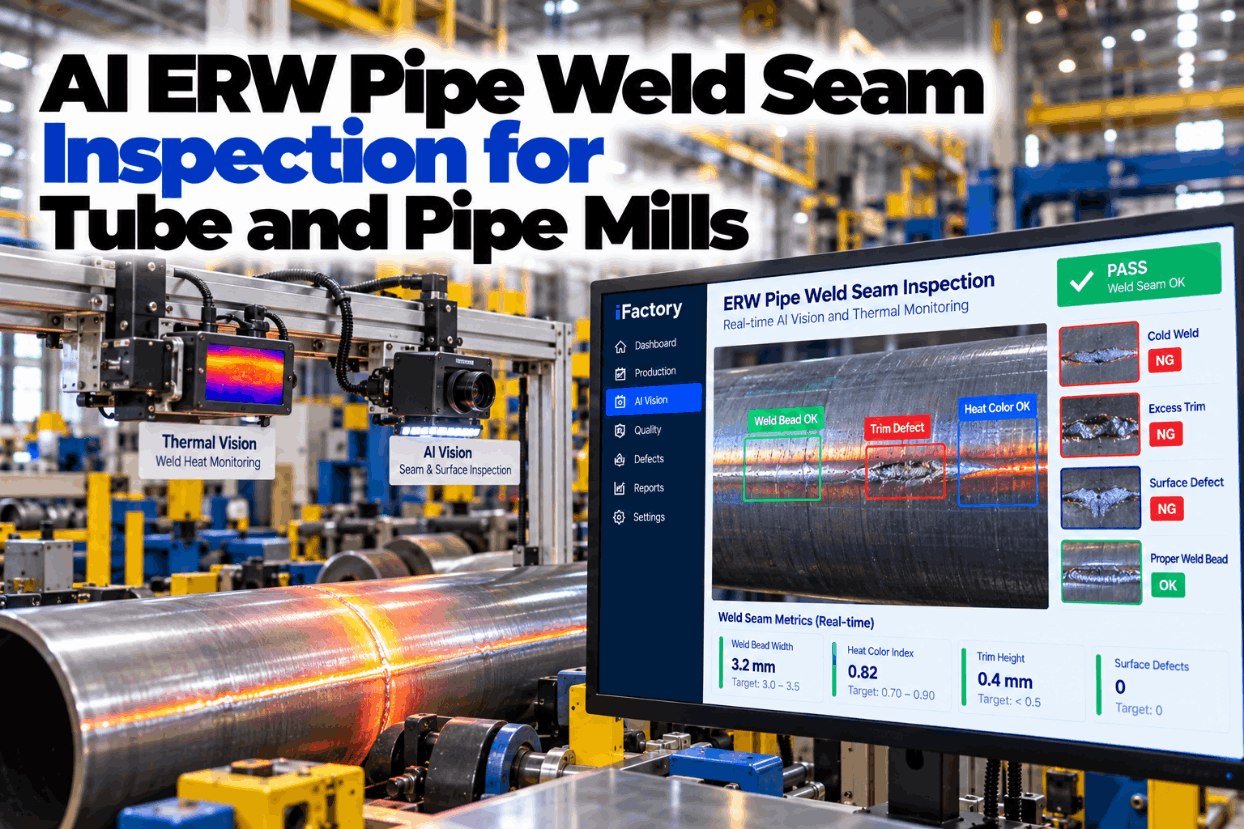
On an ERW tube or pipe mill, the weld is made in a few centimetres between the induction coil and the squeeze rolls, and most of what goes wrong there can't be seen once the bead is trimmed. A cold weld or a penetrator usually shows up later at the ultrasonic station or the hydrotest, after many more metres have been welded the same way. AI thermal and vision monitoring watches the vee, the seam heat and the trim as the pipe is made, so drift is flagged at the mill instead of at the end of the line. See it on real mill footage in a short weld seam vision demo.
Watch the Weld Vee, the Seam Heat and the Trim on Every Metre
iFactory Thermal Vision Monitoring reads the weld vee, the apex and the seam heat colour, while Vision Defect Detection checks the trimmed bead for over-trim, under-trim and gouges. Suspect lengths are tagged by position, so UT and NDT crews know where to look first.
Where an ERW Seam Is Made, Trimmed and Treated
In high frequency (HF) welding, current is fed into the formed strip by sliding contacts or an induction coil and flows along the two edges of the open seam, called the vee. Skin and proximity effects keep it in a thin layer on the edge faces, which heat to forging temperature as they run toward the apex, where they first touch. The squeeze rolls then forge the edges together and push hot metal and oxides out as a bead inside and outside. API 5L calls an electric weld made at 70 kHz or more HFW. Map your own mill layout with our tube mill team.
ERW Seam Defects and What Can Actually See Them
Most serious ERW seam defects sit in the bond line, inside the wall. A cold weld, also called lack of fusion, is an area where the edges never bonded. A penetrator is a short cold weld, often through the wall, usually holding oxide that was not squeezed out. Hook cracks start at inclusions or laminations near the strip edge that the upset turns toward a surface. Stitching, a pattern of bonded and unbonded spots, is mostly a feature of older low frequency welds. None of these can be seen on a trimmed bead. Walk through your own defect history in a seam defect review.
Too Cold, In the Window or Too Hot
Operators have always judged the weld by the colour of the vee. A thermal camera turns that judgement into numbers. Research published by Nippon Steel sorted HF weld behaviour by power input. With too little power, the edges meet as a plain vee without melting. In the right window, a narrow slit forms ahead of the weld point and stays steady. With too much, the slit grows long and oxide is not pushed out. Agree heat limits for your sizes with our welding specialists.
Edge-to-edge temperature difference, apex temperature, bead temperature after the squeeze rolls, vee angle and apex movement, sometimes called breathing. Published set-ups use short-wave infrared cameras in air-purged housings.
Four Trim Faults the Camera Sees Directly
The trimmed outside bead is in plain view, and that is where vision does its most direct work. After the squeeze rolls, scarfing tools cut the OD bead and, where the product needs it, the ID bead. Worn or chipped tools, a tool set too deep or too high, and chips caught under the tool all leave marks a camera can measure along the length. API 5L sets weld seam tolerances in clause 9.13, and API 5CT has its own clause on height and trim of electric-weld flash, so load the limits from the spec on each order. See trim checks running in a bead trim demo.
An OD camera can't see inside the pipe. Where the ID bead is removed, a camera can watch the cut bead leave the mill, and a change in it often points to the ID tool.
Suspect Lengths Marked Before They Reach UT
iFactory ties every heat alarm and trim flag to the pipe position from the mill encoder, so the NDT crew sees which lengths to re-check and why. Ultrasonic testing and hydrotest stay the judge of every length.
Is the Annealer Heating the Seam or the Steel Beside It?
API 5L requires the weld seam and the entire heat-affected zone of PSL 2 HFW pipe to be heat treated so as to simulate normalizing. For PSL 1 EW pipe, the same applies above Grade X42 (L290). Inline seam annealers do this with induction heads that must stay over the seam as it twists. One supplier quotes 950 to 980 °C as a typical process range, with a pyrometer at each head and tracking for seam twist up to ±15°. A pyrometer proves temperature at a spot. A thermal camera can show whether the heated band covers the weld zone. Review your annealer set-up with our heat treatment team.
- Reads one spot per head
- Feeds the power control loop
- Can't show if the heated band slid off the seam
- Logs temperature, not coverage
- Sees the whole heated band across the seam
- Checks band centre against the seam line
- Flags lengths where the band moved or ran cool
- Logs coverage and peak heat by pipe position
What API 5L and API 5CT Ask of an ERW Seam
Specs ask for a weld made a certain way, heat treated, tested and trimmed within limits. API 5L allows low frequency welding (LFW, below 70 kHz) only for PSL 1, so PSL 2 electric-welded pipe must be HFW. Annex E calls for full-length non-destructive inspection of weld seams, and for EW seams the methods are ultrasonic and electromagnetic. API 5CT, the OCTG spec also published as ISO 11960, covers EW casing and tubing, with flattening tests and limits on the height and trim of the weld flash. Check the edition named on your orders with our pipe quality team.
Vision Before NDT, Not Instead of It
The honest place for vision and thermal monitoring is in front of NDT. Automated ultrasonic seam testing, often to ISO 10893-11, finds longitudinal imperfections inside the weld. Eddy current testing to ISO 10893-2 is common on smaller tube. Hydrotest proves the pipe holds pressure. None of them tells you why a weld went wrong or when the process moved. Vision fills that gap. Plan how the signals meet with our NDT specialists.
Three Moments When Seam Signals Pay Off
These are illustrations, not case studies. Each shows the camera pointing people at a likely cause early, while UT still makes the call. Walk through your own recent seam rejects in a scrap review session.
A Simple Worksheet for Seam Rejects
Value comes from catching a drifting weld after metres, not after a shift. The inputs below are assumed and show the arithmetic only, so replace each with your own figures. Our team can build it with your numbers.
Multiply the tonnes by the gap between prime price and reject or scrap value. Then add fewer UT re-checks and tool changes made before a gouge runs for a whole coil.
Thermal Cameras, Seam Vision and NVIDIA Server in One Package
iFactory delivers seam monitoring as a turnkey bundle. Cameras go in at the weld point, trim station and seam annealer, and a pre-configured NVIDIA AI server ships racked and ready with the vee, trim and annealer models pre-loaded, so images are processed on site at line speed. You rack it, plug in power and Ethernet, and the AI is live. To scope it for your mill, request a turnkey quote.
- Pre-configured NVIDIA AI edge server, racked and ready
- Thermal camera at the weld vee in a purged housing
- OD bead trim camera with lighting
- Thermal view of the seam annealer band
- Links to mill encoder, weld power and frequency
- Length tags shared with UT and NDT stations
- 24×7 remote monitoring of models and hardware
Cameras and server installed, encoder and welder signals linked, images collected across sizes.
Heat and trim limits set per size, flags compared silently with UT and test results.
Alarms and length tags switched on, mill and NDT crews trained.
Seam Monitoring Built for the Tube Mill
iFactory watches the parts of the process that decide weld quality and hands NDT a clear list of where to look. Our support team can walk you through a pilot plan.
What Mill Managers Ask About ERW Pipe Weld Seam Inspection
See the Weld Before the Bead Hides It
Watch vee heat, trim and annealer coverage on every metre and send UT a tagged list of suspect lengths. The full system is delivered turnkey and goes live in 6 to 12 weeks.